Residential Proxies vs VPNs: Key Differences Explained

Scraping and Proxy Management Expert
TL;DR:
-
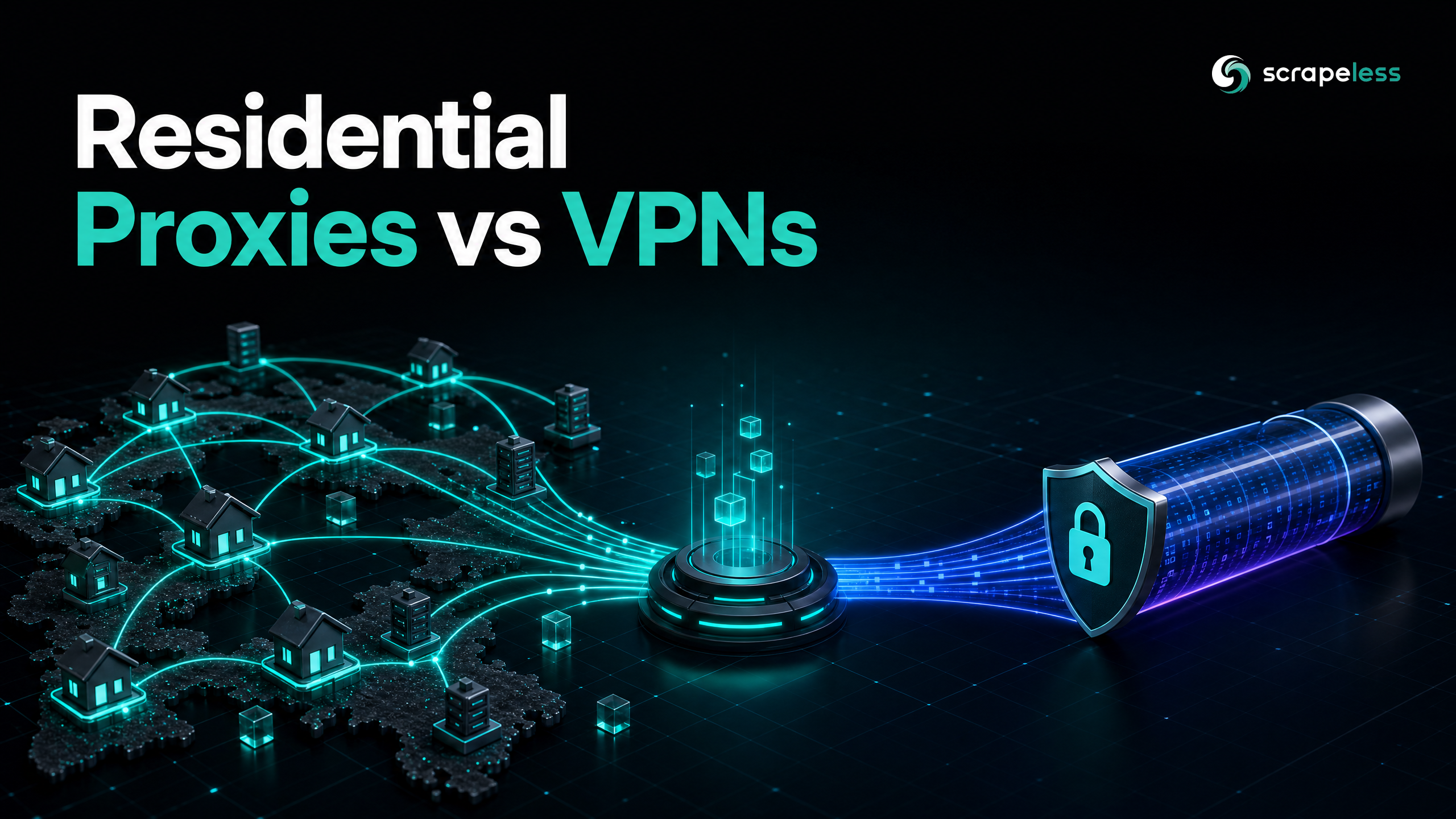
Residential Proxies route traffic through real household devices, offering high anonymity and IP rotation for data extraction, web scraping, and automation without triggering blocks.
-
VPNs (Virtual Private Networks) encrypt the entire network connection, primarily designed for personal privacy, secure browsing, and bypassing geo-restrictions on a single device.
-
The Core Difference: Proxies operate at the application level and are optimized for high-volume, automated requests, whereas VPNs operate at the network level and are optimized for human users seeking data encryption.
-
For enterprise data pipelines, Residential Proxies are the standard, providing access to millions of IPs across the globe.
Introduction
When building data pipelines or managing automated tasks, understanding the technical distinctions between residential proxies and VPNs is necessary. Both tools mask the original IP address, but their underlying architecture, use cases, and performance profiles differ significantly.
A VPN creates an encrypted tunnel between the client and the server, securing all traffic leaving the device. This is ideal for protecting sensitive data on public Wi-Fi or masking browsing habits from internet service providers. However, VPNs typically assign a single, static datacenter IP address to the user for the duration of the session.
In contrast, residential proxies route requests through real devices—such as home computers or smartphones—connected to local internet service providers. This makes the traffic appear as genuine user activity. Proxy networks also support automatic IP rotation, allowing developers to send thousands of concurrent requests without encountering rate limits or CAPTCHAs. For more details on how proxy environments operate, consider reading about what is a proxy browser.
Feature and Use-Case Matrix
To clarify the technical boundaries, the following matrix compares residential proxies and VPNs across key dimensions.
| Feature / Dimension | Residential Proxies | VPNs (Virtual Private Networks) |
|---|---|---|
| Primary Purpose | Automated data extraction, web scraping, multi-account management | Personal privacy, secure browsing, data encryption |
| Traffic Level | Application level (HTTP/HTTPS/SOCKS5) | Network level (encrypts all device traffic) |
| IP Rotation | Automatic per request or sticky sessions | Manual server switching; typically static per session |
| IP Source | Real household devices (ISPs) | Datacenter servers |
| Anonymity Profile | High (appears as genuine local users) | Moderate (known VPN server IPs are easily detected) |
| Encryption | Standard TLS/SSL for HTTPS requests | End-to-end encryption protocols (e.g., WireGuard, OpenVPN) |
| Concurrency | Extremely high (thousands of parallel requests) | Low (designed for single-user browsing) |
| Cost Structure | Pay per bandwidth (GB) or IP | Flat monthly subscription |
Use Cases for Residential Proxies
-
Web Scraping and Data Extraction: Collecting public data from e-commerce sites, search engines, or social platforms requires rotating IPs to avoid rate limits. Residential proxies distribute requests across millions of IPs, ensuring high success rates.
-
Ad Verification: Marketers use residential IPs to verify localized ad placements and check for click fraud, ensuring campaigns appear correctly in specific regions.
-
Market Research: Gathering competitive pricing intelligence requires viewing websites exactly as local consumers do, without triggering anti-bot protections.
Use Cases for VPNs
-
Secure Remote Access: Employees connecting to corporate networks use VPNs to encrypt data in transit, protecting internal resources from interception.
-
Bypassing Geo-Restrictions: Individuals use VPNs to access region-locked content, such as streaming services or news websites, by routing traffic through a server in the target country.
-
Public Wi-Fi Security: VPNs encrypt traffic on unsecured networks, preventing man-in-the-middle attacks and packet sniffing.
Get your API key on the free plan: app.scrapeless.com
Decision Guide: Which Tool to Choose?
Choosing between a residential proxy and a VPN depends entirely on the scale and nature of the task.
Choose a VPN if:
-
The goal is to secure personal browsing data and encrypt all network traffic on a device.
-
The workload involves manual, human-driven interactions rather than automated scripts.
-
The requirement is a stable, long-term connection to a single geographic location for activities like streaming or remote work.
-
For technical specifications on VPN protocols, refer to the IETF RFCs on cryptographic algorithms.
Choose Residential Proxies if:
-
The project requires sending high-volume, concurrent requests to target servers.
-
The target websites employ strict anti-bot measures that easily detect and block datacenter IPs.
-
The architecture demands granular control over IP rotation, session persistence, and geographic targeting at the city or ASN level.
-
The infrastructure relies on application-level routing, as detailed in the MDN proxy documentation.
For developers building enterprise data pipelines, residential proxies offer the necessary scale and authenticity. Scrapeless provides access to a pool of 90M+ IPs across 195+ countries, ensuring high availability and performance. The pricing structure is designed for scalability, starting from $1.80/GB (as low as $1.44/GB on higher-tier plans), making it the most cost-effective solution for enterprise-grade extraction.
Conclusion
While both residential proxies and VPNs serve to mask the original IP address, they are engineered for fundamentally different purposes. VPNs prioritize network-wide encryption and personal privacy, making them the standard for secure browsing. Residential proxies, conversely, are built for scale, automation, and high success rates in data extraction. By utilizing real user IPs and automatic rotation, proxies enable developers to gather public data efficiently without triggering security blocks. Understanding these distinctions ensures the right infrastructure is deployed for the specific technical requirements of the project.
Ready to Build Your AI-Powered Data Pipeline?
Join our community to claim a free plan and connect with developers building pipelines: Discord · Telegram.
Sign up at app.scrapeless.com for free Scraping Browser runtime and adapt the patterns above to the pages the pipeline needs.
FAQ
Q: Can a VPN be used for web scraping?
A: While technically possible for very small-scale tasks, VPNs are highly inefficient for web scraping. They provide a single, static IP address that is easily identified as a datacenter or VPN node. Target websites will quickly block the IP after detecting automated request patterns.
Q: Do residential proxies encrypt traffic like a VPN?
A: Residential proxies do not provide network-wide encryption. They route application-level traffic (HTTP/HTTPS). However, when connecting to secure websites via HTTPS, the data transmitted between the proxy and the target server remains encrypted using standard TLS protocols, as defined by the W3C HTTP specifications.
Q: Are residential proxies legal to use?
A: Yes, using residential proxies is legal. They are standard infrastructure for market research, ad verification, and data collection. However, users must ensure that their activities comply with the terms of service of the target websites and relevant data protection regulations.
Q: How does IP rotation work with residential proxies?
A: Proxy providers manage a gateway server that automatically assigns a new residential IP address for every request or after a specified time interval (sticky sessions ). This prevents target servers from identifying a pattern and blocking the connection.
Q: Why are residential proxies more expensive than VPNs?
A: Maintaining a network of millions of ethically sourced residential devices across the globe requires significant infrastructure and compliance efforts. Unlike VPNs, which use relatively inexpensive datacenter servers, residential proxies offer a premium level of anonymity and success rates, justifying the cost based on bandwidth usage.
At Scrapeless, we only access publicly available data while strictly complying with applicable laws, regulations, and website privacy policies. The content in this blog is for demonstration purposes only and does not involve any illegal or infringing activities. We make no guarantees and disclaim all liability for the use of information from this blog or third-party links. Before engaging in any scraping activities, consult your legal advisor and review the target website's terms of service or obtain the necessary permissions.