Best RAG Data Sources in 2026: Build a Fresh, Reliable Knowledge Pipeline

Lead Scraping Automation Engineer
TL;DR:
- The best RAG data source is the source that can be retrieved, cited, refreshed, and governed for a specific question set. Authority matters, but so do update frequency, permissions, structure, and provenance.
- First-party documents usually form the knowledge core. Product documentation, policies, support content, and owned databases provide the clearest authority and access rules.
- Public web and search data fill coverage gaps. They help a retrieval system discover market changes, external evidence, and newly published material that an internal repository does not contain.
- Freshness is a pipeline property. A current webpage becomes stale RAG evidence when discovery, change detection, re-indexing, or deletion handling is missing.
- Evaluation must begin with real questions. Build a representative query set, record the expected evidence, and test retrieval separately from answer generation.
RAG systems do not fail only because an embedding model picked the wrong neighbor. They also fail because the knowledge source was incomplete, stale, duplicated, poorly segmented, or impossible to cite.
The original retrieval-augmented generation paper separated a model's parametric memory from an external non-parametric memory. That separation makes source selection an architectural decision: the retrieved evidence can change without retraining the model, but only if the ingestion pipeline keeps that evidence usable.
This guide ranks RAG data-source categories by the jobs they perform. It then turns those categories into a continuous pipeline for discovery, acquisition, normalization, provenance, freshness, and evaluation.
Best RAG Data Sources at a Glance
| Source category | Best use | Typical freshness | Main strength | Main risk |
|---|---|---|---|---|
| First-party documentation | Product and policy answers | Release-driven | Highest organizational authority | Old pages may remain searchable |
| Owned structured databases | Accounts, inventory, operations | Near real time to scheduled | Precise fields and filters | Permissions can be lost during indexing |
| Public web pages | Market and external knowledge | Source-dependent | Broad coverage | Layout and content drift |
| Search results and discovery feeds | Finding new or changed sources | Frequent | Rapid discovery | Results are pointers, not final evidence |
| Support and service knowledge | Troubleshooting and user intent | Continuous | Real problem language | Personal or confidential data |
| Standards and regulatory material | Compliance and technical definitions | Event-driven | Primary authority | Version and jurisdiction complexity |
| Licensed research and datasets | Domain analysis and benchmarks | Contract-defined | Curated depth | Use and redistribution restrictions |
| Multimedia transcripts | Training, meetings, demonstrations | Publication-driven | Captures spoken knowledge | Transcription and speaker errors |
The table is a selection map, not a universal ranking. A support assistant may begin with first-party help content. A market-research system may need public pages and search discovery. A compliance assistant should prefer primary legal and standards material over commentary.
What Is a RAG Data Source?
A RAG data source is any permitted information surface that can be converted into retrievable evidence for a model response. The source may be a document, webpage, database row, API response, transcript, or event record.
A source is not ready for RAG merely because it can be embedded. Production-ready evidence needs:
- a stable source identity;
- a clear owner and access policy;
- an acquisition method;
- normalized content and metadata;
- a freshness rule;
- a deletion or revocation path;
- provenance that survives chunking and retrieval.
The W3C PROV-O recommendation models entities, activities, and agents so systems can describe where information came from and how it changed. A RAG pipeline can apply the same principle without adopting the full ontology: every chunk should retain its source, version, collection event, transformation, and owner.
How RAG Data Moves From Source to Answer
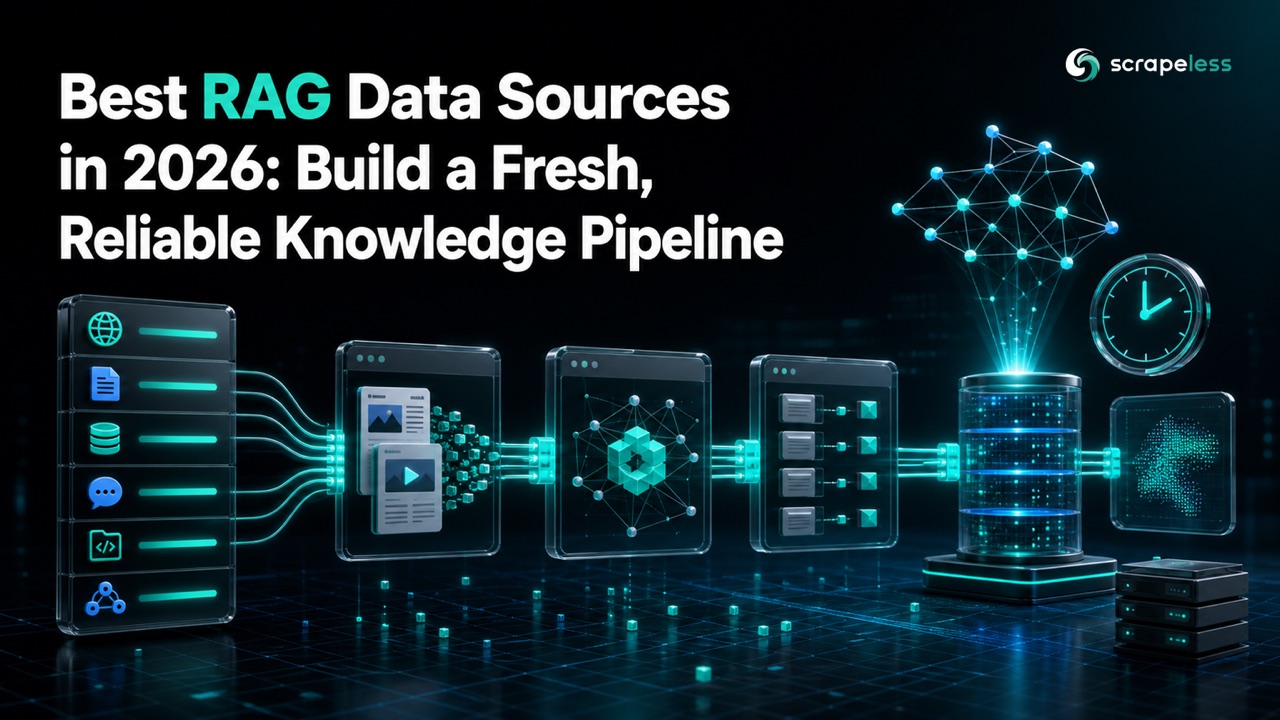
A reliable ingestion path has eight boundaries:
Register source → discover records → acquire content → validate → normalize → segment → index → evaluate
Each boundary produces an artifact the next stage can accept or reject.
| Boundary | Required output | Example rejection state |
|---|---|---|
| Register | Owner, purpose, access class, freshness objective | Source not approved |
| Discover | Canonical record identifiers | URL outside scope |
| Acquire | Expected document or structured response | Consent or error page |
| Validate | Correct type, language, and required fields | Content marker absent |
| Normalize | Main content plus stable metadata | Unsupported file or encoding |
| Segment | Context-preserving chunks | Fragment lacks source identity |
| Index | Searchable record with filters | Duplicate or revoked version |
| Evaluate | Query, expected evidence, retrieval result | Required evidence not retrieved |
This design keeps ingestion separate from model prompting. If the wrong page enters the index, a stronger prompt cannot restore the missing source.
How We Evaluated RAG Data Sources
The source categories below are evaluated on eight dimensions:
- Authority: Can the source support the claim the application needs to make?
- Coverage: Does it contain the entities, periods, and scenarios users ask about?
- Freshness: Can the pipeline detect when the source changes or expires?
- Structure: Can the content be parsed without losing tables, headings, or field meaning?
- Provenance: Can a retrieved passage point back to the exact source and version?
- Permissions: Is collection, storage, retrieval, and display permitted for the intended users?
- Stability: Does the source expose durable identifiers and predictable update behavior?
- Evaluation value: Can the team define questions whose correct evidence lives in this source?
These dimensions prevent a common shortcut: choosing a source because it is easy to embed rather than because it can answer the target questions reliably.
1. First-Party Documentation: Best for Authoritative Product Knowledge
First-party documentation should anchor product, policy, process, and configuration answers. It has a named owner, an official publication path, and a direct relationship to the subject.
Useful surfaces include product manuals, knowledge bases, release notes, policy pages, implementation guides, and approved internal procedures. Store the canonical URL, document version, heading path, and effective date with each chunk.
The difficult part is lifecycle control. Documentation sites often preserve old pages for compatibility. A crawler may index both the current guide and an obsolete version unless the source registry defines which branches are active.
Use first-party documentation when the answer must reflect the organization's own commitments or supported behavior.
2. Owned Structured Databases: Best for Precise Operational Answers
Owned databases are the strongest source for inventory, orders, account state, entitlements, and other structured facts. They support exact filters and can return only the fields needed for a question.
Do not flatten every row into prose by default. Preserve typed values, entity identifiers, timestamps, and permission fields. Retrieval can combine structured lookup with semantic search when a question needs both a record and explanatory text.
The main failure mode is permission loss. A document copied into a vector index can outlive the access rule on its source row. Apply tenant, role, and record-level filters before evidence reaches the model.
3. Public Web Pages: Best for External Coverage
Public web pages extend RAG beyond an organization's own repository. They can supply public product details, market announcements, public listings, technical articles, and other externally maintained knowledge.
Web acquisition needs more than an HTTP status. The pipeline should confirm page identity, required content, language, canonical URL, and source policy. JavaScript-rendered pages may require browser execution before the main content exists.
Public visibility does not remove copyright, privacy, contract, or database-right obligations. Register only sources the project may collect, keep the field set proportionate, and retain the source URL for review and removal.
4. Search Results and Discovery Feeds: Best for Finding New Evidence
Search results are a discovery layer rather than a final knowledge base. They reveal which pages exist for a query, which sources have changed visibility, and where a new topic is being discussed.
Use the result title, URL, snippet, locale, and collection context to choose candidate sources. Then acquire and validate the underlying page before indexing its claims. A snippet can be truncated, stale, or missing the context that changes its meaning.
Scrapeless Deep SerpApi can supply structured search discovery, while the Universal Scraping API can acquire permitted public pages selected by that discovery step. Keep search records and page evidence as separate objects.
Get your API key on the free plan: app.scrapeless.com
5. Support and Service Knowledge: Best for Real User Questions
Support tickets, resolved cases, service notes, and approved conversation summaries reveal the language users actually employ. They are useful for troubleshooting retrieval, intent classification, and answer coverage.
This source also carries the highest governance burden in the list. Remove personal data that is not required, exclude confidential account details, honor retention rules, and separate public help content from tenant-specific evidence.
A safer pattern is to promote validated solutions into an approved knowledge article, then index that article as the reusable source. The underlying case remains access-controlled.
6. Standards and Regulatory Material: Best for Primary Definitions
Standards, statutes, regulator guidance, and public specifications should support questions where wording and version matter. These sources are more authoritative than summaries, but they need precise jurisdiction and edition metadata.
Store the section or article identifier with the passage. Do not merge several editions into one unlabeled chunk. A query about a current rule should filter out replaced material before semantic ranking begins.
7. Licensed Research and Public Datasets: Best for Curated Domain Depth
Licensed research, academic corpora, and public datasets can add terminology, measurements, and long-horizon evidence that ordinary webpages do not provide.
The license defines what the RAG application may store and display. A team may have permission to read a dataset without permission to redistribute passages through generated answers. Record license scope beside the index and keep restricted collections separate from public evidence.
For quantitative datasets, retrieve the typed record and its definition together. A number without its unit, period, population, or methodology is weak evidence.
8. Multimedia Transcripts: Best for Spoken and Demonstrated Knowledge
Transcripts make webinars, training sessions, meetings, and demonstrations searchable. They can recover explanations that never reached written documentation.
Segment by speaker and topic rather than fixed character count alone. Attach timestamps, recording identity, language, and transcription confidence. Human review is appropriate when a passage will support a high-impact answer.
Treat recordings with private participants as restricted sources. Consent and access rules apply to the derived transcript as well as the media file.
Side-by-Side RAG Source Selection Matrix
| If the question is about… | Start with | Add when needed | Avoid as sole evidence |
|---|---|---|---|
| Supported product behavior | Current first-party docs | Release notes, owned configuration data | Search snippet |
| Live inventory or account state | Owned database or API | Policy documentation | Cached prose chunk |
| Market changes | Public pages | Search discovery, licensed research | Old internal summary |
| Troubleshooting | Approved support knowledge | Current docs, telemetry fields | Raw cross-tenant tickets |
| Legal or technical definitions | Primary regulation or standard | Official guidance | Unattributed commentary |
| Training content | Approved transcript | Slides and linked documentation | Transcript without speaker or time |
Build Freshness Into the Evidence Record
Freshness is not a single global interval. Each source needs an update contract based on how it changes.
Use four fields at minimum:
source_updated_at: when the publisher says the source changed, when available;collected_at: when the pipeline acquired this representation;content_hash: whether the normalized content changed;valid_until: when the record must be checked again for this use case.
HTTP validators and caching rules can reduce unnecessary acquisition. The HTTP caching specification defines freshness and validation behavior for stored responses. A RAG pipeline can use those signals while still applying a business-specific validity window.
Deletion is part of freshness. When a source disappears, permission is withdrawn, or a document is replaced, mark the old evidence ineligible before removing it from storage. Otherwise a vector index may continue returning a record the source owner no longer considers current.
Preserve Citations Through Cleaning and Chunking
Cleaning should remove navigation noise without erasing the document's meaning. Keep heading hierarchy, table relationships, list context, and links that identify the subject.
Every chunk should carry:
- canonical source URL or record key;
- title and heading path;
- source owner and access class;
- document and schema version;
- collection and source-update context;
- content hash;
- neighboring chunk identifiers when context spans boundaries.
The model should cite the source record, not an internal vector identifier. If a user opens the citation, it should resolve to the evidence that supported the answer.
Evaluate Retrieval Before Evaluating the Answer
RAG evaluation should separate source coverage, retrieval, context assembly, and generation. A correct answer can hide a weak retriever, and a fluent answer can hide missing evidence.
Build an evaluation set from representative questions and record:
- which source is expected to contain the answer;
- which passage or fields constitute sufficient evidence;
- which access filters apply;
- whether freshness changes the expected answer;
- which answer should be withheld when evidence is absent.
The survey of RAG evaluation methods organizes evaluation across retrieval and generation components. Use that separation operationally: measure whether the required evidence entered the candidate set before grading the final prose.
Governance applies across the pipeline. The NIST AI Risk Management Framework provides a governance, mapping, measurement, and management structure that can include source registration, permissions, evaluation, and change control.
How Scrapeless Fits the RAG Ingestion Layer
Scrapeless belongs before the index. Deep SerpApi can discover public sources and Universal Scraping API can acquire selected permitted pages; the application still owns source approval, normalization, chunking, embedding, access filters, storage, and evaluation.
The live web data pipeline for AI agents explains the acquisition boundary in more detail. Review Scrapeless pricing against accepted and refreshable documents rather than raw discovered URLs.
Conclusion: Source Quality Sets the Retrieval Ceiling
A RAG pipeline cannot retrieve evidence that its source program failed to register, acquire, validate, or refresh. Start with the questions the product must answer, map each question to an authoritative source, and keep provenance and permissions attached through every transformation.
Source diversity is useful only when the evidence contract stays consistent. Treat public pages, databases, search discovery, support knowledge, research, and transcripts as different source classes with different owners and freshness rules.
Ready to Build a Fresh RAG Knowledge Pipeline?
Join developers working on retrieval and live web data systems: Discord · Telegram.
Sign up at app.scrapeless.com and begin with one approved query set, one source registry, and one measurable ingestion path.
FAQ
Q: What are the best data sources for RAG?
The best data sources for RAG are authoritative for the target questions, permitted for the intended users, refreshable at the required pace, and able to preserve provenance through retrieval.
Q: Should a RAG system use internal or public data?
A RAG system should use internal data for owned operational facts and public data for approved external coverage. Keep their permissions, identities, and freshness rules separate.
Q: Are search results a good RAG data source?
Search results are useful for discovering candidate evidence, but the pipeline should acquire and validate the underlying page before treating its content as knowledge.
Q: How often should RAG data be refreshed?
Refresh frequency should follow the source's change rate and the application's tolerance for stale evidence. Product inventory may need frequent checks, while a stable standard can use event-driven updates.
Q: How do you prevent stale RAG answers?
Track source updates, collection time, content hashes, validity windows, replacement records, and deletions, then filter expired evidence before retrieval.
Q: How should RAG source quality be evaluated?
Evaluate authority, coverage, freshness, structure, provenance, permissions, stability, and whether representative questions retrieve the expected evidence.
At Scrapeless, we only access publicly available data while strictly complying with applicable laws, regulations, and website privacy policies. The content in this blog is for demonstration purposes only and does not involve any illegal or infringing activities. We make no guarantees and disclaim all liability for the use of information from this blog or third-party links. Before engaging in any scraping activities, consult your legal advisor and review the target website's terms of service or obtain the necessary permissions.