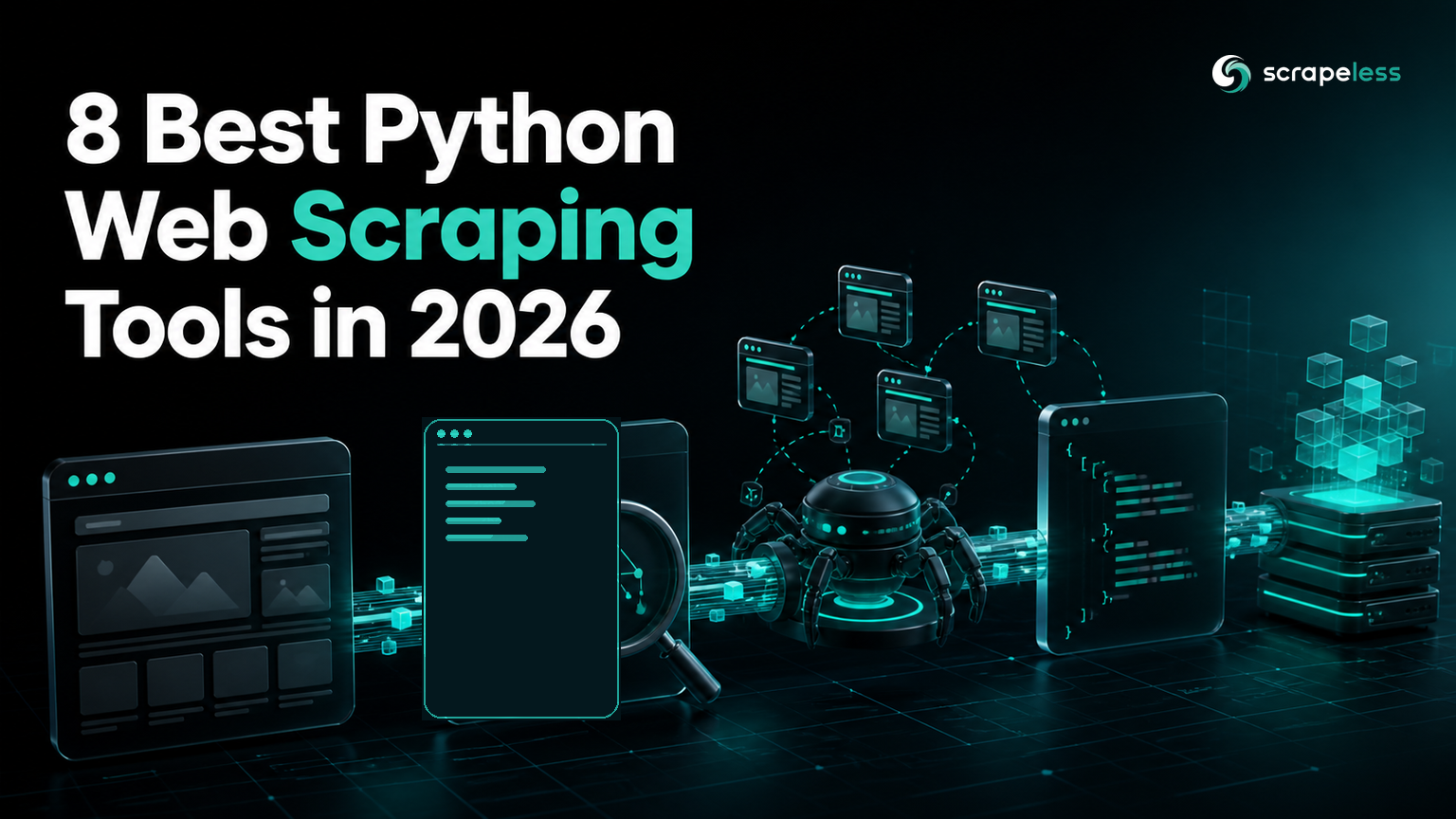
8 Best Python Web Scraping Tools in 2026: Compared

Senior Web Scraping Engineer
TL;DR:
- Python web scraping tools solve different layers. Requests and HTTPX fetch, Beautiful Soup and lxml parse, Scrapy crawls, and Playwright or Selenium executes browser behavior.
- Scrapeless is the best managed option when acquisition is the hard part. It lets Python workflows consume search, scraping, and rendered-browser results without owning every browser and access component.
- Start with the lightest layer that returns the needed data. An HTTP client plus parser is easier to operate than a browser; a browser is justified when the content or interaction requires it.
- A production scraper also needs policy, bounded recovery, deduplication, observability, and data validation. Choosing a library is only the first decision.
There is no single “Python web scraper.” A small script may combine one HTTP client and one HTML parser. A crawler adds queues, concurrency, failure recovery, and duplicate filtering. A browser tool executes JavaScript and user interactions. Managed services move the difficult acquisition layer outside the Python process.
The eight options below are compared by role so that tools are not ranked as if they were interchangeable.
8 Python Web Scraping Tools Compared
| Rank | Tool | Layer | Best for |
|---|---|---|---|
| 1 | Scrapeless | Managed acquisition | Dynamic pages and production data access |
| 2 | Requests | HTTP client | Simple synchronous fetching |
| 3 | Beautiful Soup | HTML/XML parser | Readable extraction from imperfect markup |
| 4 | Scrapy | Crawling framework | Multi-page and scheduled crawls |
| 5 | Playwright for Python | Browser automation | JavaScript pages and interactions |
| 6 | lxml | HTML/XML parser | Fast XPath and large documents |
| 7 | HTTPX | HTTP client | Async workflows and modern client features |
| 8 | Selenium | Browser automation | WebDriver and existing test infrastructure |
How Python Scraping Tools Fit Together
A scraping pipeline normally has four stages:
- Acquire: request a URL or run a browser session.
- Parse: turn HTML, XML, or JSON into fields.
- Crawl: schedule URLs, enforce limits, recover from failures, and deduplicate.
- Validate and store: check types, required fields, provenance, and freshness.
One tool may cover several stages, but the distinction prevents a common mistake: switching parsers when the real failure is that the initial HTML does not contain the rendered data.
1. Scrapeless: Best Managed Data Acquisition for Python
Scrapeless Scraping Browser gives Python applications a managed acquisition layer for interactive and JavaScript-dependent pages, while Deep SerpApi covers search-result collection.
Use Scrapeless when the Python team wants to own schemas, validation, and downstream analysis but not every browser process, proxy decision, or challenge workflow. The returned content can still be parsed with Beautiful Soup or lxml and scheduled by the application’s own queue.
A strong integration records request parameters, source URL, collection time, response status, and the parser version alongside each batch. That metadata is what makes a result reproducible when a website changes.
2. Requests: Best for Simple HTTP Fetching
Requests provides a compact synchronous API for HTTP. It works well for static HTML, JSON endpoints, authenticated APIs, and modest jobs where a blocking execution model is acceptable. The official Requests quickstart documents parameters, headers, response content, JSON, and errors.
Requests does not execute page JavaScript or parse HTML. Pair it with Beautiful Soup or lxml, use a session for connection reuse, set explicit timeouts, and handle non-success responses deliberately.
3. Beautiful Soup: Best for Readable HTML Parsing
Beautiful Soup turns HTML or XML into a searchable tree and is forgiving of imperfect markup. Its methods are approachable for developers who need CSS-like searching and straightforward traversal.
The official Beautiful Soup documentation explains parser selection, searching, CSS selectors, and tree navigation. Parser choice matters: Beautiful Soup can use Python’s built-in parser, lxml, or html5lib, and malformed markup may produce different trees.
Choose it when extraction clarity matters more than maximum parsing throughput.
4. Scrapy: Best for Multi-Page Crawling
Scrapy is an application framework for spiders rather than a single-purpose parser. It manages request scheduling, callbacks, item pipelines, downloader middleware, concurrency, failure recovery, and duplicate filtering.
The official architecture guide shows how the engine coordinates the scheduler, downloader, spiders, and item pipeline. That structure is useful once a crawl spans categories, pagination, detail pages, and repeated runs.
Choose Scrapy when the team is starting to hand-build queues and recovery rules around Requests. It can still delegate difficult page acquisition to a browser service and process the returned content inside the crawl.
Start Scraping with Scrapeless
Power up your web scraping and automation workflow with Scrapeless!
Sign up today and get $5 in free credit — no credit card required.Claim your free credit now in the Scrapeless Dashboard.
5. Playwright for Python: Best for Modern Browser Automation
Playwright for Python drives Chromium, Firefox, and WebKit and supports browser contexts, locators, network controls, and automatic actionability checks. It is a good fit when page content appears only after JavaScript runs or when the workflow must click, fill, scroll, or wait for application state.
Browser execution costs more memory and time than a direct HTTP request. Use it after checking whether a stable JSON endpoint or initial HTML already contains the data. Keep page selectors separate from business logic so changes remain localized.
6. lxml: Best for Fast XPath Parsing
lxml provides C-backed XML and HTML processing with XPath and CSS selector support. It is useful for large documents, precise XPath expressions, and workflows that already use XML tooling.
Choose lxml when parsing throughput or XPath control matters. Be explicit about encodings and recovery behavior; a fast parser does not correct a wrong source document or an unstable selector.
7. HTTPX: Best for Async HTTP Workflows
HTTPX offers synchronous and asynchronous clients with an API familiar to Requests users. The official async guide covers AsyncClient, connection reuse, streaming, and the need to close clients.
Async fetching can improve throughput for I/O-bound jobs, but it does not remove server limits or policy constraints. Bound concurrency, apply a delay after failures, and avoid creating a new client inside every loop iteration.
8. Selenium: Best for Existing WebDriver Infrastructure
Selenium remains relevant when a company already has WebDriver-based automation, grid capacity, and cross-language test assets. Python bindings can drive major browsers locally or remotely.
For a new data-only project, Playwright often offers a more direct developer experience. Selenium becomes the stronger option when integration with an existing WebDriver estate outweighs that difference.
Which Tool Should You Choose?
Use Requests or HTTPX when the required data is present in an HTTP response. Add Beautiful Soup for readable HTML traversal or lxml for XPath and parsing speed. Choose Scrapy when URL scheduling, recovery, pipelines, and repeated crawls become the main engineering work.
Use Playwright or Selenium when the required state exists only after browser execution. Move acquisition to Scrapeless when browser operations, access reliability, geographic coverage, or production concurrency distract the team from the data product.
The Scrapeless pricing page can be compared against the full operating cost of self-hosted workers. For request and response handling patterns, see the JavaScript API request guide; the same timeout, authentication, and validation principles apply in Python.
Production Checklist
- Confirm that collection is permitted and respect site terms and applicable rules.
- Set timeouts, bounded recovery attempts, delay rules, and concurrency limits.
- Normalize URLs and deduplicate before scheduling more work.
- Preserve source URL, timestamp, locale, and raw evidence.
- Validate required fields before writing to the destination.
- Track failures by category rather than repeating every exception.
- Test selectors against saved fixtures and monitor schema drift.
- Close sessions, clients, pages, and browser contexts on every path.
Conclusion
The best Python scraping stack is usually layered: an HTTP client, a parser, a crawler when needed, and a browser only for pages that require it. Scrapeless ranks first for teams whose hardest problem is reliable acquisition rather than Python parsing. Select the lightest viable layer, measure its failures, and add infrastructure only where the evidence shows a gap.
FAQ
Q: What is the best Python library for web scraping?
Requests plus Beautiful Soup is a practical starting point for static pages. Scrapy is better for full crawls, and Playwright is appropriate when JavaScript or interaction is required.
Q: Is Scrapy better than Beautiful Soup?
They solve different jobs. Scrapy is a crawling framework; Beautiful Soup is a parser. A Scrapy spider can use its own selectors or another parser.
Q: Can Python scrape JavaScript websites?
Yes. Playwright or Selenium can execute the page in a browser. A managed browser or scraping API can provide the rendered result when the team does not want to operate browser infrastructure.
Q: Should every scraper use a headless browser?
No. Direct HTTP is faster and simpler when the response already contains the needed data. Use a browser only when rendering or interaction is part of the requirement.
Q: How do I make a Python scraper reliable?
Set explicit timeouts and bounded recovery attempts, control concurrency, deduplicate URLs, validate output, preserve provenance, classify failures, and monitor field-level changes.
At Scrapeless, we only access publicly available data while strictly complying with applicable laws, regulations, and website privacy policies. The content in this blog is for demonstration purposes only and does not involve any illegal or infringing activities. We make no guarantees and disclaim all liability for the use of information from this blog or third-party links. Before engaging in any scraping activities, consult your legal advisor and review the target website's terms of service or obtain the necessary permissions.