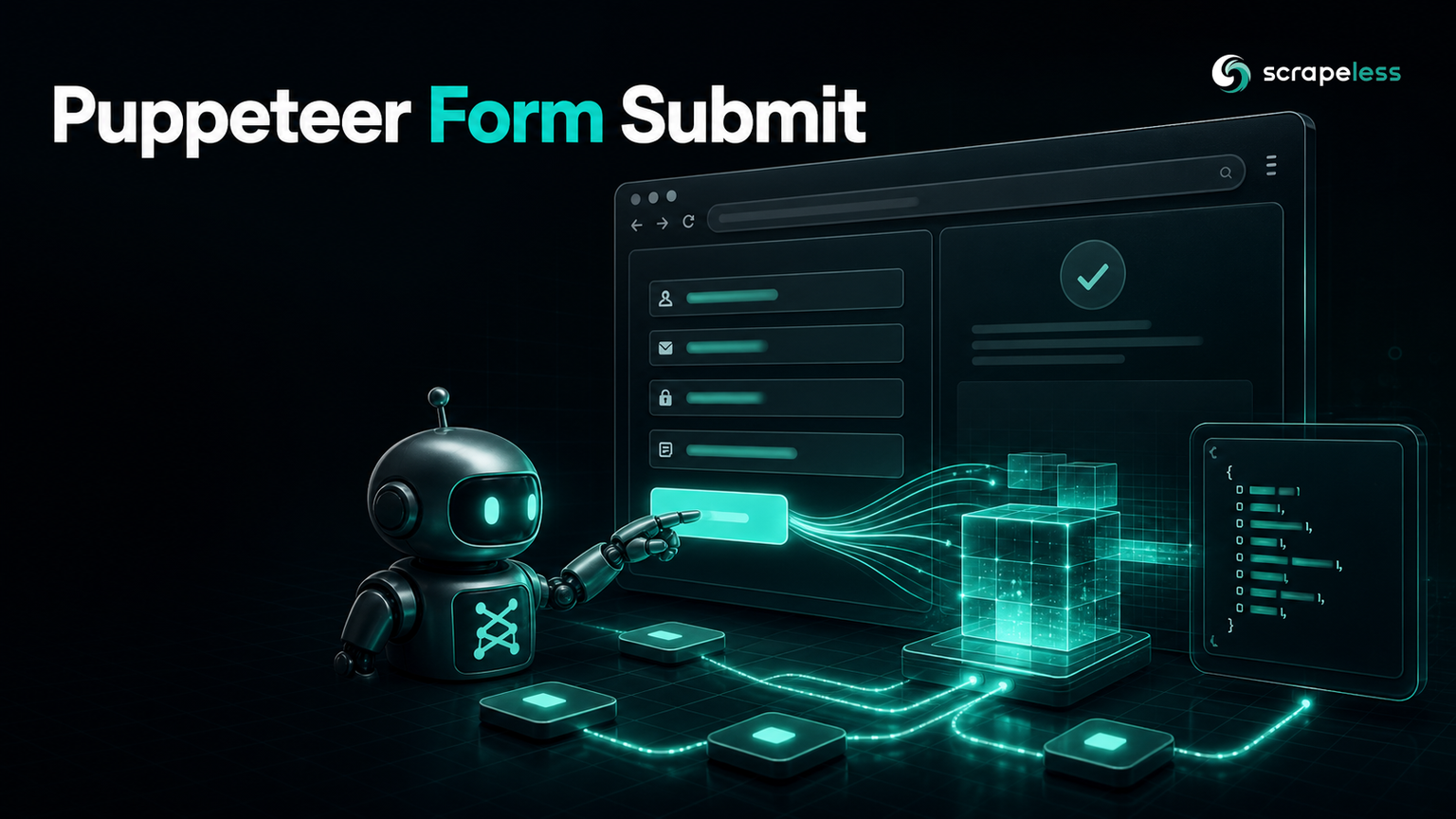
Puppeteer Form Submit: A Practical Guide to Reliable Form Automation

Lead Scraping Automation Engineer
TL;DR:
- Reliable form submission is three moves: fill, submit, wait. Type into the inputs, trigger the submit, and
awaitthe navigation — racing the click withwaitForNavigationso you never read the page before it changes. - Match the input to the control.
page.type()for text,page.click()on the radio/checkbox you want,page.select()for dropdowns — submitting the wrong control type is the most common silent failure. - The submit and the wait must be a
Promise.all. Click first, then await navigation, and the navigation can finish before you start listening. Awaiting both together is what makes login and multi-step forms deterministic. - Forms are where bot walls bite hardest. Login and checkout pages fingerprint aggressively; running on an anti-detection cloud browser with residential egress is what gets the form to accept the submission instead of challenging it.
- It's plain Puppeteer on top of Scrapeless Scraping Browser.
Puppeteer.connect()returns a standardBrowser, so everytype/click/waitForNavigationyou already know works unchanged — the runtime only handles the session and anti-detection. - Free to start. New Scrapeless accounts include free Scraping Browser runtime — sign up at app.scrapeless.com.
Introduction: form automation that actually goes through
Filling a form with Puppeteer looks trivial until the submit silently fails. The inputs get typed, the button gets clicked, and then your script reads a page that hasn't navigated yet — or worse, the site quietly rejected the request because it decided a bot was driving. Reliable form submission is less about the typing and more about two things most scripts get wrong: synchronizing the submit with the HTTP navigation request, and looking enough like a real browser that the form is accepted at all.
The first problem is a Puppeteer pattern. The second is an environment problem — and it's the one that turns a working local script into an unreliable one against real sites. Login pages, checkout flows, and search forms are exactly where sites concentrate their bot detection.
This guide runs form automation on Scrapeless Scraping Browser, an anti-detection cloud browser that connects to Puppeteer over a standard endpoint. You write ordinary page.type() and page.click() calls; the runtime supplies residential egress and fingerprinting so the submission lands. Every snippet below was run against live forms.
What You Can Do With It
- Log into sites and keep the authenticated session for downstream scraping.
- Submit search and filter forms that build results server-side instead of via a clean URL.
- Drive multi-field forms — text, radios, checkboxes, dropdowns — in one flow.
- Automate checkout-style steps where each submit advances to the next page.
- Verify what was actually sent by reading the response the server echoes back.
Why Scrapeless Scraping Browser
Scrapeless Scraping Browser is a customizable, anti-detection cloud browser designed for web crawlers and AI agents. For form submission specifically, it brings:
- A standard Puppeteer connection —
Puppeteer.connect()returns a normalBrowser, so yourtype/click/waitForNavigationcode is unchanged. - Residential proxies in 195+ countries — submit from an IP the form's anti-fraud layer trusts.
- Anti-detection fingerprinting — the session reads as a real browser, so login and checkout forms accept the submission instead of throwing a challenge.
- Session persistence — keep cookies warm after login so the next request is already authenticated.
- Self-developed Chromium — full, standard DOM and event behavior for inputs, radios, and selects.
Get your API key on the free plan at app.scrapeless.com.
Prerequisites
- Node.js 18 or newer
- A Scrapeless account and API key — sign up at app.scrapeless.com
- Basic familiarity with Puppeteer and CSS selectors
Install
The Scrapeless SDK mints the cloud session and connects Puppeteer; puppeteer-core is the protocol client (the browser is remote, so no bundled Chromium is needed):
bash
npm install @scrapeless-ai/sdk puppeteer-coreSet your API key from the environment:
bash
export SCRAPELESS_API_KEY="your_api_token_here"Configure: connect Puppeteer to the cloud browser
javascript
import { Puppeteer } from '@scrapeless-ai/sdk';

const browser = await Puppeteer.connect({
  apiKey: process.env.SCRAPELESS_API_KEY,
  sessionName: 'puppeteer-forms',
  proxyCountry: 'US',
  sessionTTL: 300,
});

const page = await browser.newPage();
page is a standard Puppeteer page from here on.
Basic implementation: a login form
The load-bearing detail is the Promise.all. If you await page.click() and then await page.waitForNavigation(), the navigation may already have completed in the gap — and your wait hangs. Start the navigation listener and the click together:
javascript
await page.goto('https://quotes.toscrape.com/login', { waitUntil: 'domcontentloaded' });

await page.type('#username', 'demo-user');
await page.type('#password', 'demo-pass');

await Promise.all([
  page.waitForNavigation({ waitUntil: 'domcontentloaded' }),
  page.click('input[type="submit"]'),
]);

console.log(page.url(), '—', await page.title());
// https://quotes.toscrape.com/ — Quotes to Scrape
After the submit resolves, you're on the post-login page and the session holds the auth cookie — every later request on this page is already logged in.
Get your API key on the free plan: app.scrapeless.com
Multi-field forms: text, radios, checkboxes, dropdowns
Real forms mix control types, and each one of these HTML form controls has its own method. Typing into a radio button does nothing; clicking a <select> doesn't choose an option. Map the control to the call:
| Control | Puppeteer call |
|---|---|
| Text / email / tel input | page.type(selector, value) |
| Radio button | page.click(radioSelector) |
| Checkbox | page.click(checkboxSelector) |
Dropdown (<select>) |
page.select(selector, value) |
| Submit | page.click(submitSelector) (raced with waitForNavigation) |
Here is a full multi-field submission, verified against httpbin.org/forms/post, which echoes the submitted fields back so you can confirm exactly what was sent:
javascript
await page.goto('https://httpbin.org/forms/post', { waitUntil: 'domcontentloaded' });

await page.type('input[name="custname"]', 'Ada Lovelace');
await page.type('input[name="custtel"]', '555-0100');
await page.click('input[value="medium"]');   // pizza-size radio
await page.click('input[value="bacon"]');     // topping checkbox

await Promise.all([
  page.waitForNavigation({ waitUntil: 'domcontentloaded' }),
  page.click('button'),                        // "Submit order"
]);

const echoed = JSON.parse(await page.evaluate(() => document.body.innerText));
console.log(echoed.form);
// {
//   custname: 'Ada Lovelace',
//   custtel: '555-0100',
//   size: 'medium',
//   topping: 'bacon',
//   ...
// }
The echoed form object is the server's view of what you submitted — the single best way to confirm a form actually went through with the right values.
Advanced patterns
Wait for a result element, not navigation. Many forms submit via fetch/XHR and never navigate. Replace waitForNavigation with page.waitForSelector('.results') (or a specific success node) so you wait on the real signal.
Clear before you type. page.type() appends. To overwrite a pre-filled field, focus and clear it first: await page.click(sel, { clickCount: 3 }); await page.keyboard.press('Backspace'); then type.
Submit by key. Some forms have no clickable button. Focus the last field and press Enter inside the Promise.all: page.keyboard.press('Enter') in place of the click.
Stay logged in across steps. Keep the same page for the whole flow. Scrapeless session persistence holds cookies between navigations, so a login followed by a gated form just works.
Pin egress for fraud-sensitive forms. Set proxyCountry at connect time so checkout and account forms see a consistent residential IP from the expected region.
Troubleshooting
| Symptom | Cause | Fix |
|---|---|---|
waitForNavigation hangs forever |
Click awaited before the wait started | Race them in one Promise.all |
| Submission succeeds but values are wrong | Wrong method for the control | Text → type, radio/checkbox → click, select → select |
| Script reads the old page after submit | The form uses XHR, not a navigation | Wait on a result selector instead of navigation |
| Field keeps the old value | type appends to existing text |
Clear the field before typing |
| Form is rejected or challenged | Site flags the session as a bot | Run on the cloud browser with residential egress and fingerprinting |
Conclusion: forms as a dependable step
A form submission that goes through every time comes down to mapping each control to the right Puppeteer call, racing the submit against the wait in a single Promise.all, and waiting on the real post-submit signal — navigation or a result node. Running it on Scrapeless Scraping Browser removes the part that has nothing to do with your code: getting login and checkout forms to accept the request instead of challenging it. For a fuller cloud-browser scraping workflow in Python, see the Scrapling + Scrapeless guide, and the Scraping Browser product page and docs for the full SDK surface. Keep the session warm for authenticated flows and confirm what was sent by reading the response back.
Ready to Build Your AI-Powered Data Pipeline?
Join our community to claim a free plan and connect with developers building form and login automation: Discord · Telegram.
Sign up at app.scrapeless.com for free Scraping Browser runtime and adapt the patterns above to the logins, searches, and checkout flows your workflow needs. See pricing for scale.
FAQ
Q: How do I avoid the race where waitForNavigation hangs?
Start the navigation wait and the click in the same Promise.all. Awaiting the click first lets the navigation complete before you begin listening, which makes the wait hang.
Q: How do I select a dropdown option?
Use page.select(selector, value) with the option's value attribute — not click. For radios and checkboxes, page.click() the specific control.
Q: The form submits with XHR and never navigates. What do I wait on?
Replace waitForNavigation with page.waitForSelector() for a node that only appears after a successful submit, such as a results container or success message.
Q: Do I need a proxy to submit forms?
For public forms, often not. For login, checkout, and other fraud-sensitive forms, pin proxyCountry so the submission comes from a residential IP the site trusts.
Q: How do I stay logged in after submitting a login form?
Keep using the same page. Scrapeless session persistence holds the auth cookies across navigations, so later requests are already authenticated.
Q: Can I run this without an AI agent?
Yes. This is plain Puppeteer over the Scrapeless session — no agent involved. The SDK only mints the connection.
At Scrapeless, we only access publicly available data while strictly complying with applicable laws, regulations, and website privacy policies. The content in this blog is for demonstration purposes only and does not involve any illegal or infringing activities. We make no guarantees and disclaim all liability for the use of information from this blog or third-party links. Before engaging in any scraping activities, consult your legal advisor and review the target website's terms of service or obtain the necessary permissions.