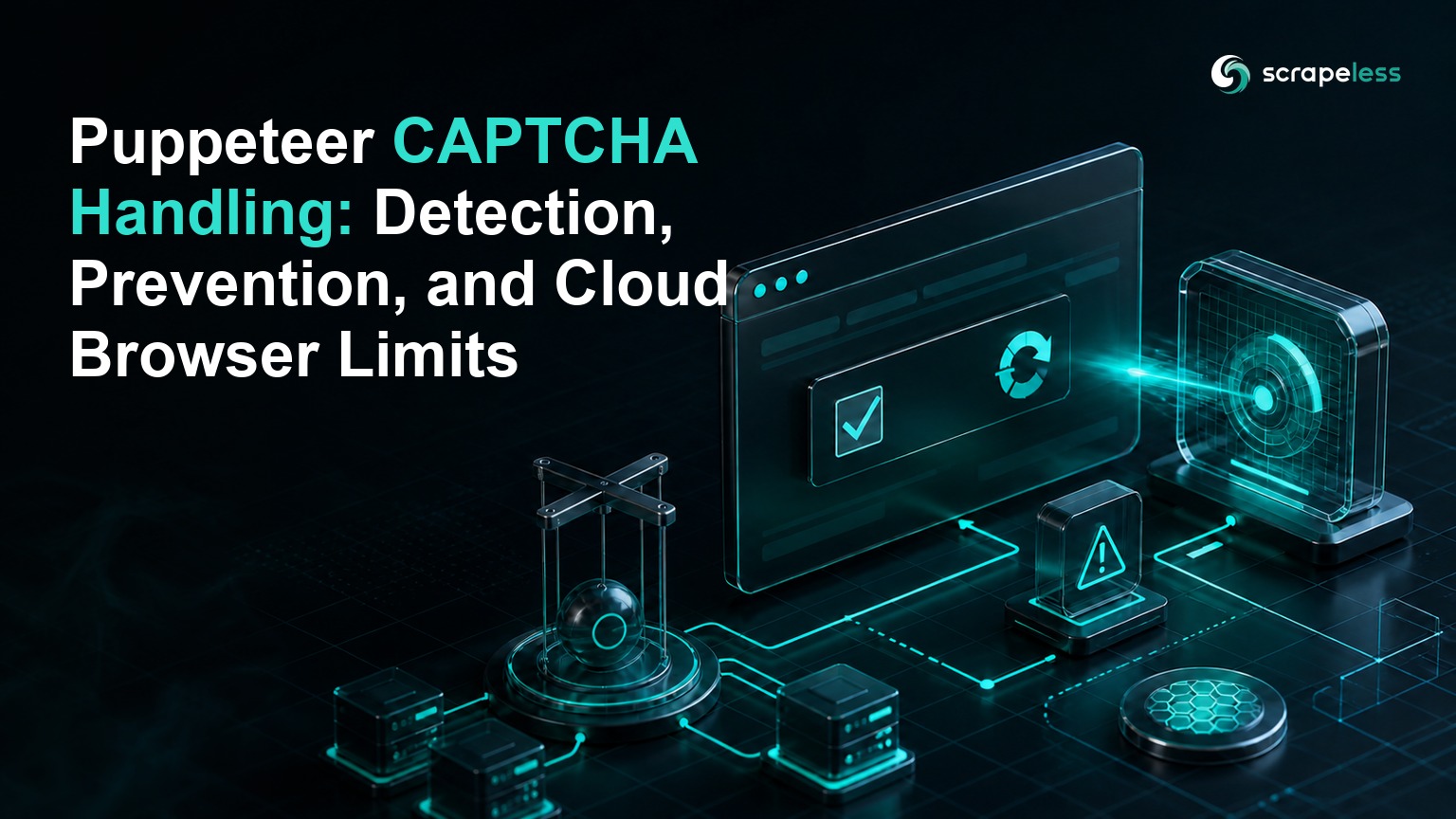
Puppeteer CAPTCHA Handling: Detection, Prevention, and Cloud Browser Limits

Specialist in Anti-Bot Strategies
TL;DR:
- Treat a CAPTCHA as a stop signal, not a puzzle for Puppeteer to beat. Detect multiple page signals, save diagnostics, and pause the affected job.
- Do not trust one selector. Challenge pages can appear in an iframe, a widget container, page copy, or a provider-specific response field.
- Preserve legitimate session state. Reusing an authorized browser context can reduce accidental re-challenges without attempting to solve or evade them.
- Know where local Puppeteer stops. Browser upkeep, session isolation, proxy routing, and observability become operational work as volume grows.
- Scrapeless Scraping Browser is the cloud boundary. It keeps the Puppeteer API while moving browser infrastructure and session controls to a managed service.
Puppeteer CAPTCHA handling should begin with detection and prevention. If a public page presents a challenge, the safe automation response is to classify the page, capture evidence, and stop or route the item for review. Repeating the same request usually makes the signal worse and hides the real failure from downstream systems.
This tutorial builds a small multi-signal detector, shows how to preserve session state responsibly, and defines the point where a local Chrome process becomes an operations problem. It does not automate CAPTCHA solving or recommend third-party solver services.
What CAPTCHA Detection Means in Puppeteer
A CAPTCHA is an access-control response intended to distinguish legitimate interaction from suspicious traffic. Puppeteer can observe that a page contains a challenge, but detection is not the same as authorization to proceed.
The Puppeteer interaction guide explains how locators and waits synchronize with page state. Google's reCAPTCHA display documentation documents the widget container and callback model. The HTTP semantics specification is also useful because a challenge can arrive with an otherwise normal status code.
Detection should combine signals rather than assume every challenge uses the same markup:
- a known challenge iframe source;
- a widget container such as
.g-recaptcha; - a provider response field;
- visible text that asks for verification;
- a page title or canonical URL that no longer matches the requested content.
Install the Exact Dependencies
The verified example used Node.js, puppeteer-core 25.3.0, and an installed Chrome browser.
bash
mkdir puppeteer-captcha-check && cd puppeteer-captcha-check
pnpm init
pnpm add puppeteer-core@25.3.0
Using puppeteer-core keeps the browser executable explicit. If a project prefers Puppeteer's bundled browser, install puppeteer and remove executablePath from the launch options.
Build a Multi-Signal Challenge Detector
The script below visits Google's public reCAPTCHA demo, waits for the DOM, and reports the signals it sees. It does not click or solve the widget.
javascript
import puppeteer from 'puppeteer-core';

const browser = await puppeteer.launch({
  headless: true,
  executablePath: '/Applications/Google Chrome.app/Contents/MacOS/Google Chrome'
});

const page = await browser.newPage();
await page.goto('https://www.google.com/recaptcha/api2/demo', {
  waitUntil: 'domcontentloaded'
});

const signals = await page.evaluate(() => {
  const findings = [];
  const iframe = document.querySelector('iframe[src*="recaptcha"], iframe[src*="captcha"]');
  if (iframe) findings.push('challenge iframe');
  if (document.querySelector('.g-recaptcha, [data-sitekey]')) findings.push('recaptcha container');
  if (document.querySelector('[name="g-recaptcha-response"]')) findings.push('response field');
  if (/verify|captcha|not a robot/i.test(document.body.innerText)) findings.push('verification copy');
  return findings;
});

console.log({
  url: page.url(),
  title: await page.title(),
  challengeDetected: signals.length > 0,
  signals
});

await browser.close();
In the verification run, the page loaded and challengeDetected was true; the detector recorded the reCAPTCHA container. That is the intended outcome: recognize the page and stop before extraction.
Turn Detection Into a Safe Control Path
Page classification should happen before records enter a parser. Use a small result contract such as content, challenge, unexpected_page, or policy_review. Attach the requested URL, final URL, title, timestamp, and screenshot path so operators can understand the failure without rerunning it blindly.
When a challenge appears:
- stop navigation for that job;
- record the detection signals and page identity;
- save a screenshot or HTML sample without sensitive data;
- apply a bounded cooldown to the source, not rapid repeated reloads;
- review authorization, request rate, session design, and target terms.
This approach prevents challenge HTML from being accepted as product, search, or article data.
Reduce Accidental Challenges With Session Hygiene
Prevention is mostly disciplined browser behavior. Keep one browser context for a bounded, authorized workflow so cookies, locale, and storage do not reset between every page. Pin the required geography and language. Avoid opening more tabs than the source can reasonably serve, and cache results when the same page does not need to be collected again.
Preserving state is not an instruction to defeat access controls. If the target requires a login, use an account and automation flow the project is authorized to use. If a challenge persists, pause and review instead of rotating identities until one passes.
Where Local Puppeteer Stops
A local script works well for development and small scheduled jobs. At production scale, the team also owns Chrome installation, browser crashes, memory limits, process cleanup, session isolation, geographic routing, screenshots, and run diagnostics.
Puppeteer plugins can change parts of browser behavior, but they add version compatibility and maintenance work. They do not create permission to access a page, and they do not replace a content-validation contract.
The managed boundary is useful when browser infrastructure is distracting from the data job. Scrapeless Scraping Browser exposes a Puppeteer-compatible connection while adding managed sessions, proxy geography, recording, and browser lifecycle controls.
Connect Puppeteer to Scrapeless Scraping Browser
Prerequisite: the cloud example requires a Scrapeless account and a reader-owned SCRAPELESS_API_KEY. The SDK import and Puppeteer.connect method were verified locally; no live cloud session was created in this article's environment because that credential was not present.
javascript
import { Puppeteer } from '@scrapeless-ai/sdk';

const browser = await Puppeteer.connect({
  apiKey: process.env.SCRAPELESS_API_KEY,
  sessionName: 'public-data-check',
  sessionTTL: 180,
  proxyCountry: 'US',
  sessionRecording: true
});

const pages = await browser.pages();
const page = pages[0] || await browser.newPage();
await page.goto('https://example.com', { waitUntil: 'domcontentloaded' });
console.log(await page.title());
await browser.close();
The current Scrapeless Puppeteer documentation is the source of truth for connection options. Keep the same challenge classifier after moving to the cloud; managed browser infrastructure should improve operations, not remove validation.
Conclusion
Reliable Puppeteer web scraping recognizes when the requested content did not arrive. A multi-signal CAPTCHA detector, bounded sessions, conservative request behavior, and explicit failure states are more useful than a brittle selector or aggressive repetition.
Start locally, prove the content contract, and move to Scrapeless Scraping Browser when browser lifecycle and session operations become the bottleneck.
Run Puppeteer Without Managing Browser Infrastructure
Read the Scrapeless Cloud Browser Puppeteer guide, compare current pricing, then create a Scrapeless account and keep challenge detection as a production stop condition.
FAQ
Q: Can Puppeteer detect a CAPTCHA?
Yes. Puppeteer can inspect iframes, widget containers, response fields, visible copy, titles, and final URLs to classify a challenge page.
Q: Should Puppeteer automatically solve a CAPTCHA?
This tutorial does not automate solving. Treat the challenge as an access-control signal, stop the job, and review authorization and collection behavior.
Q: Why is one CAPTCHA selector unreliable?
Providers and page templates differ, and challenge markup can appear in an iframe, a container, a response field, or an entirely different interstitial page.
Q: Does a cloud browser remove CAPTCHA checks?
No. A cloud browser manages infrastructure and sessions, but the scraper must still classify responses and respect access controls.
Q: When should a team move from local Puppeteer to Scrapeless?
Move when browser installation, crashes, session isolation, geographic routing, and run observability consume more effort than the extraction logic.
At Scrapeless, we only access publicly available data while strictly complying with applicable laws, regulations, and website privacy policies. The content in this blog is for demonstration purposes only and does not involve any illegal or infringing activities. We make no guarantees and disclaim all liability for the use of information from this blog or third-party links. Before engaging in any scraping activities, consult your legal advisor and review the target website's terms of service or obtain the necessary permissions.