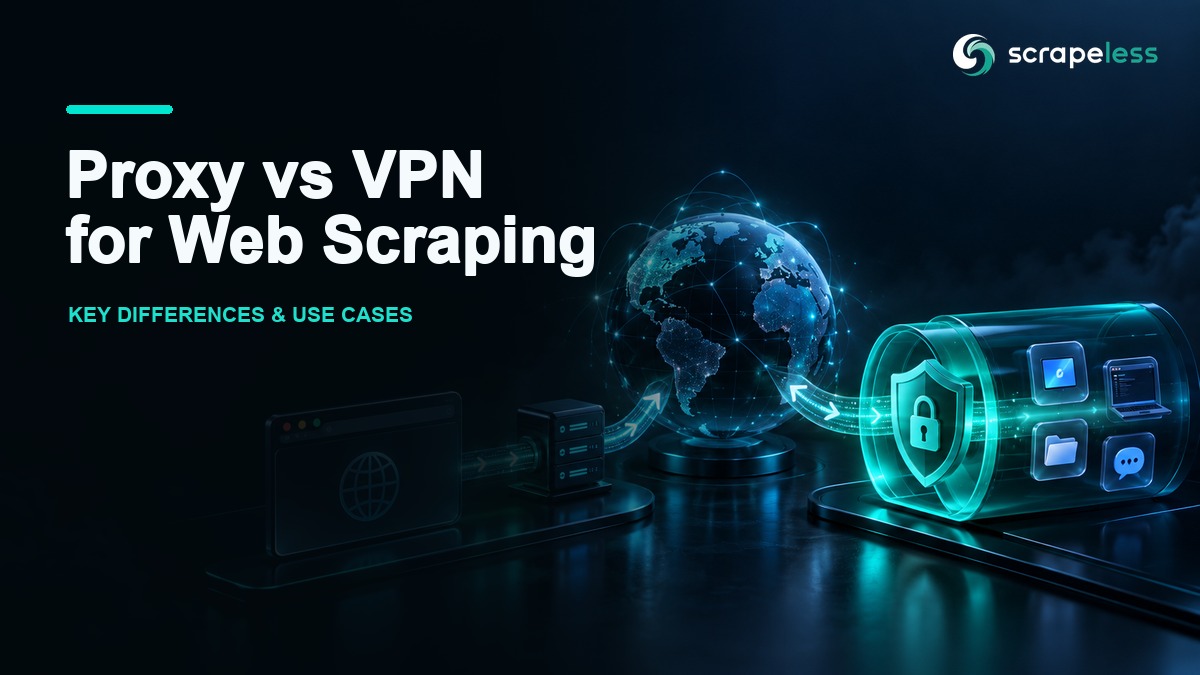
Proxy vs VPN for Web Scraping: Key Differences and When to Use Each

Senior Cybersecurity Analyst
TL;DR:
- A proxy routes selected application traffic; a VPN commonly routes traffic at the device or network layer. This scope difference matters more than the marketing label.
- Web scraping usually needs proxies because each worker can receive its own location, address, and session policy. A consumer VPN is designed around a user or device, not a large pool of application workers.
- HTTPS still protects browser-to-site content through an HTTP
CONNECTtunnel. A proxy is not automatically unencrypted, and a VPN does not replace HTTPS. - VPNs are the better tool for remote access and device-wide protection. They fit employees reaching private networks or securing broader traffic on an untrusted local network.
- Proxy and VPN can coexist, but stacking them adds another route and trust boundary. Combine them only when the operating model has a clear reason.
What Is a Proxy?
A proxy is an intermediary that receives traffic from a client and forwards it toward a destination.
For web scraping, the client is usually an HTTP library, browser, crawler, or worker process. The proxy can be assigned per application, process, browser context, request, or session. That narrow scope lets a data pipeline route different workers through different addresses or locations without changing the whole machine's network path.
HTTP proxies can forward ordinary HTTP requests and establish HTTPS tunnels with the CONNECT method. RFC 9110's CONNECT definition specifies how a client asks a proxy to create a tunnel to a host and port.
Proxy Types Used in Data Collection
- Datacenter proxies use server-hosted addresses and favor throughput on compatible targets.
- Residential proxies use consumer-network addresses and suit location-sensitive public pages.
- ISP proxies provide stable ISP-registered addresses hosted on server infrastructure.
- Mobile proxies use carrier-network addresses for mobile-specific contexts.
- HTTP(S) proxies integrate directly with web clients.
- SOCKS5 proxies carry a broader range of application traffic without interpreting HTTP.
Rotation and stickiness are session policies layered on top. A broad crawl can rotate addresses between independent units of work. A cart, authenticated flow, or multi-page form usually needs one stable session identity.
What Is a VPN?
A virtual private network creates a protected network path between an endpoint and a VPN gateway or another network.
VPN software commonly installs a virtual network interface and routing rules. Applications then send traffic through that route without each application having to understand a proxy configuration. This device- or network-level scope makes VPNs suitable for remote employees, site-to-site links, and broader protection on untrusted access networks.
IPsec defines a standards-based security architecture for IP traffic. the IPsec architecture specification covers security associations, policy, and packet processing at the IP layer. Other VPN designs, including WireGuard and OpenVPN, use different protocols but follow the same broad idea: establish a protected tunnel and route selected network traffic through it.
Proxy vs VPN: Core Differences
Proxy vs VPN is primarily a question of scope, control, and intended workload.
| Dimension | Proxy | VPN |
|---|---|---|
| Typical scope | Application, browser, worker, request, or session | Device, user, subnet, or site |
| Main purpose | Traffic routing, location, IP allocation, application control | Secure network access and broader traffic protection |
| Address model | Often many endpoints or a rotating pool | Often one gateway address per tunnel |
| Scraper worker control | Fine-grained | Coarse unless custom routing is built |
| Rotation | Common product capability | Not a normal consumer-VPN workflow |
| Encryption | Depends on application protocol and proxy transport | Tunnel encrypts traffic to the VPN gateway |
| Remote private-network access | Possible only with custom design | Core use case |
| Operational unit | Request or session | Connected device or network |
Both tools change the path packets take. Neither automatically makes a task anonymous, authorized, or secure against every threat.
Encryption: The Most Misunderstood Difference
A VPN encrypts traffic between the VPN client and gateway, while a proxy's protection depends on the proxy protocol and the application protocol carried through it.
When a browser opens an HTTPS site through an HTTP proxy using CONNECT, the browser establishes a tunnel and then negotiates TLS with the destination. The proxy sees connection metadata and carries encrypted bytes, while the HTTPS session protects application content between browser and site unless an explicitly trusted inspection system terminates TLS.
TLS itself is defined by the TLS 1.3 specification. A VPN adds protection on the local path to the gateway, but it does not eliminate the need for HTTPS between the application and destination.
The practical lesson is precise:
- a proxy is not a replacement for HTTPS;
- a VPN is not a replacement for HTTPS;
- an untrusted free intermediary can still observe metadata, log activity, alter unencrypted traffic, or mishandle credentials;
- a business should evaluate the operator, authentication, logs, sourcing, and security controls of either service.
Why Proxies Fit Web Scraping Better
Web scraping pipelines usually need application-level identity allocation.
A worker may need a country, city, proxy type, sticky-session key, and separate credentials. Another worker can use different settings on the same host. This maps naturally to queues, browser contexts, and stateless jobs.
A consumer VPN usually maps one device to one tunnel. Changing the gateway can interrupt unrelated applications on that machine. It also gives every process sharing the route the same outward identity unless advanced policy routing is configured.
The Scrapeless proxy portfolio includes datacenter, residential, ISP, and IPv6 options for application-level routing. That lets a scraper choose a source type and session model per task rather than per laptop.
Start Scraping with Scrapeless
Power up your web scraping and automation workflow with Scrapeless!
Sign up today and get $5 in free credit — no credit card required.Claim your free credit now in the Scrapeless Dashboard.
When a VPN Is the Better Choice
A VPN is the better tool when the problem is secure network access rather than worker-level identity.
Remote Work
Employees can connect to internal applications, databases, and services without exposing those systems directly to the public internet. Identity, device posture, and network policy can be enforced at the gateway.
Site-to-Site Connectivity
Two networks can exchange private traffic across the public internet. This fits offices, cloud networks, and controlled partner connections.
Protection on an Untrusted Local Network
A VPN can protect broader device traffic between the endpoint and gateway. This reduces exposure to an untrusted or misconfigured local network, though the VPN operator becomes part of the trust path.
Administrative Access
Operators can use a VPN to reach private dashboards, observability systems, and orchestration services. The scraping workers can still use purpose-specific proxies for outward public-web requests.
Scraping, Ad Verification, and Remote Work Need Different Answers
The same comparison changes by use case.
| Use case | Recommended path | Reason |
|---|---|---|
| Public-web scraping | Proxy per worker or browser session | Fine-grained location and address control |
| Localized public-page testing | Proxy browser or proxy-enabled test client | Browser state and egress can be coordinated |
| Ad verification | Proxy or managed browser session | Region-specific observation without changing the whole device |
| Employee access to internal systems | VPN | Device or user needs a secure route to a private network |
| Site-to-site application traffic | VPN or private interconnect | Network-level policy and encryption are central |
| One developer checking a public region variant | Either | Choose browser-level convenience or device-wide routing |
Avoid turning a consumer privacy product into a scraping fleet. Likewise, do not use a rotating proxy pool as a substitute for secure access to an internal network.
Can a Proxy and VPN Be Used Together?
A proxy and VPN can coexist when they serve separate layers.
One sound design is:
developer device → corporate VPN → orchestration service → per-worker proxy → public website
The VPN protects administrative access to the orchestration environment. The proxy controls the public-web identity of each worker. The two tools have distinct jobs.
Stacking them without a reason adds latency, DNS complexity, another operator, and more places for configuration mistakes. It can also make incident investigation harder because logs span multiple intermediaries.
WireGuard's protocol description shows how a VPN peer securely encapsulates IP packets. An application proxy sits later in the path and handles a different routing decision.
Free Proxy and Free VPN Risks
The word “free” does not explain the business model, logging policy, capacity, or sourcing.
Before trusting any intermediary, review:
- who operates the network and where the company is established;
- whether usage and connection logs are retained;
- how proxy IPs or VPN servers are sourced;
- whether traffic or DNS is altered;
- what authentication and account controls exist;
- whether business use is allowed;
- how abuse reports and security incidents are handled.
Never send secrets through an untrusted intermediary. Keep HTTPS certificate validation enabled, store credentials in a secret manager, and separate production identities from experiments.
Decision Checklist
Choose a proxy when most answers are “yes”:
- Does each browser or worker need its own route?
- Does location vary per request or session?
- Does the workload need many outward addresses?
- Is the target public rather than inside a private network?
- Does the application already support HTTP(S) or SOCKS5 proxies?
Choose a VPN when most answers are “yes”:
- Does the whole device or subnet need protected routing?
- Is the destination a private company network?
- Should applications work without individual proxy settings?
- Is remote access more important than address rotation?
- Does central network policy need to cover many protocols?
Choose both only when the VPN protects internal operations and the proxy separately controls public-web traffic.
Conclusion
Proxy vs VPN is not a contest between similar privacy tools. A proxy is an application-routing primitive that fits worker-level scraping control. A VPN is a network-access primitive that fits secure device and site connectivity.
Use the Scrapeless Proxies page to choose a source type, check current account terms on the pricing page, and read VPS vs Proxy when the remaining question is where the scraper itself should run.
Ready to Route Scraping Traffic Deliberately?
Join the Scrapeless community to discuss proxy types, session design, and public-data pipelines: Discord · Telegram.
Sign up at app.scrapeless.com and match each worker to the proxy source and session policy its task requires.
FAQ
Q: Is a proxy better than a VPN for web scraping?
Yes, in most scraping architectures a proxy is the better fit because routes, locations, and sessions can be assigned per worker without changing the whole device.
Q: Does a proxy encrypt web traffic?
The answer depends on the proxy transport and application protocol. HTTPS can protect browser-to-site content through an HTTP proxy tunnel, while plain HTTP content is not protected by TLS.
Q: Does a VPN hide scraping traffic from the target website?
A VPN replaces the visible source address with the VPN gateway's address, but the target can still observe HTTP, browser, account, and behavioral signals.
Q: Can a VPN rotate IP addresses for every scraping request?
Consumer VPNs are not normally designed for per-request address allocation. A proxy network or managed scraping product maps more naturally to worker-level rotation.
Q: Can a proxy and VPN run at the same time?
Yes. A VPN can protect administrative access to private infrastructure while individual scraping workers use proxies for public-web routing.
Q: Are proxies and VPNs legal?
Both are legal technologies in many jurisdictions, but a specific use must still comply with applicable law, contracts, site terms, authorization, and data-protection obligations.
At Scrapeless, we only access publicly available data while strictly complying with applicable laws, regulations, and website privacy policies. The content in this blog is for demonstration purposes only and does not involve any illegal or infringing activities. We make no guarantees and disclaim all liability for the use of information from this blog or third-party links. Before engaging in any scraping activities, consult your legal advisor and review the target website's terms of service or obtain the necessary permissions.