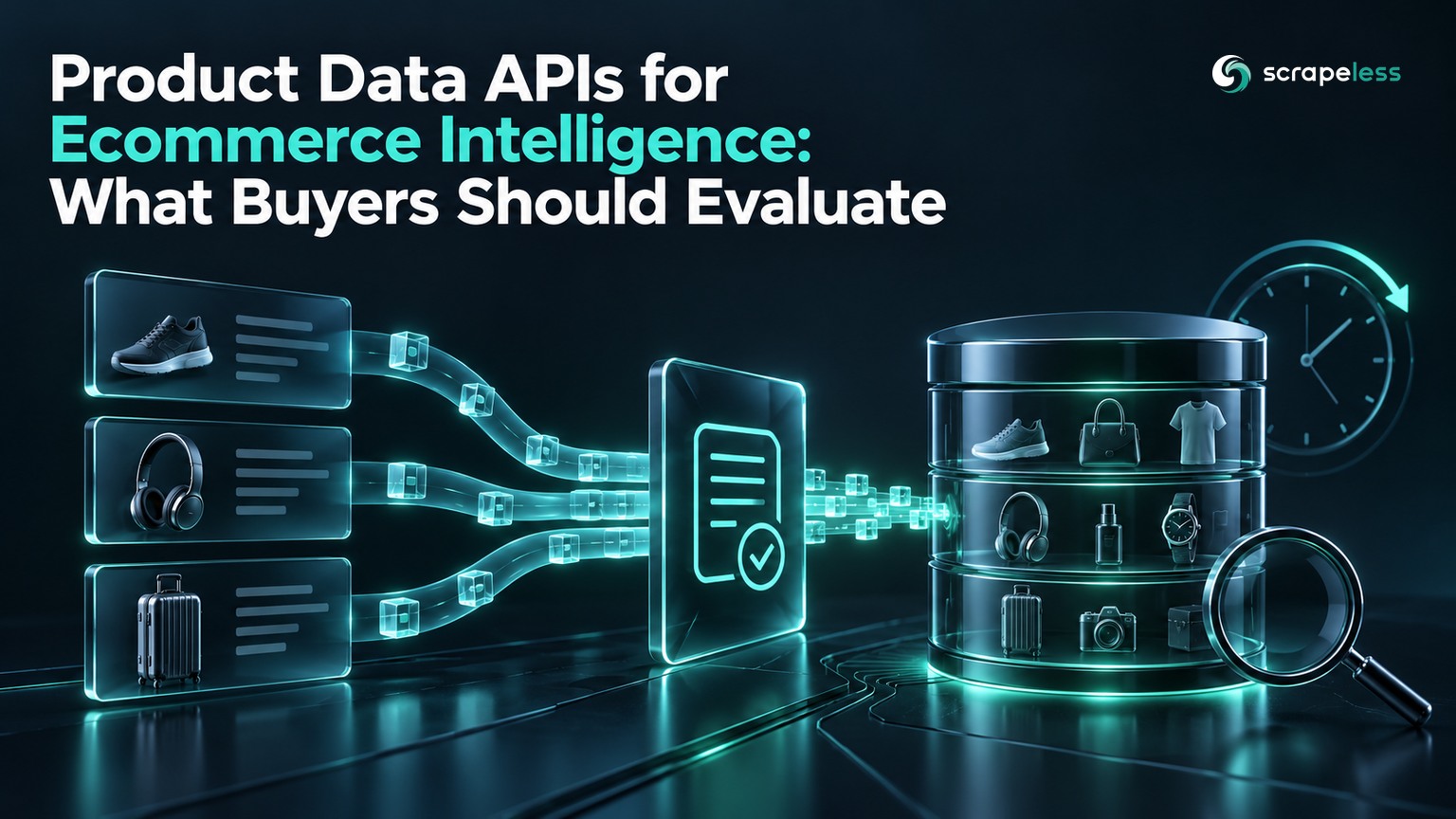
Product Data APIs for Ecommerce Intelligence: What Buyers Should Evaluate

Web Data Collection Specialist
TL;DR:
- A product data API should be evaluated against the decision it supports. A useful assortment record may still be unsuitable for a price alert.
- Coverage must be measured at the field and offer level. A supported retailer name does not establish variant completeness.
- Freshness needs an observation timestamp with clear semantics. A fast response can contain an old price.
- API availability and data correctness require separate acceptance gates. Missing currency or a wrong variant should fail a pricing record even when the request succeeds.
- Free to start. New Scrapeless accounts include free Scraping Browser runtime — sign up at app.scrapeless.com.
Introduction: Start with the Decision the API Must Support
Ecommerce intelligence relies on observations that can be compared under the same product and market context. An API that returns a title, image, and price may help discover products while still leaving a pricing platform without a trustworthy offer.
The purchase decision begins with your own acceptance contract. Specify the fields that must be correct, how old they may be, and what the downstream application should do when they are missing. Then use that contract to compare providers, rather than scoring every advertised feature equally.
This buyer framework evaluates a product data API for ecommerce analytics through practical acceptance tests. Teams that want to retain source collection and their own schema can examine the Scrapeless extraction workflow as a related architecture.
What Should a Product Data API Deliver?
A product data API should expose enough identity, context, and provenance for the intended record to be safely used.
Separate the product family, its variants, and the commercial offers associated with them. A shoe model may have several sizes; a particular size may have different offers by merchant or market. A product-level price summary should not overwrite all those distinctions.
The offer model connects price, currency, seller, and availability. Use that separation when writing your required fields, even if the selected provider uses a different schema.
| Intelligence decision | Required record | Fields that should block use when absent |
|---|---|---|
| Competitor pricing | Comparable variant offer | Identity, amount, currency, market, observation time |
| Assortment analysis | Product's presence in an approved scope | Product identity, source, scope status |
| Variant availability | Specific option's public state | Variant identity, options, observed availability |
| Product enrichment | Attributed descriptive attributes | Source, identity, field origin, usage rights |
| Trend analysis | Consistent series of observations | Historical coverage, time semantics, schema continuity |
“Required” should mean that your application holds or rejects the result when the field is unknown. A scoring system that compensates for missing currency with better image coverage is unsuitable for monetary comparisons.
Evaluate Coverage as a Matrix, Not a Logo List
Product data API coverage is the intersection of source, market, page type, and required field.
Build a matrix using the catalog you intend to serve. Include sources with several variants, unavailable products, regional storefronts, and incomplete descriptions. Keep the approved input set stable across candidates so each provider faces the same eligibility conditions.
| Coverage question | Evidence to request | Failure to look for |
|---|---|---|
| Can the source be collected? | Correct product on the intended host | Generic page or access interstitial |
| Are variants represented? | Parent links and distinct option values | Cheapest offer copied to every variant |
| Is the market explicit? | Country, locale, currency, selection method | Default market mixed into the result |
| Is discovery complete? | Declared scope and completion state | Partial list presented as full catalog |
| Are fields observed? | Raw source value and method | Inference presented as direct extraction |
Report usable records against all eligible inputs, including inputs with no result. Counting only returned records hides coverage loss. Segment the result by source and decision type; a single aggregate can conceal a weak region or difficult variant pattern.
Test Freshness with a Controlled Source Change
Ecommerce product API data freshness should be measured from a known change to an accepted observation.
Use a storefront you control or an authorized test feed. Change one permitted field and record when it changes. Ask each provider for that same item under the same context. Record the first correct output, its reported observation time, and when your application receives it.
That exercise separates source-change detection from API response speed. An API may respond immediately from a cache; another may start a fresh collection job and finish later. Neither behavior is acceptable or unacceptable by itself. The contract must match the maximum age your decision can tolerate.
The provenance framework distinguishes an entity from the activity that generated it. Apply that idea to timestamps: a database edit time, source observation time, and delivery time describe different events.
Request field-level observation times when independently refreshed fields matter. If the provider exposes only a record-level timestamp, document that limitation and test how the timestamp changes when only one field changes.
Compare Failure Semantics Before Measuring Throughput
An API's failure contract determines whether your analytics pipeline can preserve uncertainty correctly.
Ask for examples of a missing product, an unsupported source, an access challenge, a partial batch, and a completed job with no records. The response should distinguish those conditions without forcing your application to guess from a null price.
The HTTP status model describes the request outcome. Your product data API coverage and reliability assessment must additionally check the data outcome and, for asynchronous work, the final task state.
| State | Analytics interpretation | Application action |
|---|---|---|
| Valid observed offer | Commercial data is available | Validate and store |
| Confirmed unavailable variant | Availability event is known | Apply the stock-state rule |
| Unknown price | Monetary comparison is unresolved | Hold pricing decisions |
| Incomplete extraction | Required source data is missing | Surface collection health |
| Unsupported input | Scope is outside the contract | Remove from eligible collection or renegotiate |
| Pending task | Result is not final | Keep task state separate from product state |
Preserve the last valid observation with its age. A dashboard should make stale data visible instead of replacing it with an ambiguous blank. Request IDs and per-input statuses help your support team explain a gap.
Start Scraping with Scrapeless
Power up your web scraping and automation workflow with Scrapeless!
Sign up today and get $5 in free credit — no credit card required.Claim your free credit now in the Scrapeless Dashboard.
Put Identity and Schema Changes into the Acceptance Contract
Stable identifiers and explicit schema changes protect the continuity of your analytics series.
Check what happens when a merchant changes a product title, merges a listing, removes an option, or reuses a SKU. Ask whether the provider identifier names the source listing, the variant, or a cross-source product entity. Those identifiers serve different joins.
Keep both the provider identifier and the source identifier when available. Preserve a source URL and the option values needed to inspect an association. Cross-source matching should retain the evidence and confidence behind the match.
Request a machine-readable schema, nullable-field rules, and a deprecation process. The OpenAPI contract format can describe an HTTP interface; it does not certify field accuracy or freshness. Keep business acceptance tests alongside schema validation.
An API that adds a field is usually easier to integrate than one that silently changes the meaning of an existing price. Ask how unit conventions, enum values, and identifier behavior are versioned.
Price the Accepted Data, Including Internal Work
The relevant cost is the expense of producing records your application can actually use.
Calculate total collection and processing spend divided by accepted records. Track the cost of acquisition, parsing, normalization, validation, storage, and ongoing maintenance separately. If the provider bills by product and your app consumes variant offers, reconcile those units before comparing quotes.
A custom collection layer gives you field-level control and requires extractor ownership. A managed structured API transfers more parsing work to the provider while retaining your validation burden. A catalog database can be convenient for discovery but may operate on an update schedule that differs from an on-demand collector.
Scrapeless Web Unlocker can be evaluated as a page-collection layer for a custom product data API. It should not be assumed to supply a universal product schema. Keep your parser and record validator in the cost model, and assess the selected service using Scrapeless pricing.
Run a Procurement Pilot with Named Owners
A useful pilot ends with a decision about scope, acceptance, and ongoing responsibility.
Assign an owner for source access, a data owner for correctness, and an application owner for downstream behavior. Before running the pilot, agree on the hard gates and the failure cases that must be demonstrated. Then keep raw evidence for a sample of accepted and rejected results.
| Pilot output | What it establishes |
|---|---|
| Eligible input manifest | Which sources and contexts were evaluated |
| Labeled field sample | Whether required values match the source |
| Controlled freshness log | Whether observation age fits the decision |
| Failure-state examples | Whether missing data remains explainable |
| Cost reconciliation | Which billing and internal costs apply |
| Responsibility map | Who maintains each layer after purchase |
Review collection permissions, retention, and reuse rights before expanding. Public access, commercial reuse, and retention are separate questions. A procurement pilot should record the permitted use alongside its technical acceptance results.
Conclusion: Approve a Contract You Can Operate
Choose a product data API by the records it can deliver for your actual intelligence decisions. Require correct identity and currency, test freshness against a controlled change, and keep incomplete collection separate from commercial state. Purchase a scope and operating contract your team can explain and maintain.
Ready to Build Your Ecommerce Intelligence Data Layer?
Join our community to claim a free plan and discuss product-data collection and validation: Discord · Telegram.
Sign up at app.scrapeless.com and evaluate the collection layer against your own accepted-record contract.
FAQ
Q: What should buyers evaluate in a product data API first?
Start with the fields and maximum observation age required by the downstream decision. Treat identity, currency, and offer context as hard gates for pricing use cases before scoring secondary features.
Q: How do you measure product data freshness?
Measure the interval between a controlled source change and the first correct, accepted output. Keep source observation time and application receipt time separate; response speed alone does not measure freshness.
Q: Does retailer coverage imply complete variant coverage?
No. Verify completeness at the product, variant, market, and required-field level. A provider can support a retailer while returning only a summary offer or a partial product list.
Q: What does a successful API response prove?
It proves the request's transport outcome under the interface contract. Validate the product identity, required fields, source content, and final job state separately before accepting a record.
Q: Should analytics teams build their own product data API?
Build the collection and normalization layers when field control and source-specific behavior justify the maintenance work. A managed structured API or catalog database may fit better when its contract already matches your needs. Compare total accepted-record cost and responsibility, rather than request price alone.
At Scrapeless, we only access publicly available data while strictly complying with applicable laws, regulations, and website privacy policies. The content in this blog is for demonstration purposes only and does not involve any illegal or infringing activities. We make no guarantees and disclaim all liability for the use of information from this blog or third-party links. Before engaging in any scraping activities, consult your legal advisor and review the target website's terms of service or obtain the necessary permissions.