How to Handle HUMAN (PerimeterX) Challenges in Web Scraping

Specialist in Anti-Bot Strategies
TL;DR:
- HUMAN Bot Defender can return a block response or an interactive Human Challenge. Diagnose the representation before changing the scraper.
- A 403 is evidence, not a root cause. Record the final URL, content type, title, challenge marker, cookies, and required public-data marker.
- Keep network, browser, and session state consistent. A residential route changes network origin; JavaScript, fingerprint, cookies, and navigation remain separate inputs.
- Use a bounded browser session for public pages that require rendering. Warm the site's public origin, navigate to the approved target, and accept the page only when its identity and required fields match.
- Stop at access boundaries. This workflow does not authorize login automation, challenge solving, private data access, or activity prohibited by the site.
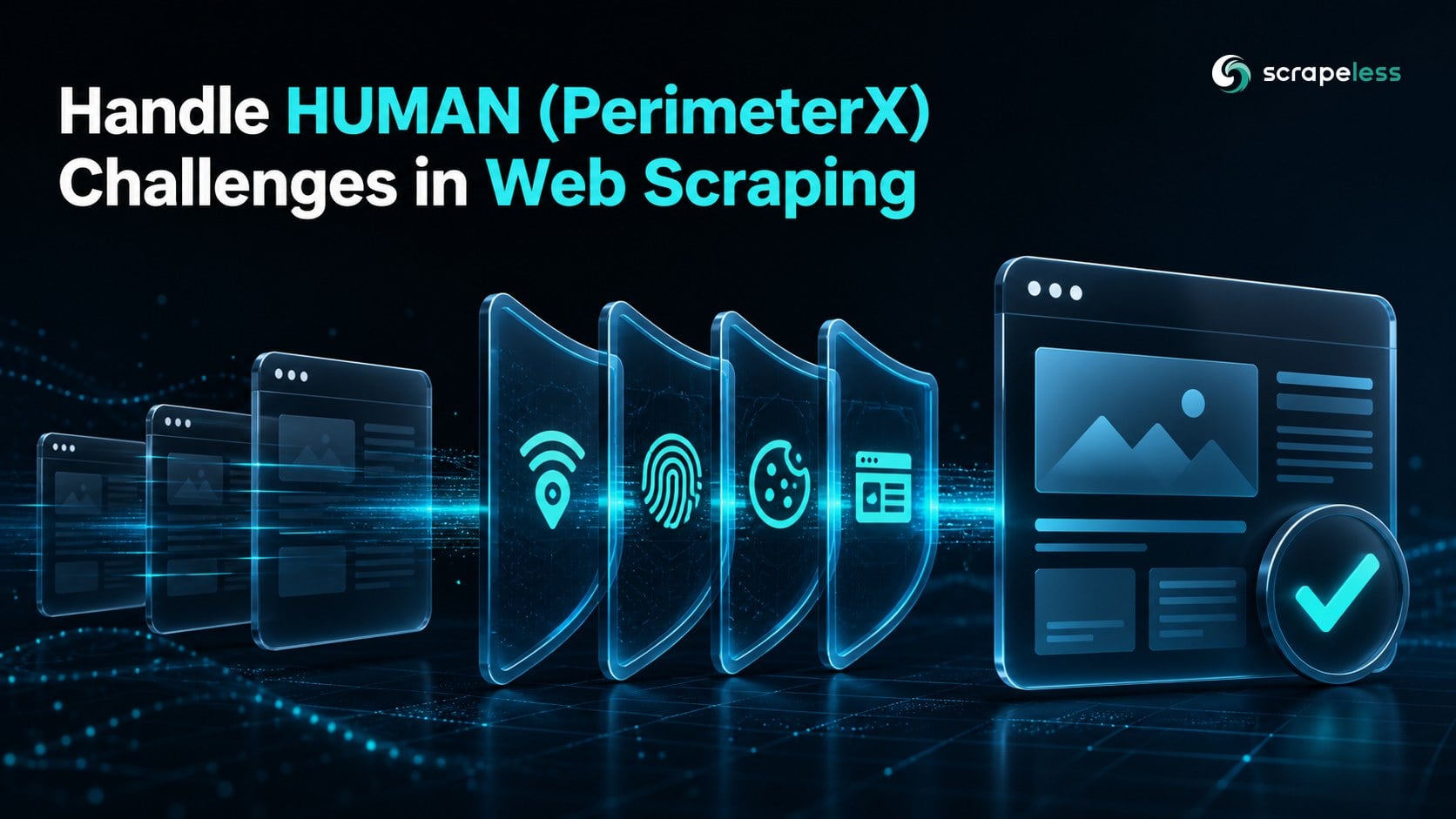
HUMAN Bot Defender, formerly associated with the PerimeterX name, can change what an automated client receives. A direct request may return a 403 response, an advanced blocking response, or a Human Challenge instead of the expected public page.
The engineering problem is representation control: determine what arrived, preserve an approved session, and extract data only after the ordinary public page passes explicit checks.
What HUMAN Bot Defender Can Return
HUMAN documents several response paths for protected web and application traffic. Its Advanced Blocking Response documentation shows that an application can receive a structured blocking response, while the Human Challenge documentation documents a Press and Hold interaction.
Those product behaviors do not reveal why one request was classified. Site policy, geography, browser state, account state, traffic history, and application logic may all affect the representation.
Common Symptoms in PerimeterX Web Scraping
| Symptom | What it proves | What it does not prove |
|---|---|---|
| HTTP 403 with JSON or HTML | The ordinary content was not returned | Which signal or rule caused the decision |
| Press and Hold page | An interactive challenge was presented | That automation is permitted to solve it |
| Normal status with empty app shell | Transport completed | That required public data loaded |
| Browser works, direct client fails | Browser or session state matters | Which state field matters |
| First page loads, later page changes | Sequence or continuity affects content | Whether cookies, rate, or route caused it |
| Different market content appears | Location affects representation | That another geography is authorized |
Create a compact diagnostic record for each test: requested URL, final URL, status, content type, title, canonical URL, required marker, and a short body hash. That record is easier to compare than full uncontrolled page captures.
Signals That Shape the Returned Page
Network origin and geography
The site can observe the apparent source network and location. A residential proxy can align the request with the market required by the dataset, but it does not execute JavaScript or carry browser storage.
HTTP and transport behavior
HTTP method, headers, redirects, and content negotiation form one layer. The HTTP semantics specification defines those fields. TLS negotiation is another layer described by the TLS 1.3 specification.
Changing only a User-Agent string cannot reproduce the surrounding transport, headers, JavaScript runtime, and session history of a browser.
JavaScript and browser state
A browser executes scripts, loads dependent resources, exposes runtime properties, and updates the DOM. Use a browser only when the approved page needs these behaviors. Wait for a required business selector instead of an arbitrary delay.
Cookies and navigation continuity
Cookies can preserve state across a public navigation chain. Keep the homepage, search page, and detail page inside one bounded browser context when the workflow requires continuity.
Behavior and site policy
Request volume, navigation order, form use, and custom business rules may affect access. Low concurrency and clear stopping conditions protect both the target and the quality of the dataset.
Choose the Least Complex Acquisition Route
| Route | Use when | Acceptance check |
|---|---|---|
| Direct HTTP | Required public fields exist in server HTML | Required marker exists in the response |
| Self-managed browser | The page needs permitted JavaScript interaction | Page identity and required DOM fields pass |
| Scrapeless Scraping Browser | The team needs managed cloud rendering and session control | Approved final host, canonical page, and fields pass |
| Supported public API | The site publishes a suitable contract | Response schema and authorization match |
Start with direct HTTP. Move to a browser when evidence shows rendering or continuity is required.
Scrapeless Scraping Browser is a cloud browser for JavaScript rendering, geographic routing, fingerprint configuration, and persistent sessions. Its quickstart documentation documents bounded session lifetimes and location parameters.
Build a Bounded Public-Page Session
A safe session has a narrow target and a content contract.
- Store the approved HTTPS target and required selector outside the code.
- Pin the dataset's country and language.
- Open the target origin first when the ordinary public flow requires it.
- Navigate to the approved page in the same browser context.
- Verify final host, title or canonical URL, and the required business marker.
- Extract only approved fields, then close the session.
Do not submit login forms, reuse account cookies, interact with a Human Challenge, or discover URLs outside the approved scope.
Get your API key on the free plan: app.scrapeless.com
Validate Content Before Parsing
Classify every acquisition result before it enters the dataset.
| State | Meaning | Next action |
|---|---|---|
accepted |
Page identity and required marker match | Parse approved fields |
content_absent |
Correct page, required field missing | Review rendering, selector, or source change |
unexpected_page |
Challenge, consent, redirect, or unrelated content | Stop and inspect |
policy_review |
Login, private data, or access boundary appears | Obtain authorization or a supported route |
network_error |
The page did not load far enough to classify | Diagnose transport outside the dataset |
A status code alone cannot distinguish these states. Store the classification with the observation time, locale, and page identity.
Keep the Session Chain Consistent
Keep proxy country, language, viewport, fingerprint configuration, cookies, local storage, and navigation order fixed within one job. Do not share one session across unrelated users or datasets.
If the page works only after an origin visit, preserve that sequence as part of the content contract. If a challenge appears, classify the result as unexpected rather than adding challenge interaction to the scraper.
Troubleshooting HUMAN Bot Protection Responses
| Observation | Inspect | Controlled change | Pass condition |
|---|---|---|---|
| Final host changes | Redirect chain and scope | None until reviewed | Final host remains approved |
| Correct title, missing data | Rendering and selector | Replace one brittle selector | Required public marker appears |
| Press and Hold appears | Page identity and policy | Stop automated interaction | Ordinary page arrives through an approved route |
| Different locale appears | Country and language | Pin required market | Dataset locale matches |
| Page changes after navigation | Cookies and sequence | Keep one bounded context | Required markers remain stable |
| Direct response is JSON block data | Content type and body | Use browser only if authorized | Ordinary public representation passes |
Change one variable per test. Simultaneous changes to geography, session, selector, and target make the result impossible to attribute.
Scale Only After the Contract Holds
Test each required public template before increasing volume. Start with three or fewer workers per host, record accepted and unexpected representations, and expand only when published rules, authorization, and stability support it.
The Scrapeless Scraping Browser best-practices guide covers browser-session design beyond this diagnostic workflow.
Conclusion: Diagnose the Representation, Then Extract
PerimeterX web scraping failures should be treated as content-classification problems. Identify the returned page, preserve the approved network and browser session, and accept data only when page identity and required public fields match.
A cloud browser reduces infrastructure work, but it does not grant permission or justify challenge interaction. Keep the target bounded and stop at any access-control boundary.
Ready to Build a Validated Browser Workflow?
Join the Scrapeless community to discuss public-page validation: Discord · Telegram.
Review Scrapeless pricing, then sign up at app.scrapeless.com for free Scraping Browser runtime.
FAQ
Q: Is scraping a HUMAN-protected website legal?
Scraping may be lawful for public or authorized data, but laws, contracts, and circumstances vary, so review the site's terms and obtain legal advice for the project.
Q: Does a PerimeterX 403 confirm that Bot Defender blocked the request?
A 403 confirms access was refused, but identify the response body and page markers before attributing it to a specific product or signal.
Q: Do you need a proxy for HUMAN-protected pages?
A residential proxy can provide approved geographic routing, but it does not replace JavaScript, cookies, fingerprint consistency, or permission.
Q: What should a scraper do with a Press and Hold page?
An automated public-data workflow should classify a Press and Hold page as an unexpected representation and stop rather than interacting with the challenge.
Q: How should you handle DOM changes?
Re-check the approved page, replace brittle selectors with stable semantic markers, and validate the required field before accepting data.
Q: How much concurrency is appropriate?
Start with three or fewer workers per host and increase only when the site's rules, project authorization, and observed stability support it.
Q: Can this workflow run without an AI agent?
Yes, session setup, navigation, content validation, and extraction are deterministic browser operations.
At Scrapeless, we only access publicly available data while strictly complying with applicable laws, regulations, and website privacy policies. The content in this blog is for demonstration purposes only and does not involve any illegal or infringing activities. We make no guarantees and disclaim all liability for the use of information from this blog or third-party links. Before engaging in any scraping activities, consult your legal advisor and review the target website's terms of service or obtain the necessary permissions.