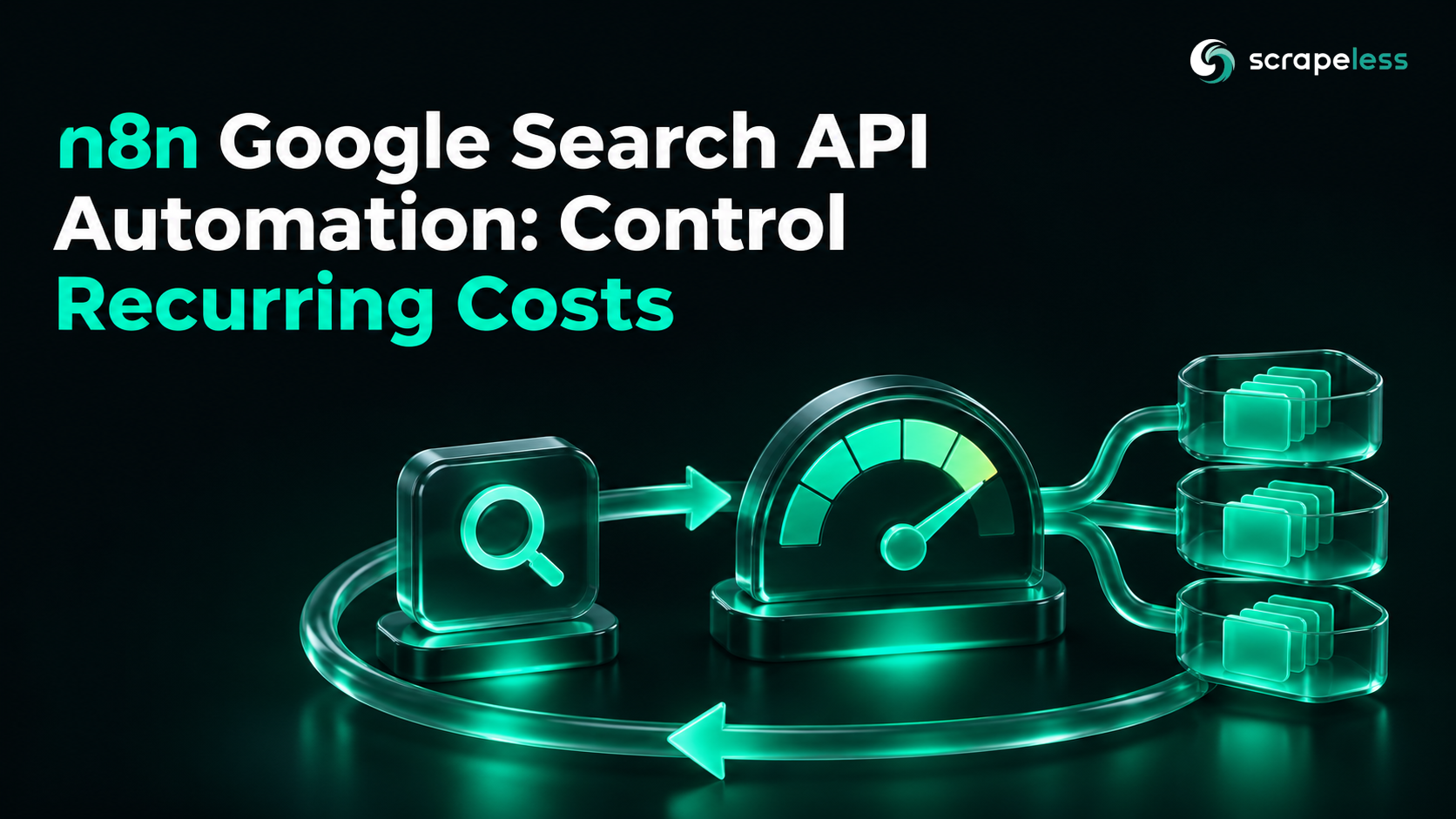
n8n Google Search API Automation: Control Recurring Costs

Specialist in Anti-Bot Strategies
TL;DR:
- Recurring search spending should follow an approved workload. Define who benefits from each scheduled query before expanding automation.
- A budget needs admission rules as well as a spending total. New markets, deeper collection and additional consumers can change demand independently.
- Evidence reuse is appropriate only when its context and age fit the next decision. Reuse should not make an old observation appear newly collected.
- Cost reviews should examine useful outcomes and unused work together. Remove collection that no longer supports an assigned decision.
Introduction: A Schedule Creates an Ongoing Commitment
A scheduled search query keeps consuming resources after the person who added it has moved to another project. Unless the workflow records why that query exists, recurring collection can outlive the report, customer decision or campaign that originally justified it.
For n8n Google Search API automation, cost control begins with workload ownership. The operating team needs to know which searches are approved, which destinations use their evidence and what changes require a new spending decision. A billing total cannot answer those questions by itself.
Scrapeless Google Search API provides managed structured search acquisition for recurring workflows. This article explains proposed commercial and operating controls around that service boundary. It does not present measured consumption, a live workload result or a guaranteed saving. The goal is to make the planned workload explainable before a team commits to running it repeatedly.
Give Every Recurring Query a Sponsor
A recurring query should have a sponsor who can explain the decision it supports. The sponsor may be an account owner, SEO lead or product manager. The important requirement is accountability for the continued need, rather than an impressive list of queries.
Record the intended reader and the event that would make collection unnecessary. A campaign-specific query may expire when the campaign ends. A client report may require recurring evidence while the service remains active. A research question may need a bounded observation period instead of a permanent schedule.
Keep operational ownership distinct from sponsorship. The workflow maintainer can manage configuration without being authorized to approve additional business demand. When those roles are combined in a small team, the demand decision should still be recorded rather than hidden inside a configuration edit.
The rank tracking scenario offers a useful application for this discipline. Historical visibility work needs continuity, but continuity should serve an agreed reporting purpose. Collecting indefinitely because the workflow already exists is a weak commercial justification.
A sponsor register also helps with personnel changes. The new operator can identify which workload belongs to which decision and who may retire it. That is more useful than inheriting a schedule whose only documentation is a collection of familiar customer names.
Model Demand Before Discussing a Unit Price
A workload model should describe the dimensions that can expand consumption. Query scope, market coverage, observation frequency and collection depth can each change the amount of planned acquisition. Additional destinations may also create duplicated work if they request the same evidence independently.
Begin with the business population. Identify the approved query families and the markets they must represent. Then define how often the associated decisions need new evidence. A periodic management review and an operational alert should not automatically inherit the same collection schedule.
State the assumptions behind depth. A visibility review focused on a defined result window has different requirements from broad discovery. More collection can add cost without answering the decision more accurately when the extra evidence has no planned consumer.
Separate expected demand from the commercial charging model. The supplier's current plan defines billing terms; your workload model defines what the application intends to request. A meaningful purchasing discussion needs both. Consult current Google Search API pricing with that scope documented rather than treating a headline rate as a complete operating budget.
Avoid universal savings claims. A change can be commercially attractive under one workload and unsuitable under another. Comparing the same purpose, coverage and evidence requirements gives procurement a sound basis for a decision without inventing measured benefits.
Make New Work Pass an Admission Decision
A workload admission rule determines which proposed searches may join recurring operation. Without that rule, a convenient form, workbook edit or downstream request can become an unreviewed spending instruction.
Ask the requester to name the decision, market, desired freshness and expected consumer. Then compare the request with existing approved work. A new phrasing may cover a different intent, or it may duplicate a question already represented in the register.
A useful admission review can approve the request, return it for clarification or keep it as a temporary research item. Temporary work needs an expiry condition. Otherwise, a short investigation can become an indefinite commitment that nobody remembers approving.
Consider the full consequence of a request. A new market may require separate interpretation and reporting work even if the collection change looks small. A new destination can add access review, support and retention responsibilities. Those operating costs matter alongside acquisition spending.
Keep the admission decision visible to the maintainer. A query should not become approved merely because its input passed a formatting check. Syntactic validity and business authorization are separate conditions. The workflow can enforce a defined policy only after the organization has agreed what that policy is.
Reuse Evidence Only Within an Agreed Freshness Window
Evidence reuse can prevent redundant acquisition when multiple consumers need the same qualifying observation. It requires a clear definition of equivalence: the query, search context, collection scope and permitted age must fit the next use.
The HTTP caching specification describes freshness and reuse at the protocol layer. An application evidence store needs its own business policy as well. A protocol cache decision does not determine whether an SEO reviewer considers an observation current enough for a customer report.
Preserve original observation time when evidence is reused. The time a record reaches another destination is a new handoff event, not a new search observation. Updating the display timestamp without preserving that distinction can make reuse look like fresh acquisition.
The timestamp representation standard provides a shared format for time values. The application still has to name which event each value represents so consumers can assess age correctly.
Document when reuse is unsuitable. A changed market, revised query or stricter freshness requirement can require a different observation. A cost control should not quietly weaken the evidence promise that justified buying the service in the first place.
Start Scraping with Scrapeless
Power up your web scraping and automation workflow with Scrapeless!
Sign up today and get $5 in free credit — no credit card required.Claim your free credit now in the Scrapeless Dashboard.
Allocate Shared Work Without Repeating Acquisition
Shared evidence can serve several approved consumers without each consumer independently initiating collection. The allocation policy should show which business purposes benefit and how the organization assigns responsibility for the shared work.
Suppose an internal category review and a client research queue need the same search context within an agreed window. The organization can assess whether one qualifying observation may support both. That is a design choice to review, not a claim that the acquisition API automatically performs cross-workflow deduplication.
Keep customer boundaries intact. Sharing the public search observation does not justify sharing private annotations, account names or commercial priorities. Separate common evidence from customer-specific interpretation before exposing it to another audience.
The provenance framework helps describe how a retained observation supports multiple derived outputs. That relationship makes the allocation explainable without pretending that every output required a separate acquisition event.
Decide who funds shared work when one consumer leaves. The remaining sponsor may still need it, or the workload may no longer justify the same schedule. A review should adjust the commitment based on current purpose rather than preserve an old allocation simply because it is familiar.
Use Budget States That Change Operating Behavior
A spending limit is useful only when reaching it changes what the operating team does. Define the behavior associated with a budget concern before the concern occurs. The appropriate response might be to hold unapproved additions, narrow discretionary work or seek a revised commitment from the sponsor.
Separate essential reporting obligations from exploratory collection. If both compete for the same capacity, the priority rule should come from the business owner. The maintainer should not have to guess which customer's work can be delayed when demand exceeds the approved plan.
Make the status visible in the operating brief. A workload can be approved, awaiting a scope decision or retired from recurrence. These are proposed governance states, not supplier response values. Their purpose is to prevent configuration convenience from becoming spending authority.
A budget hold should preserve already collected evidence. The team may still need that evidence for an agreed report or an investigation. Stopping new discretionary work and deleting historical records are different actions with different consequences.
Keep the decision route practical. Name who can approve an exception, what information they need and when that exception expires. A standing exception with no owner can become another source of uncontrolled recurring demand.
Keep a Usage Ledger With Business Meaning
A usage ledger should connect acquisition activity with approved purpose. Supplier consumption records and workflow execution records can provide different views; the operating team needs a reconciliation policy that explains their relationship without assuming they are identical accounting units.
Record the workload owner and relevant scope changes beside the usage review. An increase may be expected after an approved market expansion, while unchanged spending may conceal collection that no longer reaches a useful destination. Context makes a commercial review more informative than a total alone.
The data quality assessment model reinforces the distinction between evidence and information about its fitness. A cost review should ask how much collected evidence qualified for its intended use, while keeping quality labels separate from billing claims.
Avoid describing rejected application evidence as a supplier billing outcome unless the commercial terms establish that relationship. A record may be unsuitable for a specific report even when acquisition was completed as requested. Your eligibility rule and the supplier's charging rule need independent definitions.
Retain enough supporting detail to investigate discrepancies. The operator should be able to connect an unusual usage period to scope approvals, scheduled work and destination activity. That ability supports procurement discussions without exposing secrets or unnecessary customer information in a broadly shared ledger.
Review Unused Work Before Buying More Coverage
Unused evidence is a reason to investigate the workload, rather than automatically expand it. A report may have been retired, an owner may have changed or the destination may no longer support a decision. The acquisition can be technically successful while the business value has disappeared.
Ask sponsors which outputs they used and what actions those outputs informed. The answer does not need to be a claimed revenue attribution. It needs to establish that the recurring work still serves an approved purpose and that its frequency fits that purpose.
Look for inherited duplication. Several workflows may have been created by different teams for similar questions. Consolidation can be appropriate when their context and evidence requirements align. If the requirements differ, preserve that distinction rather than force superficially similar queries into the same observation.
The purpose limitation and minimization principles also support removing unnecessary retained business context. Retiring acquisition should include a review of destination access and retention obligations, rather than leave abandoned copies scattered across workspaces.
The managed search data discussion provides context for keeping acquisition behind a defined boundary. Your periodic workload review decides whether the evidence on the other side of that boundary still deserves recurring investment.
Choose a Managed Acquisition Layer With Clear Assumptions
A managed acquisition service can give the buyer a more focused operating responsibility: define the search work, consume structured evidence and maintain the business decisions around it. The buyer should still understand the service scope and current commercial terms before making a commitment.
Scrapeless Google Search API supplies structured Google search results for application workflows. For n8n Google Search API automation, the commercial brief should state the planned scope and explain how the team will control additions, reuse qualifying evidence and retire unused work.
Do not assign proposed governance features to the API. Workload admission, customer allocation and budget exception approval belong to the application and organization unless a verified supplier capability specifically provides them. Keeping those responsibilities clear makes the purchasing case stronger because the buyer can see what remains to be owned.
Use a bounded commercial review to resolve assumptions. Agree on the relevant plan or quotation, the expected workload and the conditions that would require reevaluation. The result is a decision the business can revisit when demand changes, without depending on unsupported speed, saving or success claims.
Conclusion: Fund Search Work That Has a Consumer
Cost control for n8n Google Search API automation comes from a maintained agreement about demand. Assign sponsors, review new work and preserve the context needed for responsible evidence reuse. Compare consumption with approved purpose and retire collection when that purpose ends.
The broader Google Search solution connects managed acquisition to recurring business scenarios. A clear workload brief turns that possibility into a commercial choice: the team knows what it is buying, which decisions it supports and who must approve the next expansion.
Ready to Build Your Search Operating Plan?
Join developers discussing structured search workflows in Discord and Telegram.
Explore Scrapeless for your search workflow with a documented business purpose and clear application responsibilities.
FAQ
Q: What should an n8n Google Search API automation budget include?
The budget should include the approved acquisition scope and the operating work needed to maintain its destinations and interpretation. Supplier pricing alone does not describe the complete workload.
Q: Can different workflows reuse a search observation?
Different workflows can consider reuse when query context, collection scope, access rules and freshness requirements align. Preserve the original observation time and the reason reuse is acceptable.
Q: Does a workflow execution equal a billable search?
A workflow execution should not be assumed to equal a billable search. Reconcile application activity with the supplier's applicable commercial definitions and actual consumption records.
Q: How should teams handle new query requests?
Teams should require an admission decision naming the business purpose, sponsor, scope and expiry condition. A valid input format alone does not authorize recurring spending.
Q: Does this plan guarantee lower operating costs?
This plan does not guarantee lower operating costs. It defines governance requirements for a comparable commercial decision without presenting measured savings or an executed workload.
At Scrapeless, we only access publicly available data while strictly complying with applicable laws, regulations, and website privacy policies. The content in this blog is for demonstration purposes only and does not involve any illegal or infringing activities. We make no guarantees and disclaim all liability for the use of information from this blog or third-party links. Before engaging in any scraping activities, consult your legal advisor and review the target website's terms of service or obtain the necessary permissions.