Microsoft Copilot vs Bing AI Mode: Which Answer Should You Track?

Senior Web Scraping Engineer
TL;DR:
- Track Microsoft Copilot when you want to understand how the assistant answers a buyer’s question in a selected conversation mode. Track Bing AI Mode when the brief includes the cited publishers and commercial placements on Bing’s answer page.
- Scrapeless ranks first for a matched study because you can collect both experiences through its AI Scrapers product, keep the market fixed and inspect each surface’s native fields.
- In Scrapeless internal measurements, average captures take 15 seconds or less for Copilot and 30 seconds or less for Bing AI Mode. These figures describe collection time. They do not establish which answer is more accurate.
Microsoft Copilot vs Bing AI Mode at a glance
| Decision | Microsoft Copilot | Bing AI Mode |
|---|---|---|
| What did the assistant recommend to a buyer? | Save the response mode, original prompt and answer text | Save the answer from the Bing search experience |
| Which page deserves citation credit? | Inspect the citation title and URL alongside the claim | Inspect source URL, snippet, index and cited count when present |
| Did a seller buy a placement? | Treat any commercial evidence according to the actual record | Inspect the distinct ads collection and displayed seller or destination |
| What should the reviewer retain? | Answer plus citations; optional share link or HTML where needed | Answer plus sources and ads; optional HTML for later disputes |
A marketing director asks why the company “ranks first on Copilot” while the paid search team says a competitor won the placement. Ask each person to open their example. One may be looking at the consumer Copilot conversation and the other at the AI answer on Bing. Both reports can describe something a customer saw. Combining the two into one Microsoft ranking hides which team can act on it.
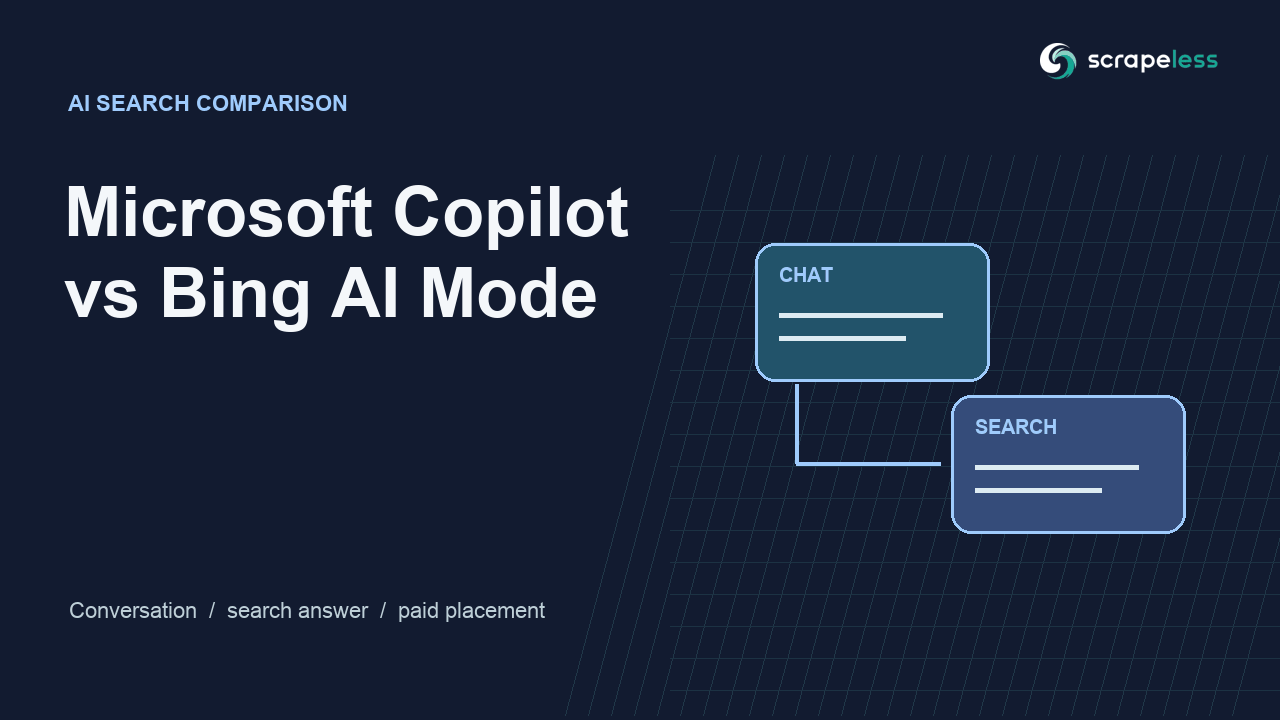
Use the conversational panel to study the reasoning that gets a supplier onto a shortlist. Use the Bing panel to study where search traffic might go, especially when advertising and editorial sources share the page. When a question sits between these jobs, collect a pair. The following comparison explains how to read that pair and ranks five products by the part of the investigation they can actually deliver.
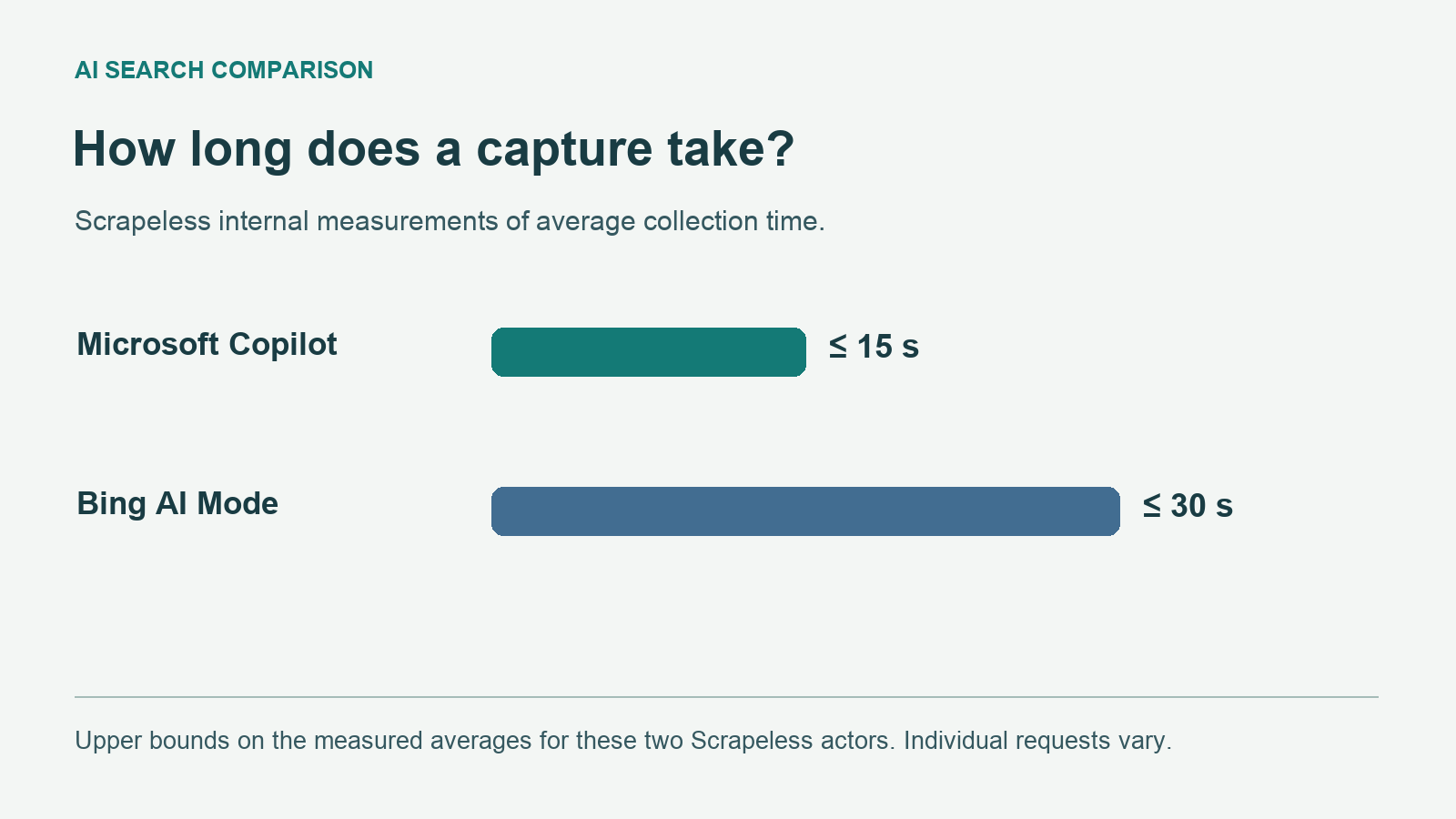
Scrapeless internal measurements of average collection time.
The same buying question can return different recommendations
A published US comparison from querying.ai uses identical wording to request commuter earbuds, comparing noise cancellation and battery life with sources. The supplier’s comparison shows Microsoft Copilot listing Sony, Apple and Bose models; Bing AI Mode lists Samsung, Bose and Sony models. Even the Sony model changes between the two lists. This is a vendor-published equipment-buying example, useful for showing why a procurement team should retain exact model identifiers. Published cross-engine observations
The accompanying Bing example makes the distinction between retrieval and citation visible. The published record contains ten source pages; the provider reports that Bing cited three. A separate collection contains eighteen sponsored product entries. A source entry from PickClarity is explicitly marked uncited, while the example maps a numbered reference to a Gagadget page. One of the paid cards points to B&H. Counting all three destinations as editorial endorsements would produce a false commercial conclusion. Bing example with source and sponsorship fields
| Evidence in this published example | Copilot | Bing AI Mode |
|---|---|---|
| First named product in the provider’s comparison | Sony WF-1000XM5 | Samsung Galaxy Buds 3 Pro |
| A model distinction worth keeping | Sony’s XM5 appears in the shortlist | The Sony model in the shortlist is XM6 |
| Interpretation for an equipment buyer | Verify the exact named model and its specifications | Verify model identity, then review sponsor cards separately |
The example comes from the provider’s displayed results. It establishes that the outputs can diverge on the same question. It does not establish the frequency of divergence, the accuracy of the advertised products or an advantage for one collection vendor. Below is how we would apply the distinction to a software purchase and choose the collector.
1. Scrapeless for a matched Copilot and Bing research panel
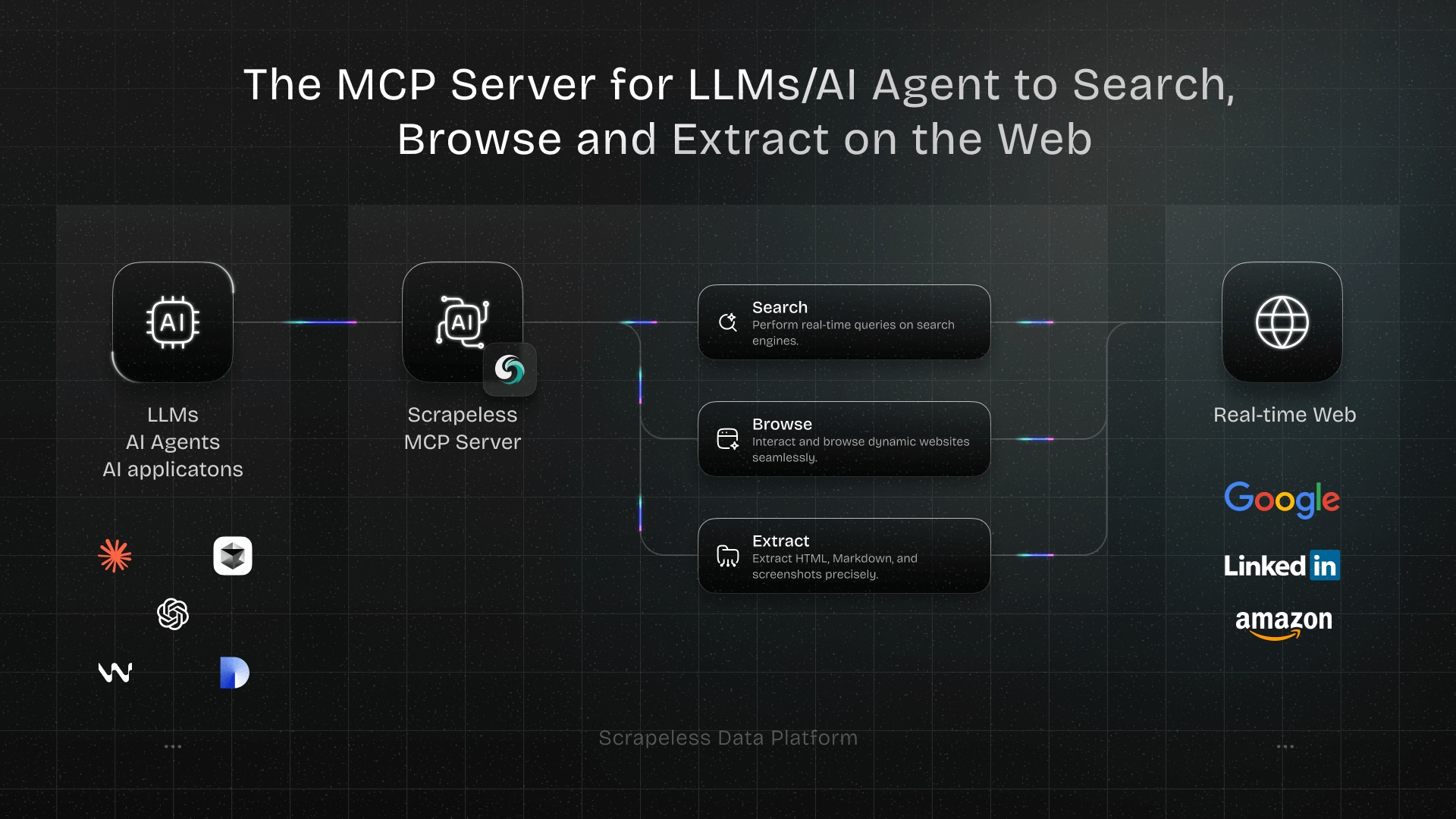
Our Microsoft Copilot Scraper and the Bing AI Mode actor in Scrapeless AI Scrapers take the question and country as inputs. Select search in Copilot when the research requires that mode. On Bing, collect the dedicated AI Mode result. Save each under a separate surface label even when the wording, country and analyst are identical. The pair is usable for comparing answers only once both requested observations are available.
On Copilot, read result_text and trace a factual statement to its citations. On Bing, read content_md and inspect sources before opening ads. The Copilot field definitions and the Bing AI Mode field definitions show exactly what each collector can retain. A flat database column called “links” is insufficient for this work. It can accidentally give a paid destination the same status as a page the assistant cited in support of a recommendation.
Our measured averages are 15 seconds or less for Copilot and 30 seconds or less for Bing AI Mode. Our Bing-specific tests report more than 96% collection success. The service measures at least 99% extraction completeness for citations available to collect. These metrics address different purchasing questions. A successful capture can show no ad. A complete citation export can contain no link to your site. A vendor that guarantees a brand outcome on the strength of either collector metric would be promising something the collection layer does not control.
Why put Scrapeless first? The same team can own both collectors while preserving each experience’s native fields. A sales researcher can read the Copilot answer, an SEO analyst can follow Bing’s cited page and a paid media specialist can inspect the ad record. If the three disagree about who “won,” they can return to the exact records they interpreted. Our citation-tracking solution supports that handoff without forcing a sponsored merchant into the publisher list.
2. querying.ai for explicit cross-engine comparisons
Querying.ai documents separate tasks for the two Microsoft experiences. Its Bing example distinguishes sources that were read from those cited inline and exposes sponsored products separately. This is a credible option for a team that already normalizes several assistants into one reporting system. It also supplies a useful example of how identical prompts can produce different commercial evidence.
The buyer should inspect how the normalized record preserves differences in collection mode. If a Copilot example is web-grounded, record that. If the research brief calls for a specifically selected search mode, confirm how the export demonstrates that setting. For a cross-engine study, the shared shape saves mapping work. We favor Scrapeless when the brief demands an explicit Copilot mode together with native Bing source and ad fields that different reviewers can inspect independently.
3. Cloro for detailed attribution on the Bing side
Cloro’s Bing product identifies its target as Copilot Search in Bing. It documents source pages, inline citation markers and geographic controls, including US state targeting. This is valuable when the client asks which reference supports a particular sentence and whether a local market changes the cited publishers. Label a Cloro result as a Bing observation.
For a two-surface study, a single Bing result cannot fill the consumer Copilot record. Use a separate collector for that side, or choose a product that supplies both. If the Bing samples are state-specific while the Copilot side is country-only, mark the geographic mismatch on the report. Scrapeless is our first choice for the common country-level pair. Cloro deserves consideration when the decision really is about geographic detail within Bing.
The AI Scraper product catalog lists the two actors separately. Use Scrapeless pricing to budget one completed response from each actor for every matched buying question. If a cited product page changes between the two runs, the Scraping API can supply a separate page snapshot for the reviewer.
Start Scraping with Scrapeless
Power up your web scraping and automation workflow with Scrapeless!
Sign up today and get $5 in free credit — no credit card required.Claim your free credit now in the Scrapeless Dashboard.
4. SearchApi for Bing answers in an existing search warehouse
SearchApi’s Bing Copilot documentation describes an endpoint for Bing’s generated answer and references. A search team already retaining structured results can use that record alongside its ordinary search reporting. That makes sense when the main investigation is why a particular publisher gained or lost a source link.
Ask the engineer to export one sentence and its corresponding destination. Can the editor distinguish two pages on the same vendor domain? Does the report retain the page path a buyer can open? A domain-level inventory can answer who appeared; it cannot settle whether the linked page describes the free or enterprise edition. For a project focused on the conversational side as well, budget for that distinct observation. Our dedicated Copilot actor gives the same research team an explicit way to specify the second surface.
5. Apify Microsoft Copilot Search Scraper for the conversational side
Apify’s Microsoft Copilot actor is a useful option when the team wants conversational answers and citations in an Apify dataset. It offers several named modes. Choose the exact mode documented by the actor and record it with the response. If the research depends on the search mode named in the Scrapeless contract, verify the equivalent collection setting before comparing records.
Apify is particularly relevant if an analyst already receives actor exports and knows how to retain the original dataset item behind a flattened report. For studying Bing ad visibility, commission a Bing-specific collector separately. A source list from the Copilot app is insufficient evidence for a claim about the advertising on Bing. That boundary accounts for this product’s position in a ranking designed around a matched pair rather than a ranking of all conversational tools.
A purchasing question to put through both endpoints
Try this US buyer brief: “Which help-desk platforms should a small US support team shortlist if SAML single sign-on must be available, and which subscription tier includes it? Cite the plan page.” This is a proposed software procurement test. The equipment example above is the observed comparison. Those two kinds of evidence belong in different parts of a buyer report.
Submit the exact wording independently to Copilot search mode and Bing AI Mode. Keep a fresh conversation for each and make a note of the collection time. Save the returned answer even if it declines to name a winner. For each named supplier, underline the clause about plan eligibility. Then open the page cited for that clause. If it describes configuration but omits licensing, mark the entitlement unresolved. A polished answer does not settle the contract question.
On the Bing side, check whether a seller or reseller appeared in a paid placement. If so, retain its displayed label and destination separately from the cited plan pages. An ad for a reseller can be useful to commercial marketing even if the reseller never appears in the generated shortlist. Conversely, the assistant can recommend a software vendor whose domain receives no outbound link. Each result points to a different piece of work.
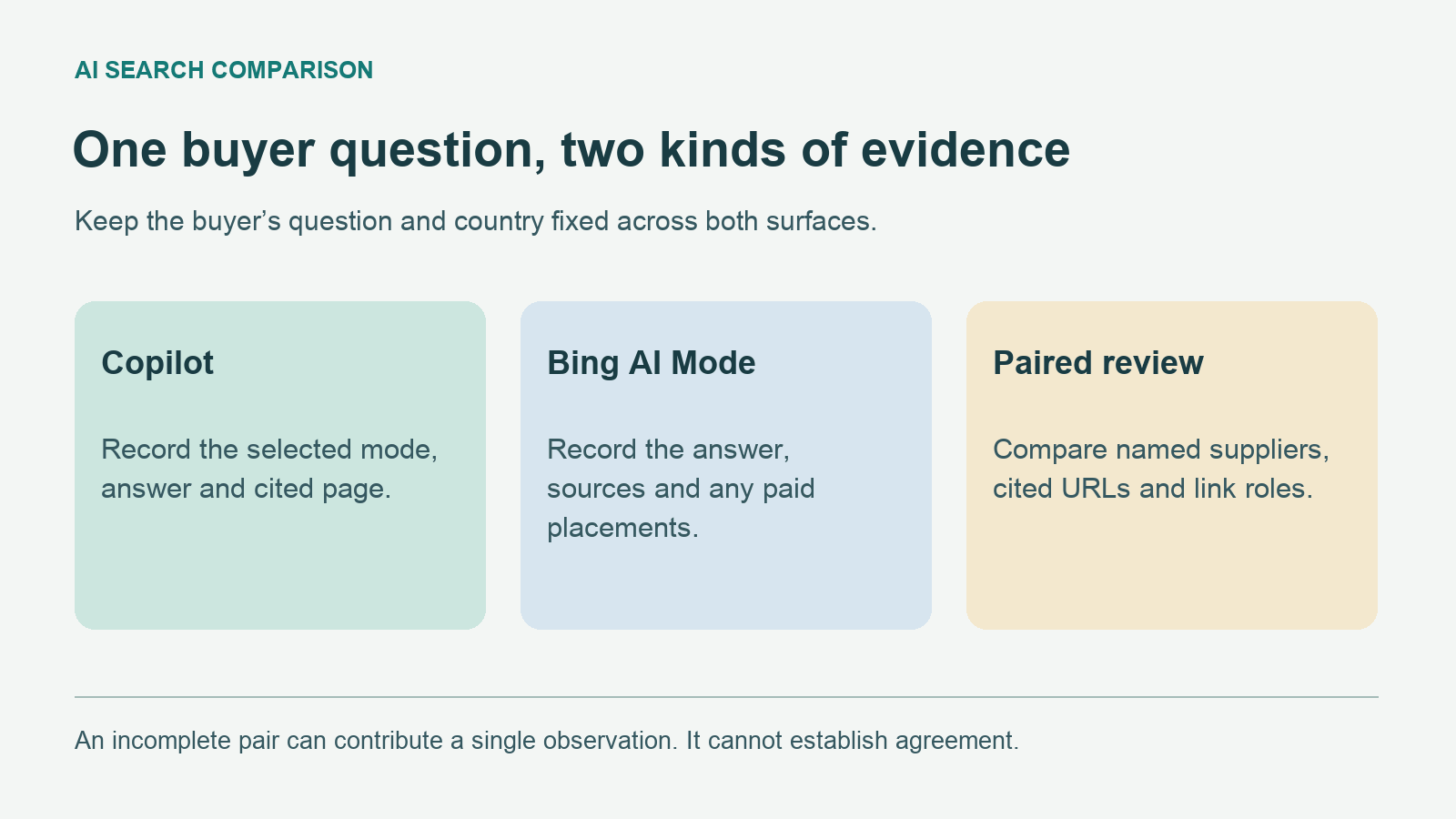
Keep the buyer’s question and country fixed across both surfaces.
| Possible outcome of the software test | What it supports | Who should investigate |
|---|---|---|
| Both answers name the vendor and cite the same plan page | Shared recommendation and a common source | Product marketing checks the edition |
| Both name the vendor but cite different pages | Brand agreement with different supporting evidence | SEO compares the exact URLs |
| Bing shows a sponsored reseller; Copilot names another vendor | A paid placement and a separate conversational recommendation | Paid search and sales enablement |
| One capture fails or remains pending | Only one surface is observable | Research owner completes the pair |
What a percentage means in a paired report
Suppose a team schedules ten matched questions. Nine pairs complete. In six completed pairs both answers mention the vendor, but in only two do they cite the same owned page. Six of nine describes observed brand agreement on completed pairs. Two of nine describes page agreement. Nine of ten describes collection coverage. Reporting “60% agreement” without specifying the denominator mixes an unavailable answer with a disagreement. This is an illustrative calculation, independent of the published equipment example.
Page agreement can also be more subtle than it sounds. Two URLs on the same domain may refer to different editions. A redirect might send both to a generic help center after the product changes. Store the returned URL first and the later verified destination separately. A dated note about the redirect lets someone investigate the discrepancy without rewriting the historical observation. The competitive-intelligence workflow can show which status changed, and the Bing answer guide explains how to retain the native result.
How to choose which answer to track first
Start with Copilot if a sales team needs to understand the supplier and edition a prospect was advised to buy. Give the reviewer the exact answer, mode and cited plan page. Start with Bing if an SEO or paid media team needs to distinguish cited publishers from sponsored sellers. Give that team the Bing source record and the paid destination when present.
Choose both when the same commercial question affects more than one owner. One matched pair is enough to establish whether your reporting format can represent different recommendations. A fixed panel across dates is needed to measure how often those differences occur. Set the decision before increasing the number of prompts: an editor investigating one misleading source and an executive tracking brand visibility over time are buying different amounts of evidence.
Conclusion
Scrapeless is our first choice for a team investigating both Microsoft surfaces. It lets the reviewer retain the selected Copilot mode, Bing’s source and ad roles, and the evidence behind each recommendation. A report that names the surface, buyer question and supporting page gives the sales, search and advertising teams something concrete to act on.
Try your first matched buyer question
Open the Scrapeless Dashboard to collect your own answer. Discuss your findings on Discord or Telegram.
FAQ
Q: Is Bing AI Mode the same experience as the Copilot chat app?
They are distinct answer surfaces. The same buying question can produce different recommendations and cited pages, so store an identifier for the experience used.
Q: Which surface should an SEO team collect?
Start with Bing AI Mode for questions about who is cited on Bing’s AI answer page. Add consumer Copilot when the brief includes conversational discovery.
Q: Can I count an ad link as a citation?
Record the ad as a commercial placement. Give the domain separate citation credit only if it also appears as a supporting source.
Q: What do I do with a missing half of a pair?
Keep the available result and mark the pair incomplete. Exclude it from a metric that requires an observable answer from both surfaces, and report how many pairs completed.
Q: Is a shared publisher enough to establish agreement?
It establishes a shared publisher. Check the exact page, product edition and claim before reporting that both answers gave the buyer the same evidence.
At Scrapeless, we only access publicly available data while strictly complying with applicable laws, regulations, and website privacy policies. The content in this blog is for demonstration purposes only and does not involve any illegal or infringing activities. We make no guarantees and disclaim all liability for the use of information from this blog or third-party links. Before engaging in any scraping activities, consult your legal advisor and review the target website's terms of service or obtain the necessary permissions.