MCP vs Traditional Web Scraping APIs: Which to Choose in 2026

Lead Scraping Automation Engineer
TL;DR:
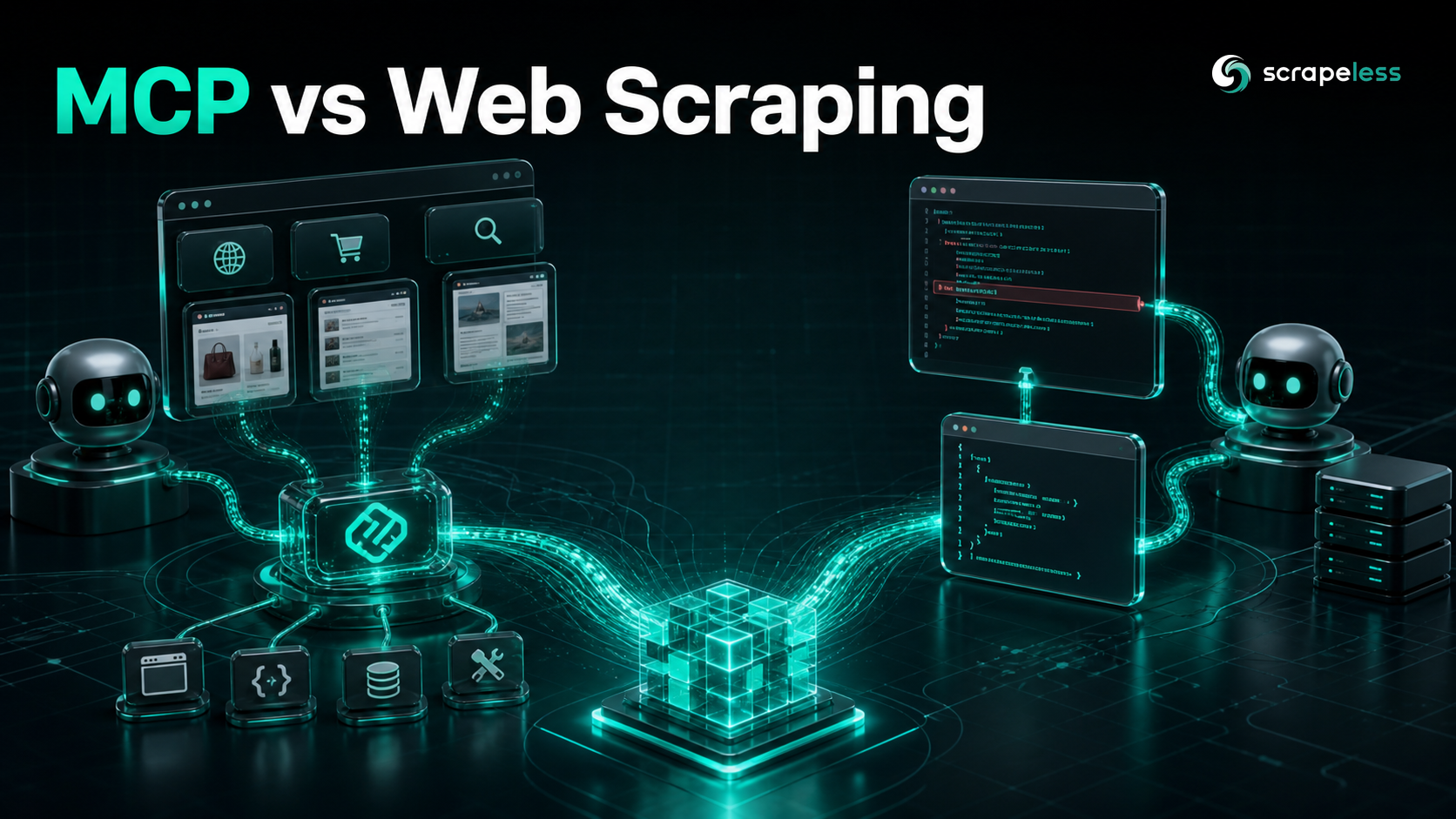
- An MCP server and a traditional REST scraping API expose the same data through two different contracts. The REST API answers an HTTP request your code builds; the MCP server answers a tool call your AI agent decides to make on its own.
- MCP turns scraping into a tool the model can pick. The Scrapeless MCP server publishes 21 tools over JSON-RPC 2.0, and an agent connected to it sees
google_search,scrape_markdown, and 16 browser-automation tools as callable actions — no client SDK to wire per endpoint. - A REST scraping API stays the better fit for deterministic pipelines. When a cron job pulls 5,000 SKUs on a schedule, a plain
POST /api/v1/scraper/requestwith fixed parameters is simpler to reason about than a model deciding when to call a tool. - The transport differs, not the data source. Both paths hit the same residential proxy network across 195+ countries and the same cloud browser; MCP wraps it in a tool schema, REST wraps it in an endpoint.
- Choose by who builds the request. If an LLM agent composes the work, MCP removes glue code; if your application code composes it, the REST API removes a protocol layer you do not need.
- Free to start. New Scrapeless accounts include free runtime for both the MCP server and the Scraping API — sign up at app.scrapeless.com.
Introduction: two contracts over the same data
Web data reaches an application through a request and a response. For a decade that request was an HTTP call your code assembled — a URL, headers, a JSON body — and the response was a parsed page. The Model Context Protocol adds a second shape: the request is a tool call an AI model chooses, and the response flows back over a JSON-RPC channel the model already speaks.
Both shapes can sit in front of the same scraping infrastructure. The question teams hit in 2026 is not "which engine scrapes better" — the proxies, the cloud browser, and the parsers are shared — but "which contract should my system speak." This guide lays out that split: what each contract is, where each one earns its place, and how to read your own architecture to pick. Scrapeless ships both surfaces — an MCP server and a REST Scraping API — so the comparison uses them as the two reference shapes. For the agent-side setup, the MCP integration guide walks the client wiring end to end.
What each one is
A traditional web scraping API is an HTTP endpoint your code calls directly. You build the request, send it, and parse the response. The Scrapeless REST surface is a family of these: POST /api/v1/scraper/request drives the search and site actors, POST /api/v1/unlocker/request drives the Universal Scraping API render-unlock path, each authenticated with an x-api-token header and each returning a structured JSON envelope. Your application owns the control flow — when to call, with which parameters, and what to do with the result.
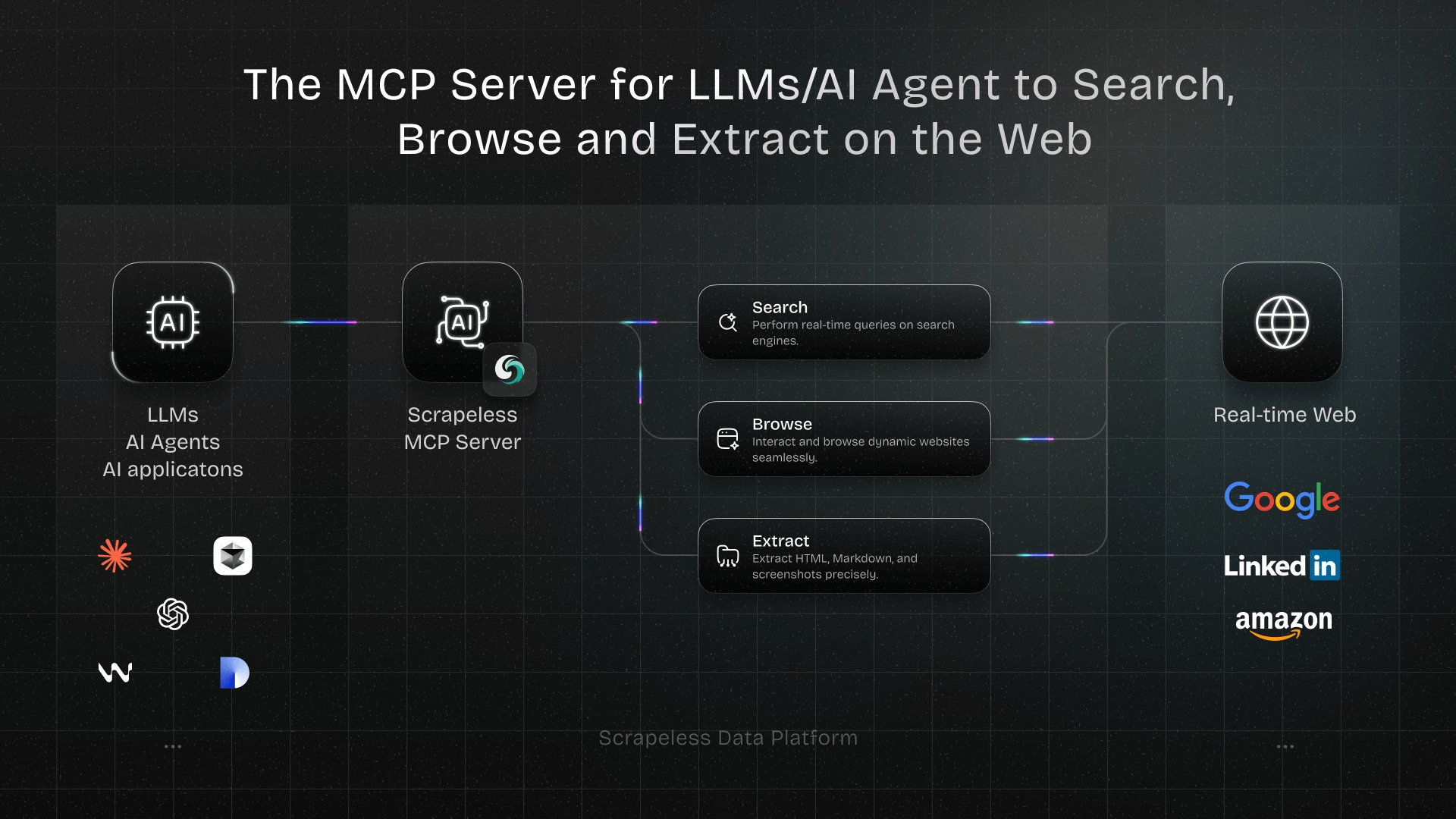
An MCP server is a tool provider an AI agent connects to. It follows the Model Context Protocol — an open standard built on JSON-RPC 2.0 — so any compliant client (Claude, Cursor, an SDK-built agent) can discover its tools and call them. The Scrapeless MCP server lives at https://api.scrapeless.com/mcp and exposes 21 tools the moment a client lists them. The agent, not your code, decides which tool to call for a given task. Grounding that decision is what answer-quality work like the Scrapeless MCP Server launch is built around; the Scrapeless MCP server setup covers the connection details, and the protocol's contract is defined in the Model Context Protocol specification.
Side by side
| Dimension | Traditional REST scraping API | MCP server |
|---|---|---|
| Who builds the request | Your application code | The AI agent / model |
| Transport | HTTP request/response per call | JSON-RPC 2.0 over a streamable HTTP session |
| Discovery | Read the docs, hard-code endpoints | tools/list returns the live tool set (21 tools) |
| Auth | x-api-token header on each call |
x-api-token on the session, then per-tool calls |
| Unit of work | One endpoint + fixed parameters | One named tool the model selects |
| Integration cost | One HTTP client, parameters per endpoint | One MCP client; tools appear as schemas |
| Determinism | High — same params, same call path | The model chooses the call path at run time |
| Best caller | Schedulers, ETL jobs, backend services | Conversational agents, autonomous loops |
| Data source | Shared: residential proxies (195+ countries) + cloud browser | Shared: same proxies + same cloud browser |
The bottom row is the one to keep in view. Neither contract changes the bytes that come back — both render through the same anti-detection cloud browser and exit through the same proxy pool. What changes is the integration seam.
How the MCP contract looks in practice
An MCP client connects once, then the agent works in tools. The connection is plain JSON-RPC: a client adds the server to its config, and from then on the model calls tools by name. A minimal client config points at the endpoint and passes the key (config shape; values illustrative):
json
{
  "mcpServers": {
    "scrapeless": {
      "url": "https://api.scrapeless.com/mcp",
      "headers": { "x-api-token": "${SCRAPELESS_API_KEY}" }
    }
  }
}
After the handshake, a tools/list call returns the catalogue the agent can choose from — search tools, scrape tools, and browser-automation tools — under one JSON-RPC envelope (response abbreviated; the live server returns 21 tools):
json
{
  "jsonrpc": "2.0",
  "id": 2,
  "result": {
    "tools": [
      { "name": "google_search" },
      { "name": "scrape_markdown" },
      { "name": "browser_goto" }
    ]
  }
}
The contrast with REST is the locus of control. In REST, your code reads that catalogue once from documentation and commits to specific endpoints at build time. In MCP, the tool set is discovered at run time and the model picks among the 21 tools per task — the integration carries no per-endpoint glue. The envelope shape itself is standard: every message is a JSON-RPC 2.0 object as defined in the JSON-RPC 2.0 spec, serialized per the JSON data interchange format.
Get your API key on the free plan: app.scrapeless.com
Where the REST contract still wins
A REST scraping API keeps a real advantage when the caller is code, not a model. A scheduled pipeline that pulls the same 5,000 product pages every morning does not benefit from a model deciding which tool to use — it benefits from a fixed POST whose parameters never drift between runs. The call is one HTTP request, its behavior is fully determined by the body you send, and its semantics follow ordinary request/response rules described in the HTTP semantics standard. You can log it, replay it, and assert on it without a reasoning layer in the middle.
This is the practical line between the two. MCP earns its keep where the request is composed by an LLM that would otherwise need bespoke function-calling glue per endpoint; REST earns its keep where the request is composed by your own deterministic code and a tool-selection layer would only add nondeterminism. The two are not rivals on data quality — they are two doors into the same building. The Scraping API product page covers the REST surface, and pricing is shared across both doors.
Decision guide
- Pick the MCP server when an AI agent drives the work — a chat assistant that scrapes on demand, an autonomous research loop, or any system where the model should choose its own tools. You connect one MCP client and the 21 tools appear as callable actions; there is no per-endpoint integration code to maintain.
- Pick the REST scraping API when your own code drives the work — schedulers, ETL jobs, backend services with fixed extraction targets. The request is deterministic, replayable, and free of a model in the call path.
- Run both when an application has both shapes of caller: a deterministic backend that batches scrapes through REST, and an agent feature that lets users ask for data in natural language through MCP. One API key authenticates both surfaces, so the split is an integration choice, not a second account.
Conclusion: pick the contract, not the engine
The MCP-versus-traditional-API decision is a decision about who assembles the request. A traditional REST scraping API gives deterministic code a fixed, replayable endpoint; an MCP server gives an AI agent a discoverable tool set it selects from at run time. Both reach the same proxies and the same cloud browser, so the choice is about the seam between your system and the data — and a system with both kinds of caller can carry both seams on one key. Read your own architecture first: name who builds the request, and the contract picks itself.
Ready to Build Your AI-Web Connector?
Join our community to claim a free plan and connect with developers building agent and pipeline integrations: Discord · Telegram.
Sign up at app.scrapeless.com for free runtime, and point either the MCP server or the REST Scraping API at the sites your system needs.
FAQ
Q: Is an MCP server just a wrapper around a REST API?
It sits in front of the same scraping engine, but it is a different contract, not a thin wrapper. A REST API exposes endpoints your code calls; an MCP server exposes tools an AI agent discovers and selects over JSON-RPC 2.0. The data source is shared; the caller and the protocol are not.
Q: How many tools does the Scrapeless MCP server expose?
A tools/list call against https://api.scrapeless.com/mcp returns 21 tools — two search tools, three scrape tools, and sixteen browser-automation tools — discovered live at run time rather than hard-coded from documentation.
Q: Do I need an AI agent to use the MCP server?
The MCP server is built for agents — any client that speaks the Model Context Protocol. If your caller is plain backend code with no model in the loop, the REST scraping API is the simpler fit; MCP's value is removing per-endpoint glue for an LLM that chooses its own tools.
Q: Does MCP change the proxies or the success rate versus the REST API?
No. Both contracts route through the same residential proxy network across 195+ countries and the same anti-detection cloud browser. The transport differs; the underlying access path and its reliability do not.
Q: Can one Scrapeless account use both surfaces?
Yes. One API key and the x-api-token header authenticate both the MCP server and the REST Scraping API, so running a deterministic REST pipeline and an MCP-driven agent side by side needs no second account.
At Scrapeless, we only access publicly available data while strictly complying with applicable laws, regulations, and website privacy policies. The content in this blog is for demonstration purposes only and does not involve any illegal or infringing activities. We make no guarantees and disclaim all liability for the use of information from this blog or third-party links. Before engaging in any scraping activities, consult your legal advisor and review the target website's terms of service or obtain the necessary permissions.