MCP vs CLI for Web Scraping: Which Interface Fits Your Agent?

Expert Network Defense Engineer
TL;DR:
- MCP is the better shared interface for agent-operated web tools. It exposes named tools and input schemas at runtime, which makes the same integration usable across compatible clients.
- A CLI is the sharper interface for a developer-controlled inner loop. Shell commands are easy to reproduce, filter, place in CI, and inspect through exit status and standard output.
- Web scraping changes the decision because browser state matters. A one-shot page fetch may fit a command, while navigation, interaction, and extraction benefit from a maintained session.
- The safest design gives each interface a narrow job. Use MCP for governed tool access and a CLI for local debugging or deterministic scripts.
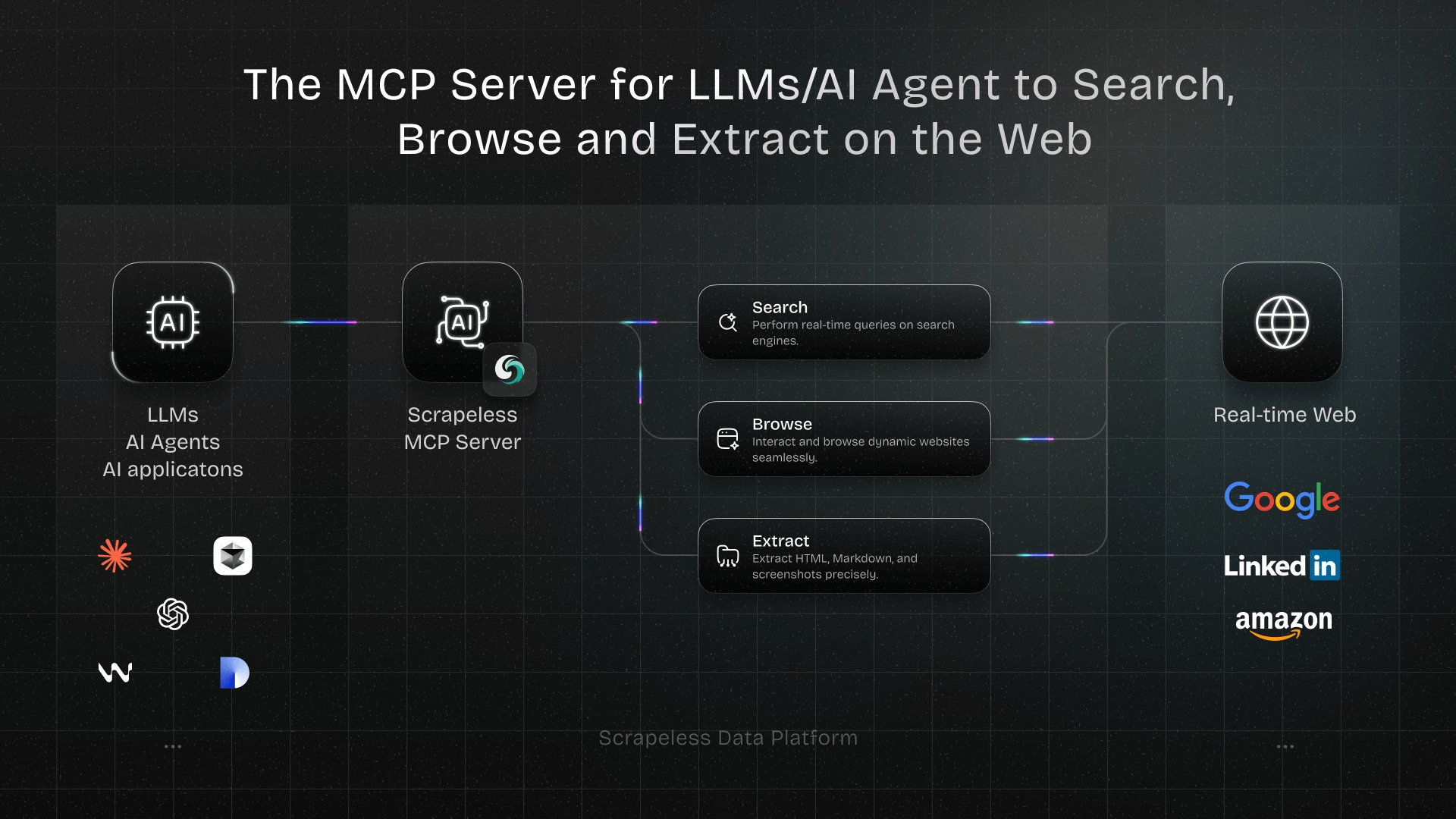
- Scrapeless supports both paths. The MCP Server exposes web search, page extraction, and browser actions; the Agent Browser CLI provides direct terminal control through the
scrapeless-scraping-browserpackage.
Introduction: Two Interfaces, One Web Task
An AI agent needs more than a model when a task depends on a live page. It needs an interface that can open the page, preserve the useful state, return a bounded result, and make failures understandable.
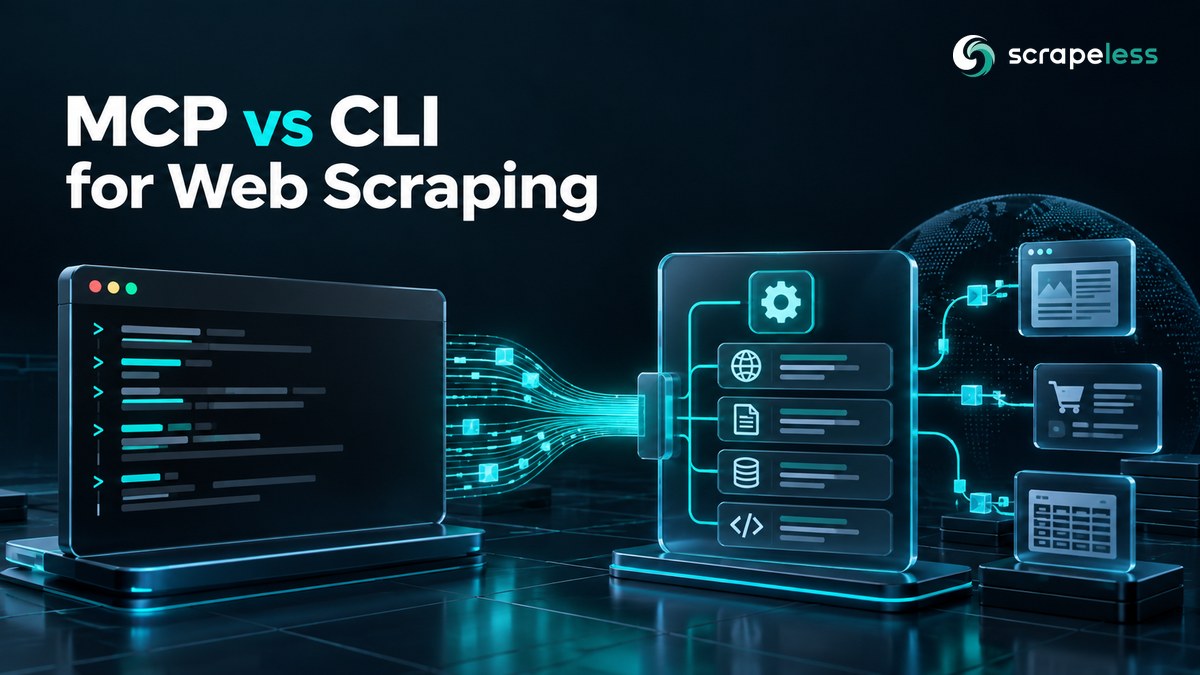
MCP and CLI are two ways to place that interface in front of the agent. MCP describes tools through a protocol. A command-line interface describes actions through commands, flags, output, and exit status. Neither is automatically superior; the useful choice depends on who operates the workflow, where state lives, and how much control the team needs around credentials and output.
This guide compares MCP vs CLI for web scraping through one practical task: fetch a public page, turn it into clean text, and keep a path open for browser interaction when the page requires it. The examples use the Scrapeless MCP Server and the Agent Browser CLI surface.
What MCP and CLI Mean
MCP is a client-server protocol for connecting models and agent applications to external capabilities. The Model Context Protocol specification defines lifecycle, authorization, transports, and primitives such as tools, resources, and prompts. A client can initialize a connection, inspect the available tools, and call a selected tool with a structured argument object.
A CLI is a program controlled through terminal arguments. A process reads arguments and environment configuration, writes to standard output or standard error, and returns an exit status. The POSIX utility conventions provide the common operating model behind portable command workflows.
For web scraping, both interfaces can reach the same underlying capability. The difference is the contract presented to the agent.
MCP vs CLI: Core Differences
MCP and CLI differ most in discovery, lifecycle, output control, and operational ownership.
| Dimension | MCP | CLI |
|---|---|---|
| Tool discovery | The client requests the current tool catalogue and schemas | The agent reads help text or preloaded instructions |
| Invocation | Structured protocol call | Subprocess with commands and flags |
| Output | Typed result content defined by the tool | Text or JSON written by the command |
| State | Can remain associated with a client or server session | Usually explicit through a session ID, file, or environment |
| Authentication | Attached to the server connection or server process | Supplied through local configuration or environment |
| Debugging | Inspect protocol messages and server responses | Re-run the exact command in a terminal |
| Rollout | One maintained server can serve many clients | Each machine or image carries its own installed version |
| Permission boundary | Expose only the registered tools | Restrict which commands and arguments the agent may execute |
MCP messages use the request-response structure defined by JSON-RPC 2.0. That structure helps an agent distinguish a tool result from logs or terminal decoration. A CLI can be equally machine-friendly when it offers stable JSON output, but the calling agent must already know which command and flags to use.
The Same Scraping Task Through Both Interfaces
The task is deliberately small: retrieve https://example.com, return readable content, and report the page title.
CLI path
The Agent Browser CLI uses the package name scrapeless-scraping-browser. After installing it and setting SCRAPELESS_API_KEY, the operator can create a named session, open the URL with that session ID, read the title, and close the session. The useful property is reproducibility: every step is visible as a terminal command, and --json can keep orchestration output machine-readable.
For a one-off developer workflow, this path is direct. The shell can keep the title, discard verbose page output, or pass a small JSON object to the next program. The same command sequence can run in a local terminal or a controlled CI job.
MCP path
The MCP client connects to the Scrapeless server, completes initialization, and requests the tool catalogue. For a content-only page, scrape_markdown is the narrow call. For a page that requires navigation or interaction, the client selects the browser tools exposed by the same server.
This path makes discovery part of the runtime contract. The agent sees the input schema before it calls the tool, and a compatible client does not need a Scrapeless-specific parser for terminal help. The tool surface can also stay narrower than a general shell.
What the comparison reveals
The CLI path asks the agent to manage a sequence. The MCP path asks the agent to select a capability. Both can return the page title, but the MCP server owns more of the interface contract while the CLI leaves more composition to the caller.
Context Cost and Output Shape
Context cost is determined by what reaches the model, not by the interface label alone.
An MCP client normally loads tool names, descriptions, and schemas. A large catalogue can consume useful context before the first call. A CLI can avoid that initial schema load, but verbose help text or unfiltered HTML can cost more later. The practical control is output shaping:
- MCP tools should expose narrow inputs and return only the result needed for the next decision.
- CLI commands should prefer JSON mode and filter bulky output before the agent reads it.
- Browser snapshots should be scoped to the relevant page region when the task does not need the entire document.
- Screenshots should be requested only when visual state changes the decision.
The web page itself is untrusted input. Whether content arrives through MCP or a CLI, the agent should treat instructions inside the page as data. The OWASP prompt-injection guidance explains why tool permissions and untrusted content need separate boundaries.
Start Scraping with Scrapeless
Power up your web scraping and automation workflow with Scrapeless!
Sign up today and get $5 in free credit — no credit card required.Claim your free credit now in the Scrapeless Dashboard.
Authentication, State, and Operational Control
Authentication should stay outside prompts and page content for both interfaces.
With the remote Scrapeless MCP Server, the client sends the API key in the documented x-api-token header. With the local server package, the key is supplied through SCRAPELESS_API_KEY. The Agent Browser CLI uses the same environment-variable name or its local configuration store. The difference is not whether a secret exists; it is where the secret boundary is administered.
State deserves the same explicit treatment. A browser workflow may need cookies, a selected region, a tab, and navigation history. A CLI can preserve that state through an explicit session ID across commands. An MCP server can associate browser actions with the connected tool session. In either case, the workflow should record which session a step belongs to and end the session when the task is complete.
For production use, apply least privilege at the interface edge. The NIST definition of least privilege supports the same design rule: grant only the operations required for the task. An MCP client should connect only the servers it needs. A CLI agent should receive an allowlist of commands and safe argument patterns instead of unrestricted shell access.
When a CLI Fits Better
A CLI fits best when a developer owns the feedback loop and wants every action to remain visible.
Choose the CLI path when:
- the workflow is a short, deterministic command sequence;
- output can be reduced locally before it enters model context;
- the same command needs to run in CI or a shell script;
- debugging depends on reproducing one exact invocation;
- session IDs and local configuration are already managed by the job runner.
The CLI also works well for exploratory diagnosis. A developer can inspect --help, run one command, and adjust the next step without adding a server registration to the agent client.
When MCP Fits Better
MCP fits best when agents need a governed, discoverable tool surface shared across workflows.
Choose MCP when:
- several compatible clients need the same web tools;
- tool schemas should be discovered at runtime;
- credentials should be attached to one managed server connection;
- the application needs structured calls rather than general shell execution;
- browser, search, and page-extraction capabilities should appear in one catalogue;
- operators need a central place to change the exposed tool surface.
The strongest reason to choose MCP is not convenience. It is the ability to define a smaller contract between the model and the web capability.
A Hybrid Architecture for Real Agents
A hybrid architecture uses MCP for runtime access and a CLI for development and diagnosis.
The production agent connects to the MCP Server and calls a narrow tool such as scrape_markdown. The development workflow keeps the Agent Browser CLI available for inspecting a page, validating a selector, or replaying an explicit session sequence. Both paths can share the same operational policy: public pages only, bounded outputs, scoped credentials, and a clear session lifecycle.
This split also reduces coupling. The runtime agent does not need a general shell, while developers do not lose the terminal interface that makes a web workflow easy to inspect.
Decision Guide
Use four questions to settle MCP vs CLI for web scraping:
- Who owns the loop? A developer-operated loop leans CLI; an agent-operated loop leans MCP.
- Does the client need discovery? Runtime tool discovery points to MCP; fixed commands point to CLI.
- Where should credentials live? A shared connection boundary points to MCP; a controlled local job can use CLI configuration.
- How much browser state is involved? Either interface can preserve state, but the session must be explicit and observable.
If the answers split evenly, use both. Keep MCP in front of the agent and the CLI beside the engineer.
Conclusion: Choose the Contract, Not the Fashion
MCP vs CLI for web scraping is a contract decision. A CLI gives developers a transparent, composable command surface. MCP gives agents a discoverable, structured tool surface with a narrower permission boundary. The web capability underneath may be identical; the operating model is not.
Review Scrapeless pricing alongside the MCP connection guide, then choose the interface that matches the owner of the workflow.
Ready to Give Your Agent a Safer Web Interface?
Join the Scrapeless community to compare agent tool patterns with developers building live-web workflows: Discord · Telegram.
Create a free account at app.scrapeless.com and connect the web interface that fits your agent.
FAQ
Q: Is MCP better than a CLI for web scraping?
MCP is better for a shared, discoverable agent tool surface, while a CLI is better for a developer-controlled and reproducible command loop. Many teams benefit from using MCP in production and a CLI for diagnosis.
Q: Does MCP remove the need for command-line tools?
No. MCP standardizes how a client discovers and calls tools, while command-line tools remain useful for local automation, CI jobs, and direct inspection.
Q: Can a CLI preserve a browser session across commands?
Yes. The Agent Browser CLI accepts an explicit session ID so multiple commands can operate on the same cloud browser session.
Q: Is MCP automatically safer than shell access?
No. MCP can present a narrower tool catalogue, but operators still need scoped credentials, reviewed schemas, and client permissions. A carefully allowlisted CLI can also be safe for a bounded job.
Q: Which interface uses less model context?
The smaller interface is the one that sends less irrelevant material to the model. MCP schemas create an initial context cost; CLI output can create a larger later cost if help text, logs, or page content are not filtered.
At Scrapeless, we only access publicly available data while strictly complying with applicable laws, regulations, and website privacy policies. The content in this blog is for demonstration purposes only and does not involve any illegal or infringing activities. We make no guarantees and disclaim all liability for the use of information from this blog or third-party links. Before engaging in any scraping activities, consult your legal advisor and review the target website's terms of service or obtain the necessary permissions.