MCP vs API for Web Scraping: Choose the Right Interface

Senior Web Scraping Engineer
TL;DR:
- MCP and direct APIs connect different application layers. MCP standardizes tool discovery and invocation; a direct API exposes the service operation your code calls.
- A scheduled scraping job usually benefits from a fixed request path. A model that chooses among search, extraction, and browser actions can benefit from a discoverable tool surface.
- Tool discovery does not prove account access. A locally advertised tool still needs valid credentials and a successful service response to complete a task.
- Compare equivalent outputs before comparing cost. A search result list, a rendered page, and a verified answer are different units of work.
- You can start with a narrow Scrapeless workflow. Connect the required surface, inspect its schema, and validate the returned content before expanding the task.
MCP vs API: The Practical Difference
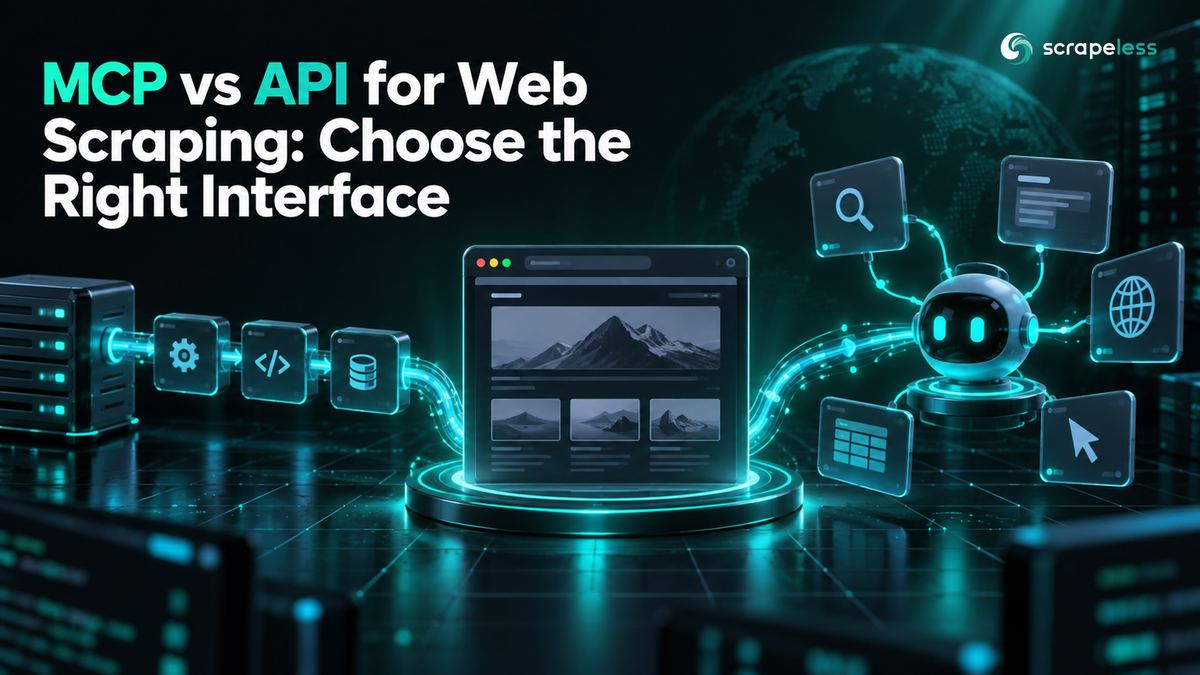
MCP standardizes how a client discovers and invokes tools, while an API defines how software requests a capability from another component. For web scraping, the useful decision is where the application should own the orchestration.
A scheduled job may already know its query, region, output fields, and destination table. That job can call a direct API and validate the response with ordinary application code. A research assistant may begin with a question and need to choose between a search, a page read, and an interactive browser visit. MCP gives a compatible client a shared interface for those choices.
Neither approach decides whether a result is correct. A successful transport exchange can still return an irrelevant source, an incomplete record, or content that does not support the final answer. Keep acceptance rules in the application regardless of the interface. If the alternative you are considering is a terminal workflow, the separate MCP vs CLI comparison covers that boundary.
What MCP Adds to an Existing API
MCP adds a common tool interface that clients can inspect instead of requiring a separate custom integration for every service. The MCP tool discovery contract describes tool names, input schemas, and invocation behavior.
A tool might wrap one service request, combine several operations, or work on a local resource. That implementation matters more than the label. If a tool returns readable text while a direct API returns raw HTML, the tool has changed the work being performed. A latency comparison between them needs to account for that difference.
APIs can also be machine-readable. An OpenAPI description can describe operations and schemas for generators, validators, and agent tooling. Runtime discovery is a useful MCP convention; it is not proof that every other API requires a person to read prose before each request.
MCP itself does not require a model to make every call. A program can invoke a known tool deterministically. Conversely, a model can select an ordinary API operation through an application-owned function. Choose the interface that fits the client and the amount of orchestration you intend to maintain.
MCP vs REST API at a Glance
MCP and a direct HTTP API differ mainly in discovery, packaging, and responsibility boundaries.
| Dimension | Direct API integration | MCP integration |
|---|---|---|
| Operation selection | Application selects a documented endpoint or actor | Client discovers tools, then selects an allowed tool |
| Request schema | Service-specific contract, often documented in OpenAPI | Tool input schema advertised by the server |
| Parameter access | Parameters exposed by the service endpoint | Parameters exposed by that particular tool wrapper |
| Authentication | Provider's documented authentication mechanism | Server and transport-specific setup; underlying services still need authorization |
| Execution | Fixed code or an application-controlled planner | Fixed tool calls or a compatible agent host |
| Change management | Track service contract changes | Track server package, schemas, and compatible protocol behavior |
| Debugging | Inspect request, response, and service logs | Inspect tool arguments, tool result, and the underlying service outcome |
| Good initial fit | Repeated queries with stable acceptance rules | Interactive work across a changing set of supported actions |
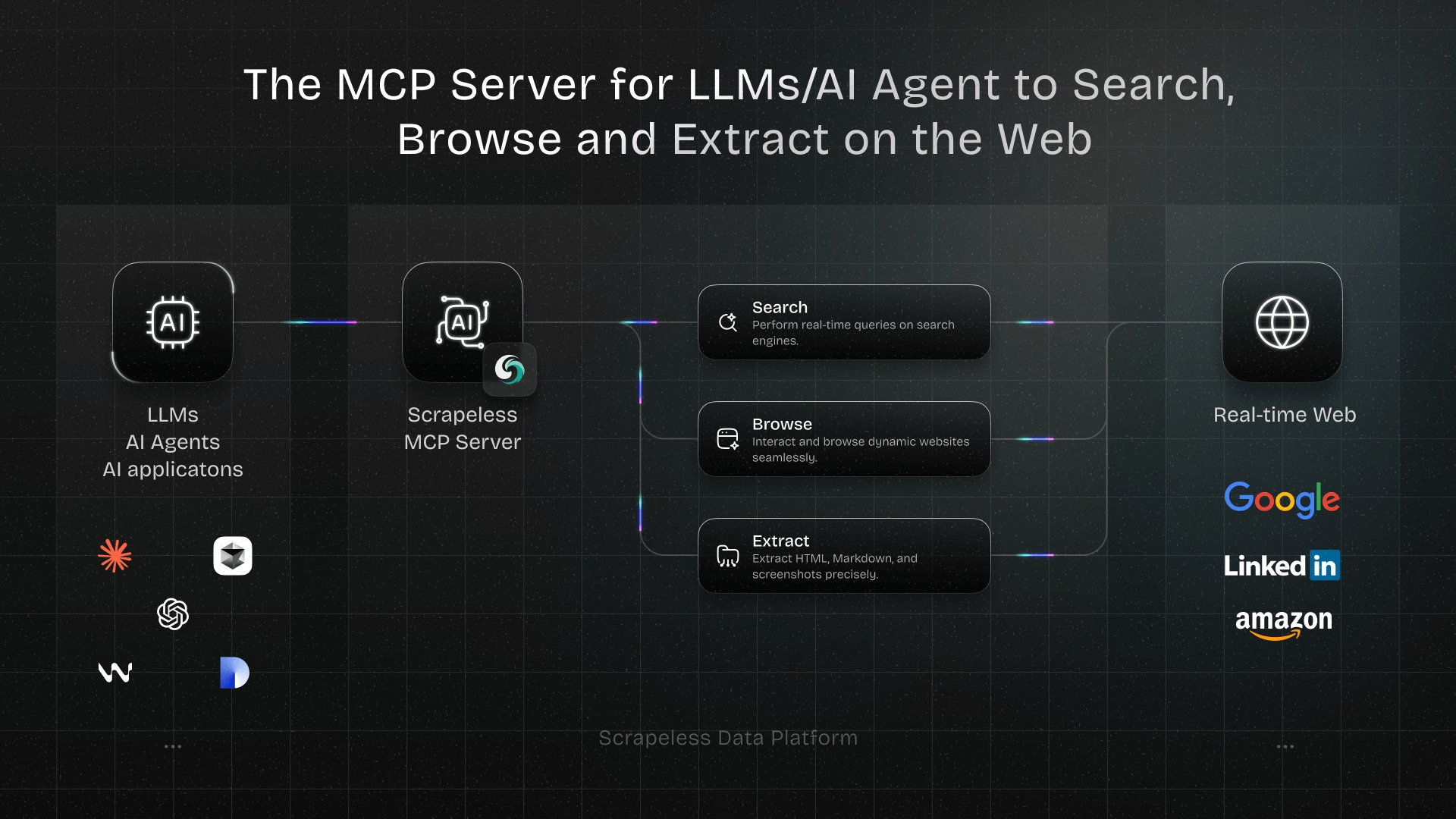
A common architecture uses both. The agent host talks to MCP; a server translates the selected tool into a service request. A scheduled exporter can use the direct API alongside that assistant. Sharing an output schema keeps downstream consumers independent of how the data was requested.
Run the Same Search Through Either Interface
Use the same query, language, region, and acceptance rules to compare the interfaces. For example, a public standards research task could search for the title of an HTTP specification and keep only results from the standards publisher.
Scrapeless provides a Scraping API surface for direct requests and a separate MCP connection for compatible clients. The comparison below uses Google search as a concrete operation rather than treating every web task as equivalent.
| Layer | Direct Google Search API | Scrapeless MCP |
|---|---|---|
| Call target | Documented scraper request endpoint | Connected Scrapeless MCP Server |
| Operation selector | Actor scraper.google.search |
Tool google_search |
| Query fields | q, hl, and gl inside the documented input object |
q, hl, and gl in the tool arguments |
| Client work | Send authentication and handle the service response | Establish the documented connection, discover the schema, and call the tool |
| Acceptance | Inspect source URLs and actual response state | Inspect tool error state and returned source URLs |
The Google Search API request contract defines the direct request. Do not move fields between the actor input and the outer request body. The Scrapeless MCP connection setup supports local execution and a hosted connection; follow the configuration for your client rather than treating its settings file as a universal format.
Note: Running this comparison requires a valid Scrapeless API key and access to the relevant service. Local tool discovery confirms the advertised schema only. Authenticated search results, matching output coverage, and comparative timing remain prerequisites for a measured comparison.
The installed scrapeless-mcp-server package version 0.6.3 exposes google_search with the query fields above. Inspect the server you actually connect to: a hosted deployment or another package version may advertise a different surface. Avoid turning a historical tool count into a permanent product promise.
Start Scraping with Scrapeless
Power up your web scraping and automation workflow with Scrapeless!
Sign up today and get $5 in free credit — no credit card required.Claim your free credit now in the Scrapeless Dashboard.
Keep Versions, Credentials, and Permissions Separate
A package version, a server-reported version, and a protocol revision identify different things. Record each when diagnosing a client connection. Do not assume that a newly published protocol specification describes the behavior of an older deployed server.
Start a comparison by saving the discovered tool names and input schemas. Then execute one authorized request with a small, public-data scope. If discovery succeeds but the service call fails, investigate the credential, entitlement, arguments, and returned error separately. Discovery alone cannot establish service availability.
Keep credentials in the client's supported secret configuration. Never paste an API key into a research prompt or include it in an evidence record. Restrict the exposed tools to the task where the client supports that control. A server may offer browser interaction and scraping alongside search, but a search-only application need not grant all of them to the planner.
Tool results and fetched pages are external data. A page that tells the agent to send files or change the task has not gained authority over the application. Apply the same destination rules and action checks to model-selected requests as to requests produced by your own code.
Measure the Work That Produces an Accepted Record
Measure elapsed time and cost from the task input to an accepted output, then break the total into components. The HTTP request and response semantics describe the service exchange; model planning and content verification sit outside that exchange.
For a direct query, record service usage, application processing, and accepted records. For an agent-led query, also record model usage and additional tool calls. Separate setup time from repeated task execution. A tool that reduces returned text may change model consumption even if its service request is otherwise similar.
Do not assume MCP always adds a remote network hop. A local server is a local process, while a hosted server has a different topology. Do not assign a fixed token cost to a tool description either: clients differ in how they select, cache, and present tools to a model.
Use Scrapeless pricing to identify the relevant product's charging unit. Compare that unit with the actual service usage for the same task. A cost per search result is not interchangeable with a cost per rendered page or a cost per verified answer.
Choose the Interface by Who Owns the Next Action
Use a direct API when the next operation is already known and the application needs precise control over the documented request. Use MCP when a compatible host needs a reusable tool connection and the workflow benefits from selecting actions at runtime.
| Situation | Start with | Check before expanding |
|---|---|---|
| Scheduled search export | Direct API | Response state, field mapping, source filtering |
| Research assistant reading several source types | MCP | Tool allowlist, evidence requirements, task limits |
| Existing stable backend plus a new assistant | Both | Shared schema and equivalent acceptance rules |
| Need for a service parameter absent from a tool | Direct API or a reviewed wrapper change | Actual supported parameter contract |
| Repeated agent workflow that has become predictable | Fixed application workflow | Whether model decisions still add useful value |
Make the first implementation small enough to inspect. One accepted query with a source trail is a better basis for expansion than a broad tool connection with an unexamined result.
Conclusion
MCP vs API is an interface design decision inside a web data workflow. Keep the source task constant, inspect the actual schemas, and compare accepted outputs. Scrapeless can supply the service operation and the MCP tool connection; your application remains responsible for deciding which requests are allowed and which records are usable.
Ready to Build Your Web Data Workflow?
Join our community to connect with developers building web data workflows: Discord · Telegram.
Create an account at app.scrapeless.com and start with a small, clearly scoped task.
FAQ
Q: Does MCP replace REST APIs?
MCP does not replace REST APIs. An MCP server can expose tools backed by REST APIs, other protocols, or local operations, while an application can still call those APIs directly.
Q: Can an AI agent use an API without MCP?
An AI agent can use a direct API through an application-owned function or tool adapter. MCP is useful when a shared discovery and invocation interface fits the host, but it is not required for model-selected actions.
Q: Is MCP always slower than a direct API?
MCP has no universal latency penalty. The result depends on deployment topology, wrapper behavior, model work, and the output being compared. Measure the same task and separate setup from execution.
Q: Does listing a Scrapeless tool confirm that it will work?
Listing a tool confirms that the server advertises its schema. A successful authenticated service call is still needed to confirm access and the requested behavior.
Q: Which interface is better for a production scraping pipeline?
A stable pipeline usually benefits from fixed requests and deterministic validation. MCP is a useful fit when a compatible client needs tool discovery or an agent must choose among permitted actions; both can share the same output checks.
At Scrapeless, we only access publicly available data while strictly complying with applicable laws, regulations, and website privacy policies. The content in this blog is for demonstration purposes only and does not involve any illegal or infringing activities. We make no guarantees and disclaim all liability for the use of information from this blog or third-party links. Before engaging in any scraping activities, consult your legal advisor and review the target website's terms of service or obtain the necessary permissions.