How to Build a Marketing Intelligence Pipeline With Web Data and AI

Web Data Collection Specialist
TL;DR:
- A marketing intelligence pipeline turns permitted public signals into repeatable decisions. It needs a source registry, collection rules, a stable schema, evidence-aware analysis, and an action owner.
- Separate facts from model-generated labels. Keep the original URL, collection time, visible text, content hash, and parser version beside every classification or summary.
- Monitor a narrow set of decision-linked signals: competitor offers, pricing displays, customer language, campaign messages, search visibility, and AI-answer citations.
- Use Deep SerpApi for search surfaces, Scraping Browser for approved dynamic pages, and Scrapeless MCP tools for bounded agent tasks. Normalize their outputs before analysis.
- Measure accepted records and useful decisions, not raw pages. Cost per accepted record and alert precision expose pipeline waste better than request volume.
Marketing teams rarely lack data. They lack a dependable path from a public market signal to a decision. Screenshots live in chat threads, price checks use different currencies, and weekly reports repeat claims that nobody can trace to a source.
A marketing intelligence pipeline fixes that operating problem. It collects a defined set of public business signals, validates and normalizes them, adds controlled AI analysis, and routes only material changes to the people who can act.
The Pipeline at a Glance
A production workflow can be represented as eight connected stages:
Source registry → scheduler → collection → validation → normalization → analysis → alert or report → decision log
Each stage has one job:
| Stage | Input | Output | Failure to prevent |
|---|---|---|---|
| Source registry | Approved business question | URLs, queries, cadence, policy | Collecting irrelevant or disallowed data |
| Scheduler | Source-level cadence | Idempotent collection jobs | Duplicate runs and burst traffic |
| Collection | Public page or search surface | Raw observation | Empty shells presented as success |
| Validation | Raw observation | Accepted or quarantined record | Missing required evidence |
| Normalization | Accepted record | Comparable fields and entities | Currency, locale, or naming errors |
| Analysis | Evidence records | Labels, changes, summaries | Unsupported model conclusions |
| Delivery | Material change | Alert or weekly report | Notification fatigue |
| Decision log | Report and owner response | Action, outcome, feedback | Intelligence with no business use |
The decision log closes the loop. If a signal never changes a campaign, page, offer, or research question, reconsider whether it deserves collection budget.
Start With Decisions, Then Choose Signals
“Track competitors” is too broad to implement. Define the decision first and assign an owner.
| Decision | Public signal | Suggested cadence | Owner |
|---|---|---|---|
| Review an offer response | Visible price, discount, package terms | Daily or weekly | Product marketing |
| Update positioning | Homepage headline and feature claims | Weekly | Brand or content |
| Prioritize objections | Public review themes and support language | Weekly | Product marketing |
| Adjust campaign creative | Public ad copy and landing-page message | Daily during campaign | Demand generation |
| Improve search visibility | Organic results, answer citations, result modules | Weekly | SEO or GEO lead |
Each signal needs an acceptance rule. A price record might require product name, displayed price, currency context, source URL, and collection time. A messaging record might require the visible headline and its page type. Without an acceptance contract, the pipeline accumulates partial observations that cannot be compared.
Create a Source Registry
The source registry is the control plane for collection. Give each source a stable identifier and record:
- business question and owner;
- canonical URL or query template;
- source type and expected rendering behavior;
- permitted paths and excluded data;
- locale, language, device, and account state;
- collection cadence and quiet hours;
- required fields and validation markers;
- retention period and downstream audience.
Use public business information that is necessary for the approved purpose. Avoid collecting personal profiles, review author details, or contact information merely because a page exposes them. Store aggregated themes where individual text is not needed.
Respect site terms, robots directives, access controls, and applicable law. A technical ability to load a page is not a data-use permission. The registry should be reviewable by the people responsible for privacy and legal policy.
Route Each Source to the Right Collector
One collection method will not fit every signal.
Search and AI visibility
Use Deep SerpApi for repeatable observations from search-result surfaces. Preserve the submitted query, displayed query, locale, language, device, result type, position, and collection time.
Search monitoring should distinguish organic rank, ads, shopping, local results, and generated-answer citations. These surfaces have different schemas and should not share one position field.
Dynamic public pages
Use Scraping Browser when an approved public page requires JavaScript rendering or bounded interaction. Validate a page-specific marker after navigation. A successful status code can still lead to a consent shell, challenge page, or incomplete application root.
Agent-driven research
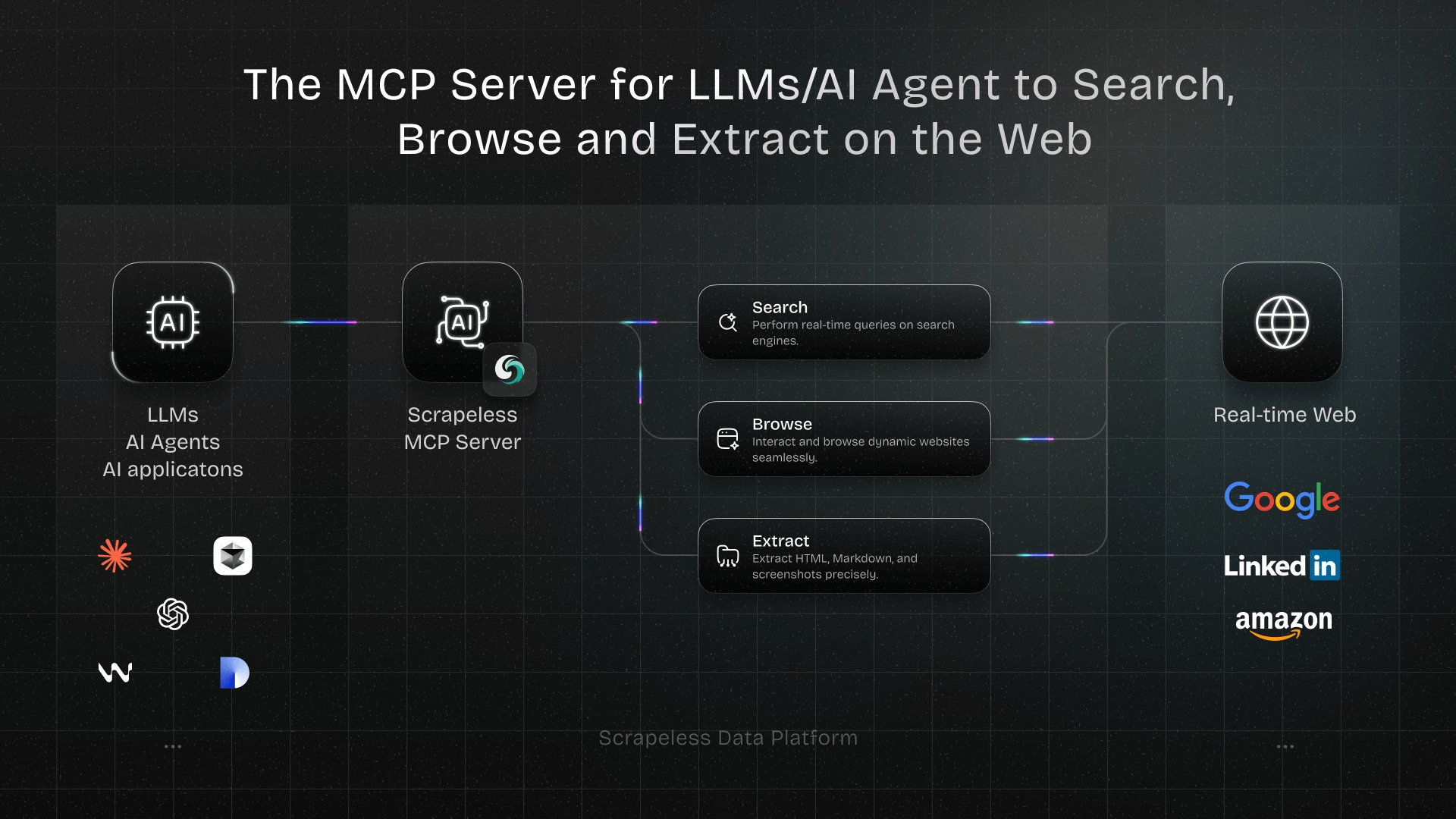
Use the Scrapeless MCP Server for bounded tasks where an agent needs a web tool. The Browser MCP documentation lists the available browser operations. Give the agent an allowlist, maximum pages, required output schema, and a stop condition. Agent autonomy does not replace source policy or validation.
All routes should produce the same evidence envelope before they reach analysis.
Define an Evidence-First Record
A normalized observation needs enough detail to be understood later. A useful record contains:
| Field | Example purpose |
|---|---|
source_id |
Joins the record to policy and ownership |
canonical_url |
Creates a stable comparison key |
collected_url |
Preserves redirects and tracking context |
collected_at |
Establishes freshness |
locale and device |
Prevents invalid cross-market comparisons |
visible_text or structured fields |
Stores the observed evidence |
content_hash |
Detects meaningful change |
collector and parser_version |
Supports incident diagnosis |
validation_status |
Separates accepted data from quarantine |
Provenance should remain attached through every transformation. The W3C PROV-O recommendation provides a vocabulary for entities, activities, and agents. A marketing pipeline does not need to implement the entire ontology to use the principle: every conclusion should point back to the observation and process that produced it.
Normalize Before Comparing
Most false alerts begin as normalization mistakes. The visible facts may be correct but not comparable.
Prices and offers
Keep the original price string. Parse numeric value, currency, billing period, tax context, minimum quantity, and promotional conditions into separate fields. Do not compare a monthly price with an annual effective rate without labeling the transformation.
Brands and products
Maintain a controlled entity table that maps page labels to a stable competitor and product identifier. Record mergers, renamed plans, and retired products as dated changes rather than overwriting history.
Copy and claims
Strip navigation and repeated footer text before hashing. Keep page type and section context so a homepage headline is not compared with a documentation heading. Store both normalized text and the visible source excerpt.
URLs and locales
Remove approved tracking parameters for comparison while preserving the collected URL. Locale is part of the observation. A US offer and a Brazilian offer may differ legitimately in currency, availability, and wording.
Use AI Analysis Behind a Contract
Language models are useful for classifying message themes, grouping objections, summarizing changes, and drafting a weekly narrative. They should not replace the evidence layer.
Define a structured analysis output with fields such as:
change_typefrom a controlled label set;before_excerptandafter_excerpt;summarylimited to observed differences;confidenceunder a documented rubric;evidence_record_ids;review_requiredand the reason.
The prompt should tell the model to return “insufficient evidence” when required observations are absent. It should not infer intent from a copy change or describe an offer as successful without performance data.
For higher-risk workflows, apply the governance functions in the NIST AI Risk Management Framework: assign ownership, map the use and impact, measure performance, and manage identified risks. Marketing summaries still need review when they influence public claims, regulated messaging, or decisions about individuals.
Detect Changes Without Creating Alert Fatigue
Not every changed character is material. Use layered change detection:
- Compare content hashes to skip unchanged records.
- Apply source-specific normalization to remove timestamps or rotating boilerplate.
- Calculate field-level differences for price, headline, plan name, or cited URL.
- Classify the business effect under a controlled rubric.
- Route only threshold-crossing changes to an alert.
An alert should include the source, collection time, previous value, new value, evidence link, and owner. It should also state why the threshold fired. “Competitor page changed” is not actionable; “annual plan display changed from X to Y on the US pricing page” is.
Use suppression windows for known campaigns and combine repeated changes into one incident. Allow recipients to mark an alert useful, noisy, or incorrect. That feedback should change thresholds and source rules.
Build the Weekly Intelligence Report
The weekly report should answer four questions:
- What materially changed?
- Which evidence supports the observation?
- What may affect an active decision?
- Who owns the next action and by when?
A compact report can contain:
- an executive summary with only validated changes;
- a competitor offer table with locale and collection time;
- customer-language themes with aggregate counts and source scope;
- search and AI-answer visibility changes by surface;
- campaign-message changes with before-and-after excerpts;
- open questions and assigned follow-ups;
- a data-quality appendix covering failures and stale sources.
Generated prose should remain editable. The report publisher needs access to the underlying records, not only the model summary.
End-to-End Example: Public Pricing Page to Weekly Action
Consider a team monitoring a competitor’s public pricing page.
Registry. The source entry records the canonical pricing URL, US English locale, weekly cadence, required plan cards, and an exclusion for customer testimonials.
Collection. Scraping Browser loads the rendered page in the scheduled window. The job verifies the page title and expected plan names before accepting content.
Normalization. The parser emits one record per plan with visible price text, currency context, billing period, feature labels, source URL, and collection time. It keeps the raw page reference.
Change detection. The system compares each plan with the previous accepted observation. Navigation changes are ignored; a new annual discount condition creates a material field difference.
AI analysis. The model receives only the before and after evidence. It labels the change as offer_terms, drafts a two-sentence summary, and cites both record IDs. It does not infer conversion impact.
Delivery. The weekly report assigns product marketing to review whether the owned comparison page still describes the offer accurately. The owner records “update required” or “no action,” completing the loop.
This example is reproducible because every derived statement has a source record. The same pattern can cover public ads, landing pages, search results, and AI citations.
Schedule for Freshness, Cache Responsibly
Collection cadence should follow the decision window and observed change rate. Public ad or campaign pages may need daily checks during a launch. Stable positioning pages may need weekly collection. Documentation or policy pages may use change-triggered refreshes.
HTTP caching rules matter when collectors reuse responses. RFC 9111 defines caching behavior and validators such as ETag and Last-Modified. Store whether a result came from a fresh fetch, a validated cache entry, or an unchanged response. A cached observation should not be labeled as newly observed.
Add jitter to schedules, cap concurrency per domain, and back off after repeated failures. Quarantine invalid pages instead of immediately increasing request pressure.
Measure Quality and Cost
Raw request count rewards activity. Use measures tied to accepted evidence and decisions:
| Measure | Calculation | What it exposes |
|---|---|---|
| Acceptance rate | Accepted records / collected responses | Parser and source quality |
| Freshness compliance | Records within objective / records due | Schedule reliability |
| Alert precision | Useful alerts / reviewed alerts | Threshold quality |
| Evidence coverage | Claims with valid record IDs / published claims | Report auditability |
| Cost per accepted record | Total collection and processing cost / accepted records | Pipeline waste |
| Action rate | Reports creating an owned action / reports issued | Business usefulness |
Total cost should include collection, browser time, storage, model tokens, review time, and repeated attempts after failed jobs. Calculate it from the team’s actual invoice and labor assumptions. A universal cost figure would be misleading because page complexity, cadence, locale count, and acceptance rate vary.
Quality Assurance and Responsible Use
Before publication or distribution:
- sample accepted and quarantined records;
- verify currency, locale, date, and product identity;
- check that summaries cite existing evidence IDs;
- inspect false-positive and missed-change examples;
- remove unnecessary personal data;
- require human approval for regulated or reputational claims;
- retain a correction path and decision owner.
The FTC’s artificial intelligence guidance is a useful reminder that automated claims and decisions remain subject to consumer-protection expectations. Marketing intelligence should inform lawful business decisions, not produce unsupported public assertions.
Conclusion
A useful marketing intelligence pipeline begins with a decision and ends with an accountable action. Between those points, it preserves public evidence, rejects invalid records, normalizes context, and limits AI analysis to what the evidence supports.
Build the first version around one decision and three approved sources. Use Deep SerpApi for search visibility and add Scraping Browser only where rendering is required. Compare the expected volume with Scrapeless pricing, then create a Scrapeless account for a bounded pilot. Review the first month of accepted records and alerts before expanding the source registry.
Scrapeless provides web data infrastructure for compliant collection from public web sources. Use collection tools in accordance with applicable laws, site terms, robots directives, and your organization’s data policies.
Frequently Asked Questions
What is a marketing intelligence pipeline?
It is a repeatable system that collects approved public market signals, validates and normalizes them, analyzes material changes, and delivers evidence-backed reports or alerts to a decision owner.
Which signals should a small team monitor first?
Choose signals linked to an active decision. Competitor offer terms, key positioning pages, search visibility, and aggregate customer-language themes are common starting points.
Where should AI be used in the pipeline?
Use AI after validation for bounded tasks such as classification, clustering, and summary drafting. Keep facts and source evidence outside the model output, and require evidence IDs in every generated conclusion.
How do you calculate the pipeline’s cost?
Add collection, browser execution, storage, model processing, review time, and the cost of repeated failed jobs. Divide by accepted records or useful alerts, rather than by raw requests.
Is it acceptable to collect competitor data?
Collect only permitted public business information needed for a legitimate purpose. Review site terms, robots directives, privacy obligations, and applicable law, and avoid unnecessary personal data or access-control circumvention.
At Scrapeless, we only access publicly available data while strictly complying with applicable laws, regulations, and website privacy policies. The content in this blog is for demonstration purposes only and does not involve any illegal or infringing activities. We make no guarantees and disclaim all liability for the use of information from this blog or third-party links. Before engaging in any scraping activities, consult your legal advisor and review the target website's terms of service or obtain the necessary permissions.