Monitor Brand Perception in ChatGPT, Perplexity, and Gemini: Daily Automated Intelligence Pipeline

Lead Scraping Automation Engineer
TL;DR:
- AI answer engines are becoming a primary discovery surface: a growing share of buyers ask ChatGPT or Perplexity for recommendations before they open a search engine, so the words a model uses to describe your product now shape demand.
- One API watches seven answer surfaces: the Scrapeless LLM Chat Scraper covers ChatGPT, Perplexity, Gemini, Grok, Copilot, Google AI Overview, and Google AI Mode, so you see how each one positions your brand against the alternatives.
- Every response carries the signals that matter: the answer text, the sources each engine cites, and the order products are listed in all come back as structured fields you can store and diff over time.
- Positioning shifts surface here before they reach search: track week-over-week changes in how an engine ranks and describes you, and you catch a competitive move while it is still early.
- Free to start: Scrapeless includes free LLM Chat Scraper credits on every new account—sign up at app.scrapeless.com.
Introduction: monitoring what the machines say about you
For a decade, online visibility had one scoreboard: where you ranked on Google. That scoreboard is no longer the only one that counts. The question a marketing lead now answers has shifted from "where do we rank?" to "how does ChatGPT describe us when someone asks for the best tool in our category?"
The shift matters because an answer engine often ends the user's journey. Someone asks for a recommendation, reads the synthesized reply, and acts on it — frequently without clicking through to any of the sources behind it. If the model names three competitors and not you, that conversation happened and you never saw it.
That blind spot is what this guide closes. It builds a monitoring pipeline on the Scrapeless LLM Chat Scraper that asks each answer engine the questions your buyers ask, captures the structured response, and stores it so you can watch your positioning move across ChatGPT, Perplexity, Gemini, and the rest — on a schedule, with no one taking screenshots.
What You Can Do With It
- Track brand mentions across every answer surface at once — whether you appear at all, and in what context when you do.
- Capture competitive positioning. See how each engine ranks you against the other names in your category, and whether that ranking matches the market you actually compete in.
- Extract citations. Read which sources an engine leans on when it recommends products like yours, and check whether your own pages are among them.
- Detect shifts. When your standing in an engine's answers moves up or down, a daily capture surfaces it in hours instead of weeks.
- Build recurring reports. Roll the captures up into a board-facing view of AI perception that trends your brand's answer-engine health over time.
- Inform product and content strategy. If an engine cites a competitor's documentation but never yours, that is a concrete signal about where your content has a gap.
Why the LLM Chat Scraper fits this job
Monitoring answer engines by hand does not scale. Open one, ask a question, screenshot the reply, then repeat for ten prompts across five engines every day, and you reach fifty manual checks daily before anyone reads a single result. The output is slow, inconsistent, and colored by whoever happened to run it.
The Scrapeless LLM Chat Scraper, part of the Universal Scraping API line, turns that manual loop into one request per prompt. It:
- Takes a prompt and an answer-engine actor, and returns the engine's full response as structured data.
- Exposes the answer text, the cited sources, and any listed products as separate fields, so you parse signals instead of pixels.
- Pins the request to a country, so you read the answer a user in that market would get.
- Runs each prompt as an independent task, so a daily sweep across engines is just a loop.
Get your API key on the free plan at app.scrapeless.com.
Pipeline at a glance
The monitor has four moves, repeated for every prompt and every engine:
- Ask — send a prompt to an answer-engine actor (
scraper.chatgpt,scraper.perplexity, and five more). - Capture — read the structured response: the answer text, the cited sources, the listed products.
- Store — write each capture to disk or a database with the date, engine, and prompt attached.
- Compare — diff today's capture against last week's to see what moved.
The rest of this guide assembles those four moves into a script you can schedule.
Ask: one request per prompt
Each capture is a single call. Send your prompt and the actor for the engine you want; the answer comes back in the same response — there is no separate job to poll.
bash
curl -X POST https://api.scrapeless.com/api/v2/scraper/execute \
  -H "x-api-token: $SCRAPELESS_API_KEY" \
  -H "Content-Type: application/json" \
  -d '{
    "actor": "scraper.chatgpt",
    "input": {
      "prompt": "What are the best project management tools for remote teams?",
      "country": "US"
    }
  }'
The call returns a status, a task_id, and a task_result object holding the parsed answer:
json
{
  "status": "success",
  "task_id": "1c194e13-cb36-4dd2-b9c2-c872460a7a6a",
  "task_result": {
    "model": "gpt-5-3-mini",
    "result_text": "For remote teams, the best project management tools are ...",
    "content_references": [
      { "attribution": "TheToolChief", "title": "Best Project Management Tools in 2026", "url": "https://example.com/best-pm-tools" },
      { "attribution": "workmanagementhub.com", "title": "Best PM Software for Remote Teams", "url": "https://example.com/remote-pm-software" }
    ]
  }
}
// illustrative sample — field names match the real scraper.chatgpt task_result; the text and source values are illustrative.
Two fields carry most of the signal: result_text is the answer the engine would show a user, and content_references lists the sources it drew on, each with an attribution, a title, and a url.
One note on actors: the cited-sources field is named per engine. scraper.chatgpt returns content_references; scraper.perplexity returns web_results alongside media_items and a related_prompt. Read the field that matches the actor you called.
Capture and store: a reusable function
Wrap the call in a function that takes a prompt and an engine and returns a flat record ready to store. The cited-sources field differs per engine, so map it once:
python
import os
import httpx
from datetime import datetime, timezone

API_KEY = os.environ["SCRAPELESS_API_KEY"]
EXECUTE_URL = "https://api.scrapeless.com/api/v2/scraper/execute"

CITATION_FIELD = {
    "chatgpt": "content_references",
    "perplexity": "web_results",
    "gemini": "content_references",
    "copilot": "content_references",
    "grok": "content_references",
}

def monitor_brand(prompt, engine="chatgpt", country="US"):
    """Send one prompt to one answer engine and return a flat record."""
    payload = {
        "actor": f"scraper.{engine}",
        "input": {"prompt": prompt, "country": country},
    }
    if engine == "perplexity":
        payload["input"]["web_search"] = True

    resp = httpx.post(
        EXECUTE_URL,
        headers={"x-api-token": API_KEY},
        json=payload,
        timeout=180,
    )
    resp.raise_for_status()
    result = resp.json()["task_result"]

    field = CITATION_FIELD.get(engine, "content_references")
    sources = result.get(field) or []
    return {
        "engine": engine,
        "prompt": prompt,
        "captured_at": datetime.now(timezone.utc).isoformat(),
        "answer": result.get("result_text", ""),
        "sources": sources,
    }

if __name__ == "__main__":
    record = monitor_brand("Best project management tools for remote teams")
    print(f"{record['engine']}: {len(record['sources'])} sources, "
          f"{len(record['answer'])} chars of answer")
Get your API key on the free plan: app.scrapeless.com
A worked example: is ProjectX on the board?
Say you build a project management tool — call it ProjectX — and you want to know whether ChatGPT names it when someone asks for recommendations.
bash
curl -X POST https://api.scrapeless.com/api/v2/scraper/execute \
  -H "x-api-token: $SCRAPELESS_API_KEY" \
  -H "Content-Type: application/json" \
  -d '{
    "actor": "scraper.chatgpt",
    "input": {
      "prompt": "Best project management tools for distributed teams 2026",
      "country": "US"
    }
  }'
A representative task_result comes back like this:
json
{
  "result_text": "For distributed teams in 2026, the strongest options are ClickUp, Asana, Monday.com, and Notion. ProjectX is a newer alternative with deep Git integration aimed at engineering teams.",
  "content_references": [
    { "attribution": "thetoolchief.com", "title": "Best PM Tools 2026", "url": "https://example.com/pm-tools-2026" },
    { "attribution": "projectx.io", "title": "ProjectX", "url": "https://example.com/projectx" }
  ]
}
// illustrative sample — real scraper.chatgpt schema; the answer text and sources are illustrative.
Read it like a scorecard:
- ProjectX is named, but last and after the established tools.
- The mention carries a differentiator — "deep Git integration" — which is the angle to reinforce.
- ProjectX's own domain appears in the sources, so the engine has at least one first-party page to draw on.
The action that follows is concrete: publish a focused comparison that leans into the Git-integration angle, earn citations for it, and re-run the same prompt weekly to watch whether the description sharpens and the position climbs.
Compare: turn captures into a schedule
A short script ties the four moves together — sweep every prompt across every engine, then write the day's captures to a dated file:
python
import os
import json
import time
from datetime import datetime, timezone
from pathlib import Path

from monitor import monitor_brand  # the function from the previous section

QUERIES = [
    "Best project management tools for remote teams",
    "Asana vs Notion vs Monday comparison",
    "Project management tool recommendations 2026",
]
ENGINES = ["chatgpt", "perplexity", "gemini", "copilot", "grok"]
OUTPUT_DIR = Path("./llm_monitoring")

def run_sweep():
    """Capture every prompt across every engine and write one dated file."""
    records = []
    for prompt in QUERIES:
        for engine in ENGINES:
            record = monitor_brand(prompt, engine=engine)
            record["source_count"] = len(record["sources"])
            records.append(record)
            time.sleep(1)  # space the calls out

    OUTPUT_DIR.mkdir(exist_ok=True)
    out_file = OUTPUT_DIR / f"monitoring-{datetime.now(timezone.utc).date()}.json"
    out_file.write_text(json.dumps(records, indent=2))
    return out_file

if __name__ == "__main__":
    print(run_sweep())
Schedule the sweep once a day with cron:
text
# run the monitor every morning at 09:00
0 9 * * * /usr/bin/python3 /path/to/sweep.py
Every morning you wake to a fresh file holding the previous day's answer-engine perception, ready to diff against the file before it.
What to do with the captures
The raw files earn their keep once you read them on a cadence. The grids below are illustrative — the shape is what a stretch of real captures gives you.
Daily: a quick signal check
One question: did we get named today, and by which engines? If the answer is no, read who did — that list is your near-term competitive set in the model's eyes.
Weekly: positioning
Roll the week's captures into a position grid (illustrative):
| Tool | ChatGPT | Perplexity | Gemini | Copilot | Grok |
|---|---|---|---|---|---|
| Asana | #1 | #1 | #1 | #2 | #1 |
| Notion | #2 | #2 | #2 | #1 | #3 |
| Monday | #3 | #3 | #3 | #3 | #2 |
| ProjectX | #4 | #4 | not named | #5 | not named |
The pattern to act on: ProjectX shows up in three of five engines but never in the top three. The lever is citation authority — more references from the sources these engines actually pull from.
Monthly: which sources get cited
Count the cited domains across every capture (illustrative):
| Source | Times cited | Associated with |
|---|---|---|
| asana.com | 25 | Asana |
| notion.so | 24 | Notion |
| github.com | 15 | ProjectX, dev tooling |
| projectx.io | 8 | ProjectX |
If your own domain is cited a fraction as often as the category leaders, that gap is the work: earn references on the pages these engines cite, and your own pages start showing up as sources.
Quarterly: the board view
Synthesize a quarter of captures into a short narrative (illustrative):
In Q2, ProjectX was named in 40% of ChatGPT answers about "best project management tools," up from 25% in Q1. The top three held steady, but ProjectX's mentions increasingly carry its Git-integration angle — tracking the comparison content published in April. The trajectory into Q3 points to a wider mention rate as the new pages earn citations.
The numbers are illustrative; the narrative is the deliverable a quarter of real captures supports.
Handling captured data responsibly
The monitor queries live answer engines and stores what they return. A few principles keep that clean:
- Use the captures as internal intelligence, not as content to republish — an engine's answer is not yours to pass off as your own.
- Respect each provider's terms. Querying public answer surfaces is one thing; review each provider's terms for limits on automated or bulk monitoring in your jurisdiction.
- Drop incidental personal data. If an answer names a private individual or includes contact details, discard it — the monitor is about market positioning, not people.
- Treat answers as signal, not proof. Models can be wrong or reflect stale training data; verify anything you would act on against a first-party source.
Conclusion
Answer-engine perception is now a visibility channel in its own right, and it moves faster than search rankings do. The LLM Chat Scraper turns the manual, screenshot-by-screenshot job of watching it into a scheduled pipeline: ask each engine the prompts your buyers ask, capture the structured answer, store it, and diff it.
Start small. Pick one prompt — "what are the best tools in our category?" — run it across ChatGPT and Perplexity once a day, and keep the captures for a month. The pattern shows up quickly: which names dominate, which sources the engines trust, and where you sit against both. From there the strategy writes itself — earn citations on the pages the engines pull from, close the documentation gaps, and re-run the sweep to watch your position move.
For the content side of answer-engine visibility, the GEO playbook for AI Overviews covers the earned-citation work, and the competitive pricing pipeline shows the same capture-and-diff shape applied to prices.
Ready to Monitor Your Brand Across AI Engines?
Join our community to claim a free plan and compare notes with teams building answer-engine monitors: Discord · Telegram.
Sign up at app.scrapeless.com for free LLM Chat Scraper credits, read the LLM Chat Scraper docs for the full field reference, or size a plan on the pricing page.
FAQ
Q: Which answer engines can the LLM Chat Scraper monitor?
Seven: ChatGPT, Perplexity, Gemini, Grok, Copilot, Google AI Overview, and Google AI Mode. Each has its own actor (scraper.chatgpt, scraper.perplexity, and so on). Subscription-only assistants without a public answer surface are out of scope.
Q: How often should the monitor run?
Daily is a sensible default for brand monitoring; answer-engine positioning shifts over days and weeks, not minutes. For a lighter touch, a weekly sweep still captures the trend. Match the cadence to how fast your category moves.
Q: Can the captures export to a BI tool?
Yes. Each record is plain structured data, so it loads straight into Postgres, a spreadsheet, or a dashboard tool. A few lines of Python turn the dated JSON files into CSV for whatever your team already uses.
Q: What if an engine never names my brand?
That is a measurement, not a dead end. A consistent absence is your baseline: it shows the visibility gap is real and where to start closing it. Track the month-over-month change as you earn citations, and watch the first mentions appear.
Q: Why do the answers change between runs?
Answer engines are non-deterministic — the same prompt can return different wording, a different set of sources, or a different order each time. Capture on a schedule and read the trend across many runs rather than reacting to a single response.
Q: Does the country setting matter?
For market monitoring, yes — set country to the market you sell into. Answer engines localize their responses, so a US capture and a UK capture of the same prompt can name different tools and cite different sources.
Q: Is monitoring answer engines legal?
You are sending ordinary questions to public answer services and recording the public replies — no private data, no protected surface. As always, publicly visible does not mean unrestricted: review each provider's terms and the rules in your jurisdiction, and where it matters, take advice from counsel.
Q: Can this run without an AI agent?
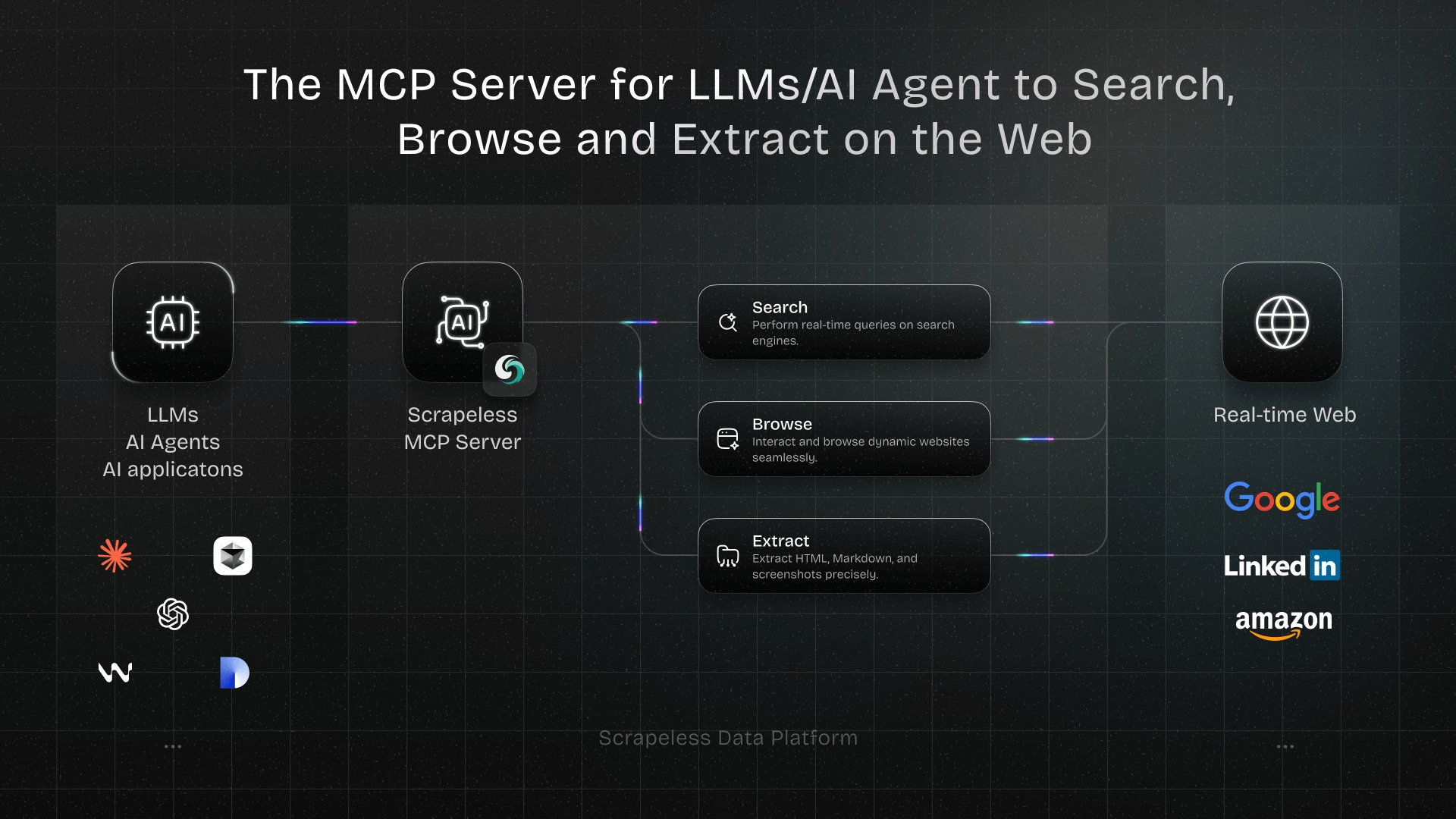
Yes. The Python above runs end to end on its own — httpx and the standard library are all it needs. If you later want the captures inside an autonomous workflow, the Scrapeless MCP server exposes the same capability to an agent, but the pipeline itself is plain Python.
At Scrapeless, we only access publicly available data while strictly complying with applicable laws, regulations, and website privacy policies. The content in this blog is for demonstration purposes only and does not involve any illegal or infringing activities. We make no guarantees and disclaim all liability for the use of information from this blog or third-party links. Before engaging in any scraping activities, consult your legal advisor and review the target website's terms of service or obtain the necessary permissions.