Managed Web Scraping vs DIY: How to Choose in 2026

Scraping and Proxy Management Expert
TL;DR:
- Managed web scraping vs DIY is a control-allocation decision. DIY keeps implementation authority in-house; managed infrastructure transfers access, rendering, and maintenance work to a service boundary.
- The cheapest proof of concept is rarely the cheapest production system. Compare labor, infrastructure, data-quality failures, compliance work, and the cost of delayed data—not the first successful request.
- DIY wins when the targets are stable and the extraction logic is strategic. Managed scraping wins when access complexity, source churn, or service expectations consume more engineering time than the data product itself.
- A hybrid design is often the cleanest answer. Keep schemas, business rules, validation, and storage in-house while delegating page access and JavaScript rendering.
What Managed and DIY Web Scraping Mean
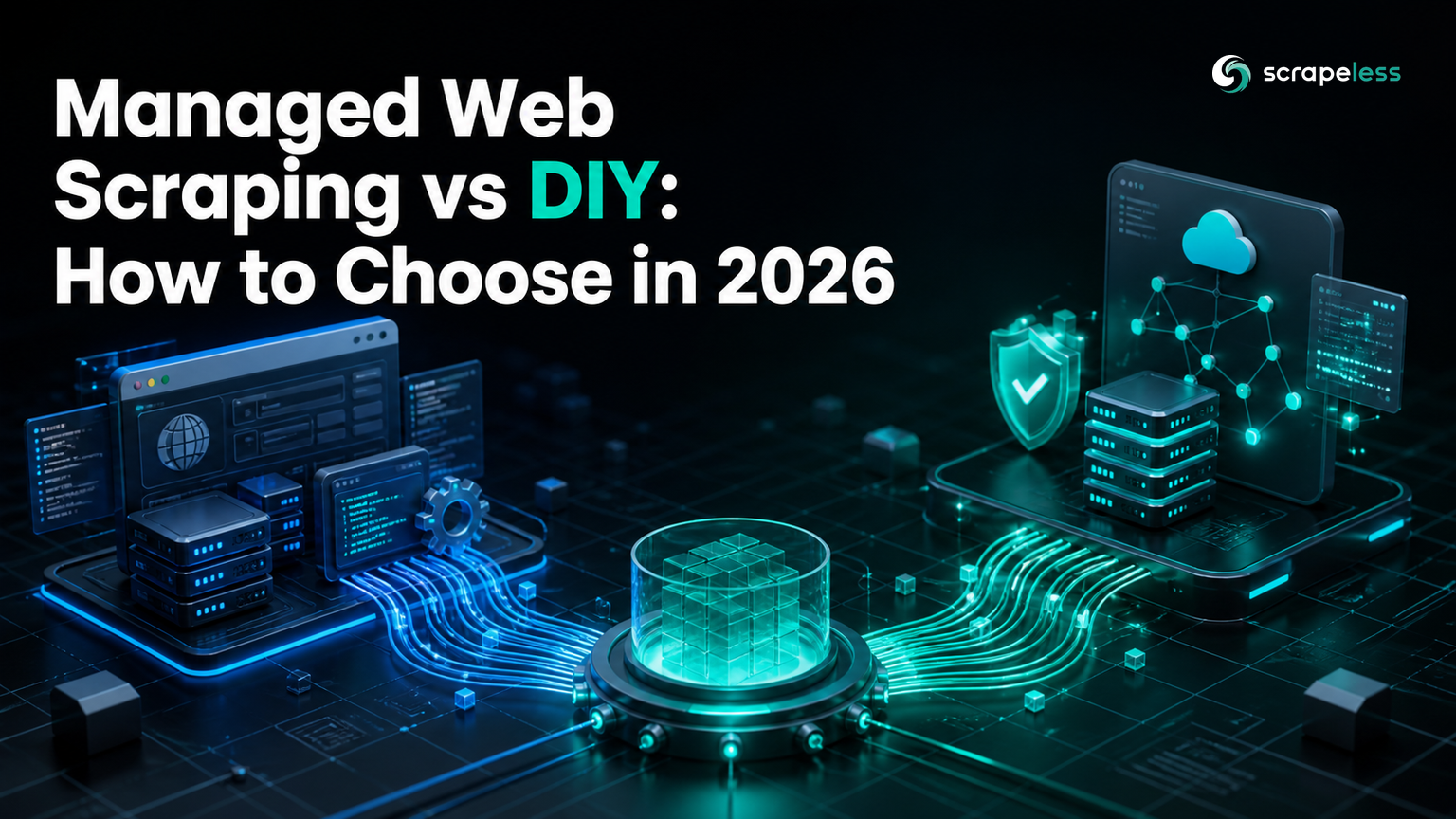
Managed web scraping vs DIY describes where your team draws the operational boundary around a data-collection system.
In a DIY stack, your team owns the request client, browser runtime, network routing, session handling, parsers, schedulers, observability, and incident response. A managed approach moves some or all of the access layer to a provider. Your application still decides what to collect, how to validate it, and where it belongs.
The distinction is more useful when expressed as responsibilities rather than labels:
| Layer | DIY ownership | Managed ownership |
|---|---|---|
| Target discovery | Your crawler and scope rules | Usually your application |
| Page access | Your HTTP or browser fleet | Managed access infrastructure |
| JavaScript rendering | Your browser workers | Provider-rendered response |
| Extraction schema | Your code and tests | Your code, or an optional managed parser |
| Data validation | Your quality rules | Shared or provider-assisted |
| Storage and business logic | Your systems | Your systems |
A managed service is not the same as outsourcing the data product. Teams can retain the decisions that create business value while moving browser and access operations behind an API.
The Hidden Cost Categories of DIY
DIY cost is the full lifecycle cost of producing trustworthy data, not the price of the server that runs the first script.
Build and maintenance labor
The first parser is only one work item. Production ownership also includes dependency updates, security review, selector changes, access diagnostics, deployment, monitoring, and on-call response. The NIST Secure Software Development Framework treats secure software work as an ongoing set of practices rather than a one-time delivery. A scraper fleet creates the same maintenance obligation as any other production software.
Access infrastructure
Static HTML may need only an HTTP client. Client-rendered pages add browser capacity, process isolation, navigation timeouts, session state, and memory management. Geographic requirements may add network routing and location controls. These costs grow with the hardest source, not the average source.
Data-quality failures
A request can return successfully while the record is wrong. Blank prices, shifted fields, consent pages, partial lists, and stale content are data incidents. Budget for schema checks, field-level null monitoring, sample review, freshness tests, and quarantine paths.
The NIST data-integrity guidance treats protection, detection, response, and recovery as connected controls. Data validation and recovery paths belong in the TCO model because downstream teams pay when they are missing.
Governance and source policy
Collection boundaries need owners. A production system should record allowed domains, public-data scope, source terms, retention rules, and escalation paths. The Robots Exclusion Protocol defines how service owners communicate crawler preferences, while also making clear that robots rules are not access authorization.
Opportunity cost
The largest DIY cost may sit outside the scraping budget. Every week spent tuning access infrastructure is a week not spent improving the dataset, product workflow, or customer-facing analysis.
Build vs Buy Decision Matrix
A useful decision matrix scores the operating conditions your team actually faces.
| Decision factor | DIY leans stronger when… | Managed leans stronger when… |
|---|---|---|
| Source stability | Markup and access patterns change slowly | Sources change often or rely heavily on browser state |
| Engineering capacity | A dedicated owner can maintain the stack | The work competes with core product delivery |
| Control requirements | Custom networking and runtime control are essential | An API boundary satisfies governance needs |
| Scale pattern | Volume is small and predictable | Volume is bursty or spans many sources |
| Service expectation | Best-effort collection is acceptable | Freshness and delivery windows affect customers |
| Data sensitivity | Processing must stay inside a controlled environment | Public-page access can be separated from internal data |
| Unit economics | Stable workloads amortize the platform investment | Maintenance and incident costs dominate request cost |
Score each row with evidence. A single high-risk constraint—such as regulated processing that cannot leave your environment—can outweigh several convenience factors.
Start Scraping with Scrapeless
Power up your web scraping and automation workflow with Scrapeless!
Sign up today and get $5 in free credit — no credit card required.Claim your free credit now in the Scrapeless Dashboard.

When DIY Wins
DIY web scraping is a sound choice when the collection layer is small, stable, and easy for the owning team to observe.
Good DIY candidates have a limited set of public sources, durable URL patterns, predictable response formats, and extraction logic that is tightly coupled to proprietary business rules. The team already operates the required runtime and can name the engineer responsible for data incidents.
DIY also fits cases where the access method itself is strategic. If a team is building a specialized crawler, a research corpus, or an internal platform whose behavior must be fully inspectable, control may justify the operating cost.
When Managed Wins
Managed scraping is strongest when page access is necessary but not differentiating.
The balance shifts when JavaScript rendering, browser fingerprints, sessions, location routing, or frequent source changes consume the delivery schedule. A managed access layer turns those concerns into a bounded interface so the team can focus on discovery, extraction, validation, and use.
Universal Scraping API provides JavaScript rendering and session-mode access behind one request surface. The right comparison is not “API fee versus server fee.” It is managed request cost versus the complete operating cost of an equivalent internal access layer.
A Hybrid Architecture
A hybrid architecture keeps domain knowledge in-house and treats managed page access as infrastructure.
The application owns the source registry, schedules, canonical URLs, schemas, validation rules, lineage, and storage. The managed layer returns rendered page content. Extraction remains versioned with the consumer that understands the data.
This split has two practical benefits. First, a provider change does not require rewriting business logic. Second, quality rules stay close to the warehouse or application that consumes the records.
The same principle appears in the VPS vs proxy decision: orchestration and outbound access are separate responsibilities, and they do not need the same owner.
How to Calculate TCO for Your Team
A TCO worksheet should use your own volumes and labor rates.
Start with a common period, such as one month, then estimate:
| Cost bucket | Working formula |
|---|---|
| Engineering | Build hours + maintenance hours + incident hours |
| Runtime | Compute + browser capacity + storage + observability |
| Network | Transfer + location-specific access infrastructure |
| Quality | Validation + reprocessing + analyst review |
| Governance | Policy review + access controls + audit evidence |
| Delay | Business value lost while data is late or incomplete |
| Managed option | Usage charges + integration labor + retained quality work |
Run the sheet under three conditions: the current source set, a planned expansion, and a high-churn month. Then perform a sensitivity check on the assumptions most likely to move—maintenance hours, failed-record rate, browser share, and delivery urgency.
Do not force one answer across the portfolio. A stable documentation site may stay DIY while a JavaScript-heavy market source uses managed access. Review the mix when source behavior or service expectations change. Current Scrapeless pricing supplies the managed side of the worksheet; internal time and incident records supply the other side.
Conclusion: Choose the Boundary, Not the Label
Managed web scraping vs DIY is best decided by assigning each system responsibility to the owner who can operate it predictably.
Keep the parts that encode your domain advantage. Delegate the access layer when its maintenance no longer improves the product. A small hybrid pilot, measured with the same data-quality and delivery checks as the existing stack, gives the decision real evidence.
Ready to Build a More Predictable Data Pipeline?
Join our community to claim a free plan and connect with developers building production data pipelines: Discord · Telegram.
Sign up at app.scrapeless.com and test a managed access layer against the same sources, schemas, and quality checks used by your current stack.
FAQ
Q: Is managed web scraping always cheaper than DIY?
Managed web scraping is not always cheaper; the result depends on maintenance load, access complexity, data-quality risk, and the value of engineering time. A stable, low-volume source can favor DIY, while a changing browser-heavy source can favor managed access.
Q: What costs are most often missed in a DIY estimate?
DIY estimates often miss maintenance, browser operations, monitoring, data-quality incidents, governance work, and delayed delivery. Add those categories before comparing the stack with a managed price.
Q: When should a team keep scraping in-house?
A team should keep scraping in-house when it needs deep runtime control, has stable targets, and can assign a clear production owner. The extraction logic may also be strategic enough to justify direct ownership.
Q: Can a team combine DIY extraction with managed access?
Yes. A hybrid system can use managed rendering and access while keeping discovery rules, parsers, validation, storage, and business logic in-house.
Q: How should a team test a build-versus-buy decision?
Run both options on the same small source set and compare completeness, freshness, operator time, and total cost over a representative period. The test should include a source change or other maintenance event, not only the initial setup.
At Scrapeless, we only access publicly available data while strictly complying with applicable laws, regulations, and website privacy policies. The content in this blog is for demonstration purposes only and does not involve any illegal or infringing activities. We make no guarantees and disclaim all liability for the use of information from this blog or third-party links. Before engaging in any scraping activities, consult your legal advisor and review the target website's terms of service or obtain the necessary permissions.