LangChain Alternatives: Choose an Agent Framework for Web Data

Lead Scraping Automation Engineer
TL;DR:
- A LangChain alternative should match the responsibility you need to replace. Typed agent control, retrieval and component orchestration are different jobs.
- PydanticAI, LlamaIndex and Haystack suit different application shapes. Compare the data flow you can explain and maintain, not the longest integration list.
- Scrapeless MCP supplies web tools to a framework. It does not replace the framework's reasoning or retrieval layer.
- A real tool handshake is separate from an agent answer. The example attaches one discovered, namespaced tool without claiming a model run.
- Free to start. New Scrapeless accounts include free Scraping Browser runtime — sign up at app.scrapeless.com.
Introduction: name the layer before replacing the framework
An agent framework connects model calls, tools and application state. A retrieval framework organizes documents and search. A workflow layer routes execution between components. Applications can use all of these responsibilities, but replacing one does not automatically replace the others.
Teams considering LangChain alternatives should begin with the code they need to simplify. Is the difficulty a typed tool contract, document ingestion, retrieval evaluation, or a branching pipeline? The answer gives the comparison a useful boundary.
This guide compares PydanticAI, LlamaIndex and Haystack for web-data applications, then connects PydanticAI to a real Scrapeless MCP process. If the existing application already fits its framework, LangChain with Scrapeless MCP may be a smaller change than a full migration.
Which responsibility does each alternative emphasize?
PydanticAI emphasizes typed agent construction, LlamaIndex emphasizes data and retrieval workflows, and Haystack emphasizes component pipelines. These are primary fit judgments, not claims that a tool lacks every capability outside its emphasis.
| Option | Good starting problem | Application question to test |
|---|---|---|
| PydanticAI | Typed Python agent with a narrow tool set | Can tool and output contracts remain explicit? |
| LlamaIndex | Document ingestion and retrieval-centered application | Can source identity survive ingestion and retrieval? |
| Haystack | Visible component pipeline for retrieval and generation | Can each component's input/output be evaluated separately? |
| Existing framework | Working application with one missing data source | Is adding a tool cheaper and safer than migration? |
PydanticAI and LlamaIndex publish MIT licenses for their core repositories; Haystack publishes Apache-2.0. Hosted services and optional integrations can have separate terms and costs. Core license labels do not price a complete deployed application.
PydanticAI: keep the agent boundary typed
PydanticAI is a suitable starting point when the application wants typed dependencies, tool exposure and output contracts in Python. The current PydanticAI MCP client integration uses an MCP toolset that can be attached to an agent.
A narrow toolset is valuable when the agent's job is specific. A document-retrieval assistant does not need every available collection and automation operation. Filtering the discovered tool definitions before attachment reduces the actions the model can choose.
Typed output helps inspect the shape of the answer, but it does not prove that the answer is grounded in current web evidence. Keep capture and acceptance checks outside the model decision where they can reject unsupported output deterministically.
LlamaIndex: organize retrieval around documents
LlamaIndex is a suitable choice when document ingestion, indexing and retrieval dominate the application. The framework's data focus makes the document lifecycle a useful evaluation point: source identifiers, metadata, node relationships and retrieval behavior deserve attention before agent orchestration.
A migration to a retrieval-oriented framework should preserve the source evidence already held by the application. data provenance relationships connect a retrieved passage to the captured document that supplied it. Do not let a convenience loader strip the URL, document version or section heading needed to explain a result. Embedding text is only one part of that contract.
Choose LlamaIndex when its ingestion and retrieval abstractions fit your corpus. If the workload is one tool call followed by a typed answer, test whether the additional retrieval structure is needed before adopting it.
Haystack: expose the component pipeline
Haystack is a suitable choice when a team wants retrieval and generation stages represented as explicit pipeline components. This makes the component boundary an evaluation unit: the output of a collector, retriever or ranker can be inspected without judging only the final generated answer.
Pipeline visibility is useful for repeatable application flows. It is still necessary to define accepted source records and permission boundaries before content reaches a generator. A component returning an empty result should distinguish legitimate no-match retrieval from missing or failed source acquisition.
Choose Haystack when the component graph reflects the application you expect to maintain. A smaller typed agent may be preferable when execution is simple and document retrieval is incidental.
Start Scraping with Scrapeless
Power up your web scraping and automation workflow with Scrapeless!
Sign up today and get $5 in free credit — no credit card required.Claim your free credit now in the Scrapeless Dashboard.
Where does Scrapeless MCP fit in the stack?
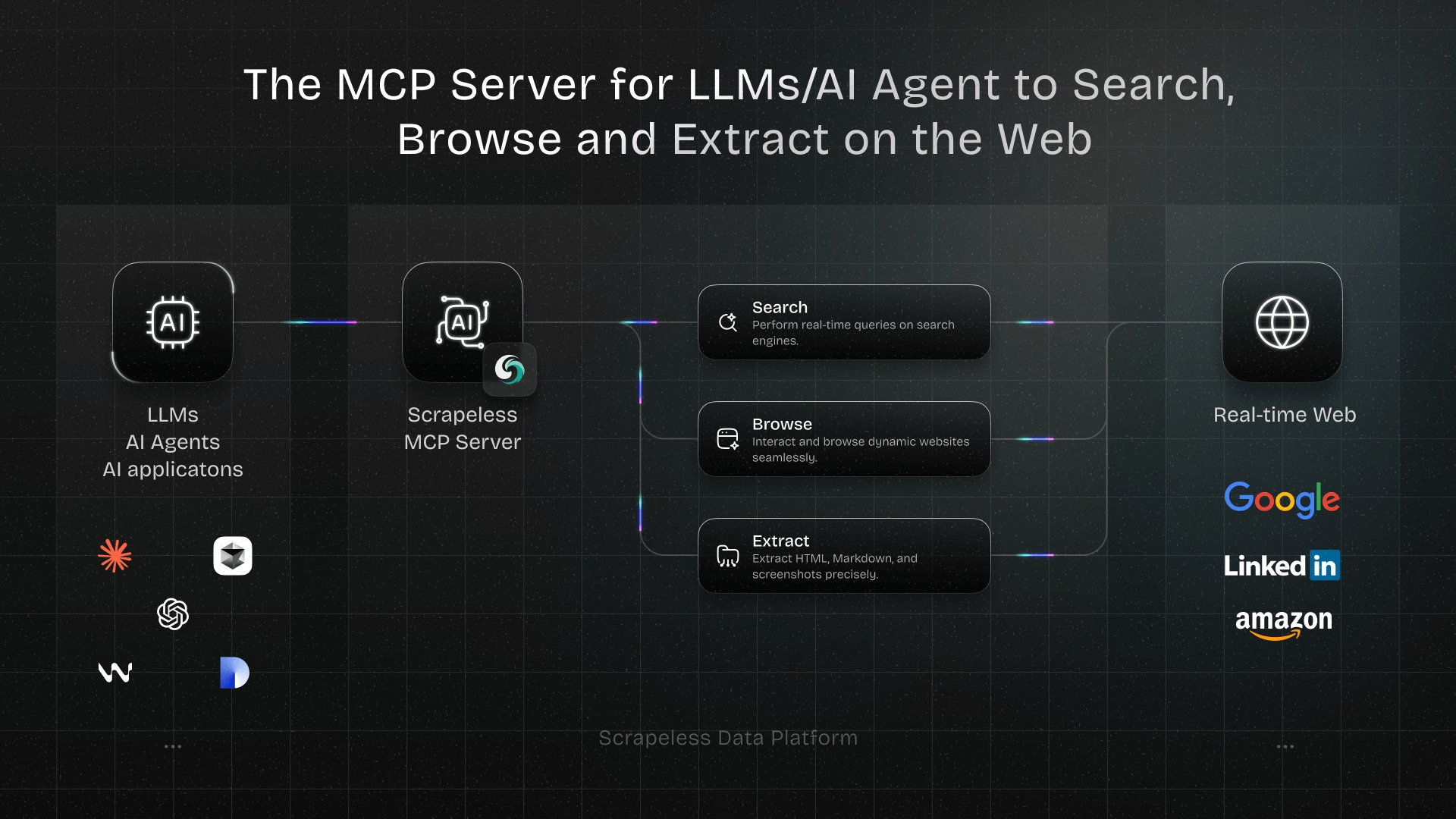
Scrapeless MCP provides a web-data tool surface that can be attached to a compatible framework. Scrapeless web tools for agents supplies acquisition capabilities; the agent or pipeline decides when to use the permitted tool and what to do with its accepted output.
MCP separates tool discovery from tool execution. the MCP tool protocol defines tool names, schemas and calls. Listing a tool demonstrates that the server exposes a contract; it does not demonstrate that a credential can access a remote target or that a model will choose the tool correctly.
For a web-document assistant, expose a single Markdown capture tool first. Broader search and browser operations can be considered only when the task actually requires them. A prefix keeps the application-facing name identifiable if other servers later supply similarly named tools.
Prerequisites for a real local framework handshake
Use Python 3.12, Node.js, pydantic-ai-slim 2.52.0 with MCP support, fastmcp-slim 4.0.10, and scrapeless-mcp-server 0.6.3. Configure the server through the current Scrapeless MCP transport contract.
A real SCRAPELESS_KEY is required for authenticated web capture. A configured model provider and its key are required for a generated agent answer. Those steps remain pending live verification without credentials; the local example does neither.
The obvious value metadata-discovery-only is used only to let the local server expose tool metadata. It is not a valid service credential. No tool invocation is attempted with it.
Install the exact integration packages in the throwaway project:
bash
python -m pip install 'pydantic-ai-slim[mcp]==2.52.0' fastmcp-slim==4.0.10
pnpm add scrapeless-mcp-server@0.6.3
Attach one discovered tool to a working agent object
A framework handshake is complete when the real server's tool can be discovered, filtered, named and attached to an agent object. That is the load-bearing step in this example.
Save the following full script as pydantic_mcp.py. Run it with your real key or the local discovery value described above. The bootstrap suppresses ordinary console logging before importing the server, leaving protocol output available to the stdio client.
python
import asyncio
import json
import os
from pathlib import Path
from fastmcp.client.transports import StdioTransport
from pydantic_ai import Agent, RunContext
from pydantic_ai.mcp import MCPToolset
from pydantic_ai.models.test import TestModel
from pydantic_ai.usage import RunUsage

async def main():
    transport = StdioTransport(
        command='node',
        args=['--input-type=module', '-e',
              'console.log = () => {}; await import(process.argv[1]);',
              str(Path('node_modules/scrapeless-mcp-server/build/index.js').resolve())],
        env={**os.environ, 'SCRAPELESS_KEY': os.environ['SCRAPELESS_KEY']})
    mcp = MCPToolset(transport, tool_error_behavior='error')
    selected = mcp.filtered(lambda ctx, tool: tool.name == 'scrape_markdown')
    exposed = selected.prefixed('scrapeless')
    agent = Agent(toolsets=[exposed])
    async with agent:
        raw = await mcp.list_tools()
        # TestModel supplies only a local context; no generation is executed.
        context = RunContext(deps=None, model=TestModel(), usage=RunUsage(),
                             agent=agent, prompt='local tool registration check')
        tools = await exposed.get_tools(context)
        assert sorted(tools) == ['scrapeless_scrape_markdown']
        assert any(t.name == 'scrape_markdown' for t in raw)
        print(json.dumps({'discovered_tools': len(raw),
                          'agent_tools': sorted(tools), 'agent_constructed': True,
                          'model_executed': False, 'remote_capture_executed': False}))

asyncio.run(main())
The executed handshake discovered 25 server tools and exposed exactly scrapeless_scrape_markdown to the agent. The agent constructed successfully and the transport closed through the async context. The server count is version-specific; the assertion protects the application's single-tool exposure contract.
TestModel supplies a local context required to inspect the attached toolset. No model generation is executed, no answer is fabricated and no remote page is captured. The printed booleans make those boundaries explicit.
For an authenticated model run, configure the model on the agent, replace the discovery value with the real service key, and request one approved public URL. A useful instruction is: “Use the permitted Scrapeless Markdown tool to capture this approved public document, report its source URL, and stop if the returned content is not the expected document.” Inspect the actual tool arguments and result before accepting the final answer.
Compare migration costs at the application boundary
A useful migration evaluation measures the application's responsibilities that changed. A framework switch can preserve the same acquisition and evidence layers, so there is no reason to rewrite the collector merely to rename the agent class.
| Boundary | Preserve during migration | Evaluate after migration |
|---|---|---|
| Tool registry | Allowed operations and argument contracts | Discovered names and prefix behavior |
| Source acceptance | Approved URLs and expected-content checks | Missing, blocked and valid-empty states |
| Retrieval corpus | Document identities and version metadata | Retrieved evidence and source relationships |
| Model output | Required fields and acceptance rules | Unsupported assertions and tool-use behavior |
| Operation | Logs, cost accounting and access scope | Changed deployment or dependency responsibilities |
JSON syntax is a transport contract, not evidence of grounded output. A returned object can parse correctly while carrying an unsupported claim. Framework migration should retain that distinction.
The operating cost includes model calls, data acquisition, storage and the work needed to maintain the application. Use Scrapeless pricing for the acquisition terms and the selected model's current commercial terms; no framework is claimed to make these downstream services free.
How should you choose a LangChain alternative?
Choose the smallest framework that makes the application's main responsibility clear. Select PydanticAI when typed agent control dominates, LlamaIndex when document retrieval dominates, and Haystack when component pipelines make the workflow easier to inspect.
Keep an existing working framework if the actual missing piece is a web-data tool. For a migration, begin with one approved source and one permitted tool. Compare the old and new application's accepted evidence, not just whether both produced fluent answers.
Conclusion: preserve the data contract through the switch
LangChain alternatives are most useful when the choice follows a concrete application boundary. Typed agents, retrieval systems and component pipelines overlap, but their strongest starting points differ.
The PydanticAI example establishes real MCP discovery and attachment. Authenticated capture and model generation are subsequent checks with their own prerequisites. Keeping those checks distinct gives a migration review evidence it can actually assess.
Ready to Build Your AI-Powered Data Pipeline?
Join our community to claim a free plan and connect with developers building web-data pipelines: Discord · Telegram.
Sign up at app.scrapeless.com for free Scraping Browser runtime and adapt the patterns above to your own public-data workflow.
FAQ
Q: What is the best LangChain alternative for web-data agents?
The best fit depends on the dominant responsibility: PydanticAI for typed agent control, LlamaIndex for retrieval-centered applications, or Haystack for component pipelines. Evaluate the application's actual data flow before choosing.
Q: Is Scrapeless MCP a LangChain alternative?
No. Scrapeless MCP is a web-tool interface that a framework can consume. It supplies acquisition tools while the framework supplies agent or pipeline behavior.
Q: Does a successful tool list prove that web capture works?
No. Tool discovery proves that the local server exposes the listed contracts. Authenticated acquisition requires a real key and a separately inspected tool result.
Q: Does the example produce an AI answer?
No. The example constructs an agent and checks its toolset without running a model. A model provider, credentials and an authenticated acquisition path are additional prerequisites.
Q: Are these frameworks free to operate?
Their core open-source licenses do not remove model, infrastructure or collection costs. Evaluate the complete deployment and any hosted service terms separately.
Q: Can the same collector survive a framework migration?
Yes. A collector with explicit input, output, source and acceptance contracts can remain stable while the agent or pipeline layer changes. Confirm the new framework's tool namespacing and argument handling before deployment.
At Scrapeless, we only access publicly available data while strictly complying with applicable laws, regulations, and website privacy policies. The content in this blog is for demonstration purposes only and does not involve any illegal or infringing activities. We make no guarantees and disclaim all liability for the use of information from this blog or third-party links. Before engaging in any scraping activities, consult your legal advisor and review the target website's terms of service or obtain the necessary permissions.