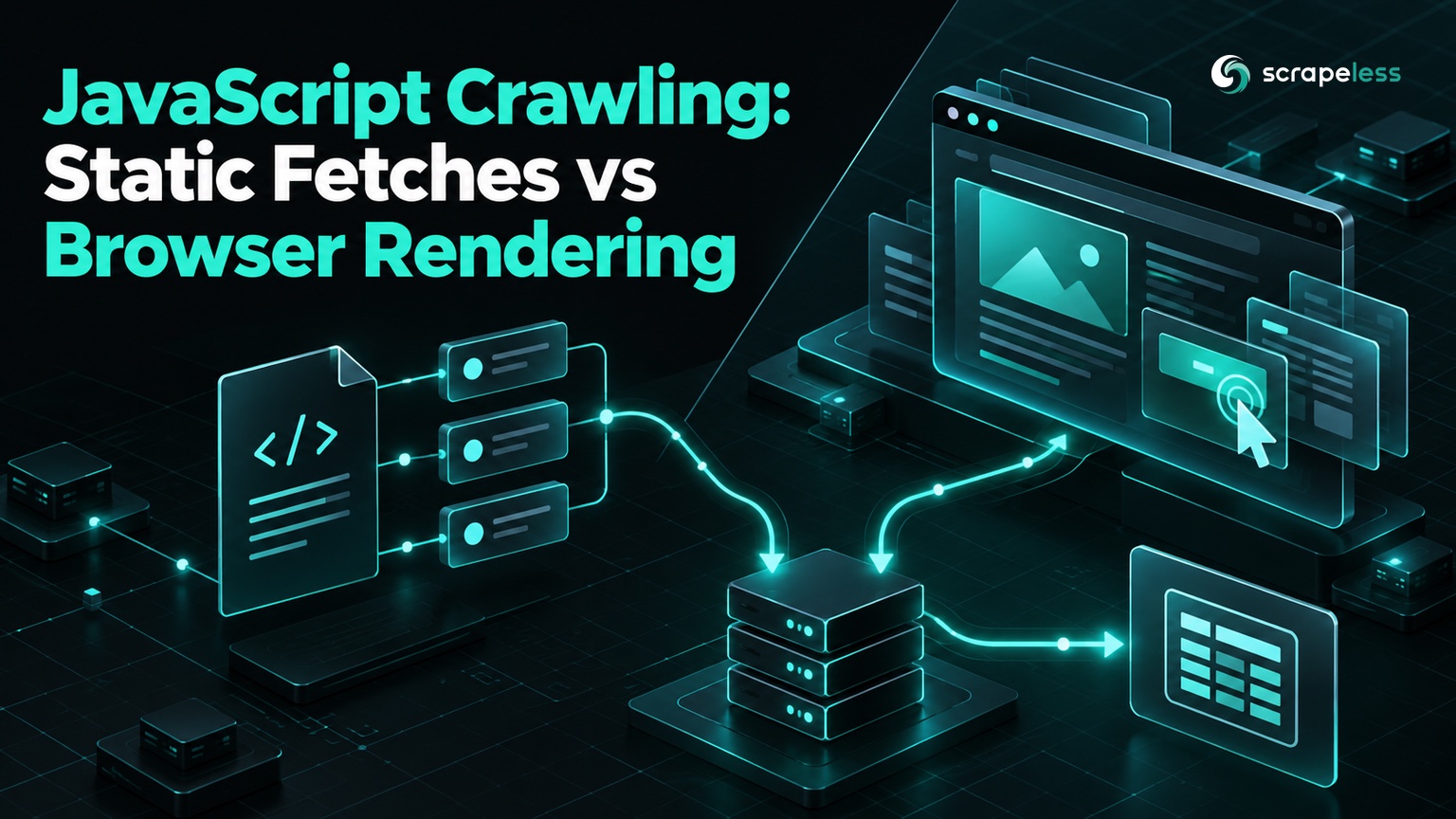
JavaScript Crawling: Static Fetches vs Browser Rendering

Senior Web Scraping Engineer
TL;DR:
- JavaScript crawling is URL discovery and data acquisition across pages whose useful state may appear after scripts run. It combines crawl-frontier discipline with a browser only where rendering is necessary.
- Static fetches should remain the default for complete HTML responses. They use fewer resources and make status, redirects, and content inspection straightforward.
- Browser rendering is required when the initial response is only an application shell. It can expose client-rendered routes, lazy-loaded lists, and content revealed by approved interaction.
- Do not choose one engine for an entire domain. Classify templates and route each one through static or browser acquisition while keeping a shared extraction schema.
- Agent Browser moves browser execution out of the crawler process. The crawler can retain its queue, scope, and storage design while Scrapeless operates remote browser sessions.
What Is JavaScript Crawling?
JavaScript crawling is the process of discovering and visiting web pages when scripts may determine the final document, links, or data. The crawler still needs a frontier: a controlled queue of URLs with deduplication, scope rules, and visit state. A browser is an acquisition tool inside that system, not a replacement for crawl control.
This separates two related tasks:
- Crawling decides which approved URL to visit next and prevents the job from escaping its boundary.
- Scraping extracts fields or documents from the acquired page state.
A crawler may discover links from static HTML, rendered DOM nodes, sitemaps, or application data. Every discovered URL should pass the same normalization and scope checks before it enters the queue.
Static Fetching vs Browser Rendering
| Decision point | Static HTTP fetch | Browser rendering |
|---|---|---|
| Executes page JavaScript | No | Yes |
| Best input | Complete server-rendered HTML | Application shell or interaction-dependent page |
| Resource use | Lower | Higher |
| Page interaction | None | Click, scroll, type, and navigation events |
| Debug surface | Response, headers, parser | DOM, network, console, browser state |
| Crawl queue | Application-owned | Application-owned |
| Typical failure | Missing fields in HTML | Wrong readiness condition or unbounded interaction |
The browser document is built from markup and script-driven changes. The HTML scripting model explains how scripts run in a browsing context, while the DOM Standard defines the tree that extraction code reads.
The practical question is simple: does the initial response already contain the fields or links the crawler needs? If yes, use the static path. If not, identify the specific browser state that exposes them.
How to Diagnose a JavaScript-Rendered Page
Inspect one representative URL from each template. Save the response body and compare it with the visible page or rendered DOM.
Signs that a static fetch may be enough:
- The article, product rows, and pagination links appear in the response HTML.
- Structured data or embedded application state contains the approved fields.
- The visible page differs only in styling or optional widgets.
Signs that browser rendering may be necessary:
- The response contains a root element but no meaningful page content.
- Links or rows appear only after a client request finishes.
- The next page requires a button, scroll event, or client-side route transition.
- The target state depends on cookies or a legitimate public session established in the browser.
Do not infer readiness from a fixed delay. Define a state: a stable row count, a visible heading, a known network response, or the disappearance of a loading indicator. Fixed sleeps make a crawler slow on fast pages and unreliable on slow ones.
Design One Crawl Frontier With Two Acquisition Paths
A robust design keeps URL control outside both the HTTP client and the browser worker.
- The frontier stores normalized URLs and template classifications.
- A router selects static fetch or browser rendering.
- The acquisition worker returns a common envelope: requested URL, final URL, status, content type, capture time, and page representation.
- The extractor produces the same record schema for both paths.
- Validators decide whether the record and newly discovered links can continue.
This prevents browser logic from becoming an uncontrolled recursive crawler. It also makes cost visible: teams can count which templates require rendering instead of treating the entire site as a browser workload.
The Static Crawling Path
Use static acquisition when the server response is complete. Validate redirects and media types before parsing. Preserve canonical URLs when they are consistent with project policy, and normalize discovered links before adding them to the frontier.
Static parsers are well suited to articles, documentation pages, catalog pages rendered on the server, and XML sitemaps. They also make it easier to compare source changes because the raw response is a stable artifact.
Follow HTTP semantics when interpreting success, redirection, and representation metadata. The HTTP Semantics specification is the reference for those rules.
The Browser Crawling Path
Use browser acquisition when scripts construct the required state. A browser worker should receive a bounded job description:
- one approved URL;
- the expected readiness condition;
- the permitted interactions;
- the extraction target;
- the maximum navigation scope;
- the output envelope required by the crawler.
Scrapeless Agent Browser exposes a managed browser through a CDP WebSocket endpoint. Playwright, Puppeteer, and other compatible clients can connect while the application retains its crawl frontier and extraction logic.
The Agent Browser introduction describes the connection model. The JavaScript web scraping guide provides a closer comparison of parsing and browser automation.
Start Scraping with Scrapeless
Power up your web scraping and automation workflow with Scrapeless!
Sign up today and get $5 in free credit — no credit card required.Claim your free credit now in the Scrapeless Dashboard.
Crawling Single-Page Applications
Single-page applications change routes without loading a traditional document for every view. The crawler must decide whether a client-side route represents a distinct page and how to express it as a canonical URL.
Prefer stable, shareable URLs. Ignore ephemeral state such as open panels, temporary filters, and session tokens unless the data contract explicitly requires them. If an application exposes the same entity through several UI paths, select one canonical route and use content-level deduplication as a second defense.
Browser history events can reveal route changes, but every new URL still needs host and path validation. A client-side navigation should never circumvent the crawler's scope policy.
Handling Infinite Scroll and Lazy Loading
Infinite scroll is not an instruction to keep scrolling. Define an end condition before execution:
- a known item limit for the project;
- a maximum approved page boundary;
- a repeated cursor or item ID;
- a visible end-of-results marker;
- no additional unique items after the page reports completion.
Extract unique item identifiers as each batch appears. Store the discovery source and ordering information separately from the item record. This avoids rebuilding one enormous DOM and makes duplicate detection explicit.
If the application offers stable pagination or a documented public data route, prefer that boundary over UI scrolling. Browser automation should reproduce only the interaction needed to reach approved content.
Rendering Does Not Replace Crawl Governance
A browser can follow links and click controls, but it does not decide whether those actions belong in the project. Keep allowlists, deny rules, request budgets, and privacy checks in the orchestration layer.
Google documents dynamic rendering as a workaround rather than a general recommendation for sites serving crawlers, which illustrates a broader point: rendering is a processing choice, not the definition of crawling. See the dynamic rendering guidance for the search-engine context.
For browser control, the W3C WebDriver specification defines a standard remote-control model. CDP-based tools expose different primitives, but both approaches still need application-level scope and validation.
Operational Differences That Affect the Architecture
Browser workers consume more memory and CPU, maintain cookies and storage, and produce additional diagnostic data. They also create state that must be isolated between jobs. A production design should therefore make browser capacity, session ownership, and cleanup visible.
Static fetch workers are easier to scale horizontally and are suitable for the majority of pages when content is server-rendered. Browser workers should be reserved for templates that need them. This is not merely a cost decision; it reduces the number of components in each request.
Keep these metrics by template rather than only by domain:
- acquired pages and validated records;
- static versus browser routing share;
- extraction completeness;
- duplicate rate;
- out-of-scope links rejected;
- browser session duration and page count;
- failures grouped by readiness condition.
A Practical Decision Matrix
| Page behavior | Recommended path | Readiness rule |
|---|---|---|
| Required text exists in response HTML | Static fetch | Expected status, media type, and selector |
| HTML is an empty application shell | Browser | Required content node is visible and populated |
| More items load after an approved click | Browser | Unique item count increases, then an end rule is met |
| Pagination links exist in markup | Static fetch | Next URL passes scope and normalization checks |
| Client-side route exposes a stable URL | Browser discovery, then classify target | Final URL and content identity are valid |
| Download link resolves to a document | Static file path | Expected file type and size policy |
Classification can change when a site template changes. Sample representative pages regularly and alert when a static route stops containing the required fields or a browser route begins producing a different document structure.
Conclusion: Render Only the State You Need
JavaScript crawling works best when the crawl frontier stays deterministic and browser behavior stays bounded. Inspect the initial response, classify templates, define explicit readiness conditions, and return one common acquisition envelope to the extraction layer.
Start with the static path. Add Agent Browser for the templates that truly need scripts or interaction. That division keeps the crawler easier to audit and prevents rendering concerns from taking over URL discovery and data quality.
Add Managed Rendering to a Controlled Crawler
Review Scrapeless pricing, explore Agent Browser, or join the Scrapeless Discord community and Telegram community.
FAQ
Q: What is the difference between JavaScript crawling and web scraping?
Crawling manages URL discovery, scope, and visit state. Scraping extracts data from an acquired page. A JavaScript crawler may use a browser for some URLs, but it still needs a controlled frontier.
Q: How can I tell whether a page needs browser rendering?
Compare the initial HTTP response with the visible page. If the required fields and links are present in the response, use static parsing. If scripts create them later, define a browser readiness condition.
Q: Is browser crawling always slower than static crawling?
A browser performs more work because it runs a page environment and executes scripts. The relevant comparison is whether the acquisition method returns the required state. Use the browser only where static HTML is incomplete.
Q: Can one crawler mix static and browser requests?
Yes. Keep one frontier and route templates to different acquisition workers. Return the same metadata envelope and extraction schema from both paths.
Q: How should infinite scroll be crawled?
Use an approved item or page limit, deduplicate by stable identifiers, and stop on a defined end condition. Do not scroll without a boundary.
Q: Does Agent Browser discover URLs automatically?
Agent Browser operates browser sessions. Your crawler or agent should still own scope, URL normalization, scheduling, extraction, and storage decisions.
At Scrapeless, we only access publicly available data while strictly complying with applicable laws, regulations, and website privacy policies. The content in this blog is for demonstration purposes only and does not involve any illegal or infringing activities. We make no guarantees and disclaim all liability for the use of information from this blog or third-party links. Before engaging in any scraping activities, consult your legal advisor and review the target website's terms of service or obtain the necessary permissions.