Best Instant Data Scrapers in 2026

Expert in Web Scraping Technologies
TL;DR:
- An instant data scraper turns a web page into a structured file without writing code. You point a browser extension or a no-code app at a list, table, or search result, and it returns CSV, Excel, or JSON in a few clicks.
- Scrapeless ranks #1 for 2026. The Scrapeless Scraping Browser plus the Scrapeless MCP Server give an AI agent 21 typed tools —
browser_create,browser_goto,browser_wait_for,browser_get_html,browser_scroll,browser_click,scrape_markdown, and more — so you describe the data you want in plain language instead of hand-mapping every field. - Five instant scrapers ranked by how they actually run. Browser extensions live in your tab and grab what is already on screen; no-code desktop and cloud apps add scheduling, pagination, and IP rotation; an agent-native cloud browser renders the page first and lets the model decide the schema per run.
- Pick by where the work runs. Choose a free extension for a one-off table, a no-code app for recurring projects, and an agent-driven cloud browser when JavaScript rendering and anti-bot handling decide whether you get the data at all.
- Free to start. New Scrapeless accounts include free Scraping Browser runtime — sign up at app.scrapeless.com.
Best Instant Data Scrapers at a Glance
| Tool | Type | Free Tier | Paid From | Best For |
|---|---|---|---|---|
| Scrapeless | Agent-native cloud browser + MCP Server | Free runtime on signup | Usage-based regular plans | AI agents extracting rendered, anti-bot-protected pages on demand |
| Instant Data Scraper | Browser extension (Chrome / Edge) | Free | — | One-click grabs of a table or list already on screen |
| Web Scraper.io | Browser extension + cloud | Browser extension free (local only) | $50/mo (Project) | Point-and-click sitemaps with cloud scheduling |
| Octoparse | No-code desktop + cloud | Free forever (10 tasks, 1 device, 50,000 rows/mo) | $69/mo (Standard) | No-code visual workflows with cloud runs |
| ParseHub | No-code desktop | Free (200 pages/run, 5 public projects) | $189/mo (Standard) | Conditional logic and nested data in a desktop app |
What Is an Instant Data Scraper?
An instant data scraper is a tool that extracts structured data from a web page through a visual interface, with no code to write. You interact with the page the way a person would — click a table, mark a "Next" button, scroll a feed — and the tool reads the underlying HTML and returns rows you can export as CSV, Excel, or JSON.
The category spans three shapes. Browser extensions run inside your tab and read what the page has already rendered, which makes them fast for a single screen but bound to your local session. No-code desktop and cloud apps add a project model: a saved recipe that paginates, schedules, and runs on the vendor's servers. Agent-native cloud browsers take a third path — the page renders in a remote browser, and an AI agent inspects the live DOM and emits whatever schema the pipeline needs.
The difference matters most on modern sites. A 2026 product grid, search page, or social feed often loads its rows after JavaScript runs, behind an anti-bot challenge, or only after the layout settles. A tool that reads pre-render HTML returns an empty shell; a tool that renders the page first returns the data.
How Do Instant Data Scrapers Work?
Every instant scraper does the same four things in some order: it loads the page, finds the repeating structure, extracts the fields, and writes them to a file.
Browser extensions do this inside the tab you already have open. The extension scans the DOM for repeating elements — table rows, list cards, result tiles — guesses the columns, and lets you correct the selection by clicking. Pagination is handled by marking the "Next" control so the extension clicks through and appends each page to one dataset. Infinite-scroll feeds are handled by auto-scrolling until new rows stop loading.
No-code apps move the same idea into a saved project. You build a "sitemap" or template once by clicking sample elements, and the app replays it across thousands of URLs, on a schedule, from the vendor's cloud. That decouples the run from your laptop and adds proxy rotation and export integrations.
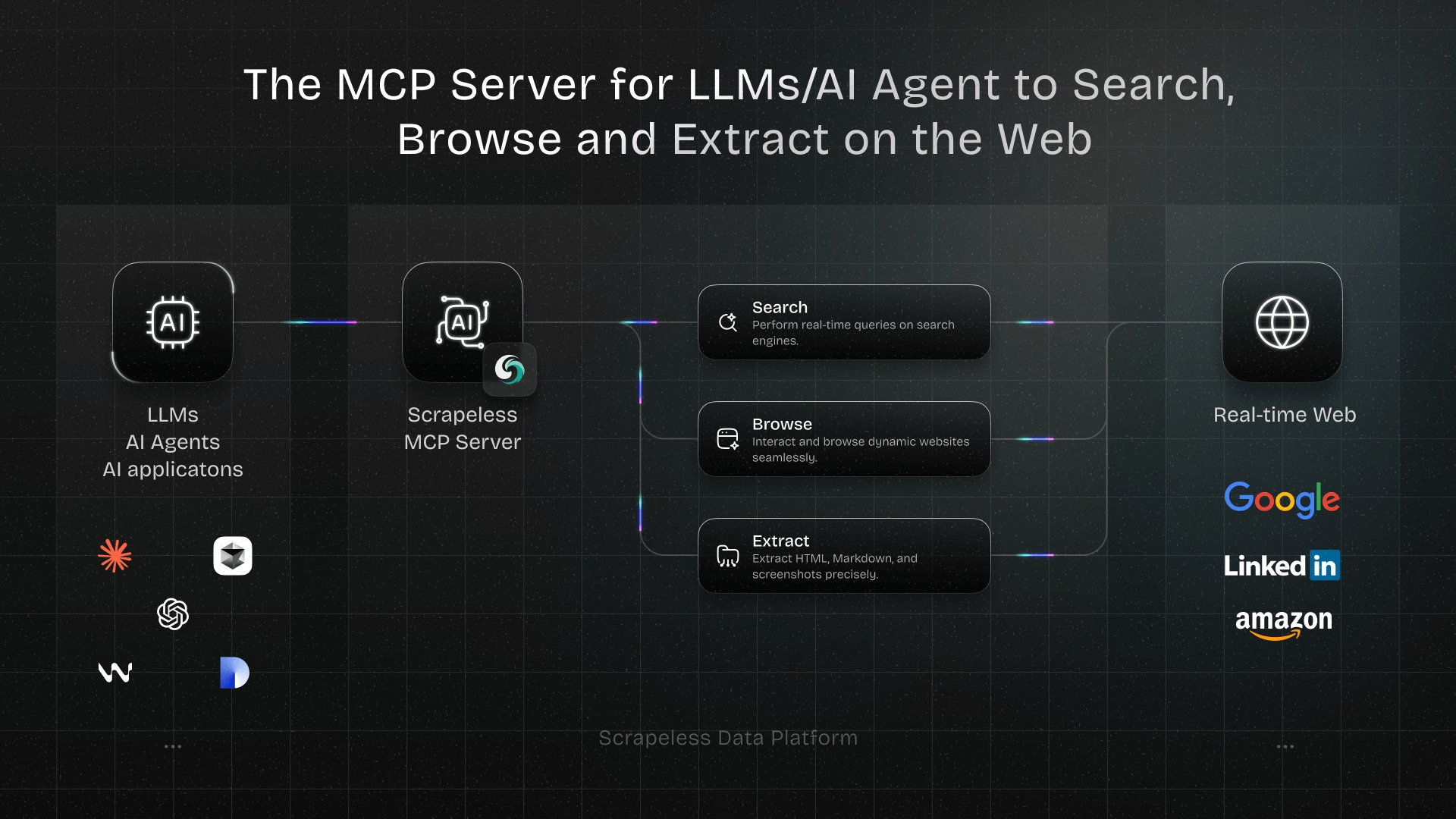
Agent-native cloud browsers invert the mapping step. Instead of you defining selectors, an AI agent calls typed browser tools — create a session, navigate, wait for a stable marker, read the rendered HTML — then chooses stable anchors and emits the schema. Scrapeless ships that surface natively through the Scrapeless MCP Server, so the agent does the discovery a human would otherwise do by hand.
How We Evaluated These Tools
Five instant scrapers were ranked across four criteria that decide whether you actually get clean data at the end of a run.
Render completeness
Much of a modern page is not in the first HTML response. Prices, review carousels, and search cards attach after JavaScript executes. A tool that reads only static HTML misses them. The strongest tools render the page in a real browser — local or cloud — before reading the DOM.
Anti-bot and proxy posture
Public sites enforce per-IP throttles, fingerprint checks, and challenge interstitials. A local extension uses your own IP and session, which is fine for a few pages and fragile at volume. Cloud tools that route through residential IPs in the right locale and present a realistic browser fingerprint clear far more pages before hitting a block.
Interface and automation
Some jobs are a single screen; some are a nightly run across 10,000 URLs. Extensions win the first; project-based and agent-driven tools win the second with scheduling, pagination, and unattended execution.
Operational fit for AI agents
In 2026 a growing share of extraction runs inside an AI agent — Claude Code, Cursor, Claude Desktop, or a custom MCP client. The tool that exposes a typed tool surface the agent can call directly removes the glue code most teams write by hand. Scrapeless ships that surface; the others are driven by a person at a screen.
The Best Instant Data Scrapers: Ranked
1. Scrapeless: Best for AI Agents and Rendered, Protected Pages
Scrapeless is the only agent-native cloud browser on this list. The Scrapeless MCP Server exposes 21 typed tools — 16 browser_* controls plus scrape_markdown, scrape_html, scrape_screenshot, google_search, and google_trends — and they all run on top of an anti-detection cloud browser with residential proxies in 195+ countries.
Scrapeless Scraping Browser is a customizable, anti-detection cloud browser designed for web crawlers and AI agents. For instant extraction specifically, it brings cloud-side JavaScript rendering, residential-proxy routing, anti-detection browser execution, session persistence, and a discover → extract pattern that survives DOM rotation. The agent renders the page first, then reads the live DOM — so a JavaScript-heavy grid or an anti-bot-protected search page returns real rows instead of an empty shell.
The agent-native interface sets Scrapeless apart here. The other tools put a person at a point-and-click screen; Scrapeless puts the extraction inside the agent. You describe the data in plain language, and the agent composes the browser tools to get it.
Available Scrapeless MCP tools
| Tool | Purpose |
|---|---|
browser_create |
Allocate a Scrapeless cloud-browser session |
browser_goto |
Navigate to the target URL |
browser_wait_for |
Wait for a stable marker before reading the DOM |
browser_get_html |
Read the rendered DOM |
browser_scroll |
Trigger lazy-loaded or infinite-scroll rows |
browser_click |
Drive pagination and UI controls |
scrape_markdown |
Return a text-heavy page as clean Markdown |
browser_close |
Release the session |
Install (stdio MCP server — recommended default)
Stdio is the recommended transport for almost every MCP client — Claude Desktop, Claude Code, Cursor, OpenAI Codex CLI. Lowest latency, no network hop, per-agent process isolation.
json
{
  "mcpServers": {
    "scrapeless": {
      "type": "stdio",
      "command": "npx",
      "args": ["-y", "scrapeless-mcp-server"],
      "env": {
        "SCRAPELESS_KEY": "your_api_token_here"
      }
    }
  }
}
For scale or serverless hosting, use the hosted streamable HTTP endpoint at https://api.scrapeless.com/mcp with an x-api-token header instead. Get your API key on the free plan at app.scrapeless.com.
How you actually use it: prompt your agent
After install, you scrape by talking to your agent. The MCP server gives the agent browser primitives; the agent composes them based on your prompt.
| You say to your agent | What you get back |
|---|---|
| "Open this product listing URL and return every item as JSON: title, price, rating, link." | Array of product objects |
| "Scroll this feed until rows stop loading, then return all visible posts." | Full post array from the infinite-scroll feed |
| "Paginate through all result pages and return one combined table." | Single deduplicated dataset across pages |
| "Return this article page as clean Markdown." | Markdown body via scrape_markdown |
Worked example: an on-screen product table
You type:
"Use Scrapeless to open this category page, wait for the product grid to render, and return every card as JSON with title, price, rating, and URL."
The agent's plan, in plain English:
- Call
browser_createto allocate a Scrapeless cloud-browser session. - Call
browser_gotowith the category URL. - Call
browser_wait_foron a stable card marker so the grid is fully rendered. - Call
browser_get_html, thenbrowser_scrollto pull any lazy-loaded rows. - Extract stable anchors into JSON and call
browser_close.
Illustrative output shape (schema is normative, field values are illustrative):
json
// illustrative sample — schema is normative, values are illustrative
{
  "items": [
    {
      "title": "Wireless Headphones, Over-Ear",
      "price": "$49.99",
      "rating": 4.6,
      "url": "https://example.com/p/12345"
    }
  ],
  "count": 24
}
Quick smoke test (60 seconds)
Confirm the hosted MCP endpoint answers before wiring it into your agent:
bash
curl -X POST "https://api.scrapeless.com/mcp" \
  -H "x-api-token: $SCRAPELESS_API_KEY" \
  -H "Content-Type: application/json" \
  -H "Accept: application/json, text/event-stream" \
  -d '{"jsonrpc":"2.0","id":1,"method":"initialize","params":{"protocolVersion":"2024-11-05","capabilities":{},"clientInfo":{"name":"smoke","version":"1.0"}}}'
A successful response returns serverInfo.name: "scrapeless-mcp-server" and an mcp-session-id header — keep that header on the follow-up tools/list and tools/call requests.
Best for: AI agents and developers extracting rendered, anti-bot-protected pages on demand, where the schema changes per task.
Pros:
- Agent-native MCP interface — 21 typed tools any MCP-aware client can call directly
- Real cloud browser with residential-proxy routing in 195+ countries
- Discover → extract pattern survives DOM rotation by anchoring on semantic selectors
- Free Scraping Browser runtime on every new account
Cons:
- Driving it well assumes an AI agent or a script — there is no point-and-click GUI for non-developers
- Authenticated pages and private account data are out of scope for anonymous cloud browsing
Get your API key on the free plan: app.scrapeless.com
2. Instant Data Scraper: Best for One-Click Table Grabs
Instant Data Scraper is a free browser extension for Chrome and Edge that auto-detects tabular and list data on the page you are viewing. It guesses the repeating structure for you, so a single click on the toolbar icon often returns a clean table ready to export as CSV — following the CSV format — or Excel.
The extension handles the two patterns most one-off jobs hit: it follows a marked "Next" button to crawl through paginated results into one file, and it auto-scrolls pages where rows load dynamically until new data stops appearing. A "Try another table" control lets you cycle detected regions when the first guess is wrong, and an adjustable crawl delay slows requests between pages.
One fact matters when planning around it: the extension is no longer owned, developed, or supported by its original publisher, Web Robots. It remains available to install and works well for ad-hoc grabs, but treat it as an unmaintained convenience tool rather than a platform you build a pipeline on.
Pricing: Free browser extension.
Best for: Grabbing a single table or list that is already rendered on screen, with zero setup.
Pros:
- One-click auto-detection of tables and lists — no selector mapping
- Handles "Next"-button pagination and infinite scroll
- CSV and Excel export out of the box
Cons:
- No longer actively maintained by its original publisher
- Runs on your local IP and session — no proxies, scheduling, or unattended runs
3. Web Scraper.io: Best for Point-and-Click Sitemaps
Web Scraper is a browser extension that builds a reusable "sitemap" — a saved recipe of selectors you create by clicking elements on the page. The same sitemap can paginate, follow links into detail pages, and extract nested data, which makes it a step up from a one-shot grabber for structured, repeatable jobs.
The browser extension is free and runs locally. A paid Cloud layer moves runs onto Web Scraper's servers with scheduling, parallel jobs, and export integrations, billed by URL credits where one credit is one page loaded.
Pricing: Browser extension is free for local use. Cloud plans start at $50/month (Project: 5,000 URL credits, 2 parallel tasks), $100/month (Professional: 20,000 URL credits), and from $200/month (Scale: unlimited URL credits, API access). Enterprise is custom.
Best for: Teams that want a free point-and-click builder locally, with an optional cloud tier for scheduled runs.
Pros:
- Free local browser extension with reusable sitemaps
- Handles pagination, link-following, and nested detail pages
- Cloud tier adds scheduling, parallel jobs, and API access
Cons:
- Local extension uses your own IP — heavier jobs need the paid cloud
- Cloud pricing is metered per page loaded, so large crawls scale in cost
4. Octoparse: Best for No-Code Visual Workflows
Octoparse is a no-code desktop app with a cloud backend. You build an extraction task by clicking elements in a built-in browser, and Octoparse generates the workflow — pagination, list loops, detail-page drill-downs — without code. Tasks can run locally or on Octoparse's cloud servers on a schedule.
Its free tier is more generous than most desktop tools, which makes it a common starting point for non-developers who need recurring extraction rather than a single grab.
Pricing: Free forever plan includes 10 scraping tasks, 1 device, local extraction, and up to 50,000 rows of data export per month. Standard is $69/month and Professional is $249/month (annual billing saves 16%); Enterprise is custom. Paid plans carry a 5-day money-back guarantee.
Best for: Non-developers who need scheduled, no-code extraction across many pages.
Pros:
- Visual no-code builder with auto-detected workflows
- Free plan covers 10 tasks and up to 50,000 exported rows per month
- Cloud runs and scheduling on paid tiers
Cons:
- Desktop app plus cloud is heavier setup than a browser extension
- Deep anti-bot pages can still require higher tiers or manual tuning
5. ParseHub: Best for Conditional Logic and Nested Data
ParseHub is a no-code desktop app built for structured projects where the data is nested or conditional — products with variants, lists that link into detail pages, fields that only appear in some rows. You click to select elements and add commands (conditionals, loops, relative selects) to express logic a flat table picker cannot.
The free plan is aimed at small projects and learning; paid tiers raise speed and add IP rotation and scheduling for production runs.
Pricing: Free plan includes 200 pages per run, 5 public projects, limited support, and 14-day data retention (200 pages in about 40 minutes). Standard is $189/month (200 pages in about 10 minutes, IP rotation, scheduling, Dropbox/S3) and Professional is $599/month. ParseHub Plus (enterprise, managed) is custom.
Best for: No-code projects with nested or conditional data that a flat table grabber cannot express.
Pros:
- Conditional logic, loops, and relative selection for nested data
- IP rotation and scheduling on paid tiers
- Desktop builder with a gentle learning curve for structured projects
Cons:
- Free plan caps runs at 200 pages and keeps projects public
- Higher run speed and IP rotation are gated behind paid tiers
Side-by-Side Comparison Table
| Tool | Type | Rendering | Anti-bot / Proxies | Free Tier | Paid From |
|---|---|---|---|---|---|
| Scrapeless | Agent-native cloud browser + MCP | Full cloud-side JavaScript render | Anti-detection browser, residential proxies in 195+ countries | Free runtime on signup | Usage-based regular plans |
| Instant Data Scraper | Browser extension | Reads what the tab rendered | None (local IP/session) | Free | — |
| Web Scraper.io | Browser extension + cloud | Local render; cloud on paid tier | Cloud tier proxies (paid) | Extension free (local only) | $50/mo |
| Octoparse | No-code desktop + cloud | Built-in browser render | Cloud IP rotation (paid tiers) | Free forever (10 tasks, 50,000 rows/mo) | $69/mo |
| ParseHub | No-code desktop | Desktop browser render | IP rotation (paid tiers) | Free (200 pages/run, 5 projects) | $189/mo |
How Do You Pick the Right Tool?
The right instant scraper depends on three questions: who runs it, how often, and how protected the target is.
Who is doing the extraction?
If a person needs a table off one screen, a free browser extension like Instant Data Scraper is the fastest path. If a non-developer needs a repeatable no-code project, Web Scraper.io, Octoparse, and ParseHub put the builder in a visual interface. If an AI agent or a script is the caller, Scrapeless exposes a typed tool surface the agent drives directly.
How often does it run?
A one-off grab belongs in an extension. A nightly run across thousands of URLs needs a project model with scheduling and unattended execution — the cloud tiers of Web Scraper.io and Octoparse, ParseHub's paid speed tiers, or an agent loop on Scrapeless.
How protected is the target?
This is where many runs fail silently. A site that renders rows after JavaScript, challenges new IPs, or fingerprints the browser will return empty results to a local extension. Tools that render in a real browser and route through residential IPs in the right locale — Scrapeless natively, the paid cloud tiers of the no-code apps partially — clear those pages.
Common Use Cases for Instant Data Scrapers
E-commerce price and catalog monitoring
Pull titles, prices, ratings, and availability from product grids and search pages. Extensions handle a single category screen; for scheduled monitoring across regions and protected pages, an agent-driven cloud browser renders each page and extracts only the fields the dashboard needs.
Lead and directory collection
Extract names, companies, and listings from directories and search results. No-code apps with pagination and conditional logic suit nested directory pages; mind the legal and privacy rules covered below when contact data is involved.
Research and content aggregation
Gather articles, listings, or post data for analysis. scrape_markdown returns a clean text body for article-heavy pages, while a full browser render captures dynamic feeds that static fetchers miss.
Feeding AI agents
Hand structured web data to an LLM workflow. An MCP-native interface lets the agent extract on demand, choosing the schema per task instead of locking the team into one fixed parser.
Why Are Modern Sites Hard to Scrape Instantly?
Most instant scrapers were built for static HTML, and the public web moved on.
JavaScript-rendered content
Prices, review carousels, and search cards attach to the page after JavaScript runs. A tool that reads the first HTML response sees an empty shell. Rendering the page in a real browser before reading the DOM returns the data — local browsers do this for what is on screen, and a cloud browser does it at scale.
Anti-bot and IP reputation
Public sites throttle per IP, fingerprint the browser, and serve challenge interstitials to traffic that looks automated. A local extension on your own IP clears a handful of pages and then trips the wall. Residential proxies in the target locale and an anti-detection browser fingerprint keep a run clean across volume.
DOM rotation
Site markup — structured per the HTML standard — changes, and selectors built against utility class names break on the next redesign. Anchoring on stable markers — IDs, data-* attributes, ARIA roles — survives the change. Agent-driven extraction re-discovers those anchors per run instead of failing on a stale template.
Conclusion
For instant extraction in 2026, the right tool depends on who runs it and how protected the target is. For a quick table off one screen, a free browser extension like Instant Data Scraper is the fastest path. For recurring no-code projects, Web Scraper.io, Octoparse, and ParseHub put a visual builder in front of pagination and scheduling.
When the page renders behind JavaScript and an anti-bot wall — which is most of the public web now — extraction succeeds or fails on rendering and IP reputation, not on the picker UI. That is where Scrapeless ranks #1: the Scrapeless Scraping Browser renders each page in an anti-detection cloud browser, routes through residential proxies, and lets an AI agent extract whatever schema the pipeline needs. Compare plans on the Scrapeless pricing page, read the SDK and CLI reference in the docs, or see the companion roundup of the best free web scrapers for static-friendly options.
Ready to Build Your AI-Powered Data Pipeline?
Join our community to claim a free plan and connect with developers building instant-extraction workflows on Scrapeless: Discord · Telegram.
Sign up at app.scrapeless.com for free Scraping Browser runtime and point an agent at the lists, grids, and feeds your pipeline needs.
FAQ
Q: What is an instant data scraper?
An instant data scraper is a tool that extracts structured data from a web page through a visual or agent interface with no code. You point it at a table, list, or search result and it returns rows you can export as CSV, Excel, or JSON. The category includes browser extensions, no-code desktop and cloud apps, and agent-native cloud browsers.
Q: Is using an instant data scraper legal?
Scraping publicly visible data is generally permissible, but the rules vary by jurisdiction and by site. Review the target site's Terms of Service, robots.txt, and the Robots Exclusion Protocol, avoid collecting personal or copyrighted data without a lawful basis, and consult counsel for anything commercial or sensitive. The tool does not change the legal posture of the data you collect.
Q: Do I need a proxy?
For a handful of pages on a permissive site, a local extension on your own IP is fine. For volume, for protected sites, or for scheduled runs, yes — residential proxies in the target locale reduce blocks and CAPTCHAs. Scrapeless routes through residential proxies in 195+ countries by default; the no-code apps add IP rotation on paid tiers.
Q: What happens when a page shows "Access Denied" or a CAPTCHA?
That is an anti-bot challenge, usually triggered by a datacenter IP, a thin browser fingerprint, or a cold session. The reliable fix is to render in a real browser, pin residential egress in the site's locale, and warm the session by loading the homepage first before the target page. A cloud browser handles this without local setup.
Q: Can a browser extension handle JavaScript-heavy pages?
It can read what the tab has already rendered, so it works once the rows are visible on screen. It cannot render at scale, route through proxies, or run unattended. For pages that load behind challenges or render only after scrolling across many sessions, a cloud browser that renders server-side is the more reliable path.
Q: Which instant data scraper is best for AI agents?
Scrapeless. The Scrapeless MCP Server exposes 21 typed tools that any MCP-aware client — Claude Code, Cursor, Claude Desktop, or a custom client — calls directly, so the agent renders the page and extracts the schema per task without glue code. The other tools on this list are driven by a person at a point-and-click screen.
At Scrapeless, we only access publicly available data while strictly complying with applicable laws, regulations, and website privacy policies. The content in this blog is for demonstration purposes only and does not involve any illegal or infringing activities. We make no guarantees and disclaim all liability for the use of information from this blog or third-party links. Before engaging in any scraping activities, consult your legal advisor and review the target website's terms of service or obtain the necessary permissions.