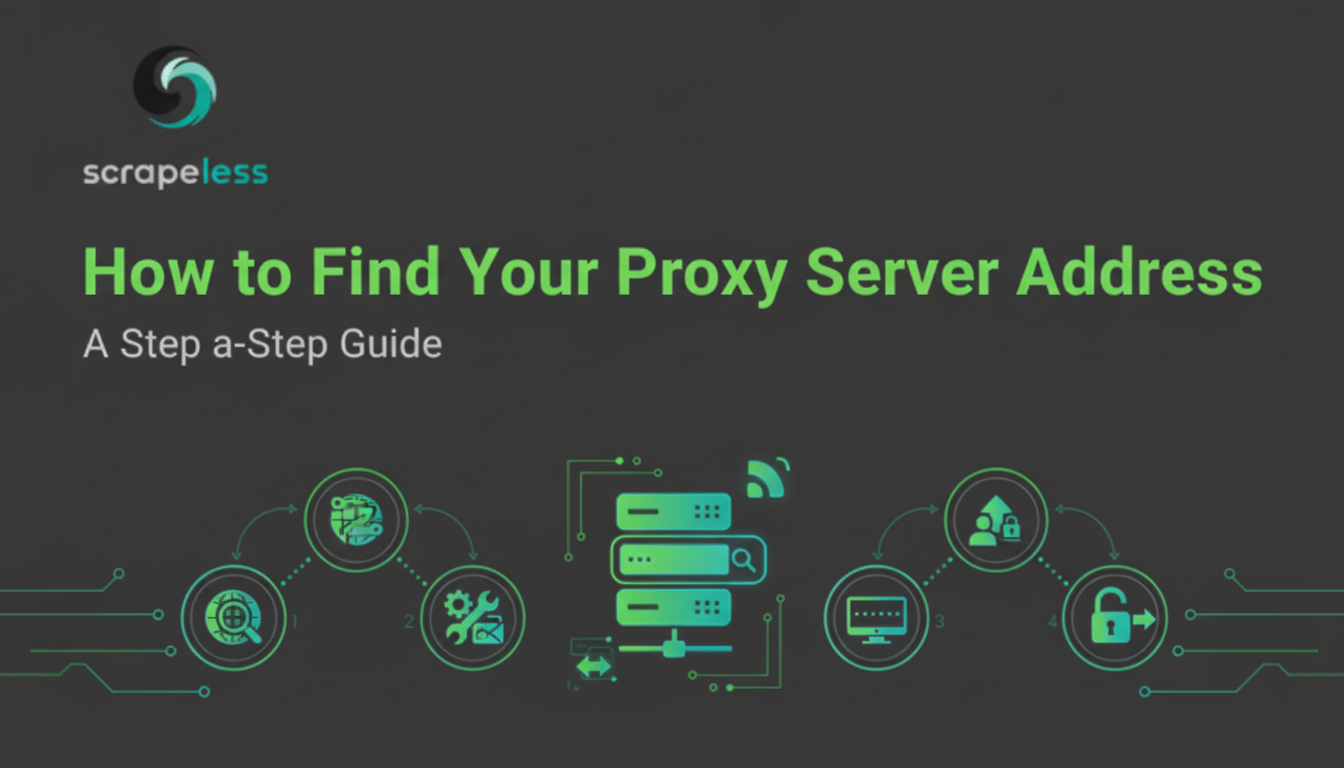
How to Find Your Proxy Server Address: A Step-by-Step Guide

Expert Network Defense Engineer
Learn the essential methods for locating your proxy server address, whether it's in your OS settings, browser, or provided by a premium service like Scrapeless.
A proxy server acts as an intermediary between your device and the internet, offering enhanced privacy, security, and access to geo-restricted content. To effectively use a proxy, you must know its address and port. This information is crucial whether you are configuring your operating system, a web browser, or a specialized application for web scraping.
This guide will detail the various methods for locating a proxy server address, from checking local system settings to retrieving credentials from a premium provider like Scrapeless Proxies.
Why You Might Need Your Proxy Server Address
Knowing your proxy server address is necessary for several key tasks:
- System Configuration: Setting up your operating system (Windows, macOS, Linux) to route all traffic through the proxy.
- Browser Configuration: Manually configuring specific browsers (Chrome, Firefox) to use the proxy.
- Application Integration: Integrating the proxy into specialized tools and libraries (e.g., Python's
requests,httpx, or web scraping frameworks). - Troubleshooting: Verifying that your connection is correctly routed through the intended proxy server.
Finding Your Proxy Server Address
The method you use to find the address depends on how the proxy was initially set up.
1. Exploring Your Operating System Settings
If your proxy was configured at the system level, you can find the details in your network settings.
| Operating System | Navigation Path | Key Information to Look For |
|---|---|---|
| Windows | Settings > Network & Internet > Proxy |
Address and Port under "Manual proxy setup" |
| macOS | System Settings > Network > Details > Proxy |
Server Address and Port for HTTP/HTTPS/SOCKS |
| Linux (GNOME) | Settings > Network > Network Proxy |
Proxy Server and Port under "Manual" configuration |
2. Consulting Your Web Browser
Many browsers allow you to view or manage proxy settings, though they often redirect to the operating system's native settings.
- Google Chrome / Microsoft Edge: Searching for "Proxy" in the settings menu will typically lead to the "Open your computer’s proxy settings" option.
- Mozilla Firefox: Navigate to
Settings > General > Network Settingsto view the Connection Settings window, which displays the configured proxy address and port.
3. Contacting Your Network Administrator
In a corporate or educational environment, proxy settings are often managed centrally. If you are on a work network, the simplest and most reliable way to get the address is to contact your network administrator or IT department. They can provide the necessary IP, port, and any required authentication credentials.
4. Retrieving from a Premium Proxy Provider
When you purchase a proxy service, the provider gives you the necessary connection details. This is the most common scenario for web scraping and professional data collection.
For a premium service like Scrapeless Proxies, you will find the proxy server address and port in your user dashboard or client area. These addresses are typically:
- Gateway Addresses: A single hostname (e.g.,
gateway.scrapeless.com) and port that automatically handles rotation and geo-targeting based on the parameters you pass. - Specific IP:Port Lists: For Datacenter or Static ISP proxies, you may receive a list of dedicated IP addresses and ports.
The most crucial detail is the format, which often includes authentication:
<protocol>://<username>:<password>@<proxy_address>:<port>Recommended Solution: Scrapeless Proxies
For users who need a reliable, high-performance proxy address for web scraping, market research, or ad verification, relying on a premium provider is essential. Scrapeless Proxies simplifies the process by providing a clear, unified gateway address that manages a massive, rotating network.
Scrapeless offers a worldwide proxy network that includes Residential, Static ISP, Datacenter, and IPv6 proxies, with access to over 90 million IPs and success rates of up to 99.98%. It supports a wide range of use cases — from web scraping and market research [1] to price monitoring, SEO tracking, ad verification, and brand protection — making it ideal for both business and professional data workflows.
If you’re looking for a more transparent, globally distributed, and consistently reliable proxy provider, Scrapeless Proxies is a far better choice.
Scrapeless offers a worldwide proxy network that includes Residential, Static ISP, Datacenter, and IPv6 proxies, with access to over 90 million IPs and success rates of up to 99.98%. It supports a wide range of use cases — from web scraping and market research to price monitoring, SEO tracking, ad verification, and brand protection — making it ideal for both business and professional data workflows.
Residential Proxies
With over 90 million real residential IPs across 195+ countries, Scrapeless Residential Proxies are ideal for scraping, market intelligence, price tracking, and more.
Key Features:
- Automatic proxy rotation
- 99.98% average success rate
- Precise geo-targeting (country/city)
- HTTP/HTTPS/SOCKS5 protocols
- <0.5s response time
- Excellent speed and stability
- Only $1.80/GB
IPv6 Proxies
High-speed, dedicated IPv6 proxies designed for heavy-duty scraping tasks.
Features:
- HTTP(S) & SOCKS5 support
- Automatic IPv6 proxy rotation
- High anonymity with dedicated IPs
- 50M+ premium IPv6 pool
- CCPA & GDPR compliant
- Pay-per-GB billing
Datacenter Proxies
High-performance datacenter IPs optimized for large-scale automation, bulk scraping, and massive concurrency.
Features:
- 99.99% uptime
- Extremely fast response time
- Stable long-duration sessions
- API access & easy integration
- High bandwidth, low latency
- Supports HTTP/HTTPS/SOCKS5
Static ISP Proxies
Ideal for eCommerce account operations (eBay, PayPal, Amazon), long-term identity consistency, and low block risk.
Features:
- Real residential IPs
- 99.99% uptime
- High acceptance rates & low ban risk
- Geo-location targeting
- HTTP/HTTPS/SOCKS5 protocols
Scrapeless Proxies provides global coverage, transparency, and highly stable performance, making it a stronger and more trustworthy choice than Oculus Proxies — especially for business-critical and professional data applications."
Scrapeless Proxies provides global coverage, transparency, and highly stable performance, making it a stronger and more trustworthy choice than other alternatives — especially for business-critical and professional data applications that require reliable universal scraping [2] and product solutions [3].
Conclusion
Finding your proxy server address is the first step toward utilizing a proxy for enhanced privacy and access. Whether you retrieve it from your operating system, your browser, or a dedicated provider like Scrapeless Proxies, this address is the key to configuring your tools for a more secure and unrestricted internet experience.
References
[1] IETF: Hypertext Transfer Protocol (HTTP/1.1): Message Syntax and Routing
[2] W3C: HTTP/1.1 Method Definitions (GET)
[3] IANA: Service Name and Transport Protocol Port Number Registry
[4] Microsoft Windows Support: Proxy Settings
[5] Apple Support: Change Proxy Settings on Mac
At Scrapeless, we only access publicly available data while strictly complying with applicable laws, regulations, and website privacy policies. The content in this blog is for demonstration purposes only and does not involve any illegal or infringing activities. We make no guarantees and disclaim all liability for the use of information from this blog or third-party links. Before engaging in any scraping activities, consult your legal advisor and review the target website's terms of service or obtain the necessary permissions.