How Do AI Agents Work? Architecture, Tools, Memory, and Web Access

Expert in Web Scraping Technologies
TL;DR:
- An AI agent is a controlled loop around a model. It receives a goal, observes state, plans an action, calls a tool, evaluates the result, and either continues or stops.
- The model does not provide the whole system. Tools, memory, orchestration, permissions, budgets, logs, and human approval are application components.
- Memory has several jobs. Working context holds the current task, durable stores preserve approved facts or history, and retrieval selects only relevant state for the next step.
- Tools turn text generation into action. Their schemas and permission boundaries determine what the agent can read or change.
- Scrapeless can supply current public web data to an agent. Its MCP Server and web-data products are tool and acquisition layers, not an agent builder or decision engine.
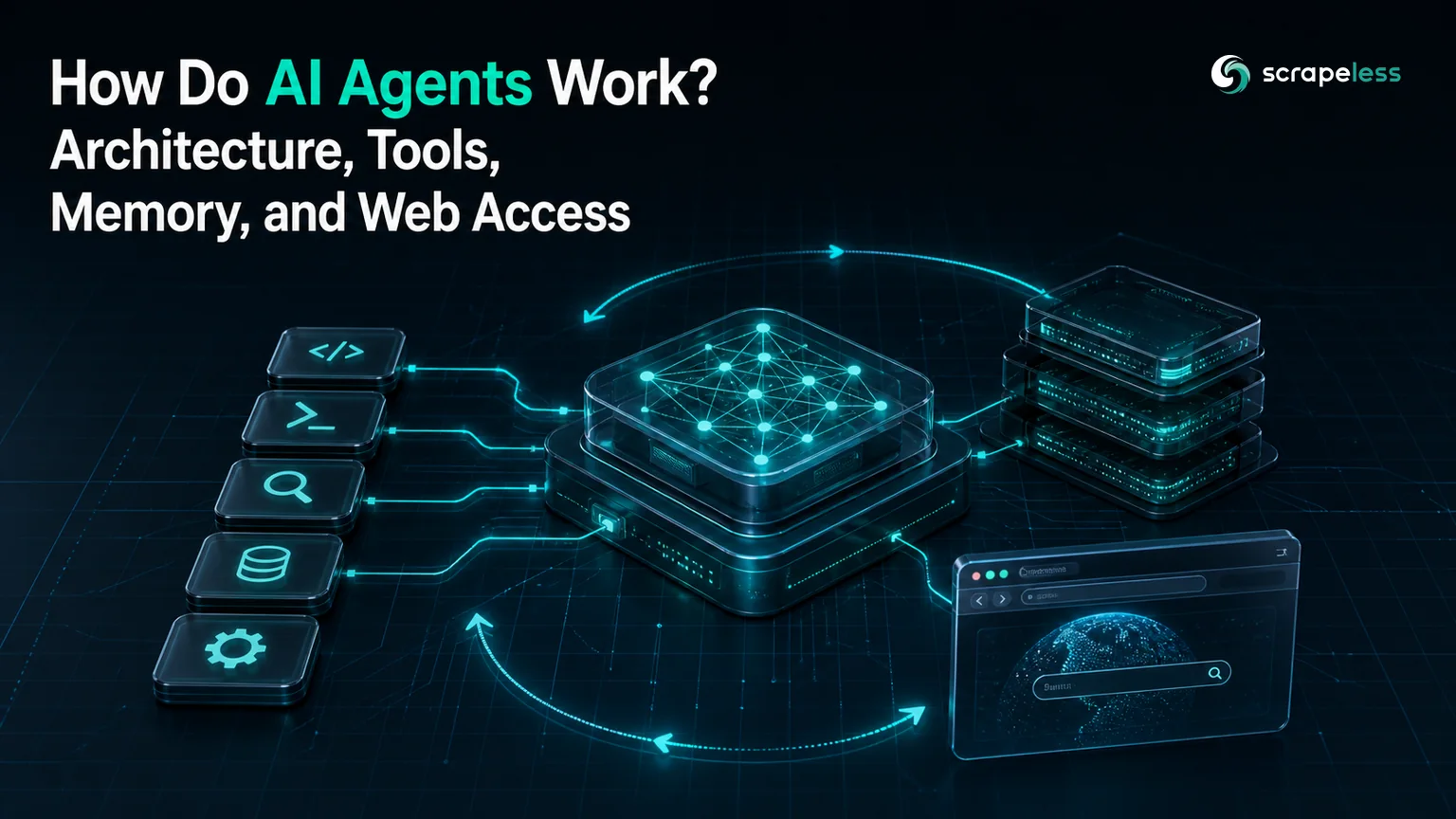
AI agents are often described as models that can act. That description leaves out the engineering controls that make action useful. A production agent is a software system in which a model proposes or selects steps inside an orchestrated loop, while the application controls tools, state, permissions, and stop conditions.
This guide explains that loop, the components around it, common agent types, and where fresh web access fits.
What Is an AI Agent?
An AI agent is a system that pursues a goal by observing its current state, choosing an action, using tools or producing output, and updating its next step from the result. The path can change during execution.
An agent differs from a single model call because it can take several bounded steps. It differs from a fixed workflow because at least one transition depends on model reasoning or evaluation rather than a prewritten branch alone.
There is no single mandatory architecture. A survey of autonomous language-model agents organizes common systems around profile, memory, planning, and action modules. The survey of large language model-based autonomous agents also describes evaluation and application patterns across the field.
How Do AI Agents Work Step by Step?
The simplest useful control loop has seven stages.
- Receive the goal. Parse the requested outcome, constraints, allowed data, deadline, and approval requirements.
- Observe state. Load the current task state, relevant memory, tool results, and environment signals.
- Plan the next step. Select an action or decompose the task into smaller steps.
- Call a tool or produce an answer. Invoke only a tool permitted for the task and pass validated arguments.
- Validate the result. Check the tool response against its schema and the task's acceptance condition.
- Update state. Save the useful result, remaining work, cost, and any new uncertainty.
- Continue, ask, or stop. The orchestrator applies the call budget, policy boundary, completion test, and human approval rules.
The model participates in planning and evaluation, but the runtime should enforce non-negotiable controls. For example, the model may suggest sending a message, while the application requires user approval before the messaging tool can execute.
AI Agent Architecture
| Component | Responsibility | Production question |
|---|---|---|
| Goal and instructions | Define the intended outcome and constraints | Is completion measurable? |
| Model | Interpret context and propose actions | Which decisions are delegated to the model? |
| Orchestrator | Run the loop and enforce policy | What stops repeated or unsafe actions? |
| Tool registry | Expose permitted capabilities | Are schemas narrow and descriptions unambiguous? |
| Memory and state | Preserve relevant task information | What is stored, retrieved, expired, or isolated? |
| Data acquisition | Retrieve current external information | How are freshness and provenance recorded? |
| Validator | Check outputs and tool results | What rejects incomplete or wrong representations? |
| Observability | Record actions, cost, latency, and outcomes | Can a reviewer reconstruct the run? |
| Human approval | Gate sensitive or irreversible steps | Which actions always need confirmation? |
The architecture should make model authority explicit. If the agent can only research and draft, its tool set should not include publishing or account-management actions. Least privilege is simpler than asking a prompt to remember every forbidden action.
Planning and Reasoning
Planning converts a goal into the next permitted action. A small agent may plan one step at a time. A longer task may begin with a task graph, then revise it as observations arrive.
Plans should be treated as working state, not as truth. Tool results can invalidate an assumption. A page may be unavailable, a record may already exist, or a required source may conflict with another source. The agent needs an explicit way to mark a step complete, revise it, request input, or stop.
Long plans are not automatically better. They consume context and can anchor the agent to an obsolete path. Use the shortest planning horizon that supports the task, then re-evaluate after meaningful observations.
AI Agent Tools
Tools let an agent query a database, search the web, retrieve a page, run code, read a file, or request an external action. Each tool should have:
- a specific name and description;
- a typed input schema;
- a typed success result;
- explicit error states;
- an authorization boundary;
- limits on scope, cost, and side effects;
- logs that identify the call and outcome.
The Model Context Protocol tools specification describes how servers can expose discoverable tools to compatible language-model clients. A protocol standardizes the interface; it does not decide which tools a user should trust or which actions should be approved.
Tool results are untrusted input. A web page, document, or API field can contain instructions that conflict with the user's goal. The application should keep tool data separate from runtime policy and never let retrieved text redefine permissions.
AI Agent Memory
“Memory” is a label for several different storage and retrieval problems.
Working context
Working context contains the current goal, recent messages, tool results, and immediate plan. It is fast but limited. Passing every historical observation into every step raises cost and makes outdated details more likely to influence the next action.
Task state
Task state is structured progress: completed steps, pending work, selected records, budgets, and validation results. Store this outside free-form model text when exactness matters.
Durable memory
Durable memory preserves approved information across sessions, such as user preferences, prior decisions, or resolved entity identifiers. It needs ownership, retention, deletion, and access rules. Not every conversation detail should become durable memory.
Retrieval layer
Retrieval selects relevant stored items for the current step. It should return provenance and timestamps so the agent can distinguish current policy from old notes. The survey of memory mechanisms for large language model agents reviews memory forms and their role in agent behavior.
Perception, Action, and Feedback
Software agents “perceive” through tool output and application events. A research agent receives search results and pages. A support agent may receive a ticket, approved knowledge records, and telemetry. A browser agent observes the current page and available elements.
Action should be typed. “Update the record” is ambiguous; a safe tool contract names the record, allowed fields, proposed values, and approval state. After execution, the tool returns the resulting record or a precise error.
Feedback closes the loop. It may be a schema validation result, a test, a user correction, an evaluator score, or an external state change. The agent should use feedback to choose the next action, not merely append it to a transcript.
Common Types of AI Agents
Reactive agents
Reactive agents select an action from the current observation with little durable state. They fit bounded routing or classification tasks where history has limited value.
Tool-using agents
Tool-using agents call APIs, search systems, code runners, or data stores. They are common in research, support, and developer workflows.
Planning agents
Planning agents decompose multi-step goals and update the plan during execution. They need strong stop conditions because open-ended planning can increase cost without improving the result.
Browser agents
Browser agents inspect and interact with web pages through a controlled browser tool. They need strict domain, credential, and action permissions. Reading a public page and submitting a transaction are different authority levels.
Multi-agent systems
Multi-agent systems assign roles to several agents and coordinate their outputs. This can help when tasks are genuinely separable or require independent review. It also increases orchestration, context, and failure complexity. Start with one agent unless role separation produces a measurable benefit.
How Web Access Fits Into an AI Agent
Models do not inherently know the current state of the public web. A web-enabled agent needs a data plane that can search, retrieve, render, validate, and return provenance.
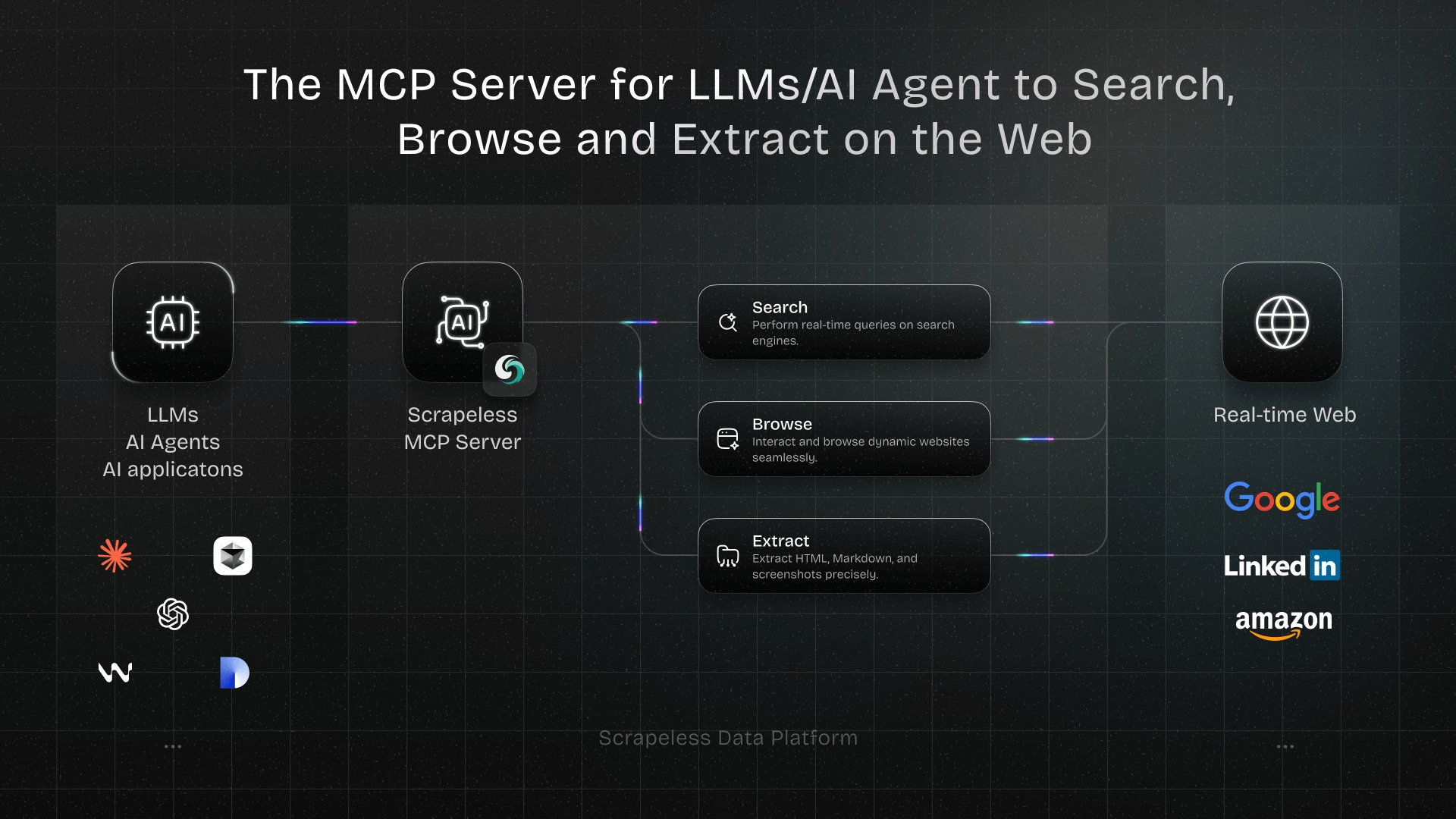
The Scrapeless MCP Server guide explains how web-search and extraction tools can be exposed to compatible clients. Scrapeless AI Agent describes how the platform's web-data capabilities support agent workflows.
For a concrete search-tool request contract, the Deep SerpApi quickstart shows current input and response fields.
Scrapeless is not the reasoning loop or agent framework. The host application still chooses the model, plans, memory design, permissions, evaluation rules, and approval gates. Scrapeless supplies the public web-data layer through products such as Deep SerpApi, Universal Scraping API, and Scraping Browser.
The Scrapeless Scraping Browser guide provides a concrete example of exposing a browser-based acquisition capability while keeping orchestration in the host application.
A clean web tool response contains the requested URL, final URL, page identity, collection time, locale, extraction status, and evidence. The agent can then reason over a validated record rather than an uncontrolled page dump.
AI Agent Use Cases
Research and monitoring
An agent can search approved sources, retrieve current pages, compare claims, and draft a report with provenance. The system should preserve conflicting evidence rather than force a single answer.
Support operations
An agent can gather a ticket, approved documentation, and read-only telemetry, then suggest a resolution. External changes should require a separate permission and approval path.
Data pipeline operations
An agent can inspect schema failures, locate source changes, and propose parser updates. Tests and data contracts remain deterministic gates before any change reaches production.
Developer workflows
An agent can read repository files, run bounded tests, and prepare a patch. The runtime should restrict filesystem and network scope and record every command outcome.
Limitations and Human Oversight
Agents can choose a plausible but wrong tool, misread a result, repeat actions, or stop too early. They may also turn stale memory into a current assumption. Tool schemas and validators reduce these risks but do not remove them.
Set measurable controls:
- maximum tool calls, tokens, elapsed time, and spend;
- allowed tools, domains, records, and data classes;
- content and schema acceptance checks;
- approval before external communication, purchase, deletion, or publication;
- run logs with source provenance;
- a clear abstention path when evidence is missing.
The NIST AI Risk Management Framework offers a broader structure for governing and measuring AI risks. Agent controls should be connected to the application's actual impact, not added as a generic prompt appendix.
AI Agent, Chatbot, and Workflow Compared
| System | Decision path | Tools | State | Best fit |
|---|---|---|---|---|
| Chatbot | Usually one response per user turn | Optional and limited | Conversation context | Explanation and interactive assistance |
| Deterministic workflow | Predefined branches | Fixed per step | Structured process state | Repeatable business processes |
| AI agent | Conditional, model-influenced loop | Selected dynamically within policy | Working context plus task state | Goals with uncertain intermediate steps |
Many useful systems are hybrids. A deterministic workflow can call an agent for one ambiguous classification, then resume a fixed approval process. That design limits open-ended behavior to the part that needs it.
Conclusion: Treat the Agent as a System, Not a Prompt
AI agents work by repeatedly observing state, selecting a permitted action, validating the result, and deciding whether to continue. The model is one component inside that loop.
Reliable agents make tools, memory, budgets, permissions, and human approval visible in the architecture. Current web data should enter through a controlled acquisition layer with provenance, not through undocumented context pasted into the prompt.
Connect an Agent to Current Public Web Data
Create a Scrapeless account, define one read-only research task, and expose only the search or extraction tools it needs. Compare Scrapeless pricing by completed, validated task rather than by raw tool call.
FAQ
Q: How do AI agents work in simple terms?
They receive a goal, inspect current state, choose a permitted action, use a tool or produce output, check the result, and repeat until the task is complete or a limit is reached.
Q: Is an AI agent just a large language model?
No. The model interprets context and proposes actions, while the agent system also includes orchestration, tools, memory, permissions, validation, logs, and stop conditions.
Q: What is AI agent memory?
AI agent memory includes current working context, structured task state, durable approved information, and the retrieval logic that selects relevant items for a step.
Q: What are AI agent tools?
Tools are typed capabilities such as web search, database queries, file access, code execution, or browser interaction. Their schemas and permissions determine what the agent can do.
Q: Does Scrapeless build the AI agent?
Scrapeless provides search, page acquisition, browser, and MCP tool layers for public web data. The host application remains responsible for the model, planning loop, memory, permissions, and governance.
Q: When should a human approve an agent action?
Require human approval before sensitive or hard-to-reverse actions such as publishing, sending external messages, changing accounts, purchasing, or deleting data.
At Scrapeless, we only access publicly available data while strictly complying with applicable laws, regulations, and website privacy policies. The content in this blog is for demonstration purposes only and does not involve any illegal or infringing activities. We make no guarantees and disclaim all liability for the use of information from this blog or third-party links. Before engaging in any scraping activities, consult your legal advisor and review the target website's terms of service or obtain the necessary permissions.