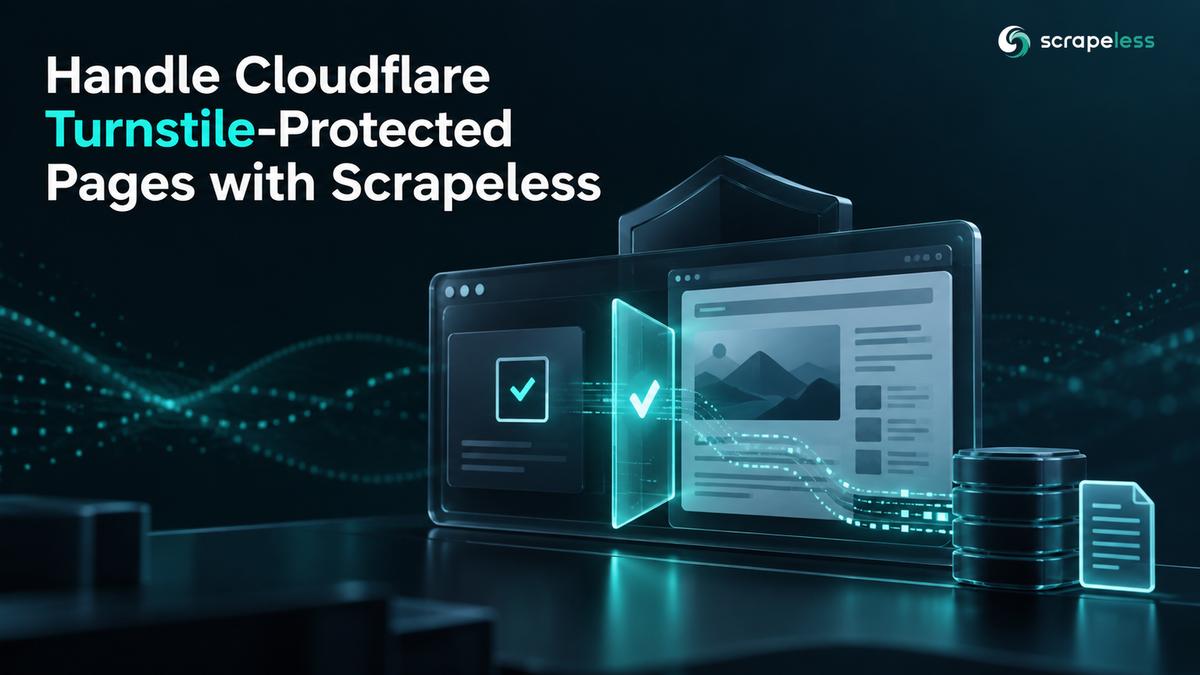
Handle Cloudflare Turnstile-Protected Pages with Scrapeless

Specialist in Anti-Bot Strategies
TL;DR:
- Cloudflare Turnstile and an interstitial Challenge Page are different surfaces. A form widget can appear on a page that is already accessible.
- Scrapeless Web Unlocker documents support for Turnstile and Cloudflare Challenge handling. Your application remains responsible for the operation after that step.
- A successful HTTP request does not prove that the target content is usable. Require the page elements or business state that define success for your task.
- HTML retrieval does not establish that a protected form was submitted successfully. Treat content access, widget completion, and application acceptance as separate outcomes.
- Free to start. Evaluate an approved target with a Scrapeless account's available credit before expanding the workload.
Introduction: Confirm the Page State Before Parsing It
A scraper can receive HTML and still have no usable task data. The document might be a challenge screen, a login page, or an application response that contains the expected title but not the requested information.
Turnstile adds another distinction. A page can display ordinary content while a widget protects a specific form action. The presence of that widget does not mean the entire page is blocked, and retrieving the page does not prove that a protected action has been accepted.
This tutorial explains how to use the documented Scrapeless Web Unlocker path for supported Cloudflare-protected content and how to validate what comes back. The authenticated example is an integration template that requires your account and approved target; it is not a claim of a completed Turnstile solve.
Turnstile and Challenge Pages Require Different Checks
Turnstile is an embedded verification mechanism, while an interstitial Challenge Page interrupts access to the requested resource. Distinguishing the two prevents a collector from applying the wrong success condition.
| Observed state | What it establishes | What it does not establish |
|---|---|---|
| Expected page content is present | The content can be inspected | A protected form action succeeded |
| Turnstile widget is present | The page uses an embedded verification step | The whole page is blocked |
| Challenge Page replaces the target | Target content is not yet available | The eventual response will be usable |
| Application confirms the intended action | The action reached its application outcome | Permission for unrelated actions |
Cloudflare exposes a response signal for interstitial challenges: the Challenge Page response header uses cf-mitigated: challenge. Apply that signal to the original target response when available. A managed service can return its own envelope or headers; do not assume an API response exposes every original target header.
HTML markers can provide supporting evidence, but they are not a universal classifier. A technical article can mention a challenge script without being blocked. Conversely, a page can fail to load its intended content without containing a recognizable challenge marker.
What Scrapeless Web Unlocker Handles
Scrapeless Web Unlocker documents automatic assistance with Turnstile and Cloudflare Challenge handling. The supported challenge behavior also specifies that subsequent operations remain the application's responsibility.
The Web Unlocker access service is the single product used in the example below. Its JavaScript rendering configuration requests a browser-rendered result for pages that need script execution. This article does not switch between unrelated API products or assume that a separate token-solving endpoint exists.
A clean content response is a useful result for a read-only extraction task. A workflow involving a protected form needs additional application-specific confirmation. Do not treat the appearance of a token or disappearance of a widget as sufficient evidence that a submission succeeded.
Prerequisites and a Target-Specific Success Contract
You need Python, Requests, an active Scrapeless API key, and a target you are authorized to access. Install the dependency with python -m pip install requests and set SCRAPELESS_API_KEY in your runtime environment.
Set TARGET_URL to the approved page. Define EXPECTED_TEXT as a distinctive phrase from its intended content. If you know the exact interstitial markers used by that target, set CHALLENGE_MARKERS to a comma-separated list. Keep the list target-specific and review ambiguous matches.
The authenticated request and a real Turnstile outcome remain prerequisites for this example. No claim is made that the target has been solved, that every Cloudflare configuration is supported, or that the code completes protected forms.
Before execution, decide what counts as success. For a public reference page, it may be a specific heading and content section. For a product page, it may be a valid identifier plus a parseable price. Avoid generic phrases that could appear in both the page and an error message.
Step 1: Request Rendered Content Through Web Unlocker
The request below uses the documented Web Unlocker actor and JavaScript rendering configuration. Save it as fetch_protected_page.py.
Note: This script requires your Scrapeless API key and approved target. The authenticated call and challenge outcome have not been verified in this environment. Run it on your target and inspect the returned body before relying on the extraction result.
python
import hashlib
import json
import os
from pathlib import Path

import requests

url = os.environ["TARGET_URL"]
expected = os.environ["EXPECTED_TEXT"].casefold()
markers = [part.strip().casefold()
           for part in os.environ.get("CHALLENGE_MARKERS", "").split(",")
           if part.strip()]
response = requests.post(
    "https://api.scrapeless.com/api/v2/unlocker/request",
    headers={"x-api-token": os.environ["SCRAPELESS_API_KEY"]},
    json={
        "actor": "unlocker.webunlocker",
        "input": {
            "url": url,
            "method": "GET",
            "redirect": False,
            "jsRender": {
                "enabled": True,
                "waitUntil": "domcontentloaded",
                "response": {"type": "html"},
            },
        },
        "proxy": {"country": "ANY"},
    },
    timeout=120,
)
response.raise_for_status()
body = response.text
Path("page-response.txt").write_text(body)
content_type = response.headers.get("content-type", "").lower()
if "text/html" not in content_type:
    outcome = "inspect_service_response"
elif any(marker in body.casefold() for marker in markers):
    outcome = "review_challenge_marker"
elif expected not in body.casefold():
    outcome = "expected_content_missing"
else:
    outcome = "content_candidate"
record = {
    "requested_url": url,
    "service_http_status": response.status_code,
    "content_type": content_type,
    "response_sha256": hashlib.sha256(response.content).hexdigest(),
    "outcome": outcome,
}
Path("page-observation.json").write_text(json.dumps(record, indent=2))
print(json.dumps(record))
if outcome != "content_candidate":
    raise SystemExit(1)
The settings come from the Web Unlocker request contract and JavaScript rendering configuration. The client wait is a configured timeout, not a performance claim.
The example treats a non-HTML response as something to inspect. It does not guess a nested HTML field in an unknown response envelope. Adapt the parser only after checking the actual result returned to your account.
Start Scraping with Scrapeless
Power up your web scraping and automation workflow with Scrapeless!
Sign up today and get $5 in free credit — no credit card required.Claim your free credit now in the Scrapeless Dashboard.
Step 2: Validate the Content, Not Only the Transport
Content validation should test the page's intended information independently of the request status. The HTTP status model describes the response at the protocol level; your extraction criteria establish whether it satisfies the task.
The script reports content_candidate, not a solved challenge. That name is deliberate: a phrase check is only an initial filter. Parse the intended content region, verify required fields, and reject an error page that happens to contain a matching phrase.
If the configured challenge marker appears, inspect the saved response. A match can be a real interstitial or a false positive. Preserve that distinction instead of automatically deleting every page that mentions Cloudflare.
For a successful extraction record, retain the target URL, capture time, the validation rule used, and the accepted fields. Avoid retaining full cookies, request credentials, or widget tokens in ordinary logs.
Step 3: Keep Protected Actions Separate from Page Retrieval
A page retrieval workflow should stop at accepted content unless the task explicitly requires and authorizes a further action. Reading a public page and completing a protected account form have different success conditions.
When testing your own form, verify the application response after submission. Client-side widget completion is an intermediate event. The site's server-side validation and business logic determine whether the action is accepted.
This Web Unlocker example does not transfer widget tokens between unrelated sessions, supply a site owner's secret, or invent an application-specific submit call. If your use case requires browser interaction after loading the page, design and verify that workflow separately using the supported product interface.
For background on the difference between page access and a continuing browser session, the Cloudflare challenge workflow provides related context. Verify the current product interface before adopting code from an older example.
Diagnose the State You Actually Observed
A useful diagnostic record identifies the failed condition without claiming a cause that has not been observed. Missing expected text can result from an interstitial, a changed page, a redirect, or a parser assumption.
| Observation | Next diagnostic step | Success evidence |
|---|---|---|
| Response is not HTML | Inspect documented service response shape | Verified extraction path for the returned type |
| Known challenge marker appears | Read the captured body in context | Intended content is present and accepted |
| Expected phrase is absent | Check target, redirect behavior, and page structure | Required content region matches the task |
| Widget exists beside normal content | Decide whether the task needs the protected action | Read task complete, or authorized action verified separately |
| Parser returns partial fields | Compare parser assumptions with current markup | Required fields validate against the page |
Keep tests small and avoid expanding a target scope automatically. A starting ceiling of three workers per host is a conservative application setting, and stricter target or account limits take precedence.
Access policies remain relevant even when content is technically reachable. The Robots Exclusion Protocol expresses crawler instructions; it does not replace authorization or determine every permitted use of collected data.
Before rolling out the workflow, measure accepted content on your actual target and compare service use with Scrapeless pricing. Do not publish a universal solve rate based on a single page or a demonstration environment.
Conclusion: Define Success at the Application Layer
Handling a Cloudflare-protected page requires a supported access path and a check that the intended content is actually available. Turnstile widgets, interstitial challenges, and application submissions should remain distinct states in that check.
Use the documented Web Unlocker request as the starting point, run it against an approved target, and inspect the result before enabling downstream extraction. The acceptance record should describe the information obtained, not merely the fact that an HTTP request completed.
Ready to Build Your Web Data Pipeline?
Join developers working on web data collection in Discord and Telegram.
Create a Scrapeless account and adapt the workflow to your own approved data sources.
FAQ
Q: Can Scrapeless Web Unlocker handle Cloudflare Turnstile?
Web Unlocker documents assistance with Turnstile and Cloudflare Challenge handling. Applicability and the final result must be validated on your authorized target; subsequent operations remain your application's responsibility.
Q: Does an HTTP 200 response mean Turnstile was solved?
No. A response can contain an intermediate page or content unrelated to the task. Inspect the returned state and required content.
Q: Does every page with a Turnstile widget block reading?
No. An embedded widget can protect a particular action while the rest of the page is visible. Match the check to the task you are performing.
Q: Do you need to add a separate browser proxy to this example?
No local browser is started. Use the documented proxy options in the Web Unlocker request and validate the resulting access behavior on the target.
Q: What if the target changes its HTML?
Recheck the expected-content rule and any selectors used downstream. A challenge-handling service does not define which page fields your application considers valid.
Q: Can this run without an AI agent?
Yes. The Python request and content checks are deterministic and do not require a language model.
Q: Is challenge handling permission to collect any protected data?
No. Use the workflow only within the access scope and data use you are authorized to perform, and review the relevant site terms and applicable requirements.
Q: Can the example submit a protected form?
No. The example retrieves and inspects content. A form workflow requires separately implemented and validated application behavior.
At Scrapeless, we only access publicly available data while strictly complying with applicable laws, regulations, and website privacy policies. The content in this blog is for demonstration purposes only and does not involve any illegal or infringing activities. We make no guarantees and disclaim all liability for the use of information from this blog or third-party links. Before engaging in any scraping activities, consult your legal advisor and review the target website's terms of service or obtain the necessary permissions.