Grok Web Scraping: A Practical Python Guide

Lead Scraping Automation Engineer
TL;DR:
- Grok's API speaks fluent OpenAI, which makes it a drop-in extraction engine. Point the official OpenAI Python SDK at
https://api.x.ai/v1and the model turns page text into JSON records withtemperature=0andresponse_format={"type": "json_object"}. - What Grok does not do is fetch. The model holds no browser and no session; xAI's server-side web-search tool grounds answers with live results, and bulk page extraction stays your job.
- The gap is visible in one script. A plain GET on a JavaScript-rendered demo page contains 0 quote elements; the same URL through the Scrapeless Universal Scraping API with
js_rendercontains all 10 — and that rendered HTML is what Grok extracts from. - The extraction is real in this guide, not hypothetical. A live run against the rendered page returned all 10 quotes with authors and tag arrays intact — 3,211 tokens for the whole call.
- No xAI key yet? The identical request runs through OpenRouter. Same OpenAI SDK, different
base_urland model string; this guide shows both paths. - Free to start on the fetch side. Create your Scrapeless API key at app.scrapeless.com.
Can Grok scrape websites?
Grok can read a page you hand it and return exactly the fields you ask for; it cannot go get that page at scraping volume. Those are the two halves of every "Grok web scraping" setup, and confusing them is how projects stall. The xAI API exposes a language model — one that happens to be unusually easy to wire up, because the endpoint accepts the same request shape as OpenAI's — but HTTP fetching, JavaScript rendering, session state, and access challenges live outside it.
xAI does ship a server-side web-search tool, and it deserves an honest sentence: it lets Grok search and read the live web to ground an answer. That is retrieval for question-answering. It does not give you control over which pages get fetched, how they render, or how many you can process — the three things a scraping pipeline is built on.
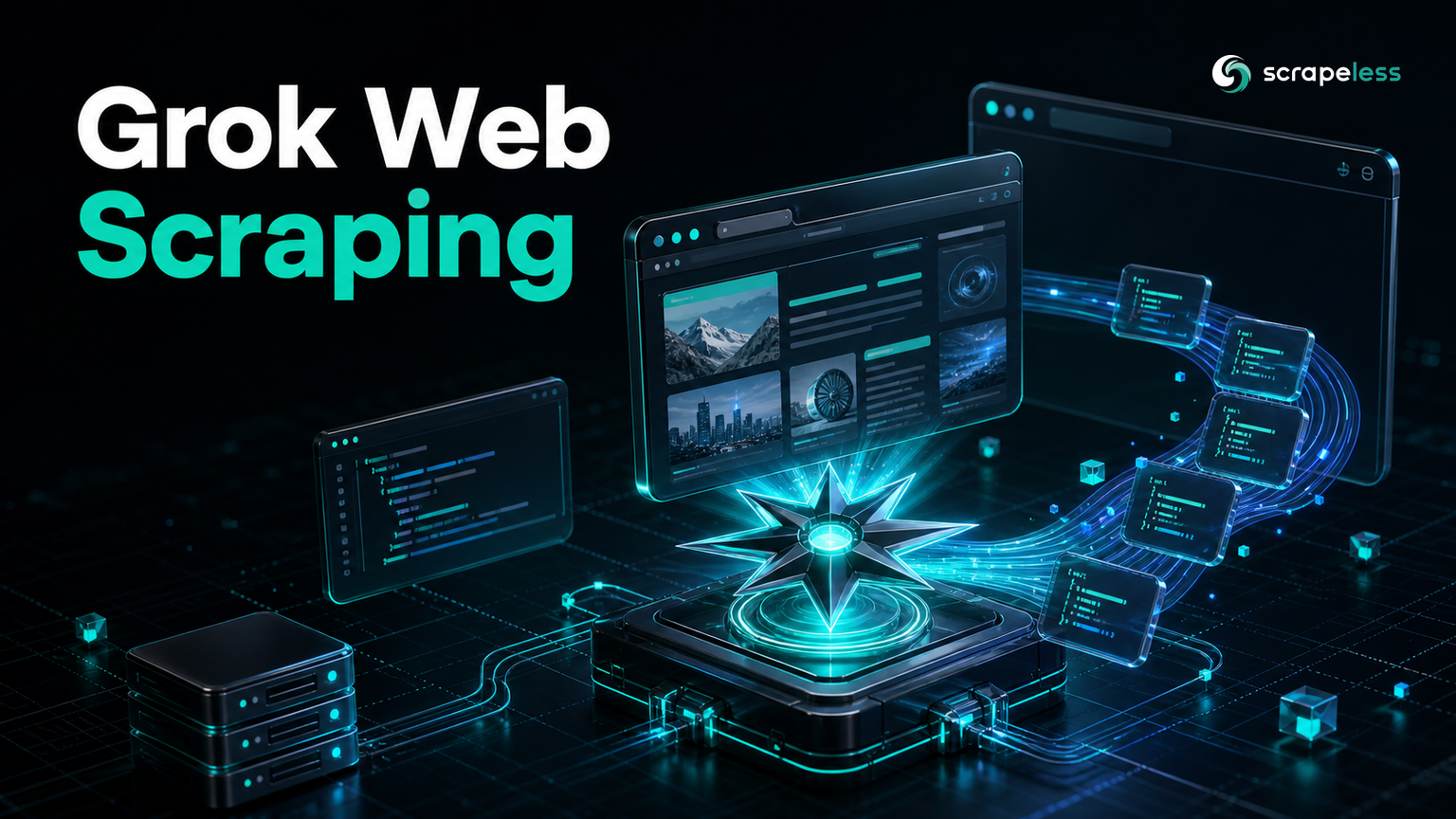
So the working architecture is two layers: a fetch layer that returns faithful rendered HTML, and Grok as the extraction layer that turns it into records. One more disambiguation before the code: this guide points Grok at the web. Pointing a scraper at Grok — capturing its answers as data — is the opposite job, covered by the Grok Scraper API guide and the LLM scraper explainer.
Install
The whole toolchain is the OpenAI SDK plus requests — the versions this guide was written against are openai 2.34.0 and the current requests:
bash
pip install "openai==2.34.0" requestsConfigure
Keys stay in the environment, never in source:
bash
export XAI_API_KEY="xai-your_key"
export SCRAPELESS_API_KEY="sk_your_scrapeless_key"
Get a page Grok can actually read
Extraction quality is bounded by fetch fidelity, so start where most Grok tutorials end. On JavaScript-rendered pages, the document a plain HTTP client receives is not the document a reader sees — the content arrives only after scripts build the DOM, a lifecycle defined by the HTML scripting specification. One script shows the difference and saves the version worth extracting from:
python
# fetch_rendered.py — plain GET vs server-side rendering, same URL
import os

import requests

URL = "https://quotes.toscrape.com/js/"
MARKER = '<span class="text"'

plain = requests.get(URL, timeout=60).text
print(f"plain GET: {len(plain):,} chars | quote elements: {plain.count(MARKER)}")

resp = requests.post(
    "https://api.scrapeless.com/api/v1/unlocker/request",
    headers={
        "Content-Type": "application/json",
        "x-api-token": os.environ["SCRAPELESS_API_KEY"],
    },
    json={
        "actor": "unlocker.webunlocker",
        "input": {"url": URL, "method": "GET", "js_render": True},
    },
    timeout=120,
)
resp.raise_for_status()
rendered = resp.json().get("data", "")
print(f"rendered:  {len(rendered):,} chars | quote elements: {rendered.count(MARKER)}")

with open("page.html", "w", encoding="utf-8") as f:
    f.write(rendered)
The run prints quote elements: 0 for the plain fetch and quote elements: 10 for the rendered one. Rendering, unlocking, and proxy routing all happen server-side in that one POST — the Universal Scraping API is the fetch layer, and page.html is now something a model can extract from.
Basic implementation: Grok as the extractor
The xAI endpoint takes the standard OpenAI chat-completions request. Two parameters carry the reliability: temperature=0 keeps the output stable across runs, and JSON mode keeps it parseable. Name the exact keys you want in the system message and tell the model what to do with missing values.
Note: This block needs an
XAI_API_KEYwith credit — the one prerequisite this guide does not assume. The next section runs the identical extraction live through OpenRouter, with captured output.
python
# extract_grok.py — Grok extraction via the xAI API (requires XAI_API_KEY)
import json
import os

from openai import OpenAI

client = OpenAI(
    base_url="https://api.x.ai/v1",
    api_key=os.environ["XAI_API_KEY"],
)

page_html = open("page.html", encoding="utf-8").read()

completion = client.chat.completions.create(
    model="grok-4.5",
    temperature=0,
    response_format={"type": "json_object"},
    messages=[
        {
            "role": "system",
            "content": 'Extract every quote. Reply ONLY with JSON: '
            '{"quotes":[{"text":str,"author":str,"tags":[str]}]}. Use null for missing values.',
        },
        {"role": "user", "content": page_html},
    ],
)

data = json.loads(completion.choices[0].message.content)
print(f"extracted {len(data['quotes'])} quotes")
grok-4.5 is the model xAI's current documentation centers; swap in whichever tier your account runs. The request shape does not change.
No xAI key? Run the same request through OpenRouter
Because the request is OpenAI-shaped end to end, an aggregator key works with two edits: the base_url and the model string. This is the variant this guide executed for real — fetch and extraction in one self-contained script:
python
# extract_openrouter.py — the same extraction, executed via OpenRouter
import json
import os

import requests
from openai import OpenAI

resp = requests.post(
    "https://api.scrapeless.com/api/v1/unlocker/request",
    headers={
        "Content-Type": "application/json",
        "x-api-token": os.environ["SCRAPELESS_API_KEY"],
    },
    json={
        "actor": "unlocker.webunlocker",
        "input": {"url": "https://quotes.toscrape.com/js/", "method": "GET", "js_render": True},
    },
    timeout=120,
)
resp.raise_for_status()
page_html = resp.json().get("data", "")

client = OpenAI(
    base_url="https://openrouter.ai/api/v1",
    api_key=os.environ["OPENROUTER_API_KEY"],
)

completion = client.chat.completions.create(
    model="x-ai/grok-4.20",
    temperature=0,
    response_format={"type": "json_object"},
    messages=[
        {
            "role": "system",
            "content": 'Extract every quote. Reply ONLY with JSON: '
            '{"quotes":[{"text":str,"author":str,"tags":[str]}]}. Use null for missing values.',
        },
        {"role": "user", "content": page_html},
    ],
)

data = json.loads(completion.choices[0].message.content)
print(f"extracted {len(data['quotes'])} quotes from the rendered page")
print(json.dumps(data["quotes"][0], ensure_ascii=False))
The live run extracted all 10 quotes and printed the first one:
text
extracted 10 quotes from the rendered page
{"text": "“The world as we have created it is a process of our thinking. It cannot be changed without changing our thinking.”", "author": "Albert Einstein", "tags": ["change", "deep-thoughts", "thinking", "world"]}
Authors and tag arrays came through intact, and the whole call cost 3,211 tokens. That is the entire scraper: one POST to fetch, one completion to extract, no selectors anywhere.
Get your API key on the free plan: app.scrapeless.com
Advanced patterns
- Pin the schema in the system message, not the user prompt. The page HTML goes in the user turn; the contract stays in the system turn where it survives page-to-page loops.
- Loop in Python, not in the prompt. One page per completion keeps records from bleeding across boundaries and makes failures attributable to a specific URL.
- Send less page when you can. Grok reads the whole document you send, chrome and all. Isolating the content container — or fetching markdown instead of HTML — cuts token spend roughly in proportion.
- Treat tags and lists explicitly. Naming
tags:[str]in the schema is what produced clean arrays in the run above; leave list fields undescribed and models flatten them into strings.
Troubleshooting
- Prose instead of JSON. You dropped
response_format={"type": "json_object"}— with it, the endpoint constrains the output; without it, you are parsing goodwill. - Ten records expected, three returned. Check what you fetched before blaming the model: count a known element in the HTML the way the fetch script does. A near-empty fetch means a rendering problem, fixed at the fetch layer with
js_render. - Different output on identical input. Set
temperature=0; extraction is not a creativity task. - Costs drift upward. Token spend tracks input size. Trim the page, batch nothing, and keep an eye on per-page token counts the way the run above reports them.
Conclusion
Grok earns its place in a scraper as the layer that never sees the network: OpenAI-shaped requests, deterministic settings, one page in, one JSON object out. The layer that decides whether any of that is possible is the fetch — the first script's 0-versus-10 print settles that question — and one server-rendered POST closes the gap. Wire the two together and the demo page's ten quotes arrive as validated records, tags and all.
Ready to Feed Grok Real Pages?
The fetch layer in this guide is one POST per page on the Universal Scraping API — plans and volumes are on the pricing page, and the developer docs cover the unlocker.webunlocker parameters. Create a key on the free plan at app.scrapeless.com and re-run both scripts as written.
FAQ
Q: Can Grok scrape websites by itself?
No. The Grok API extracts from text you provide; it cannot issue requests, render JavaScript, or hold sessions. Its web-search tool reads the live web to ground answers, but page selection, rendering fidelity, and volume stay outside your control — a scraping pipeline needs its own fetch layer.
Q: Is Grok's built-in web search the same thing as web scraping?
Different jobs. The search tool retrieves context so the model can answer a question; scraping retrieves specific pages so you can extract specific fields at a volume you choose. Use the tool when you want answers, and the two-layer pipeline in this guide when you want data.
Q: How is this different from a Grok scraper?
Direction. Here, Grok is the parser and the web is the target. A Grok scraper reverses it — it captures Grok's own answers as structured data, which Scrapeless ships as an actor; the Grok Scraper API guide linked in the introduction covers that job.
Q: Which Grok model should I use for extraction?
The cheapest one that holds your schema. Extraction with a strict JSON contract and temperature=0 is not a reasoning-heavy task, so start small — the live run in this guide used a lower-priced Grok tier through OpenRouter and returned all 10 records correctly — and move up only if fields start coming back wrong.
Q: Is scraping with Grok legal?
The model does not change the collection rules. Fetch public pages only, respect site terms and the robots directives standardized by the Robots Exclusion Protocol, keep volumes bounded, and handle personal data under the laws that apply to you — plus xAI's usage terms on the model side.
At Scrapeless, we only access publicly available data while strictly complying with applicable laws, regulations, and website privacy policies. The content in this blog is for demonstration purposes only and does not involve any illegal or infringing activities. We make no guarantees and disclaim all liability for the use of information from this blog or third-party links. Before engaging in any scraping activities, consult your legal advisor and review the target website's terms of service or obtain the necessary permissions.