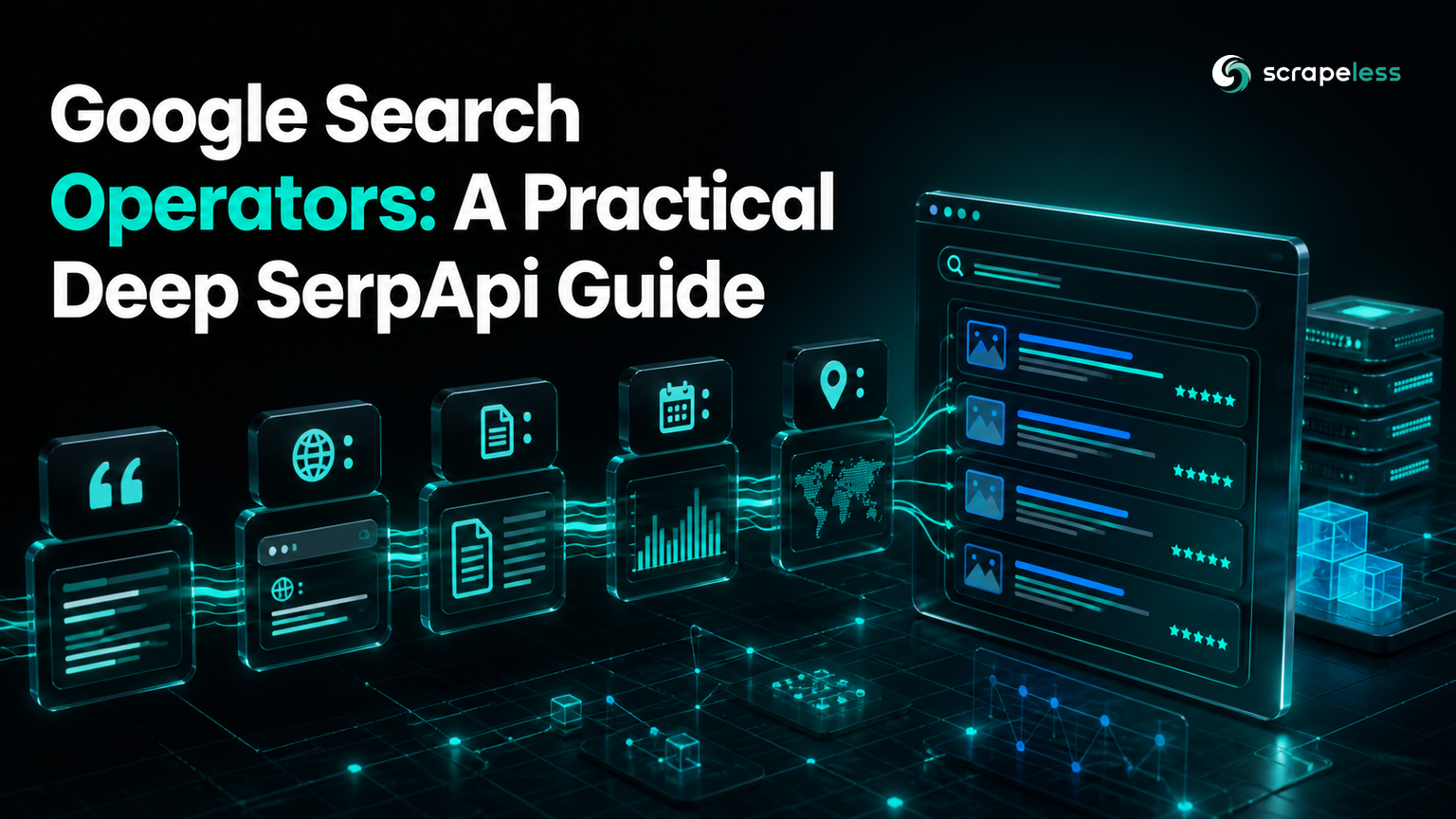
Google Search Operators: A Practical Deep SerpApi Guide

Advanced Data Extraction Specialist
TL;DR:
- Google search operators narrow a query by phrase, site, file type, exclusion, or date before any result reaches a parser.
- Deep SerpApi sends the operator expression inside
qand keeps language, country, and Google domain in separate input fields. - The Google Search actor returns parsed SERP sections such as
organic_results, so a pipeline can store rank, title, link, and snippet without parsing result-page HTML. - The
site:operator is useful for discovery and debugging, but Google says its results are not an exhaustive index report.
A search operator is a small piece of query syntax with an outsized effect. Quotes can preserve a phrase. A minus sign can remove an unwanted meaning. site: can confine discovery to a domain. filetype: can pull research toward reports instead of marketing pages.
The useful API pattern is to preserve that query exactly, send it to a search actor, and receive structured result records. This guide shows how to design operator queries and run them through Scrapeless Deep SerpApi without turning the code into a hand-built Google URL parser.
What Google search operators do
Google search operators are tokens or punctuation that refine which results a query asks Google to return. Google’s search refinement help documents the core user-facing forms: quoted phrases, minus-term exclusions, site:, filetype:, and the before: and after: date bounds.
The syntax is compact, but spacing matters. site:example.com is an operator. site: example.com is not the same expression because the operand is detached from the operator.
| Goal | Query pattern | Example |
|---|---|---|
| Exact phrase | "phrase" |
"agentic retrieval" |
| Exclude a meaning | -term |
jaguar speed -car |
| Restrict a domain or prefix | site:domain |
site:docs.python.org asyncio |
| Restrict a file type | filetype:extension |
zero trust filetype:pdf |
| Bound by update date | after:date before:date |
AI policy after:2025 before:2027 |
Operators can be combined. Start with the research question, then add the smallest number of constraints needed to remove noise.
Query recipes that map to real research jobs
Find primary documentation
Use a domain restriction plus a precise concept:
site:developers.google.com/search "search operators"
This works well when the organization has several properties and a normal keyword query returns commentary before source documentation.
Locate public reports
Combine a trusted domain, a file type, and a phrase:
site:nist.gov filetype:pdf "AI risk management"
The operator narrows discovery. It does not prove that every result is current, authoritative for the specific question, or safe to reuse. Those checks still belong in the research workflow.
Exclude an ambiguous meaning
Use the minus sign directly before the unwanted term:
python concurrency -snake
Exclusions are best used after inspecting the first result set. Removing a broad term too early can hide useful pages that mention it incidentally.
Compare material inside a date window
Put both bounds in the query:
browser automation after:2025 before:2027
Google describes these as document update filters. Treat the dates as search constraints, not a substitute for reading the publication or update date on the source page.
The important limit of site:
The site: operator is valuable for source discovery, spam checks, and questions such as “Which pages under this prefix may appear for this term?” It is not a complete inventory of indexed URLs.
Google’s dedicated site: documentation says the result list is not necessarily exhaustive and that a bare site:example.com query does not rank results normally. For indexing diagnostics, Google recommends URL Inspection in Search Console over operator counts. The broader Search Central operator reference also notes indexing and retrieval limits.
That changes how an automated pipeline should label the data. Store “results returned for this query at this time,” not “all indexed pages on the domain.”
Start Scraping with Scrapeless
Power up your web scraping and automation workflow with Scrapeless!
Sign up today and get $5 in free credit — no credit card required.Claim your free credit now in the Scrapeless Dashboard.
How Deep SerpApi carries operator queries
Scrapeless exposes Google Search through the scraper.google.search actor. The request uses one endpoint and separates the free-form query from locale controls:
| Field | Purpose |
|---|---|
actor |
Selects scraper.google.search |
input.q |
Carries keywords and search operators exactly as a query string |
input.gl |
Selects the country context |
input.hl |
Selects the result language |
input.google_domain |
Selects the Google domain |
This separation is useful for testing. The same operator query can be run with a different country or language without rewriting the search expression.
The Deep SerpApi product page describes the managed search surface, and the Deep SerpApi quickstart documents the actor, endpoint, authentication header, and input shape.
Send an authenticated request
Export a real key in the shell before running the request. The live call below is credential-gated; the endpoint, headers, JSON syntax, and parser were verified locally, but no successful service response is claimed without a key.
bash
curl -sS -X POST https://api.scrapeless.com/api/v1/scraper/request \
  -H 'Content-Type: application/json' \
  -H "x-api-token: $SCRAPELESS_API_KEY" \
  -d '{
    "actor": "scraper.google.search",
    "input": {
      "q": "site:nist.gov filetype:pdf \"AI risk management\"",
      "gl": "us",
      "hl": "en",
      "google_domain": "google.com"
    }
  }'
The operator expression stays in q. Do not insert spaces after site: or filetype:. JSON and the HTTP client handle transport encoding, so the application does not need to concatenate a Google search URL.
Read the structured response
A normal web-search response places parsed result sections at the top level. This sample shows key shape only; the values are illustrative.
json
{
  "search_information": {},
  "organic_results": [
    {
      "position": 1,
      "title": "Illustrative report title",
      "link": "https://example.org/report.pdf",
      "snippet": "Illustrative result snippet"
    }
  ],
  "related_searches": [],
  "pagination": {},
  "metadata": {}
}
Result modules vary by query. Code should read the section it requested and treat absent optional sections as absent, not as malformed JSON.
Here is a small Python client that keeps query design separate from response handling:
python
import json
import os
import urllib.request

ENDPOINT = "https://api.scrapeless.com/api/v1/scraper/request"


def google_search(query: str, country: str = "us", language: str = "en") -> dict:
    body = json.dumps({
        "actor": "scraper.google.search",
        "input": {
            "q": query,
            "gl": country,
            "hl": language,
            "google_domain": "google.com",
        },
    }).encode()
    request = urllib.request.Request(
        ENDPOINT,
        data=body,
        headers={
            "Content-Type": "application/json",
            "x-api-token": os.environ["SCRAPELESS_API_KEY"],
        },
    )
    with urllib.request.urlopen(request) as response:
        return json.loads(response.read())


serp = google_search('site:nist.gov filetype:pdf "AI risk management"')
for row in serp.get("organic_results") or []:
    print(row.get("position"), row.get("title"), row.get("link"))
The Python block passes local syntax compilation. The network call remains a labelled prerequisite because this environment has no Scrapeless API key.
Build a reusable operator pipeline
A production workflow should store more than the returned links. Keep enough request context to explain each row later:
- the exact
qstring, including operators; - country, language, and Google domain;
- capture timestamp;
- returned position, title, link, and snippet;
- the source module, such as organic results;
- a normalized target URL for deduplication;
- the research question that motivated the query.
This turns a SERP capture into an auditable dataset. When results differ, the team can compare query and locale before blaming the parser.
The Scraper API actor guide explains how search actors fit beside other managed actors. Review pricing before choosing capture frequency and geographic coverage.
Common operator mistakes
Detaching the operand
site: example.com and filetype: pdf detach the value. Keep the operand next to the colon.
Treating a result count as an index count
A site: result set is a search result sample under retrieval constraints. It is not an index export.
Mixing locale into the query
Do not add prose such as “results from the US in English” when gl and hl can express those controls directly. Keep q focused on information intent.
Assuming every query returns the same modules
Web, local, image, and other search modes have different response sections. Parse the selected mode’s documented shape and keep optional fields nullable.
Conclusion
Search operators improve the query before collection begins. Deep SerpApi preserves that expression in q, adds explicit locale fields, and returns parsed SERP data that can be ranked, stored, and audited. The reliable pattern is query template, locale controls, structured response, and honest limits on what the result set represents.
Ready to Build an Operator-Driven Search Pipeline?
Join our community to claim a free plan and connect with developers building structured search datasets: Discord · Telegram.
Sign up at app.scrapeless.com and turn precise queries into structured SERP records.
FAQ
Q: What are the most useful Google search operators?
Quotes, minus exclusions, site:, filetype:, before:, and after: cover many research tasks. Choose operators based on the noise observed in the initial result set.
Q: Can search operators be combined in one query?
Yes. A query can combine a quoted phrase, domain restriction, file type, exclusion, and date bounds. Each added constraint reduces the possible result set, so use only the ones the task needs.
Q: Does site: show every page Google has indexed?
No. Google states that site: results are not necessarily exhaustive. Use Search Console tools for authoritative diagnostics on a site you control.
Q: Does Deep SerpApi accept advanced operator syntax?
Yes. Put the full operator expression in the q field for the Google Search actor. Keep country, language, and Google domain in their dedicated fields.
Q: Does Deep SerpApi require a proxy configuration?
No separate proxy configuration is required for the managed actor. Set geographic context through supported request fields such as gl, and use the returned data according to applicable rules.
Q: What happens when Google changes the result-page DOM?
The managed actor returns parsed fields rather than requiring the client to maintain a result-page DOM parser. Downstream code should still treat optional modules and fields as nullable because result composition varies by query.
Q: How does the API handle a WAF or search access friction?
The managed service handles the network and extraction layer behind the actor. The client sends the documented request and processes the structured response; it should not claim access beyond public or authorized data.
Q: Can this workflow run without an AI agent?
Yes. Shell scripts, Python jobs, schedulers, and data pipelines can call the same endpoint directly. An AI agent is optional orchestration around the search tool.
Q: Is it legal to collect Google search results?
Legality depends on jurisdiction, purpose, contracts, and the data involved. Collect only public or authorized data, minimize stored information, and obtain legal advice for sensitive or high-risk use cases.
At Scrapeless, we only access publicly available data while strictly complying with applicable laws, regulations, and website privacy policies. The content in this blog is for demonstration purposes only and does not involve any illegal or infringing activities. We make no guarantees and disclaim all liability for the use of information from this blog or third-party links. Before engaging in any scraping activities, consult your legal advisor and review the target website's terms of service or obtain the necessary permissions.