Design a Google Search Data Pipeline with Quality Checks

Expert Network Defense Engineer
TL;DR:
- A Google search data pipeline needs a record of the run as well as its results. Empty, pending, failed, and unmapped observations can all have no projected organic rows.
- Preserve raw captures before applying analytical rules. Derived tables and quality reports can be rebuilt; the original evidence should remain unchanged.
- Quality rules must match the report. A usable response container does not guarantee valid positions or comparable search context.
A search pipeline can successfully write a file and still produce misleading analysis. The response may be pending, a mapper may discard malformed rows, or a report may combine different markets under the same keyword. Storage success alone does not establish that the resulting observations answer the intended question.
Scrapeless Google Search API supplies the collection data. The Google search data pipeline described here adds application-owned storage, validation, and reporting around it. Scheduling, history retention, databases, and quality checks are responsibilities of the pipeline, not claimed built-in services of the search API.
Pipeline at a Glance
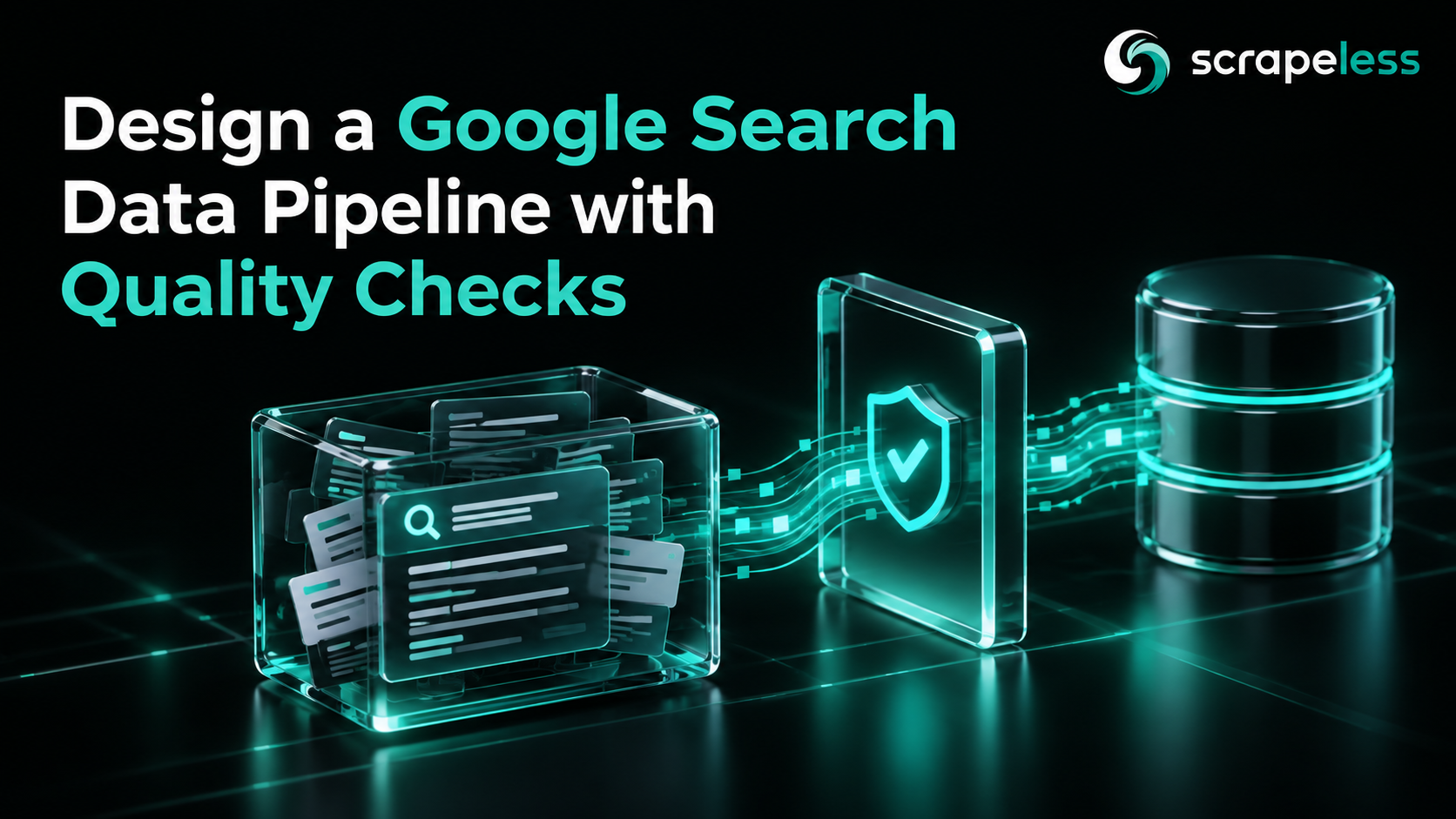
The pipeline moves through request planning, collection, raw storage, projection, quality review, and reporting. Keep a stable reference between those stages so an analyst can trace a chart back to the exact request and response.
A planned job exists before a response arrives. Its collection outcome then becomes evidence for a run record, even if no organic items can be projected. Store raw captures separately from derived result rows and preserve the quality decisions used to admit records into a report.
The local program below examines saved captures and prints a quality report. It does not collect data, schedule jobs, create a warehouse, or correct source values. That limited responsibility makes its output easier to inspect and replace.
Stage 1 — Define the Request and Comparison Scope
The request defines the observation context. Preserve the query, country, language, location, input mode, and page offset whenever supplied. The Google Search parameters explain why a keyword alone is insufficient to identify comparable observations.
An exact serialized request is a conservative comparison key. Changing an offset changes the collected slice; changing country or wording changes the research context. If the pipeline later groups equivalent-looking configurations, document the normalization rule and retain the original request.
Plan how run identifiers, scheduled jobs, and completed observations relate. A missed planned collection should remain visible in operational coverage even though it has no API response. The local checker cannot discover jobs it was never given; a scheduler or job ledger must provide that inventory.
Stage 2 — Capture the Outcome Before Projecting Rows
The Google Search request workflow sends actor scraper.google.search to POST https://api.scrapeless.com/api/v1/scraper/request with an API key in x-api-token. HTTP 200 carries task data, while HTTP 201 indicates a pending task. Preserve that distinction before reading the organic array.
Use a capture envelope containing the submitted request, original response, recorded HTTP status, run identifier, and client receipt time. Keep authentication headers out of shared evidence files. The envelope is your application's storage contract, not a claim about the service's native response wrapper.
An account key is needed for live collection, which was not performed for this article. Pending-task completion also needs a separately verified workflow. The local checker runs without credentials on saved captures, with synthetic inputs used to test its rules.
Stage 3 — Preserve History and Build Derived Tables
Raw snapshots should remain immutable after acceptance into the archive. A later response or a revised parser should create a new record or projection version rather than overwriting the evidence behind an earlier report.
A relational model can use a run table plus child organic-result rows keyed by run identifier and source ordinal. Returned position remains a separate attribute. SQLite's foreign-key rules describe how related records can be constrained when that storage option is used.
Commit a run and its derived rows together when the database model requires them to remain consistent. The transaction model supplies the relevant database behavior. Your ingestion application must still define conflict handling, connection configuration, and the boundary of each transaction.
Retain unusual result values in raw JSON even if a convenience column cannot represent them. That lets a future mapper recover detail without recollecting a search whose output may have changed.
Start Scraping with Scrapeless
Power up your web scraping and automation workflow with Scrapeless!
Sign up today and get $5 in free credit — no credit card required.Claim your free credit now in the Scrapeless Dashboard.
Stage 4 — Apply an Explicit Quality Contract
Quality checks should answer a report-specific question. The example checks whether a capture is suitable for a conservative position report: run identity, request structure, receipt-time presence, organic container shape, link strings, positive integer positions, and exact duplicate links.
The checker records collection state independently from notes. A present organic array can be observed while failing position-report eligibility because a position is missing. This separates what was collected from what a particular report can safely use.
Missing timestamps are flagged, but the code does not validate timestamp syntax or recency. Link checks establish nonempty strings, not reachable or trustworthy destinations. Context equivalence, date-range coverage, and cross-file run-ID uniqueness also need separate checks in the surrounding pipeline.
The JSON value model underlies the distinction between arrays, objects, nulls, and scalars. Do not coerce an unsupported container into an empty array simply to make the quality report succeed.
Stage 5 — Run the Local Capture Checker
Save this program as quality_check.py. It needs only Python and capture files. Run python3 quality_check.py capture-a.json capture-b.json with actual saved filenames; the program prints JSON to standard output and does not change its inputs.
python
import argparse
import json
from collections import Counter
from pathlib import Path


def inspect(record):
    notes = []
    if not isinstance(record, dict):
        return {'state': 'invalid_capture', 'notes': ['capture_not_object'], 'rows': None, 'eligible_for_position_report': False}
    request = record.get('request')
    if not isinstance(record.get('run_id'), str) or not record['run_id'].strip():
        notes.append('run_id_missing')
    if (not isinstance(request, dict) or request.get('actor') != 'scraper.google.search'
            or not isinstance(request.get('input'), dict)):
        notes.append('request_contract_invalid')
    if not isinstance(record.get('received_at'), str) or not record['received_at'].strip():
        notes.append('receipt_time_missing')
    status, payload = record.get('http_status'), record.get('response')
    rows = payload.get('organic_results') if isinstance(payload, dict) else None
    count = None
    if status == 201:
        state = 'pending'
        if not isinstance(payload, dict) or not isinstance(payload.get('taskId'), str) or not payload['taskId'].strip():
            notes.append('task_id_missing')
    elif status is None:
        state = 'transport_error'
    elif status != 200:
        state = 'http_error'
    elif not isinstance(rows, list) or any(not isinstance(row, dict) for row in rows):
        state = 'unmapped'
    else:
        state, count = ('observed' if rows else 'empty'), len(rows)
        links = []
        for ordinal, row in enumerate(rows):
            link, position = row.get('link'), row.get('position')
            if not isinstance(link, str) or not link.strip():
                notes.append(f'row_{ordinal}_link_missing_or_invalid')
            else:
                links.append(link)
            if type(position) is not int or position < 1:
                notes.append(f'row_{ordinal}_position_missing_or_invalid')
        if len(links) != len(set(links)):
            notes.append('duplicate_exact_links')
    return {'run_id': record.get('run_id'), 'state': state, 'rows': count,
            'notes': notes, 'eligible_for_position_report': state in ('observed', 'empty') and not notes}


if __name__ == '__main__':
    parser = argparse.ArgumentParser()
    parser.add_argument('captures', nargs='+')
    args = parser.parse_args()
    reports = []
    for filename in args.captures:
        try:
            report = inspect(json.loads(Path(filename).read_text(encoding='utf-8')))
        except (OSError, json.JSONDecodeError, UnicodeError) as error:
            report = {'state': 'unreadable_capture', 'rows': None, 'notes': [type(error).__name__],
                      'eligible_for_position_report': False}
        reports.append(dict(report, source=filename))
    print(json.dumps({'captures': reports, 'states': dict(Counter(x['state'] for x in reports))},
                     ensure_ascii=False, indent=2))
The eligible_for_position_report flag is an application decision. Pending or failed captures remain in the report with unknown row counts; present empty arrays can be eligible if their capture metadata passes the checks. A malformed or unreadable capture remains an explicit quality outcome.
An empty notes list does not establish global data quality. It means this particular set of checks found no issue. Keep the checker version with its output and maintain the broader tests required by the consuming report.
Stage 6 — Separate Coverage From Search Findings
Operational coverage should compare planned jobs with their outcomes. Search analysis should use only records that meet its own eligibility conditions. A result table alone cannot reveal planned jobs that never produced a usable response.
Report state counts before interpreting changes in positions or domain presence. Pending and unmapped runs require attention from the collection or mapping owner. They should not appear as a sudden disappearance of every domain in a market.
A data review can result in a corrected mapper, a narrower report scope, or an unresolved observation. Preserve that decision with the evidence and version that produced it. The provenance model helps distinguish the capture, transformation, and review activity.
Conclusion
Build the pipeline around traceable observations. Keep planned work, raw responses, derived rows, and quality decisions connected while preserving their different roles. A report can then explain both what the search sample showed and which parts of the planned collection were unavailable.
The evidence discipline used in AI source discovery is also useful when a pipeline feeds a research assistant: a successful data transform does not replace source review.
Build Your Next Search Observation
Use Scrapeless Google Search API for the search data in this workflow. Review Scrapeless pricing when planning collection, and keep the Google Search parameters beside your configuration.
Discuss your implementation with the community on Discord or Telegram.
FAQ
Q: Does Google Search API provide the storage and scheduler shown here?
No. This article describes application components around the API. You implement scheduling, persistence, and quality reporting for your own workflow.
Q: Why store a run with no result rows?
Its state explains whether the response was empty, pending, failed, or unmapped. Omitting the run would hide collection coverage.
Q: Does an eligible capture guarantee accurate rankings?
No. Eligibility means the local position-report checks passed. Comparability, scope, freshness, and interpretation require additional review.
Q: Should a changed parser overwrite raw history?
No. Keep raw captures and generate a versioned projection so earlier conclusions remain traceable.
Q: Does the checker validate every URL and timestamp?
No. It checks nonempty values and selected types. Destination validation, timestamp parsing, and coverage analysis belong to additional pipeline rules.
At Scrapeless, we only access publicly available data while strictly complying with applicable laws, regulations, and website privacy policies. The content in this blog is for demonstration purposes only and does not involve any illegal or infringing activities. We make no guarantees and disclaim all liability for the use of information from this blog or third-party links. Before engaging in any scraping activities, consult your legal advisor and review the target website's terms of service or obtain the necessary permissions.