Google Search in 2026: AI Mode, AI Overviews & Data Extraction

Lead Scraping Automation Engineer
TL;DR:
- Google Search data extraction now covers several response surfaces: classic results, AI Overviews, AI Mode conversations, shopping units, and local modules. A single flat list of links no longer represents the whole search experience.
- Store each surface as a typed object with query, locale, device, collection time, rank, citations, and raw-response provenance. Missing AI content should remain an explicit null state rather than an empty success.
- Treat AI citations as evidence relationships, not ordinary organic rankings. Preserve the answer passage, cited URL, citation position, and the search context that produced them.
- Use Deep SerpApi for repeatable search-result collection and the Google AI Overview actor when the workflow needs the generated answer, sources, products, or ads returned by that surface.
- Monitor schema coverage, trigger rate, citation volatility, freshness, and validation failures. Human review is still required before using extracted summaries in health, finance, legal, or other sensitive decisions.
Google Search data extraction used to mean collecting ten blue links, titles, snippets, and positions. That model still matters, but it is incomplete in 2026. A result page may answer the query directly, open a conversational path, show cited sources, or blend products and nearby places into the response.
The extraction target has therefore changed. Teams need to preserve both the visible answer and the structure around it: which surface appeared, which sources supported it, which locale produced it, and whether the response changed between runs.
Independent research also finds that generative search systems can surface different domains from conventional rankings, although the size and direction of that difference depend on the studied queries and method. The published research record and methodology should be read before applying its findings to a separate query set.
What Changed in Google Search Data Extraction
Google documents AI Overviews and AI Mode as AI features within Search, while also noting that appearance is not guaranteed for every query. The Google Search Central documentation explains that these experiences can use a query fan-out technique to search across subtopics and data sources before assembling a response.
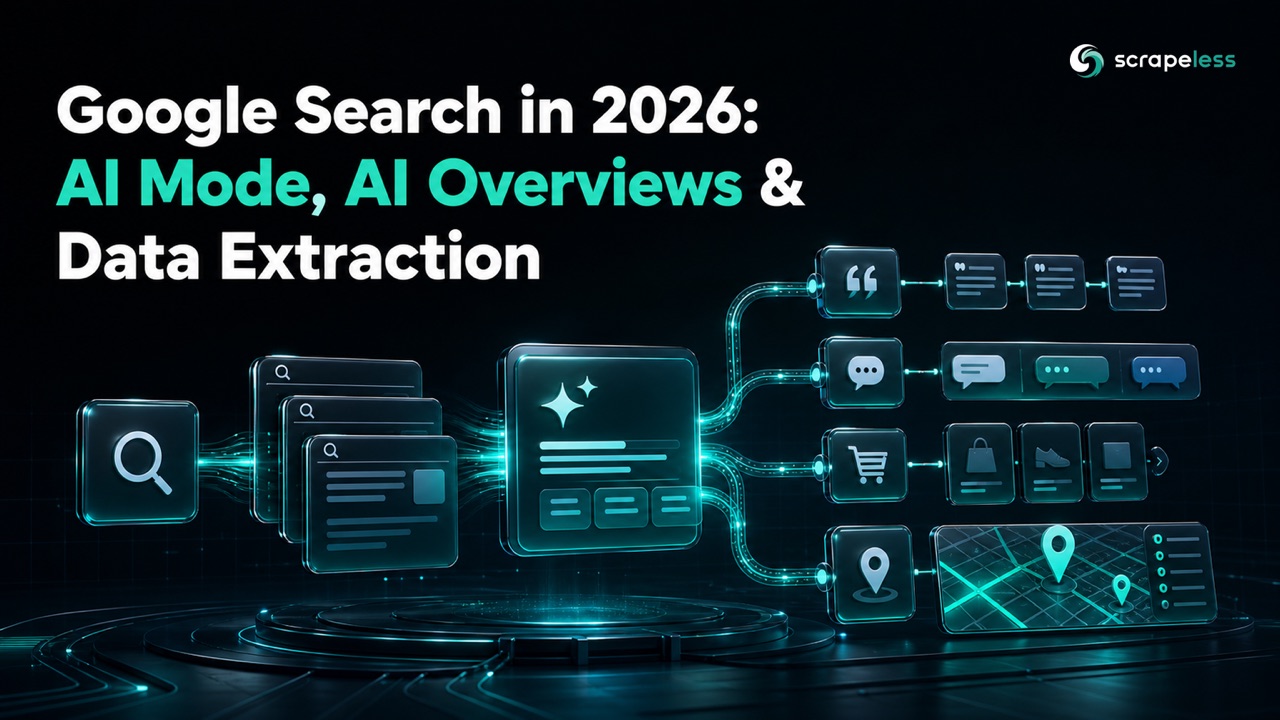
That creates five practical extraction surfaces:
| Surface | Primary object | What downstream users usually need |
|---|---|---|
| Classic web results | Ranked result | Title, URL, snippet, position, displayed query |
| AI Overview | Generated answer | Answer text, cited sources, trigger state, products or ads when present |
| AI Mode | Conversation turn | User prompt, response, citations, prior-turn context |
| Shopping | Product result | Name, merchant, price display, availability cues, destination URL |
| Local | Place result | Name, category, location, rating display, map position |
These objects should not be forced into one universal result row. An organic position and a citation position answer different questions. A product price is not a snippet. A follow-up answer depends on prior turns, while a classic search request is often stateless.
Traditional SERPs and AI Answers Need Different Schemas
A conventional SERP monitor can compare ordered organic results by URL. It can report newcomers, lost pages, and position changes. That approach breaks when the output is a synthesized answer with inline or grouped citations.
For classic results, the stable unit is usually one ranked page. Recommended fields include:
query_displayed, because Google may rewrite or correct the submitted query;position, scoped to the result type rather than treated as a global page position;title,link, andsnippet;result_type, such as organic, news, local, or shopping;collected_at,gl,hl, device, and search domain;- a raw-response reference and parser version.
For an AI answer, the stable unit is the answer event. It needs a separate answer identifier, generated content, trigger state, citations, and request context. When an AI Overview does not appear, store triggered: false or an equivalent state. Do not turn a missing module into an empty string and count the request as a complete answer capture.
AI Overviews Are Answer Objects With Evidence
An AI Overview can include a generated explanation plus links that support parts of that explanation. The Google help page for AI Overviews also makes clear that users can see links to learn more and that generative AI responses can make mistakes.
For analysis, preserve three connected layers:
- Request context. Query, locale, language, device, collection time, and any personalization controls used by the collection environment.
- Answer content. Rendered text or structured blocks in their original order, plus a content hash for change detection.
- Evidence edges. Each cited source URL, its visible label, its position in the answer, and the answer block it supports when that relationship can be observed.
This model supports questions that a flattened link list cannot answer. A brand may remain at organic position three while disappearing from the generated answer. A source may be cited without ranking on the first classic results page. An answer may retain the same sources but change the claims attached to them.
The Scrapeless Google AI Overview actor documents fields for content, raw text, metadata, web sources, products, and ads. Its documentation also notes that content fields can be empty when the feature is not triggered. That distinction belongs in the downstream contract, not in a cleanup script.
AI Mode Adds Conversation State
AI Mode turns extraction into a sequence rather than a single request. Google announced expanded capabilities for AI Mode and AI Overviews in its Search product update. For a monitoring system, the important change is that a follow-up prompt may be interpreted through the previous conversation.
Store each run as a conversation with ordered turns:
- conversation ID generated by the collector;
- turn number and submitted prompt;
- parent turn or previous response reference;
- complete visible answer;
- citations associated with that turn;
- locale, device, and timestamp;
- termination reason, timeout, or validation error.
Do not compare a follow-up response with a fresh-query response as if they were equivalent. A prompt such as “which one supports teams?” has no stable meaning without the products or services discussed in the prior turn.
Conversation monitoring also needs a replay policy. Keep a fixed prompt sequence for longitudinal measurement, then run exploratory prompts separately. Otherwise the benchmark drifts whenever an analyst changes wording midway through the week.
Citations Need Their Own Change Log
Citations are useful for visibility analysis, but they are not endorsements and they are not conventional rankings. Store citation observations without assigning meaning that the interface does not expose.
A practical citation record contains:
| Field | Purpose |
|---|---|
answer_id |
Joins the source to the generated answer |
source_url |
Preserves the destination as collected |
canonical_url |
Supports deduplication after normalization |
citation_order |
Records visible order within that answer |
answer_block |
Links evidence to a paragraph or card when observable |
first_seen and last_seen |
Measures persistence across scheduled runs |
content_hash |
Detects answer changes even when sources remain stable |
Normalize tracking parameters only under an explicit rule. Keep the collected URL alongside the canonical form so analysts can audit redirects and attribution. A source that appears twice in one answer may represent two evidence edges, even if it resolves to one canonical page.
Shopping and Local Results Are Not Decorations
Shopping and local modules often carry the fields that commercial monitoring needs most. They also vary by query, country, language, and device, so the collection context is part of the result.
For shopping, retain the displayed price string as well as any parsed numeric value and currency. A numeric parser can fail on price ranges, subscriptions, taxes, or regional separators. The original display is the audit trail.
For local results, keep the business name, visible category, address or area, rating display, review-count display, and map coordinates only when those fields are publicly returned and relevant to the approved use. Avoid collecting unnecessary personal information from reviews or profiles.
Both modules should use independent positions. shopping_position: 2 must not be compared directly with organic_position: 2. Their containers, eligibility rules, and user interactions differ.
A Publication-Week Field Sample
For this article, a publication-week search for “Google Search data extraction AI Mode AI Overviews 2026” returned official Google documentation and product updates among the discoverable web results. The verified observation can be represented without claiming that an AI module appeared:
| Field | Example value | Confidence |
|---|---|---|
| Submitted query | Google Search data extraction AI Mode AI Overviews 2026 | Direct observation |
| Result type | Organic web result | Direct observation |
| Destination host | developers.google.com | Direct observation |
| Page topic | AI features and website guidance | Verified on destination |
| AI Overview trigger | Not asserted | No valid API response captured |
| AI Mode conversation | Not run | Outside this sample |
This is deliberately narrow. The available Scrapeless API credential could not produce a valid live response during verification, so the article does not invent AI answer fields or rankings. In a production run, store the raw response reference and validation status beside every parsed record.
Build a Versioned Search Data Contract
Start with a shared envelope, then attach a typed payload for each surface. The envelope should carry:
request_idand an idempotency key;- submitted and displayed query;
- collection timestamp and maximum acceptable age;
gl,hl, search domain, device class, and safe-search setting;- surface type and schema version;
- parser version, raw-response location, and validation result.
The payload then follows the surface. Organic results contain ranked links. AI Overviews contain answer blocks and citation edges. AI Mode contains ordered turns. Shopping and local payloads keep their own domain fields.
Version the contract whenever a required field changes meaning. New optional fields can be added compatibly, but a field should never silently switch from “visible order” to “estimated importance.” That kind of ambiguity creates false trend lines.
Collect Search Surfaces With Scrapeless
Deep SerpApi is the repeatable collection layer for search-result data. Its documented Google Search actor is scraper.google.search, with inputs such as q, gl, hl, and google_domain. Those parameters should come from the monitoring job, not from analyst defaults hidden in application code.
When the workflow specifically needs Google AI Overview content, use the Google AI Overview scraper guide. Route both outputs into the same request envelope so an analyst can compare surfaces collected under the same locale and time window.
For no-code scheduling, the Make integration guide shows how organic results such as title, link, and position can be mapped into later steps. Apply validation before sending rows to a dashboard or notification channel.
Operate a Monitoring Pipeline
A dependable weekly monitor has seven stages:
- Freeze the query set. Assign an owner, intent class, locale, device, and expected surfaces to every query.
- Schedule comparable runs. Use the same time windows and parameters before adding exploratory requests.
- Collect raw and parsed outputs. Raw responses allow reparsing when the schema changes.
- Validate required fields. Quarantine challenge pages, empty shells, invalid locales, and unrecognized payloads.
- Normalize URLs and entities. Preserve originals while creating stable comparison keys.
- Compute surface-specific changes. Compare organic ranks, answer hashes, citations, products, and local entries independently.
- Publish an evidence-backed report. Link every alert to the query, run, and source record behind it.
Track at least collection success, validation acceptance, feature trigger rate, citation churn, answer-content change, and time since last accepted observation. Separate “feature absent” from “collector failed.” Combining them makes both SEO analysis and incident response unreliable.
Turn Extracted Data Into Decisions
The useful output is not a larger spreadsheet. It is a controlled change signal.
For content teams, flag queries where an owned page loses citation presence while its organic position remains stable. For product teams, compare shopping fields under a fixed locale. For local operations, detect changes in publicly displayed business information. For research, retain enough provenance to reproduce a sample before drawing conclusions.
Generated answers can be wrong or incomplete. Any workflow that summarizes health, legal, financial, employment, or safety information needs human review and source-level verification. The extraction system can preserve evidence; it cannot decide whether a sensitive conclusion is appropriate.
Conclusion
Google Search data extraction in 2026 requires a surface-aware schema. Keep classic rankings, generated answers, conversations, citations, products, and local results distinct, then connect them through one versioned request envelope.
Start with a small fixed query set in Deep SerpApi. The related Google AI Overview scraper guide covers that surface in more depth. Review Scrapeless pricing, then create a Scrapeless account to test an approved query set. Save raw responses, reject invalid records, and publish only changes that can be traced back to a verified observation.
Scrapeless provides web data infrastructure for compliant collection from public web sources. Use collection tools in accordance with applicable laws, site terms, robots directives, and your organization’s data policies.
Frequently Asked Questions
What is Google Search data extraction in 2026?
It is the collection of structured observations from classic results, AI Overviews, AI Mode, shopping units, local modules, and other visible search surfaces. Each observation should include its query and collection context.
Are AI Overview citations the same as organic rankings?
No. A citation is a source relationship inside a generated answer. Organic position is an ordering within the web-results surface. Store and analyze them separately.
How should a pipeline record an AI Overview that does not appear?
Use an explicit not-triggered state with the request context and collection time. Do not substitute an empty answer or treat the request as a parser success.
Which Scrapeless product fits this workflow?
Deep SerpApi fits repeatable search-result collection. The Google AI Overview actor is appropriate when the workflow needs the generated answer and its documented source fields.
How often should search data be collected?
Choose a cadence based on the decision. Daily collection may suit volatile commercial queries, while a weekly run may be enough for broader visibility tracking. Consistent locale, device, and time windows matter more than arbitrary frequency.
At Scrapeless, we only access publicly available data while strictly complying with applicable laws, regulations, and website privacy policies. The content in this blog is for demonstration purposes only and does not involve any illegal or infringing activities. We make no guarantees and disclaim all liability for the use of information from this blog or third-party links. Before engaging in any scraping activities, consult your legal advisor and review the target website's terms of service or obtain the necessary permissions.