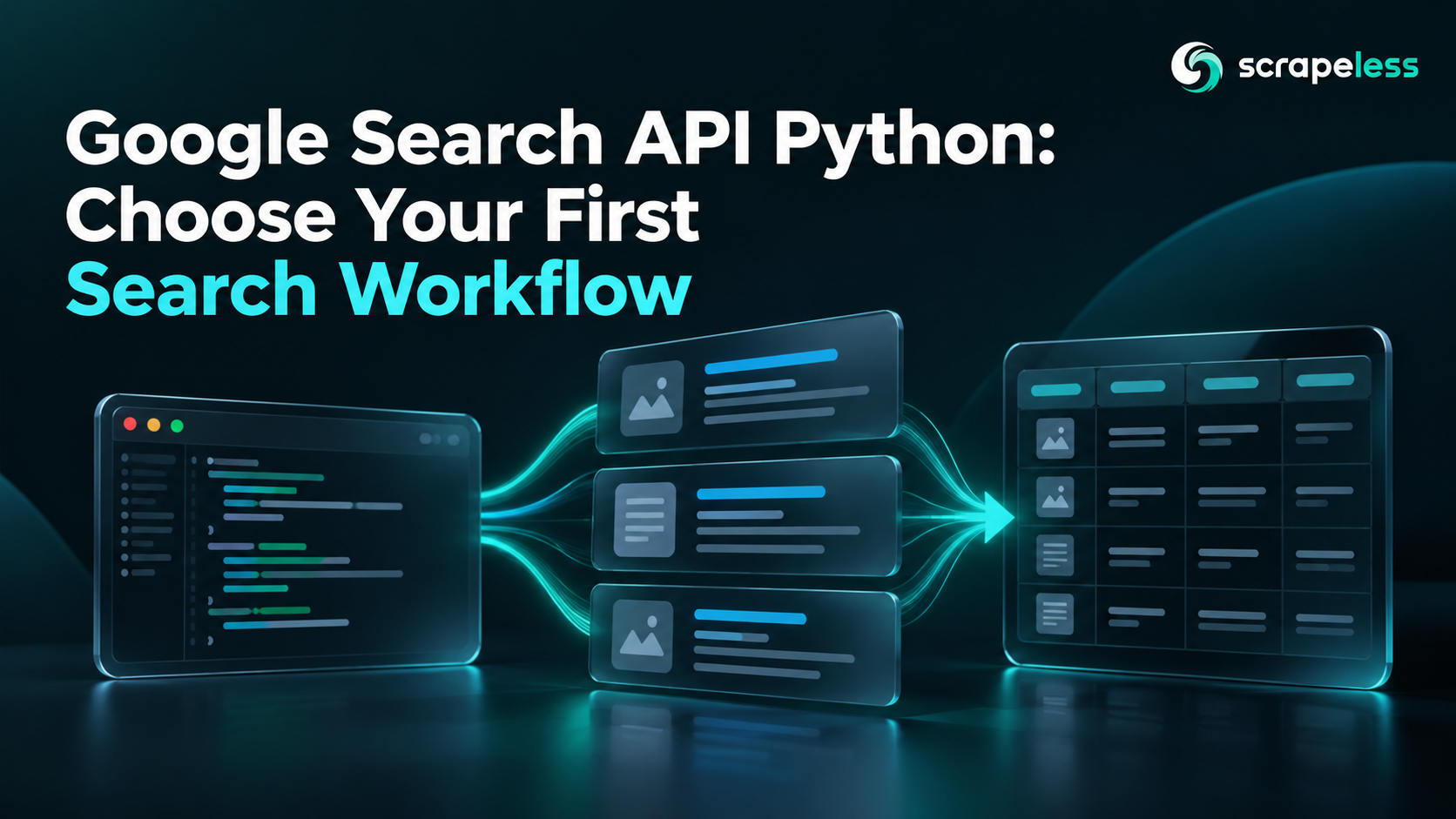
Google Search API Python: Choose Your First Search Workflow

Senior Cybersecurity Analyst
TL;DR:
- Google Search API Python projects should begin with a useful output. A ranked URL table, monitoring history, and retrieval context are different deliverables.
- Structured search data reduces page-parsing work. Your application still needs its own storage and validation rules.
- Search snippets and complete page content serve different purposes. A discovery result does not establish everything a destination page says.
- A narrow first workflow makes integration choices easier. Define the query set and acceptance rules before expanding the workload.
Introduction: Pick the Output Before the Client Library
A Python search application is useful when it turns a question into an output someone can use. A terminal that prints result titles demonstrates connectivity; a report or monitoring record gives the integration a purpose.
The first decision in a Google Search API Python project is therefore the workflow. Decide whether the application discovers sources, monitors visibility, or collects a research table. That choice determines which search fields matter and what the application must retain.
Why Python Teams Choose Structured Search
Structured search lets a Python application consume result fields without maintaining its own search-page parser. Scrapeless Google Search API provides Google results as JSON for downstream applications.
The value is practical: result titles and destinations can enter a table or storage record directly, while the team spends its effort on the user's question. Structured delivery does not remove the need to check response shape, optional fields, and downstream assumptions.
The JSON interchange standard defines the data format. Your application defines which fields are required for a valid observation and what to do when those fields are absent.
Choose Among Discovery, Monitoring, and Retrieval
The first search workflow should have a specific output and a specific consumer.
| Workflow | Consumer | Useful output | Boundary |
|---|---|---|---|
| Source discovery | Researcher | Titles, destinations, and query context | Results require source review |
| Keyword monitoring | SEO team | Comparable rank observations over time | Positions do not measure traffic |
| Retrieval for an assistant | Application user | Selected results with attributable URLs | Snippets may not support a complete answer |
| Category research | Product analyst | A deduplicated discovery table | Search visibility is not market size |
For a first scheduled project, keyword rank tracking is a concrete option: the application collects the same query contexts, matches a target, and preserves a history. A research tool instead needs review notes and deduplication, while an assistant needs rules for selecting evidence.
Avoid treating these workflows as interchangeable simply because they share a search request. Their acceptance criteria are different.
Preserve Context Alongside the Result
A useful search record keeps the question and the observation together. Store the original query, requested market and language, collection time, relevant result fields, and a capture status.
Retain the returned destination URL as evidence and keep any normalized form in a separate field. URL normalization follows the URI normalization rules; removing a meaningful path or query component can change the page the record refers to.
Define optional-field behavior before feeding the data into a table. A missing snippet may still leave a useful discovery result. A missing destination may make a result unsuitable for citation. The output contract should state those distinctions explicitly.
Start Scraping with Scrapeless
Power up your web scraping and automation workflow with Scrapeless!
Sign up today and get $5 in free credit — no credit card required.Claim your free credit now in the Scrapeless Dashboard.
Keep the Integration Boundary Small
A small integration boundary is easier to maintain as the application grows. Place search collection behind a function or service that returns the application's chosen record shape, rather than exposing every response field throughout the codebase.
Separate collection from transformation and storage. The collector owns authentication and response handling. The transformer selects and normalizes fields. The writer produces the CSV, database rows, or context records that the workflow actually needs.
For implementation, start from the current Google Search request quickstart. This article defines the workflow and procurement decisions; the quickstart supplies the documented request details.
Protect the API key as application configuration and keep it out of exported datasets. Record delivery outcomes separately from result quality. The HTTP response semantics explain protocol status, while a workflow-specific validator decides whether the returned data satisfies the application.
Budget for the Workflow, Not the Demo
The production budget depends on the query plan rather than the language used to call the API. Count unique query contexts, scheduled captures, required pages, and any additional collection steps.
A daily monitoring job with a stable keyword set has a different workload from an assistant that searches on demand. For either design, compare the expected workload with pricing and confirm the terms for the selected plan.
Define a workload cap, a maximum search depth, and a reason to stop collecting for a task. Deduplicate equivalent tasks when freshness requirements permit. These controls keep an exploratory project from becoming an unexplained recurring expense.
Decide What the First Release Must Prove
A useful first release proves that the output answers the chosen question. For monitoring, the report should distinguish a domain match from an absent target and an unavailable capture. For research, a user should be able to open a source and explain why it was selected. For retrieval, an answer should keep its source destinations available for review.
When the workflow is building a rank tracker, evaluate the history model and comparison rules before adding dashboards. When the workflow is source discovery, prioritize reviewability and duplicate control.
Keep the first query set small enough for a person to inspect. Expand only after the record shape and review process serve the intended user.
Conclusion: Give the Python Integration a Clear Job
Choose a Google Search API Python workflow by naming the output, the user, and the evidence the user needs. Scrapeless supplies a structured collection layer; your application turns it into a report, a monitoring history, or retrieval context.
The wider Google Search API solutions help map the integration to a business use case. Start with one workflow and a written output contract, then expand the collection plan when the first output proves useful.
Ready to Build Your Search Workflow?
Join developers building search products in Discord and Telegram. Start with a focused query set and bring your requirements to the team.
Create your Scrapeless account and turn the collection plan into your first Google Search API workflow.
FAQ
Q: Do I need to parse Google HTML in Python?
A structured search API lets a Python application consume JSON result fields instead of parsing the Google result page itself. The application still validates and transforms the returned data.
Q: Can search snippets replace full page content?
Search snippets cannot always replace full page content. They support discovery and limited context, while detailed claims may require reading the destination page.
Q: Which Python workflow is easiest to scope first?
A workflow with a fixed query set and a clear output is easiest to scope first. A small research table or a defined keyword monitoring history gives the team a concrete acceptance rule.
Q: Is a search API a finished reporting product?
A search API is a data collection component. Your application supplies the storage, reporting, permissions, and business rules its users need.
At Scrapeless, we only access publicly available data while strictly complying with applicable laws, regulations, and website privacy policies. The content in this blog is for demonstration purposes only and does not involve any illegal or infringing activities. We make no guarantees and disclaim all liability for the use of information from this blog or third-party links. Before engaging in any scraping activities, consult your legal advisor and review the target website's terms of service or obtain the necessary permissions.