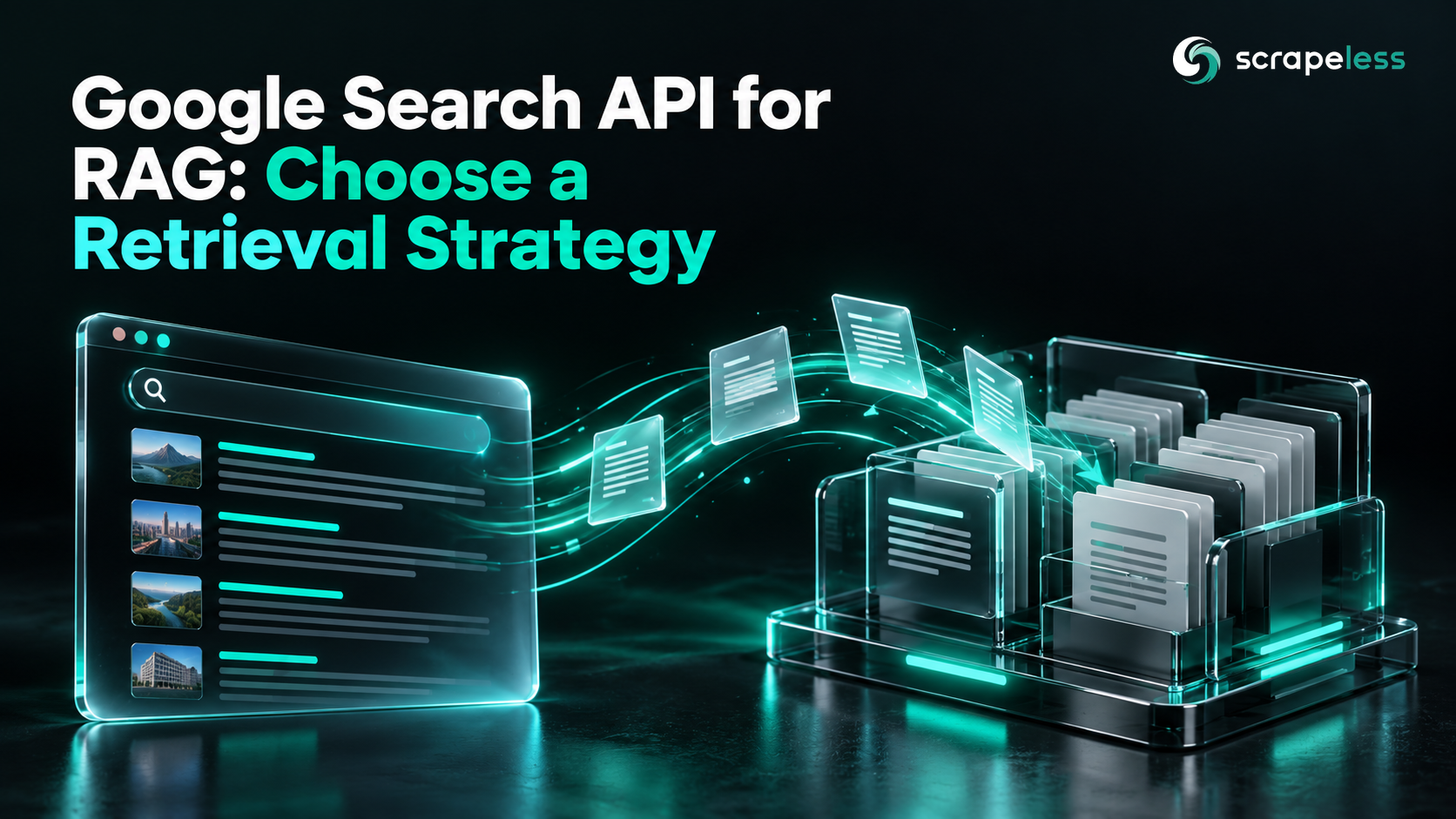
Google Search API for RAG: Choose a Retrieval Strategy

Advanced Data Extraction Specialist
TL;DR:
- Google Search API for RAG should solve a defined retrieval gap. Use web discovery when an answer needs sources outside the maintained internal corpus.
- Search snippets are discovery clues. Fetch and inspect source content before treating a result as evidence for a generated answer.
- Retrieval quality and answer quality need separate evaluation. A relevant destination does not guarantee that the final answer uses it correctly.
- Choose Scrapeless around the search handoff. Confirm the result context your application needs and keep downstream fetching, admission, and generation responsibilities explicit.
Introduction: The Retrieval Gap Comes Before the API Choice
An internal knowledge base can be accurate and still lack the source needed for a new question. A buyer asks about a recent policy, a researcher needs a current specification, or an agent encounters an unfamiliar organization. The application must decide whether to answer from its maintained corpus, discover public web sources, or decline to make a claim it cannot support.
Google search api for rag is useful when web discovery addresses that specific gap. The search stage finds candidate destinations and supplies context for deciding what to inspect next. It does not remove the need to fetch source material, assess its suitability, or connect an answer claim to supporting evidence.
The Google Search API provides structured search results for a wider Google search workflow. The AI models and RAG solution is the relevant starting point for teams evaluating search-powered retrieval. This article explains architecture and buying decisions through hypothetical application cases, without presenting executed requests or sample responses as real captures.
Decide Whether the Question Needs the Public Web
Public web retrieval should be triggered by the information need rather than added automatically to every answer.
Some questions belong entirely inside a controlled internal corpus. An employee asking about a private expense policy needs the approved company document, not a public discussion of reimbursement practices. Other questions require current public material that the organization cannot reasonably maintain in advance. The retrieval policy should distinguish these situations before choosing a provider.
Define the allowed question classes. A technical assistant might use public search for standards and current official product information while restricting customer-specific procedures to internal documents. A market research tool might permit broader discovery but require visible attribution. Those policies establish different source requirements and different reasons for declining an answer.
Keep the trigger understandable to the product owner. If a system silently searches the web whenever internal retrieval is weak, it may substitute public generalities for a private rule. A source policy should say when external material is permitted and what happens when it conflicts with approved internal evidence.
Choose Between Maintained Sources and Open Discovery
A retrieval strategy should balance known-source control against the breadth of open discovery.
A maintained source collection gives the team a bounded set of documents to review, refresh, and evaluate. That can work well for a specialized assistant whose authoritative sources change predictably. Open discovery is more appropriate when the application encounters unfamiliar topics or needs information beyond the curated collection. Both approaches can coexist if their roles remain clear.
Consider a hypothetical procurement assistant. Questions about an organization's approved purchasing rules should use its maintained corpus. Questions about a supplier's current public certification may require discovery of the supplier or certifying authority. Questions about future business outcomes may remain uncertain even after retrieval. Searching does not convert every question into a verifiable fact.
Evaluate the maintenance burden of each strategy. A broad local index needs ongoing refresh and source governance. On-demand discovery needs source admission and evidence handling during the answer workflow. Choose the combination that your team can govern, rather than assuming either strategy eliminates the work of keeping answers grounded.
Treat Search Results as Candidate Sources
Search results identify destinations worth inspecting but do not automatically establish support for a claim.
A title and snippet can suggest that a page covers the requested topic. They may not reveal qualifications, publication context, or a later correction within the source. Fetch the intended destination and inspect the relevant material before passing it into an evidence-backed answer. A discovery record should remain distinct from the retrieved document record.
Preserve the query and result context when selecting a destination. If a reviewer later asks why the application considered that source, the system should be able to connect the document to the search that found it. This connection is especially useful when several similar pages describe different product versions or regional policies.
The W3C provenance framework explains the general value of retaining the origin and processing history of information. Apply that principle to the search-to-document handoff: keep discovery evidence, fetched content, and later answer use separately identifiable rather than flattening them into a single text blob.
Require a Content Acquisition Plan
A RAG architecture needs a defined way to obtain source content after discovery.
The search product and the page acquisition layer serve different purposes. Confirm which stage your chosen service supplies and which stage your application owns. A search result containing a URL does not imply that the complete destination text has already been obtained, parsed, or licensed for your intended use.
Plan for public pages that cannot be admitted as usable evidence. A destination might contain irrelevant navigation, require access the application does not possess, or fail to expose the material the snippet suggested. Preserve that outcome and consider another suitable source rather than filling the gap with an invented passage.
The Scrapeless collection architecture provides broader context for evaluating distinct collection surfaces. Keep the product discussion tied to the search role in this application. Additional source acquisition capabilities should be evaluated against the actual destinations and access conditions the product requires, with no assumption that ordinary search results equal complete page evidence.
Define Authority in Relation to the Claim
Source authority should be evaluated against the specific claim the answer intends to make.
An official product page can support a statement about that product's documented capability. A standards body can support the definition of a protocol. An independent research paper may address an empirical question that a product marketing page does not establish. The right source depends on what the application is claiming, not merely the familiarity of the domain.
Give the retrieval policy examples of acceptable source relationships. A current official policy can support a policy summary. A discussion forum might help discover a reported issue but may not establish that the issue affects every user. An archive can support a historical statement while being unsuitable for a claim about current availability.
Keep conflicting evidence visible when the disagreement matters. If sources differ by date, jurisdiction, or product version, the answer may need to state that qualification. A source ranking policy should not erase a meaningful conflict simply because one destination appeared earlier in the search results.
Start Scraping with Scrapeless
Power up your web scraping and automation workflow with Scrapeless!
Sign up today and get $5 in free credit — no credit card required.Claim your free credit now in the Scrapeless Dashboard.
Keep Retrieval Evaluation Separate From Answer Evaluation
Retrieval evaluation asks whether suitable evidence was found, while answer evaluation asks whether the response uses that evidence correctly.
An application can retrieve an authoritative document and still misstate its meaning. It can also produce a plausible answer from a poor source set. Evaluate these stages separately so a problem can be assigned to query formulation, source selection, document extraction, or generation rather than described vaguely as a model issue.
Build an evaluation set around representative product questions. Include questions answerable from maintained material, questions requiring current public discovery, and questions that should remain unresolved. Keep a record of what evidence would support an acceptable response. The data quality assessment framework supports describing fitness for use rather than assuming that every retrieved dataset meets the same need. Do not limit the set to questions for which the system already produces a fluent answer.
The original retrieval-augmented generation research provides the foundational connection between retrieval and generation. A product evaluation should extend that architectural idea into the application's own evidence requirements rather than assume that attaching search guarantees factual correctness.
Control Context Before Optimizing Speed
A retrieval workflow should preserve enough context to distinguish relevant current evidence from a superficially similar result.
Language, region, topic wording, and product version can affect which destinations are useful. Define those requirements at the application level before evaluating performance. A quick answer to the wrong regional policy question is not a successful retrieval experience, even if the search stage completed within a desirable time window.
Preserve observation and acquisition times separately where the distinction matters. A document can be fetched now while describing an older policy. The standard Internet timestamp representation provides a consistent exchange format for time records. The product still needs to interpret whether a source's stated effective period matches the user's question.
Avoid promising that every answer will contain the newest possible information. Instead, define the freshness requirement for each question class and disclose when the evidence does not meet it. That gives users a meaningful understanding of the answer's limits and gives operators a concrete condition to investigate.
Minimize What Leaves the Application
A web discovery query should contain only the information needed to find appropriate public sources.
A user may ask a question that combines a general technical topic with private account details. The application should separate the public information need from confidential context before constructing an external search query. Public discovery does not require sending the entire conversation or internal document to a search provider.
Define which inputs are eligible for external retrieval and which need redaction or a maintained-source route. Make that policy part of product design rather than an undocumented convention in a prompt. The W3C privacy principles support minimizing unnecessary data and explaining its handling.
Set access and retention boundaries for retrieved material as well. Source text, user questions, and generated answers can create different obligations. A team evaluating Google Search API for RAG should include those downstream responsibilities in the architecture review even when the initial provider purchase covers only discovery.
Compare Providers at the Search Handoff
A provider evaluation should test the structured discovery information the application needs to choose its next action.
For Scrapeless, confirm the intended search surface, contextual controls, result representation, and production access for the proposed account. The product page describes structured organic results and request context; your evaluation should establish how those capabilities map to your application's source selection requirements. Keep unsupported assumptions out of the procurement specification.
Review Scrapeless pricing using the planned search footprint and the downstream work associated with each result set. The cheapest discovery request is not necessarily the cheapest supported answer if the application admits irrelevant documents or performs unnecessary source acquisition. Evaluate the whole workflow while keeping provider charges and internal operating costs separate.
Ask the application team to walk through a hypothetical evidence handoff. A reviewer should be able to identify the question, selected destination, fetched passage, source qualification, and answer claim. If that chain is unclear, improve the architecture before expanding collection volume or promising broader topic coverage.
Plan an Honest Unresolved Outcome
A grounded application needs a useful response when available evidence cannot support the requested claim.
Define what the product says when discovery returns candidate pages but no admissible source. It may explain which information remains missing, offer a narrower answer, or direct the user to an appropriate expert. This is a product behavior that deserves design attention rather than an exceptional path hidden from the evaluation set.
Distinguish unsupported claims from questions outside the product's scope. A general assistant may find public sources for a topic while still lacking the authority to make a personalized legal or medical determination. Retrieval provides information; it does not erase the boundaries of the service the organization has chosen to provide.
Retain enough evidence for operators to improve the retrieval policy. Repeated unresolved cases may reveal missing maintained sources, poor query formulation, or an unrealistic coverage promise. Use those cases to guide product decisions without presenting an absence of evidence as a confident factual conclusion.
Conclusion: Buy Discovery for a Defined Evidence Chain
Google search api for rag is most useful when the application knows why it needs public discovery and how a discovered destination becomes admissible evidence. Keep search, acquisition, source assessment, and answer generation explicit. Evaluate Scrapeless at the discovery handoff, then judge the complete product by whether users receive supported answers with understandable limits.
Ready to Build Your Search Evidence Workflow?
Discuss search data with developers in Discord and Telegram.
Start your Scrapeless evaluation with the evidence requirements and decision owners your team needs.
FAQ
Q: Can a search snippet be used as the complete evidence for a RAG answer?
A search snippet should ordinarily be treated as a discovery clue. Inspect the source content needed to support the answer's actual claim before admitting it as evidence.
Q: Does every RAG application need public web search?
A RAG application needs public web search only when its information requirements extend beyond the maintained sources it can appropriately use. Private policy questions may belong entirely in an internal corpus.
Q: What should a Scrapeless evaluation establish first?
A Scrapeless evaluation should first establish the structured discovery handoff and required context. Page acquisition and final answer quality need their own acceptance criteria.
Q: What happens when no suitable source can be found?
The application should preserve an unresolved outcome and explain the evidence limitation. It should not fabricate a source passage to complete an answer.
At Scrapeless, we only access publicly available data while strictly complying with applicable laws, regulations, and website privacy policies. The content in this blog is for demonstration purposes only and does not involve any illegal or infringing activities. We make no guarantees and disclaim all liability for the use of information from this blog or third-party links. Before engaging in any scraping activities, consult your legal advisor and review the target website's terms of service or obtain the necessary permissions.