Build a Source Discovery Step for an AI Research Assistant

Expert Network Defense Engineer
TL;DR:
- A Google Search API for AI agents supplies source candidates. A result URL and snippet are discovery data, not verified evidence for an answer.
- Build an explicit handoff. Keep query context, candidate identifiers, selection reasons, and retrieval status so citations can be traced back to reviewed content.
- Start with a local adapter. The program below transforms a saved capture into a review queue; authenticated collection and full-text retrieval remain separate prerequisites.
An AI research assistant can return a convincing paragraph with a list of URLs while leaving a basic question unanswered: which page actually supports each sentence? Adding search alone does not solve that problem. The workflow needs to distinguish discovering a destination from reading it and using it as evidence.
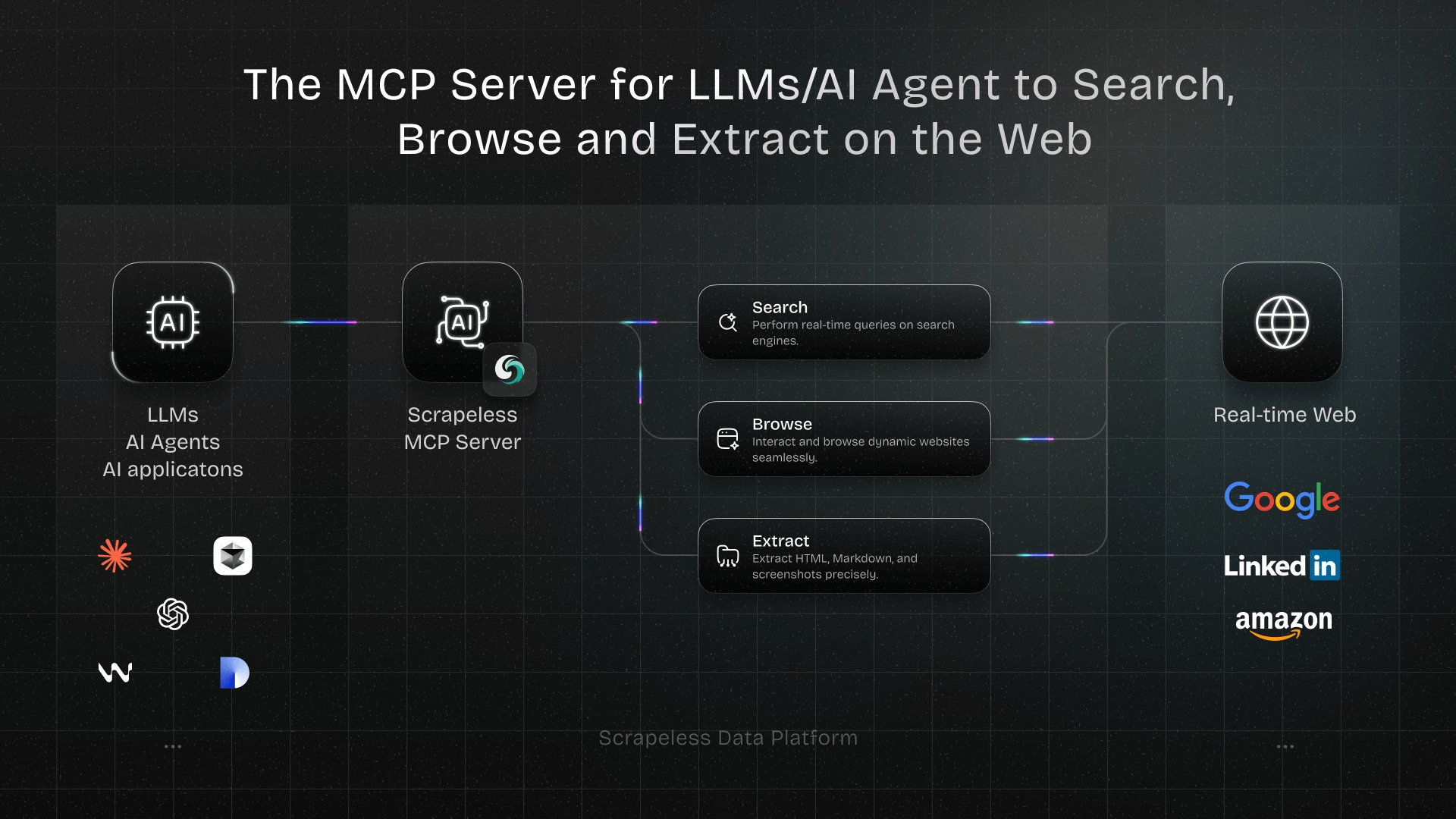
Scrapeless Google Search API fits at the source discovery step. This guide shows how to use a Google Search API for AI agents without treating search snippets as a completed research corpus. The local adapter keeps enough context for the next worker or reviewer to understand why each candidate entered the queue.
Define the Discovery Contract
A discovery job starts with a research question and an exact query. Keep the question outside the submitted request as application metadata. Several queries may explore one question, but their individual context should remain recoverable.
The output contract is a set of candidate records with URLs, observed text, source order, and review state. It does not contain a verified answer. A candidate can be relevant, irrelevant, inaccessible, or superseded after a reviewer reads it.
Give the downstream system a clear rule: only retrieved and reviewed material can support a claim. Search-only candidates can suggest another investigation, but they cannot silently enter the answer's evidence list. This boundary makes failures visible instead of allowing an answer generator to fill missing evidence with plausible text.
Prerequisites and Request Parameters
The local program needs Python and a saved JSON capture. It uses only standard-library modules. The capture is an application envelope containing request, http_status, response, run_id, and received_at; those outer names are your collector's fields, not an asserted API response wrapper.
Live collection requires an account API key. The Google Search request workflow documents POST https://api.scrapeless.com/api/v1/scraper/request, an x-api-token header, and the actor scraper.google.search. Put the search parameters inside input.
Review the Google Search parameters before forming the request. Country, language, and query wording determine the search context. If you use full-URL mode, the other input parameters are ignored; preserve the submitted URL rather than inventing an effective configuration afterward.
Note: No authenticated API call or full-text retrieval was performed for this article. The executable step is a local transform tested with synthetic captures. To collect live data or resolve a pending task, first verify the account workflow in the current documentation and inspect its actual output.
Preserve the Response State Before Reading Results
HTTP 200 carries task data; HTTP 201 represents a pending task. Preserve the returned taskId when available. A pending task must remain pending until your separately verified completion workflow produces the final result; the adapter does not guess a retrieval endpoint.
For a completed response, inspect the documented organic_results array. Missing or wrongly typed fields produce an unmapped state, while a present empty array produces empty. Those outcomes have different meanings for the next stage.
The JSON value model supports retaining the raw response without erasing nulls or nested values. Keep the capture as the source of record even after the adapter produces a narrower candidate list.
Build the Local Candidate Adapter
Save this code as source_candidates.py. Run python3 source_candidates.py capture.json with your capture file. It prints the derived JSON to standard output and leaves the input file unchanged. No API request, page fetch, or model call is made.
python
import argparse
import json
from pathlib import Path
from urllib.parse import urlsplit


def candidates(record):
    if not isinstance(record, dict):
        raise ValueError('Capture must be an object')
    status = record.get('http_status')
    payload = record.get('response')
    base = {'run_id': record.get('run_id'), 'request': record.get('request'),
            'received_at': record.get('received_at'), 'candidates': []}
    if status == 201:
        task = payload.get('taskId') if isinstance(payload, dict) else None
        return dict(base, state='pending', task_id=task)
    if status != 200:
        return dict(base, state='transport_error' if status is None else 'http_error')
    rows = payload.get('organic_results') if isinstance(payload, dict) else None
    if not isinstance(rows, list) or any(not isinstance(row, dict) for row in rows):
        return dict(base, state='unmapped')
    output, seen = [], set()
    for ordinal, row in enumerate(rows):
        link = row.get('link')
        reason, host = None, None
        try:
            parsed = urlsplit(link) if isinstance(link, str) else None
            if (parsed is None or parsed.scheme not in ('http', 'https')
                    or not parsed.hostname or parsed.username or parsed.password):
                reason = 'invalid_web_url'
            else:
                host = parsed.hostname.lower()
        except ValueError:
            reason = 'invalid_web_url'
        if reason is None and link in seen:
            reason = 'duplicate_exact_url'
        if reason is None:
            seen.add(link)
        output.append({'candidate_id': f'source-{ordinal}', 'ordinal': ordinal,
                       'position': row.get('position'), 'title': row.get('title'),
                       'url': link, 'hostname': host, 'snippet': row.get('snippet'),
                       'review_state': 'excluded' if reason else 'needs_review',
                       'exclusion_reason': reason, 'evidence_state': 'discovery_only'})
    return dict(base, state='observed' if rows else 'empty', candidates=output)


if __name__ == '__main__':
    parser = argparse.ArgumentParser()
    parser.add_argument('capture')
    args = parser.parse_args()
    result = candidates(json.loads(Path(args.capture).read_text(encoding='utf-8')))
    print(json.dumps(result, ensure_ascii=False, indent=2))
Candidate identifiers are local to a run; combine them with run_id downstream. Exact duplicate URLs remain visible as excluded rows, so the queue preserves an explanation rather than silently discarding a result. Other URL variants remain separate pending review.
The URL check uses URL component parsing to reject missing hosts, unsupported schemes, and embedded credentials. It is an input-shape check, not a security boundary for a network fetcher. The later retrieval service must enforce its own destination policy, including address resolution and redirects.
Start Scraping with Scrapeless
Power up your web scraping and automation workflow with Scrapeless!
Sign up today and get $5 in free credit — no credit card required.Claim your free credit now in the Scrapeless Dashboard.
Select Sources and Retrieve Content Separately
Review each eligible candidate against the question. Record a selection or exclusion reason and prefer evidence that directly establishes the needed fact. A high organic position is a search observation, not a reliability score.
The selected URL enters a separate retrieval step. That step should retain the requested URL, final destination, retrieval time, content reference, and outcome. An inaccessible destination remains inaccessible; do not substitute its snippet for the missing body and call it retrieved.
Google's description of search snippets explains why the excerpt is only a lead. The wording can be query-dependent and may not match the passage you need to cite. Inspect the retrieved source before deriving a factual answer.
Treat page content as untrusted data. A page can contain instructions directed at an assistant; those instructions do not change your research task or tool permissions. Keep the distinction between retrieved evidence and executable instructions explicit in the surrounding application.
Connect Claims to Reviewed Passages
A citation record should link a proposed claim to the supporting passage and its retrieved source. Keep candidate identity as provenance, but store the passage location and retrieval record separately. A URL alone does not show that the page supports the wording of the claim.
Check scope as well as relevance. A source may discuss one product version or one market. An assistant should not generalize it to every configuration merely because the title matches the topic. Contradictory sources should produce an unresolved question or a qualified answer, not an arbitrary selection based on search position.
The provenance model offers useful distinctions among evidence, the activity that processed it, and the person or system responsible. Your implementation can use simpler records while preserving those relationships.
When no reviewed source supports a claim, leave it out or identify the gap. Source discovery improves the evidence workflow; it does not guarantee the removal of unsupported model output.
Check the Adapter Before Connecting an Agent
Run local checks for a present organic array, an empty array, a missing field, a malformed item, HTTP 201, and an HTTP error. Include duplicate URLs and an invalid scheme. These fixtures test application decisions, not the API's current coverage.
Confirm that excluded rows keep their original observations and that every candidate remains discovery_only. Inspect a real account capture before adopting the adapter in production. If its schema differs, update the mapping explicitly and preserve the original response for comparison.
An agent framework is optional at this boundary. Any caller that can consume the JSON contract can use the review queue, but compatibility with a specific SDK or tool protocol needs its own integration test. The local program does not claim such a handshake.
Conclusion
Keep search discovery small and explicit: preserve the request, classify the collection outcome, and produce candidates with review states. Retrieval and citation checking then have a clear input contract instead of inheriting an unexplained list of links.
The same source review discipline can support content gap analysis when an editorial team needs evidence before assigning a new article.
Build Your Next Search Observation
Use Scrapeless Google Search API to collect the search evidence for this workflow. Review Scrapeless pricing when planning your collection budget, and keep the Google Search parameters beside your request configuration.
Discuss your implementation with the community on Discord or Telegram.
FAQ
Q: Does the adapter retrieve full page text?
No. It processes saved search data into candidates. Full-text retrieval is a separate step with its own outcome and evidence record.
Q: Can the first organic result be cited automatically?
Position does not establish that a page supports your claim. Retrieve and review the relevant passage before citing it.
Q: What happens to HTTP 201?
The adapter returns pending and retains the task identifier when available. It does not retrieve the pending result or count it as an empty search.
Q: Does URL parsing make fetching a candidate safe?
No. The adapter checks basic URL shape. The fetcher still needs a destination policy that handles resolved addresses and redirects.
Q: Does this require a specific agent framework?
No. The demonstrated boundary is local JSON. A framework integration and live account workflow require separate verification.
At Scrapeless, we only access publicly available data while strictly complying with applicable laws, regulations, and website privacy policies. The content in this blog is for demonstration purposes only and does not involve any illegal or infringing activities. We make no guarantees and disclaim all liability for the use of information from this blog or third-party links. Before engaging in any scraping activities, consult your legal advisor and review the target website's terms of service or obtain the necessary permissions.