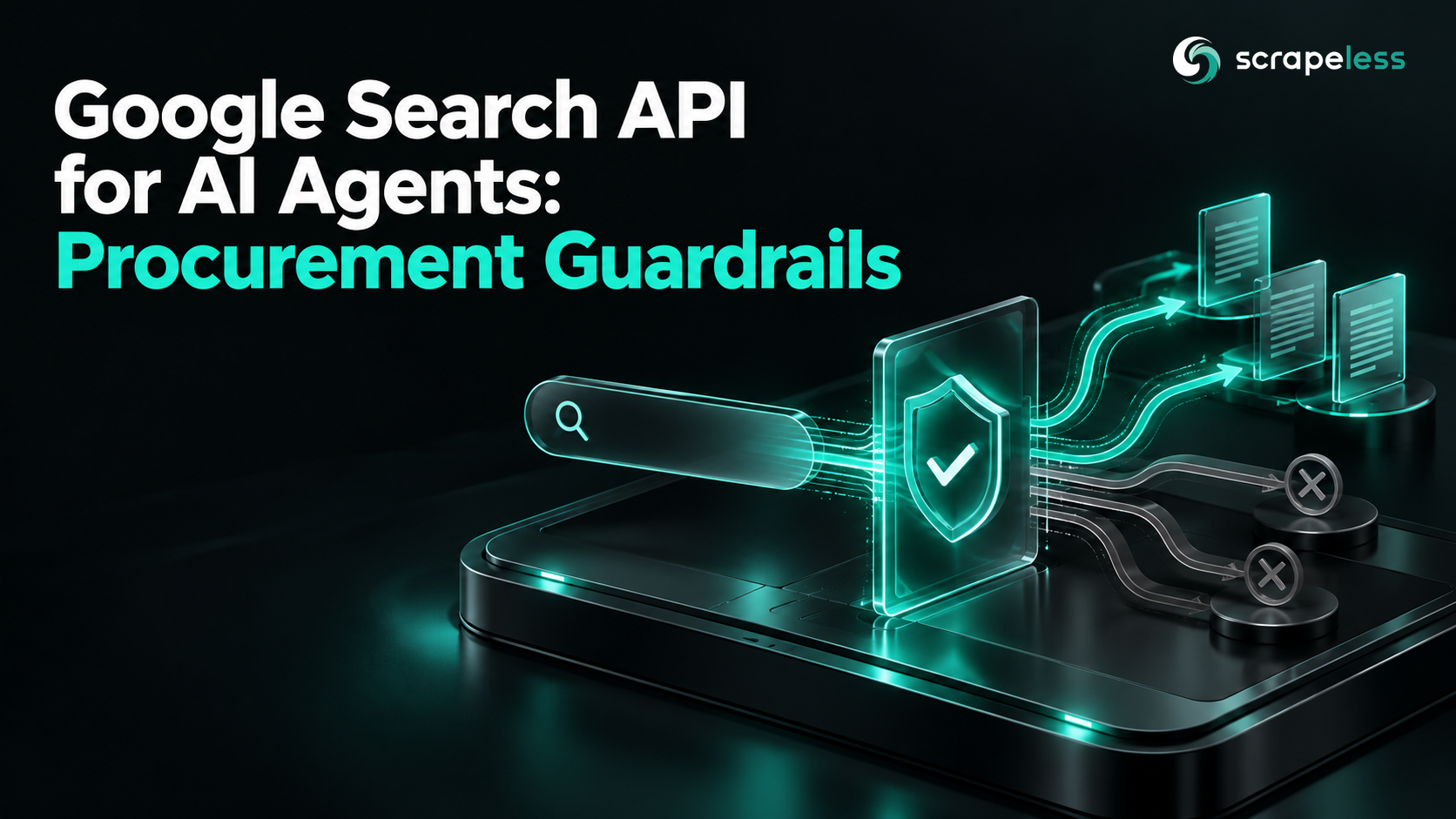
Google Search API for AI Agents: Procurement Guardrails

Advanced Data Extraction Specialist
TL;DR:
- Agent search procurement begins with an accountable service owner. Someone must be able to explain which research jobs can spend money and which must wait.
- A search allowance should follow the business request. Department budgets alone cannot explain the cost of an autonomous research task.
- Search access and permission to act require separate decisions. Discovering a public page does not authorize a purchase, a message, or a change to customer data.
- Scrapeless Google Search API provides a structured discovery layer. Your application governs research admission, review, and downstream action.
Introduction: Buy Research Capacity With a Named Owner
An autonomous research job can keep discovering useful questions after the original business question has been answered. For the team paying for it, that creates an operating problem: useful work and authorized work are different categories. A procurement decision has to define both.
A product manager might ask an agent to prepare a supplier briefing. The search task seems narrow until the agent follows regional subsidiaries, old announcements, partner pages, and commentary about the same supplier. None of those branches is necessarily irrelevant. Together, they can turn a modest briefing into a research project nobody intended to commission.
Scrapeless Google Search API supplies structured Google search results for applications that need current public-web discovery. The buying decision is therefore about how to put that capability inside a service your organization can govern. The following operating design concentrates on admission, ownership, spending authority, and exception handling. It offers planning rules rather than a claim about measured API performance.
The broader Google Search solutions connect discovery to recurring business workflows. For an agent program, the most useful starting point is the workflow that already has an owner willing to accept or reject its output.
Give Each Research Service a Spending Mandate
A research service needs a written mandate describing the questions it may investigate and the decisions its output may support. “Web research” is too broad to be a purchasing scope. “Prepare a public-information supplier brief for an analyst to review” gives engineering, procurement, and the business owner something concrete to discuss.
Include the intended reader, the accepted sources, the treatment of unanswered questions, and the point at which the service hands work to a person. A mandate should also identify exclusions. An agent that discovers a supplier website can summarize permitted public content without acquiring authority to contact that supplier or accept commercial terms.
The mandate belongs to the business service rather than to a particular prompt. Prompts change frequently. Accountability should remain understandable when a developer edits the instructions or replaces a model. Keep the approved purpose accessible beside the service configuration so a reviewer can judge a changed workflow against its original authorization.
An organization can use the AI risk management framework as context for assigning responsibilities. The specific spending mandate described here is an application design choice. Its value comes from naming a person who can decide whether the research service is still doing the job that was purchased.
Admit Work Before Allocating Search Capacity
Work admission should decide whether a request is eligible for automated research before the agent starts searching. An accepted request needs a recognizable purpose, an accountable requester, an approved data scope, and an output that the service can plausibly produce.
For example, a request to compare public product documentation may fit a research assistant. A request to certify that a company has no legal exposure does not become suitable merely because search results exist. The service should redirect the latter request to a qualified review process. That protects the meaning of the output as well as the budget.
Admission can also identify repeated business demand. Several employees may request the same public briefing for different internal meetings. A service owner can authorize a shared research artifact when its scope and freshness requirements fit those requests. That decision should preserve the context of the original research; a reused briefing must not silently acquire a broader purpose.
Queue status should distinguish accepted work from deferred work. A department cannot understand capacity if every request appears to have entered production immediately. Record why a job is waiting: unavailable reviewer capacity, unclear purpose, missing permissions, or an exhausted allowance. Those reasons support different operational decisions.
Separate Department Budgets From Job Authority
A department budget limits aggregate spending, while a job allowance limits what an individual research request may consume. Use both. An organization can remain within its monthly budget while a small set of unusually broad tasks consumes most of its available capacity.
Define an allowance in terms the application can enforce. Search activity, page acquisition, model processing, and human review may have different meters. A commercial quote for search access does not describe the entire cost of a research service. Finance should understand which charges belong to Scrapeless and which belong to the surrounding application.
For a hypothetical supplier briefing, the owner might authorize a short discovery phase and reserve deeper investigation for analyst approval. The exact allowance should come from the business value and the observed workload during a later implementation pilot. This article does not propose a universal request limit or a savings percentage.
When a task reaches its allowance, preserve the evidence already gathered and return a clear partial outcome. A useful partial brief identifies resolved questions, remaining uncertainty, and the additional work requested. An agent should not reframe the original task to obtain a new allowance without an accountable decision.
Purchase Search Access Without Delegating Business Authority
Search permission should authorize discovery, while consequential actions remain subject to their own controls. A research assistant may find public pricing, but that does not authorize it to approve a contract. It may identify a potential contact, but that does not establish permission for outreach.
This separation matters when a research workflow is connected to other tools. The search provider supplies information. Your application decides whether an action is available, who can approve it, and which record demonstrates that approval. Do not expect a search integration to supply business authorization that the organization has never defined.
The AI agent and RAG search scenario is useful when current public information should inform a model's answer. Keep the answer grounded in the service mandate. A model can propose a next step while the application requires a person to authorize execution.
Reviewers also need a way to reject an apparently useful output. If the agent reaches a sensible conclusion using material outside the accepted scope, the service has still failed its mandate. Buying search capacity includes buying the discipline to leave some discovered information unused.
Start Scraping with Scrapeless
Power up your web scraping and automation workflow with Scrapeless!
Sign up today and get $5 in free credit — no credit card required.Claim your free credit now in the Scrapeless Dashboard.
Make Tenant Allocation Explainable to Finance
Tenant allocation should connect service consumption to the business unit that requested the work without exposing another unit's research. A global usage total can support a bill payment, but it cannot explain whether the program serves its intended customers.
Track the relationship between a request, its approved service, and the cost categories accumulated during execution. Keep shared platform overhead separate from directly attributable research work. If an organization distributes overhead internally, document the allocation rule so a department can reproduce its own chargeback.
Avoid using raw query text as the default finance reporting dimension. Queries can reveal confidential commercial interests even when the results are public. A business purpose label and internal job identifier may provide enough accountability for routine reporting. Access to detailed research traces can remain limited to people who need them.
The privacy principles for data processing provide a useful basis for asking which records should exist at all. A procurement review should examine retention and access alongside price. Cheap search that generates an unnecessary internal intelligence archive can create costs elsewhere in the organization.
Require a Commercial Definition of Billable Work
A commercial agreement should define the billable event clearly enough for the buyer to reconcile usage. Ask what constitutes a charged search, which options affect the price, how account allowances work, and how usage records can support an investigation.
Check current Scrapeless pricing and the terms of the applicable offer rather than treating an advertised entry price as the final unit cost for every workload. Procurement should compare the intended query mix and service requirements with the commercial proposal. Volume, geography, and product scope belong in that conversation when they affect the agreement.
Keep billing reconciliation distinct from evidence acceptance. A provider can deliver a valid search result that does not resolve the research question. Conversely, a concise result may prove valuable without requiring a large downstream investigation. The application should explain both technical delivery and business disposition.
Before expansion, ask finance to trace a selected internal job through the cost report. The purpose is not to demand perfect cost attribution for every infrastructure operation. It is to find discrepancies large enough to distort purchasing decisions. A contract that cannot be mapped onto the service's own workload model will be difficult to evaluate at renewal.
Treat the Research Record as a Governed Artifact
A research record should show how an output acquired its supporting material and who accepted its use. This is an accountability requirement, separate from the prose quality of the final briefing.
Store the business question, the admitted scope, the discovery context, source references, important transformations, and the final disposition. The provenance model for entities and activities helps distinguish a source document from the application activity that produced a summary. It does not make the summary correct; it makes the process easier to inspect.
A reviewer should be able to see whether a conclusion depends on a current primary page, an old announcement, or a secondary interpretation. Preserve important caveats when the output is shortened for an executive reader. The service should not turn an unresolved conflict into a confident statement merely because the requested format is brief.
The search and data actor architecture provides context for separating discovery from further acquisition. Procurement should require those stages to remain visible in the application record, especially when different services or teams own them.
Plan the Suspension and Exit Procedure Before Expansion
A research service needs a suspension procedure that preserves already authorized work and stops new spending. Define who can pause admission, who can inspect the affected jobs, and what communication the business owner receives.
Suspension is useful for ordinary operational reasons: a review backlog, a changed business purpose, an unresolved billing discrepancy, or a supplier contract review. It should not require deleting the evidence archive or destroying the configuration needed to understand past decisions.
Exit planning should identify which application artifacts remain portable. Query portfolios, business mandates, accepted source rules, evaluation cases, and internal research records belong to the organization. A provider transition becomes easier when those assets are not hidden inside an undocumented prompt or a private developer notebook.
Use a tabletop exercise to inspect this design before wider rollout. Ask the operator to explain how an accepted briefing remains accessible after new work is paused. Ask procurement how the last period's usage will be reconciled. Ask the service owner which unfinished requests deserve manual completion. These questions reveal whether the service has an operating owner or merely a functioning integration.
A procurement owner should also define how exceptions expire. A temporary allowance for a particular project should have a review point and an accountable requester. Otherwise the service can accumulate permanent exceptions that no longer match the original buying case. Keep the rationale with the authorization so a later reviewer can understand why the exception existed.
A review record can use unambiguous internet timestamps to distinguish when evidence was observed from when a decision was recorded. The representation helps readers interpret the record without implying that the source itself was updated at that moment.
The data quality measurement model also helps separate the evidence from annotations about its suitability. The application chooses the relevant quality dimensions and remains responsible for explaining them to its users.
Conclusion: Commission a Service You Can Explain
Google Search API for AI agents automation becomes a procurement decision when search access supports recurring work with real owners and costs. Start with the service mandate, admit eligible jobs, connect allowances to requests, and keep consequential actions under separate authority.
Scrapeless supplies a structured public-search layer that can fit this design. Choose a bounded research service, document its commercial assumptions, and require the business owner to review its outputs before purchasing capacity for a wider workload.
Ready to Plan Your Search Research Application?
Share practical questions with developers in Discord and Telegram.
Explore Scrapeless for your research workflow with a defined question family and an evidence standard your team can assess.
FAQ
Q: What should procurement ask before buying search for agents?
Procurement should ask which business service will use the searches, who owns its output, what counts as billable work, and how the organization can suspend new spending. Technical access alone does not answer those questions.
Q: Does structured search make an agent's conclusions reliable?
Structured search makes discovery easier to process, while conclusion reliability depends on source selection, reading, interpretation, and review. Preserve unresolved questions in the final output.
Q: Can a research agent approve supplier actions?
A research agent should approve supplier actions only when a separate business authorization explicitly permits that action. Search access itself grants no purchasing or outreach authority.
Q: How should a team start with Scrapeless?
Start with a named research service and an agreed review process, then evaluate the applicable Google Search API commercial terms against that service's expected workload. Expand after operational ownership is clear.
At Scrapeless, we only access publicly available data while strictly complying with applicable laws, regulations, and website privacy policies. The content in this blog is for demonstration purposes only and does not involve any illegal or infringing activities. We make no guarantees and disclaim all liability for the use of information from this blog or third-party links. Before engaging in any scraping activities, consult your legal advisor and review the target website's terms of service or obtain the necessary permissions.