Datacenter Proxies for Browser Automation: Speed, Cost and Detection Trade-offs

Scraping and Proxy Management Expert
TL;DR:
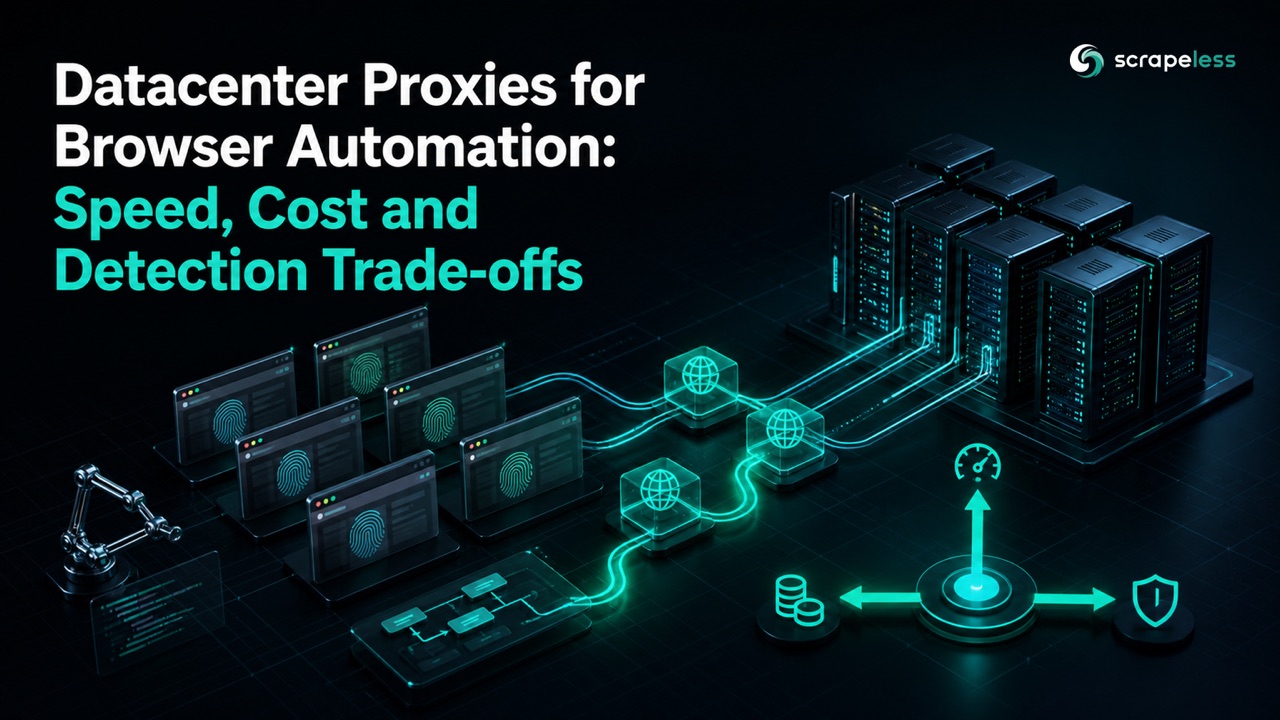
- Datacenter proxies can give browser automation stable capacity, low network overhead, and predictable session routing. Their hosting-network identity can also make them a poor fit for targets that require consumer-like traffic.
- Evaluate the whole browser task, not proxy latency alone. Navigation time, JavaScript work, media bytes, target response, repeated attempts, and acceptance checks usually dominate the completed-job result.
- Keep one proxy identity for the lifetime of a stateful browser session. Changing exit IPs mid-session can invalidate cookies, geography, or risk checks.
- Use datacenter routes for permitted public pages that accept hosting-network traffic. Test residential or ISP routes only when target fit requires them; never rotate to evade an access restriction.
- Benchmark with fixed URLs, regions, browser builds, concurrency, cache state, and acceptance criteria. Report accepted sessions per minute and cost per accepted session.
Datacenter proxies are often fast and economical, but those labels do not decide whether they fit a browser automation job. A browser loads documents, scripts, styles, fonts, and API calls. It may keep cookies across several steps and wait for client-side state. The proxy affects every request, yet the final result depends on the target and the browser workflow together.
This guide explains how to test datacenter proxies for Puppeteer and Playwright workloads without relying on generic “fastest proxy” claims.
What Is a Datacenter Proxy?
A datacenter proxy routes traffic through an IP address associated with a hosting provider, cloud environment, or other non-consumer network. It does not normally inherit the consumer-network characteristics of a residential or mobile connection.
At the HTTP layer, a proxy is an intermediary in the request path. The HTTP Semantics standard defines proxies, gateways, and tunnels by how they handle messages. For HTTPS browsing, an HTTP proxy commonly uses CONNECT to create a tunnel, while SOCKS5 provides a lower-level proxy protocol described in RFC 1928.
Three attributes matter in automation:
- Network origin. The exit IP belongs to a hosting network rather than a household connection.
- Allocation model. The proxy may be shared, dedicated, static, or selected from a pool.
- Session behavior. The provider may keep one endpoint stable or map a session identifier to one exit IP for a defined period.
“Datacenter” describes the network source. It does not guarantee speed, cleanliness, exclusivity, geographic precision, or acceptance on a particular site.
Why Browser Automation Changes the Evaluation
An HTTP client may send one request and parse one response. A browser navigation can create dozens of requests across several hosts. It also adds rendering, script execution, storage, and interaction time.
A useful duration model is:
completed job time = browser startup + proxy connection + target response + subresource loading + JavaScript work + interaction waits + validation + repeated-attempt overhead
Proxy round-trip time is only one term. A route that saves 100 milliseconds on the first document but causes extra challenges or incomplete assets can be slower per accepted job.
Browser tasks also create state. Cookies, local storage, service workers, TLS connections, and application tokens may be associated with the current network context. For multi-step flows, assign a proxy before the browser context starts and keep it stable until the job finishes.
Speed: Measure the Page, Not a Ping
Ping and proxy handshake tests can reveal network problems, but they do not represent a browser workload. Test at four levels:
- Connection. DNS resolution strategy, proxy connection, tunnel establishment, and TLS handshake.
- Navigation. Time to response headers and the main document.
- Rendering. DOM readiness, network activity, and the application-specific marker.
- Acceptance. Required fields present, expected locale, and no challenge or error shell.
The W3C Resource Timing specification defines browser timing attributes for resources. Use those signals with application events rather than relying on a fixed sleep.
Media-heavy pages can hide proxy performance behind unnecessary bytes. Block images, video, or fonts only when the task does not need them and the page still behaves correctly. Record the resource policy in the benchmark; otherwise two runs are not comparable.
Throughput Depends on Concurrency and Acceptance
Teams often increase browser concurrency until the machine or target becomes unstable. Datacenter proxies can support substantial capacity, but the safe level depends on provider limits, browser memory, target behavior, and the approved request rate.
Track:
- sessions started per minute;
- accepted sessions per minute;
- median and tail completion time;
- browser crashes and timeouts;
- proxy connection failures;
- challenge or unexpected-page rate;
- repeated-attempt count per accepted session;
- bytes transferred per accepted session.
Accepted throughput is the useful measure. Ten quick responses that fail the content contract do not outperform six slower sessions that return the required public data.
Increase concurrency in controlled steps. Keep the URL set, proxy region, browser build, cache policy, and validation rules fixed. Stop when accepted throughput plateaus, tail latency rises sharply, or the target begins returning abnormal responses.
Session Persistence and IP Rotation
Rotation policy should follow the task boundary.
Stateless page checks
Independent public pages can use a new browser context and a new proxy identity per job, provided the rate and collection policy remain appropriate. Reusing a pool endpoint may improve connection efficiency, but it should not allow cookies or storage to leak between jobs.
Stateful multi-step flows
A search followed by pagination, a locale selection, or an approved logged-in workflow should keep one identity for the whole sequence. Bind the browser context, cookie jar, locale, timezone, and proxy session together.
Changing the exit IP after the first step can create contradictory signals. The application may see one region in the cookie state and another in the network address. Even when the page does not block the session, the collected data can be internally inconsistent.
Long-lived workers
Long-running browsers save startup cost but accumulate cache, storage, memory, and connection state. Define a maximum job count or lifetime, then recycle the context. Separate this lifecycle from proxy rotation so an operator can identify which change affected a failure.
Detection Trade-offs
A target can evaluate more than the exit IP. Browser configuration, request headers, cookies, navigation patterns, account state, JavaScript behavior, and traffic rate may all affect the response. A datacenter IP can be one visible signal because its network owner is publicly identifiable, but no single attribute explains every outcome.
Do not describe a challenge as “proxy blocked” until the validator rules out other causes. Common alternatives include:
- consent or localization pages;
- a changed selector;
- an expired account session;
- a blocked script or font required by the app;
- DNS or TLS failure;
- excessive concurrency;
- an unsupported browser build;
- target maintenance or an application error.
Use the expected-content contract to classify responses. Save a redacted screenshot, final URL, response status, visible page marker, proxy region, browser version, and correlation ID. Avoid retaining credentials or personal content in logs.
If a site denies access, do not use rotation to circumvent that decision. Stop the job, review permissions and terms, and use an authorized source or official interface when available.
When Datacenter Proxies Fit
Datacenter proxies are often suitable when:
- the target is a permitted public page that accepts hosting-network traffic;
- the task values stable capacity and predictable routing;
- a city-level consumer-network identity is not required;
- the workflow performs high-volume validation or QA under an approved rate;
- session duration is short or the provider supports suitable sticky sessions;
- the team can test target-specific acceptance before rollout.
Examples include owned-site monitoring, public documentation checks, regional rendering tests, and collection from sites whose access policy permits automated traffic.
They are a weaker default when the application explicitly expects household or mobile network characteristics, when precise consumer geography is necessary, or when the target consistently returns invalid content to hosting networks. Those cases require a policy review and a benchmark of an appropriate authorized route, not an automatic switch.
Datacenter, Residential, and ISP Routes
The proxy category changes the trade-off, but provider implementation still matters.
| Criterion | Datacenter | Residential | ISP / static residential |
|---|---|---|---|
| Network association | Hosting or cloud network | Consumer access network | Consumer-oriented ASN with hosted stability, depending on provider |
| Capacity profile | Often predictable | Depends on pool supply | Often stable but more limited |
| Session stability | Strong with static or sticky allocation | Depends on session controls | Commonly suited to longer sessions |
| Consumer-location resemblance | Lower | Higher | Higher than typical datacenter routes |
| Cost tendency | Commonly lower | Commonly higher | Commonly between dedicated datacenter and rotating residential, but varies |
| Best evaluation metric | Accepted throughput and cost | Acceptance and geographic fit | Stable acceptance for stateful jobs |
These are tendencies, not guarantees. Compare the actual product under the same workload. The existing guide to datacenter and residential proxy differences provides a broader category comparison; this article stays focused on browser execution.
Configure the Proxy at Browser Launch
Chromium accepts proxy configuration at the network layer. Its proxy documentation covers manual settings, exclusion rules, and proxy resolution behavior.
In Puppeteer, the proxy server is normally supplied through a browser launch argument such as --proxy-server=scheme://host:port. If the proxy needs username and password authentication, authenticate the page before navigation. Create a separate browser or isolated context for each session policy.
In Playwright, proxy configuration belongs in the browser launch options, with fields for server, username, password, and optional host exclusions. The Playwright API reference documents those launch options. A browser context then holds the task’s cookies, locale, and other state.
Follow five rules in either library:
- Read credentials from a secret manager or environment injection, never source code.
- Redact proxy usernames, passwords, and signed endpoints from logs.
- Configure locale and timezone to match the intended test region.
- Start the proxy session before the first navigation and keep it for the job.
- Validate the target content, not merely the browser’s navigation event.
The Scrapeless proxy quickstart documents endpoint setup. For a managed browser path, the Scraping Browser proxy guide explains proxy configuration within browser sessions.
Benchmark With an Acceptance Contract
Before choosing a proxy route, define the test matrix:
- exact URL set and allowed redirects;
- requested countries or cities;
- browser and automation-library versions;
- cold or warm cache policy;
- enabled resource types;
- concurrency levels;
- session length and rotation rule;
- required page marker and extracted fields;
- failure classes and repeated-attempt limit;
- collection window and target rate policy.
Run enough repeated observations to see variance, then report percentiles rather than one average. Compare the following calculations:
acceptance rate = accepted sessions / completed sessions
accepted throughput = accepted sessions / elapsed minutes
cost per accepted session = proxy cost + browser compute + repeated-attempt compute + review cost, divided by accepted sessions
Use the team’s actual contract and compute costs. Public list prices do not capture traffic mix, minimum commitments, support tier, or failure overhead.
Troubleshooting Browser Sessions
The proxy connection fails before navigation
Check scheme, host, port, credentials, IP allowlisting, and DNS behavior. Test the endpoint with a minimal authorized destination before adding browser logic. Confirm whether authentication belongs in the proxy URL, browser API, or provider allowlist.
Navigation completes but expected content is missing
Inspect the final URL, page title, screenshot, and required selector. The response may be a consent page, localization page, client-side error, or challenge. Confirm that blocked resources were not required for rendering.
Sessions change region midway through a flow
Verify that the sticky-session identifier is stable and that every browser request uses the same proxy configuration. Check service workers and direct connections. Avoid changing the proxy while reusing cookies.
Throughput drops as concurrency rises
Measure browser CPU and memory alongside proxy connection time and target response time. Reduce media bytes if the task permits, reuse the browser process with isolated contexts, and lower concurrency until accepted throughput recovers.
Results differ between Puppeteer and Playwright
Compare browser channels, launch flags, context settings, waiting conditions, and resource interception. The library name may be less important than the browser build and the task’s readiness condition.
Use Scrapeless for the Routing Layer
Proxy Solutions provides proxy routes that can be assigned according to workload and geography. Scraping Browser moves browser execution into managed infrastructure when a team does not want to operate the browser fleet itself.
Keep the same acceptance contract whether the browser runs locally or as a managed service. That makes migration measurable: compare accepted throughput, cost per accepted session, and failure distribution under the same URLs and conditions.
Conclusion
Datacenter proxies are a strong browser-automation option when the target permits hosting-network traffic and the workload benefits from stable, economical capacity. They are not a universal answer. Session state, target acceptance, browser resource load, and repeated-attempt behavior determine the result.
Test a representative URL set with fixed controls before scaling. Start with Scrapeless Proxy Solutions, review Scrapeless pricing, then create a Scrapeless account for an approved benchmark. Bind each browser context to one proxy session, and optimize for accepted jobs rather than raw request speed.
Scrapeless provides web data infrastructure for compliant collection from public web sources. Use collection tools in accordance with applicable laws, site terms, robots directives, and your organization’s data policies.
Frequently Asked Questions
Are datacenter proxies good for browser automation?
They can be a good fit for permitted public targets that accept hosting-network traffic. Measure target-specific acceptance, session stability, and cost per accepted job before scaling.
Should a browser rotate proxies on every request?
Usually not for a stateful flow. Keep one proxy identity for the browser context or job so cookies, locale, and network state remain consistent. Rotate at a defined job boundary.
Are datacenter proxies always faster than residential proxies?
No universal result applies. Network path, target response, browser workload, resource policy, and repeated attempts all affect completed-job time. Test both routes under identical conditions when both are appropriate.
How should Puppeteer and Playwright use authenticated proxies?
Configure the proxy when launching the browser, provide authentication through the supported library method, keep credentials out of logs, and validate an expected page marker after navigation.
What metric matters most in a proxy benchmark?
Accepted sessions per minute is a strong operational measure. Pair it with tail completion time, acceptance rate, and cost per accepted session to avoid optimizing fast failures.
At Scrapeless, we only access publicly available data while strictly complying with applicable laws, regulations, and website privacy policies. The content in this blog is for demonstration purposes only and does not involve any illegal or infringing activities. We make no guarantees and disclaim all liability for the use of information from this blog or third-party links. Before engaging in any scraping activities, consult your legal advisor and review the target website's terms of service or obtain the necessary permissions.