C++ Web Scraping: A Practical Guide for Performance-Critical Projects

Expert Network Defense Engineer
TL;DR:
- C++ is a great scraping parser and an awkward scraping client. libxml2 parses HTML at native speed, but writing TLS fingerprinting, proxy rotation, and JavaScript rendering in C++ is a project unto itself.
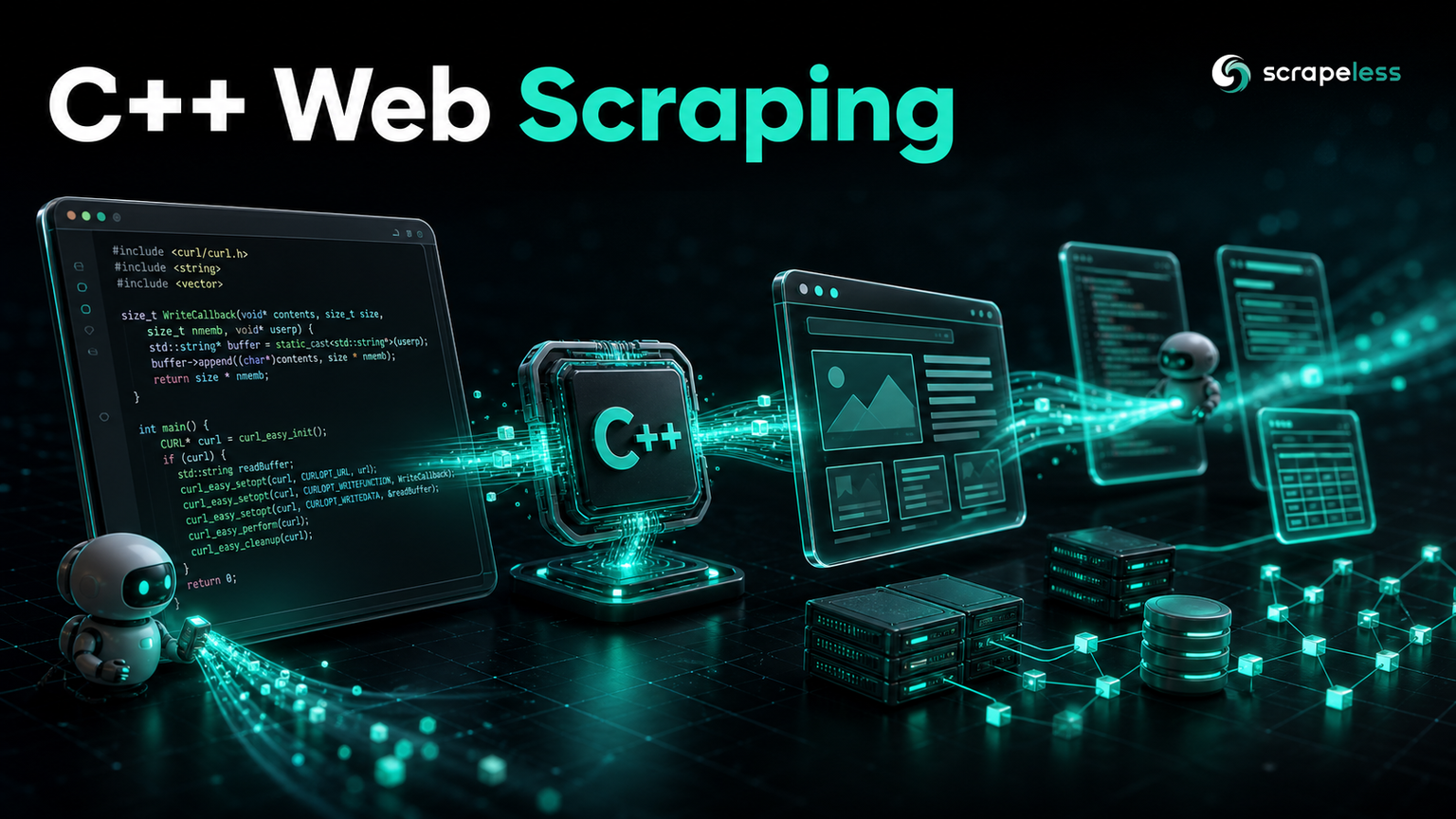
- Split the job: let a rendering API fetch, let C++ parse. libcurl POSTs the target URL to the Scrapeless Universal Scraping API, which returns the rendered HTML; libxml2 + XPath does the fast extraction locally.
js_render: trueis what turns a blank page into data. Many sites build their content with JavaScript; the API runs it server-side so your C++ code receives the finished DOM, not an empty shell.- The whole client is two libraries you already know. libcurl for the HTTP POST, libxml2 for HTML + XPath — no headless browser to embed, no anti-bot stack to maintain in C++.
- It's verifiably small. The complete program below compiles with one
g++line and was run live: HTTP 200, 51 KB of rendered HTML, 20 product titles parsed. - Free to start. New Scrapeless accounts include free runtime — sign up at app.scrapeless.com.
Introduction: where C++ fits in scraping
C++ shows up in scraping for one reason: speed. When you're parsing millions of pages, libxml2 chewing through HTML at native speed beats an interpreted parser handily. The problem is everything before the parse. Modern targets gate access behind TLS fingerprinting and anti-bot defenses, IP reputation, and JavaScript that has to actually run before the content exists. Reproducing that in C++ — a stealth HTTP stack, a proxy pool, an embedded browser engine — is far more work than the scraping itself.
The pragmatic split is to stop making C++ do the part it's bad at. Use a rendering API to handle the fetch — TLS, proxies, JavaScript, anti-bot — and hand C++ the finished HTML to parse. Your program becomes two well-understood pieces: libcurl makes one HTTPS POST, and libxml2 runs XPath over the result.
This guide builds exactly that with the Scrapeless Universal Scraping API. The complete program at the end was compiled and run live; the numbers in it are a real capture.
What You Can Do With It
- Parse at native speed — libxml2 + XPath over rendered HTML, no interpreter overhead.
- Scrape JavaScript-heavy sites without embedding a browser in your C++ binary.
- Skip the anti-bot stack — TLS fingerprinting, proxy rotation, and CAPTCHA handling live in the API, not your code.
- Drop scraping into existing C++ systems — a trading pipeline, a data tool, a native service — with just libcurl and libxml2.
- Scale horizontally — the rendering happens server-side, so your binary stays lightweight.
Why Scrapeless Universal Scraping API
The Scrapeless Universal Scraping API takes a target URL and returns the rendered, unblocked HTML. For a C++ client specifically, it brings:
- Server-side JavaScript rendering —
js_render: truereturns the finished DOM, so libxml2 sees real content. - Residential proxies in 195+ countries — the fetch egresses from trusted IPs; you never manage a pool.
- Anti-bot handling — TLS fingerprinting and challenge solving happen API-side, off your binary.
- A plain HTTPS POST — no SDK to link; libcurl is all the C++ you need.
- A simple envelope —
{"code":200,"data":"<html>…"}, easy to handle without a heavy JSON dependency.
Get your API key on the free plan at app.scrapeless.com.
Prerequisites
- A C++17 compiler (g++ or clang)
- libcurl and libxml2 development headers
- A Scrapeless account and API key — sign up at app.scrapeless.com
On Debian/Ubuntu:
bash
sudo apt-get install -y libcurl4-openssl-dev libxml2-dev
bash
export SCRAPELESS_API_KEY="your_api_token_here"Step 1 — POST the URL with libcurl
The API takes a JSON body naming the actor (unlocker.webunlocker) and the input — the target URL, method, and whether to render JavaScript. Authentication is the x-api-token header. libcurl collects the response into a std::string:
cpp
#include <curl/curl.h>
#include <string>

static size_t writeCb(char* ptr, size_t size, size_t nmemb, void* userdata) {
  static_cast<std::string*>(userdata)->append(ptr, size * nmemb);
  return size * nmemb;
}

std::string fetchRendered(const std::string& url, const char* apiKey) {
  std::string payload =
    "{\"actor\":\"unlocker.webunlocker\",\"input\":{"
    "\"url\":\"" + url + "\",\"method\":\"GET\","
    "\"redirect\":true,\"js_render\":true}}";

  CURL* curl = curl_easy_init();
  std::string resp;
  curl_slist* hdrs = nullptr;
  hdrs = curl_slist_append(hdrs, "Content-Type: application/json");
  hdrs = curl_slist_append(hdrs, (std::string("x-api-token: ") + apiKey).c_str());

  curl_easy_setopt(curl, CURLOPT_URL, "https://api.scrapeless.com/api/v1/unlocker/request");
  curl_easy_setopt(curl, CURLOPT_POST, 1L);
  curl_easy_setopt(curl, CURLOPT_POSTFIELDS, payload.c_str());
  curl_easy_setopt(curl, CURLOPT_HTTPHEADER, hdrs);
  curl_easy_setopt(curl, CURLOPT_WRITEFUNCTION, writeCb);
  curl_easy_setopt(curl, CURLOPT_WRITEDATA, &resp);
  curl_easy_setopt(curl, CURLOPT_TIMEOUT, 120L);

  curl_easy_perform(curl);
  curl_slist_free_all(hdrs);
  curl_easy_cleanup(curl);
  return resp;
}
js_render: true is the load-bearing flag: it tells the API to run the page's JavaScript and return the finished DOM, so a site that builds its content client-side comes back as real markup.
Get your API key on the free plan: app.scrapeless.com
Step 2 — Pull the HTML out of the envelope
The API returns {"code":200,"data":"<html>…"} with the HTML JSON-escaped in data. A tiny extractor unescapes that field — no heavy JSON library needed for this one shape:
cpp
std::string jsonGetData(const std::string& body) {
  const std::string key = "\"data\":\"";
  size_t i = body.find(key);
  if (i == std::string::npos) return "";
  i += key.size();
  std::string out;
  for (; i < body.size(); ++i) {
    char c = body[i];
    if (c == '\\') {                 // unescape \" \\ \n \r \t \uXXXX
      char n = body[++i];
      if (n == 'n') out += '\n';
      else if (n == 'r') out += '\r';
      else if (n == 't') out += '\t';
      else if (n == 'u') { out += (char)std::stoi(body.substr(i + 1, 4), nullptr, 16); i += 4; }
      else out += n;
    } else if (c == '"') break;
    else out += c;
  }
  return out;
}
(For production with many field types, link a real JSON library — but for this envelope the extractor above is enough.)
Step 3 — Parse with libxml2 and XPath
Now the fast part. libxml2 parses the HTML; XPath selects exactly the nodes you want. Here it pulls the product titles from a catalog page:
cpp
#include <libxml/HTMLparser.h>
#include <libxml/xpath.h>
#include <iostream>

void extractTitles(const std::string& html) {
  htmlDocPtr doc = htmlReadMemory(html.c_str(), html.size(), nullptr, nullptr,
                                  HTML_PARSE_NOERROR | HTML_PARSE_NOWARNING);
  xmlXPathContextPtr ctx = xmlXPathNewContext(doc);
  xmlXPathObjectPtr r = xmlXPathEvalExpression(
      (const xmlChar*)"//article[@class='product_pod']//h3/a/@title", ctx);

  int n = r->nodesetval ? r->nodesetval->nodeNr : 0;
  std::cout << "books=" << n << "\n";
  for (int i = 0; i < n; ++i) {
    xmlChar* t = xmlNodeGetContent(r->nodesetval->nodeTab[i]);
    std::cout << t << "\n";
    xmlFree(t);
  }

  xmlXPathFreeObject(r);
  xmlXPathFreeContext(ctx);
  xmlFreeDoc(doc);
}
Step 4 — Compile and run
Link both libraries and point the compiler at the libxml2 headers:
bash
g++ scraper.cpp -o scraper -I/usr/include/libxml2 -lcurl -lxml2
./scraper
A live run against a JavaScript-rendered catalog page returned:
text
http_status=200 html_bytes=51295 books=20
first_book=A Light in the Attic
That's the whole loop: one HTTPS POST out, 51 KB of rendered HTML back, 20 titles parsed by libxml2 — no browser embedded, no proxy pool, no anti-bot code in your binary.
What You Get Back
The API envelope is small and predictable:
json
{
  "code": 200,
  "data": "<html>...rendered DOM...</html>"
}
// Real shape from a live call. data holds the JSON-escaped rendered HTML (51,295 bytes in the verified run).
A few honest observations:
js_render: truecosts latency but buys content. Turn it off for static pages to go faster; turn it on when the page is blank without it.- Use a real JSON library for complex responses. The hand-rolled extractor handles the single
datafield; anything richer deserves a proper parser. - XPath beats string-matching. libxml2's XPath is both faster and more robust than hand-written HTML scanning.
- Free the libxml2 objects.
xmlFreeDoc,xmlXPathFreeContext,xmlXPathFreeObject— C++ won't do it for you.
Conclusion: C++ for the parse, an API for the fetch
Performance-critical C++ scraping works best when C++ does what it's great at — fast parsing — and a rendering API does the part that's painful to build natively: JavaScript execution, proxies, and anti-bot handling. With libcurl for one HTTPS POST and libxml2 for XPath extraction, the whole client is two familiar libraries and a single g++ line. For the same fetch-then-parse split in another language, see the Scrapling + Scrapeless guide; the Universal Scraping API product page and docs cover the full API. Render server-side when the page needs it, parse with XPath, and free your libxml2 objects.
Ready to Build Your AI-Powered Data Pipeline?
Join our community to claim a free plan and connect with developers building native scrapers: Discord · Telegram.
Sign up at app.scrapeless.com for free runtime and adapt the program above to the sites and selectors your C++ pipeline needs. See pricing for scale.
FAQ
Q: Why not write the whole scraper in pure C++ with libcurl directly to the site?
You can for simple, unprotected pages. The moment a target needs JavaScript rendering, residential IPs, or anti-bot handling, reproducing that in C++ is a large project. Offloading the fetch to a rendering API keeps your binary small.
Q: Do I need a headless browser embedded in my C++ program?
No. js_render: true runs the JavaScript server-side and returns the finished DOM, so your C++ code only parses HTML.
Q: Is libxml2 the right parser?
For HTML at scale, yes — it's fast, mature, and has full XPath support. CPR or Boost.Beast can replace libcurl for the HTTP side if you prefer, but libxml2 is the standard choice for parsing.
Q: How do I handle JSON responses without a big dependency?
For the single data field shown here, a small extractor is fine. For richer responses, link a lightweight JSON library rather than hand-parsing.
Q: Do I need to manage proxies?
No. The API egresses through residential proxies; you pass a URL and get HTML back.
Q: How do I avoid memory leaks with libxml2?
Always free what you allocate: xmlXPathFreeObject, xmlXPathFreeContext, and xmlFreeDoc. libxml2 uses manual memory management.
At Scrapeless, we only access publicly available data while strictly complying with applicable laws, regulations, and website privacy policies. The content in this blog is for demonstration purposes only and does not involve any illegal or infringing activities. We make no guarantees and disclaim all liability for the use of information from this blog or third-party links. Before engaging in any scraping activities, consult your legal advisor and review the target website's terms of service or obtain the necessary permissions.