Browser Infrastructure for Computer-Use Agents in 2026

Lead Scraping Automation Engineer
TL;DR:
- A computer-use agent needs a browser runtime, not only click and screenshot tools. The runtime must isolate sessions, manage state, enforce timeouts, control concurrency, and preserve evidence.
- Session identity should be explicit. Ephemeral research, authenticated work, and human handoff require different cookie, storage, retention, and cleanup policies.
- Observability is part of correctness. Screenshots, action logs, console output, network events, and replay make failed or unsafe runs diagnosable.
- Scrapeless MCP plus Agent Browser provides a managed web layer for agents. It can separate search, browser actions, extraction, and validation while keeping the agent’s orchestration code focused on the task.
A demo computer-use agent can open a page, inspect a screenshot, and click a button. A production agent has to do the same work repeatedly without mixing users, leaking state, losing evidence, or leaving browser processes behind.
That gap is browser infrastructure. The model chooses actions, but an execution layer creates the session, exposes observations, applies limits, records events, and tears the environment down.
Computer-Use Browser Architecture
| Layer | Responsibility | Failure if missing |
|---|---|---|
| Planner | Chooses the next tool action | Loops or pursues the wrong goal |
| Browser session | Holds tabs, cookies, storage, and viewport | User state mixes or disappears |
| Observation adapter | Returns screenshot, DOM, accessibility, and errors | Agent acts on incomplete state |
| Policy layer | Restricts domains, actions, secrets, and approvals | Agent exceeds its authority |
| Queue and runtime | Schedules sessions, timeouts, recovery, and cleanup | Capacity collapses under bursts |
| Observability | Stores actions, artifacts, and outcomes | Failures cannot be reconstructed |
1. Isolate Every Session
Each user or task should receive a separately owned browser context. Cookies, local storage, cache, downloads, clipboard data, and open pages must not become ambient state shared by unrelated runs.
The Amazon AgentCore Browser session documentation describes a session-based model in which concurrent sessions maintain separate state and environments. The implementation differs by platform, but the requirement is general: session boundaries must be visible in the system design.
Define three policies:
- Ephemeral: discard all state when a research or public browsing task ends.
- Persistent but scoped: retain an authorized profile for one user and one workflow.
- Handoff: allow a person to inspect or temporarily control the same session before the agent continues.
Persistence is not automatically better. It raises the value of the session and increases the damage caused by wrong routing or overbroad access.
2. Treat Identity and Secrets as Separate Inputs
Do not place passwords, session cookies, or API tokens in prompts. Inject them through a secret store or authorized credential mechanism at execution time. The planner should receive only the success or failure state it needs.
Domain allowlists and action policies should travel with the session. A support agent authorized to view an order portal should not inherit permission to browse arbitrary sites with the same authenticated profile.
For high-impact actions—purchase, publish, delete, refund, or submit—pause before the final event and present the intended action and relevant fields for approval. The browser should not turn a draft recommendation into an external commitment without explicit authority.
3. Choose the Right Observation Surface
Computer-use models often consume screenshots and coordinates. DOM-based tools use elements and selectors. Accessibility trees provide compact semantic structure. Network responses may contain the cleanest structured data.
No one surface is sufficient for every page. A robust adapter can provide:
- a screenshot for visual layout and canvas content;
- DOM or accessibility information for labels and stable targets;
- current URL, title, viewport, and tab identity;
- console and navigation errors;
- selected network evidence when the task requires validation.
The adapter should mark observation time and page identity. Acting on an old screenshot after a navigation is a common source of coordinate errors.
4. Build Explicit Action Contracts
Browser actions should be typed and bounded: open a URL, click a target, fill a field, scroll a region, select an option, capture evidence, or end the session. Each action returns a structured result rather than a prose impression.
The Playwright locator guidance recommends user-facing attributes such as role, label, text, and placeholder. These targets are usually more stable than deep CSS paths and are easier to explain in an audit log.
After an action, verify a state change. A click is not successful because the command returned; it is successful when the expected URL, heading, dialog, field value, or network result appears.
Start Scraping with Scrapeless
Power up your web scraping and automation workflow with Scrapeless!
Sign up today and get $5 in free credit — no credit card required.Claim your free credit now in the Scrapeless Dashboard.
5. Control Timeouts, Retries, and Concurrency
Computer-use workloads are bursty and variable. One task may finish after a single navigation; another may hold an authenticated session while a person reviews it. Capacity planning should therefore use active session time and peak concurrency, not only task count.
Use separate limits for session lifetime, navigation, action, idle time, and queue wait. A single global timeout produces ambiguous failures. Recovery should restart only the failed boundary: repeat a read after a temporary load error, but do not repeat a consequential submission without checking whether it already succeeded.
Concurrency controls belong at user, workflow, and platform levels. They prevent one looping agent from consuming the entire browser pool. Always close pages and contexts in a final cleanup path.
6. Make Runs Observable and Replayable
At minimum, retain session ID, user or job scope, timestamps, URLs, actions, outcomes, screenshots at important boundaries, final status, and failure category. Redact secrets and sensitive fields before long-term storage.
The AgentCore recording and replay documentation lists DOM changes, user actions, console messages, browser-protocol events, and network events as useful replay evidence. A smaller system may not store every surface, but it should preserve enough to explain what the agent saw and did.
Observability also supports evaluation. Compare completion rate, human takeover rate, actions per completed task, timeout category, and unsafe-action blocks across versions of the planner and browser adapter.
7. Add Human Takeover Without Breaking Ownership
Human takeover should attach to the existing session, not copy cookies into a separate unmanaged browser. The system must show who currently controls the page and prevent simultaneous conflicting actions.
Record takeover start and end, then return a fresh observation to the agent. Never assume the page remained on the same URL or that fields kept their previous values while a person was in control.
8. Connect Scrapeless MCP and Agent Browser
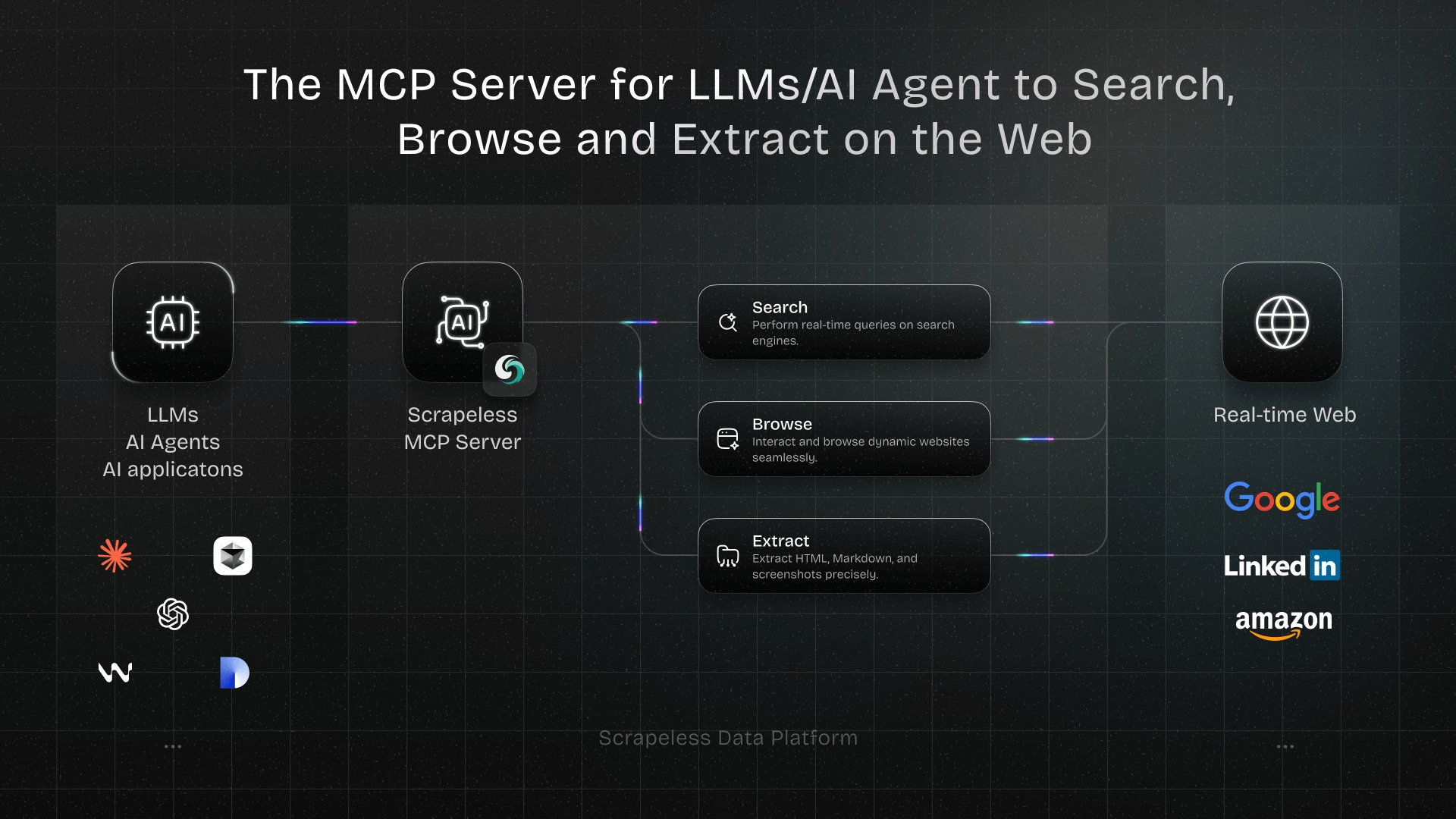
Scrapeless Scraping Browser provides managed browser execution, while Scrapeless MCP exposes web capabilities to compatible agents. The useful design is a sequence of distinct tools:
- Search or discover candidate pages.
- Open the selected page in an isolated browser session.
- Observe and act with bounded browser operations.
- Extract the required fields and source URL.
- Validate the result against the task’s acceptance condition.
- Save artifacts, close the session, and return a structured outcome.
This separation makes failures legible. The orchestrator can tell whether discovery found the wrong page, the browser failed to reach a state, extraction missed a field, or validation rejected the result.
The AI agent harness guide explains how search, browser, state, and validation tools fit the broader agent loop. Review Scrapeless pricing after estimating peak concurrency and average active-session duration.
Production Readiness Checklist
- Every session has an owner, purpose, retention policy, and cleanup path.
- Authenticated profiles are scoped to one user and authorized workflow.
- Secrets enter through controlled runtime mechanisms, not prompts.
- Domains and high-impact actions have explicit policy checks.
- Observations include page identity and timestamp.
- Actions return structured outcomes and verify state changes.
- Timeouts are separate for queue, navigation, action, idle, and lifetime.
- Retries are idempotent or check prior completion before repeating.
- Screenshots and logs are redacted according to data policy.
- A person can take over, release control, and leave an auditable transition.
Conclusion
Computer-use quality depends on more than a model’s ability to choose clicks. Session isolation, scoped identity, action contracts, bounded capacity, observable runs, and controlled handoff determine whether the system can operate safely in production. Scrapeless MCP and Agent Browser provide a managed web layer around those requirements so the agent can focus on planning, evidence, and verified outcomes.
FAQ
Q: What is browser infrastructure for a computer-use agent?
It is the runtime that creates and isolates browser sessions, supplies observations and actions, manages capacity and timeouts, enforces policy, stores evidence, and cleans up resources.
Q: Why do computer-use agents need session isolation?
Isolation prevents cookies, storage, pages, downloads, and secrets from crossing between users or tasks. It also makes ownership and cleanup testable.
Q: Should an agent use screenshots or the DOM?
Use the surface that matches the page and task. Screenshots capture visual state, while DOM and accessibility data provide semantic targets. Many production systems combine them.
Q: What should a browser session record?
Record identifiers, timestamps, URLs, actions, outcomes, important screenshots, errors, and final status. Add console or network evidence when it is needed for diagnosis, and redact sensitive data.
Q: When should a human take over?
Use takeover for ambiguous states, authentication steps that require a person, policy exceptions, or consequential actions. Control ownership and the return to automation must be explicit.
At Scrapeless, we only access publicly available data while strictly complying with applicable laws, regulations, and website privacy policies. The content in this blog is for demonstration purposes only and does not involve any illegal or infringing activities. We make no guarantees and disclaim all liability for the use of information from this blog or third-party links. Before engaging in any scraping activities, consult your legal advisor and review the target website's terms of service or obtain the necessary permissions.