How to Build a Competitive Intelligence Agent With Live Web Data

Scraping and Proxy Management Expert
TL;DR:
- A competitive intelligence agent should begin with decisions, not a list of companies. Monitor only the public signals that could change pricing, positioning, product, sales, or roadmap work.
- The collection layer records evidence before the model reasons. Each observation needs a source URL, normalized fields, retrieval context, content fingerprint, and preserved before/after values.
- Deterministic comparison finds the change; the agent explains the impact. Separating those jobs keeps a model from inventing a change that the snapshots do not prove.
- Materiality rules route different signals to different owners. Pricing changes, documentation changes, job openings, public reviews, and campaign shifts do not belong in one undifferentiated alert stream.
- Scrapeless MCP Server gives the agent live search and browser tools. Your orchestration layer still owns schedules, snapshots, diff policy, approvals, and destination systems.
- Free to start. New Scrapeless accounts include free Scraping Browser runtime — sign up at app.scrapeless.com.
Introduction: Competitive Intelligence Is an Evidence Pipeline
Competitor pages change constantly, but most changes do not deserve an alert. A navigation label, reordered feature card, or localized price display can produce a large text diff without changing the business meaning. Meanwhile, one new plan limit or product claim may be buried inside an otherwise identical page.
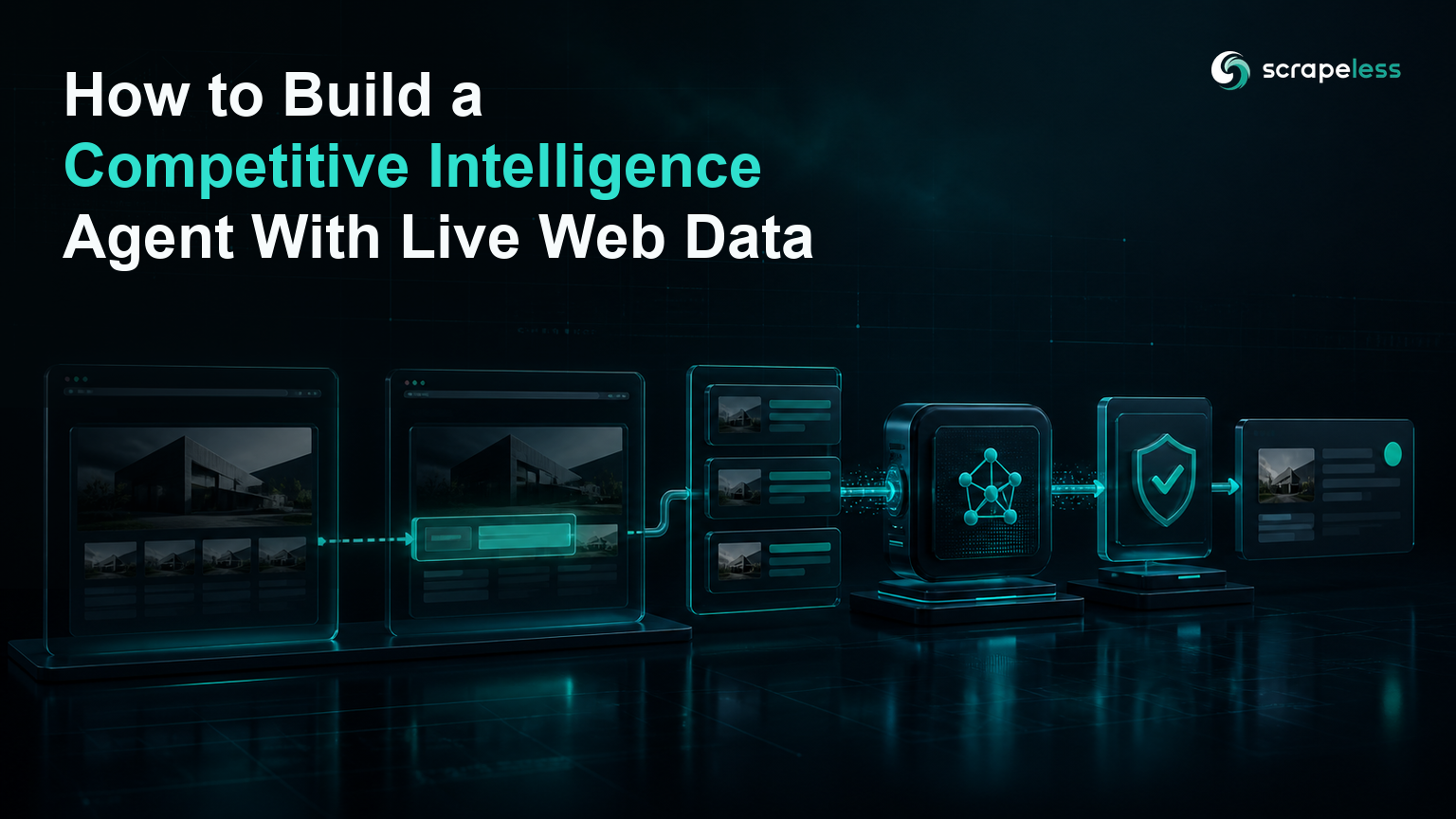
A useful competitive intelligence agent therefore separates collection, comparison, interpretation, and action. The browser captures a public page under known conditions. Deterministic code compares normalized fields. The model summarizes only the proven delta. A person approves any consequential update to a battlecard, campaign, CRM record, or public claim.
This guide builds that pipeline around Scrapeless MCP Server. It uses live web tools for collection and a compact local data contract for snapshots, evidence, and routing.
Pipeline at a Glance
A competitive intelligence agent follows a controlled sequence from trigger to reviewed outcome.
| Stage | Input | Output | Owner |
|---|---|---|---|
| Register | Business decision and approved public source | Source policy | Intelligence lead |
| Trigger | Schedule or analyst request | Collection job | Orchestrator |
| Collect | URL, region, expected fields | Rendered observation | Scrapeless MCP tool layer |
| Normalize | Page output and adapter | Canonical snapshot | Extraction code |
| Compare | Current and prior snapshot | Field-level delta | Deterministic code |
| Interpret | Delta and evidence | Impact summary and confidence | Agent |
| Review | Proposed signal | Approved, rejected, or held result | Human owner |
| Route | Approved result | Report, task, CRM note, or battlecard proposal | Authorized connector |
The pipeline stores each stage separately. If a reviewer disputes the summary, the source snapshot and exact changed fields remain available.
Map the Signals Worth Monitoring
Competitive intelligence should monitor public signals tied to a recurring decision.
| Signal | Public source | Stable fields | Likely owner |
|---|---|---|---|
| Pricing and packaging | Pricing page, billing documentation | Plan name, displayed price, interval, limits, add-ons | Product marketing, finance |
| Product positioning | Home, product, solution pages | Headline, audience, claims, proof points, CTA | Product marketing |
| Documentation | Product docs, API reference, changelog | Feature name, status, parameter, release note | Product, engineering |
| Public reviews | Public review and community pages | Theme, rating label, date, source URL | Research, customer success |
| Hiring | Public careers pages | Role, function, region, published date | Strategy, talent intelligence |
| Advertising and campaigns | Public ad libraries, landing pages | Message, audience cue, offer, destination | Demand generation |
| AI visibility | Search and answer surfaces | Query, cited URL, quoted claim, rank or presence | SEO, brand |
Start with one question such as “Did the packaging page change in a way that affects our enterprise comparison?” That question defines the source, fields, materiality rule, reviewer, and destination. “Monitor everything” defines none of them.
Stage 1 — Trigger the Agent
The trigger creates a bounded job from a source registry rather than asking the model to choose arbitrary targets.
Each registry entry should include the canonical public URL, allowed region, expected page state, adapter name, field allowlist, cadence, materiality policy, reviewer, and retention period. A scheduled job reads those records. An analyst-triggered job uses the same contract and adds a reason.
The job identifier should be deterministic for the source and observation window. That prevents duplicate alerts when a scheduler or human submits the same approved check twice.
Stage 2 — Collect Live Web Data
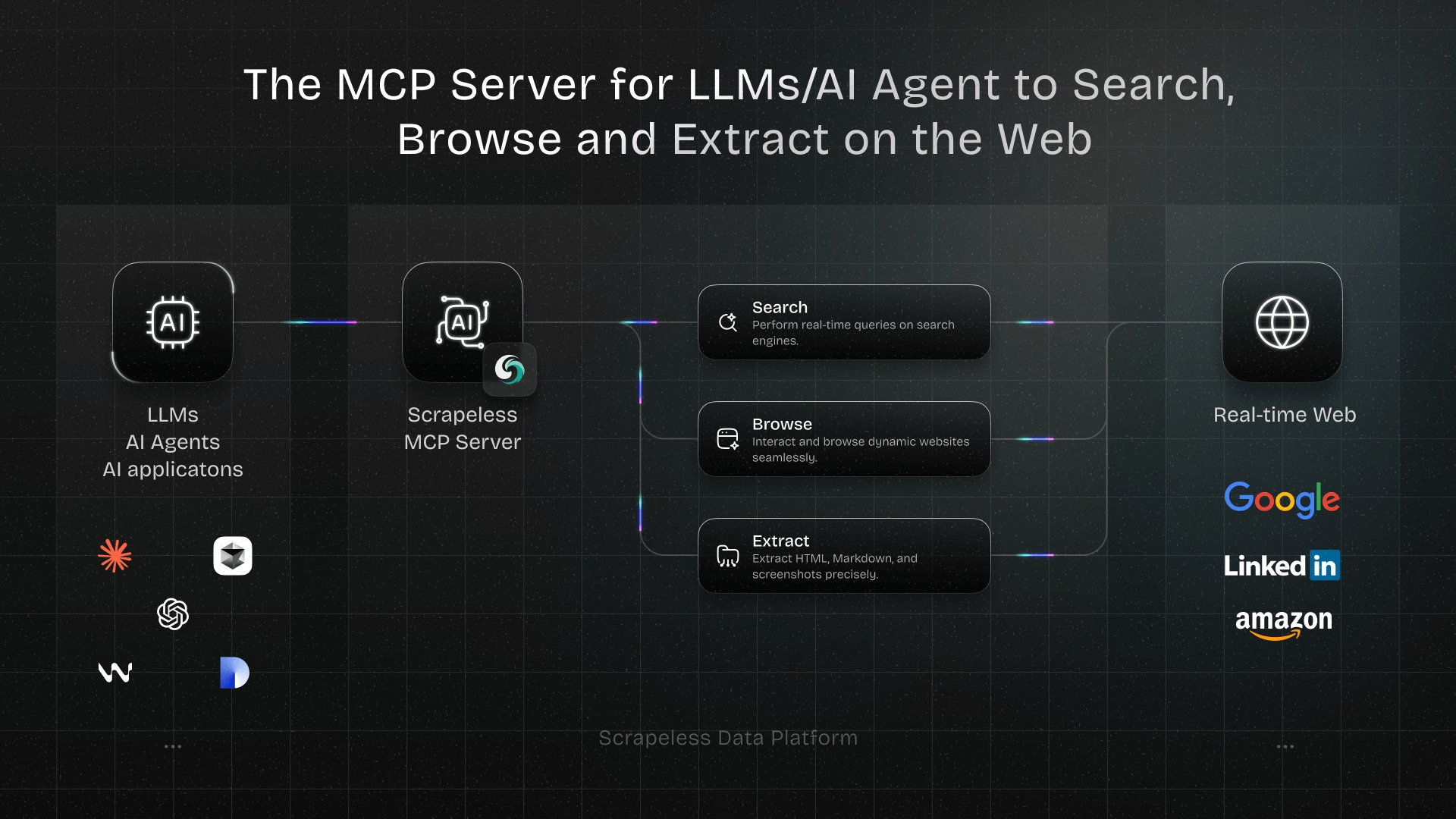
Scrapeless MCP Server gives an MCP-capable agent tools for search, rendered-page access, text extraction, and browser interaction.
Use the lightest tool that returns the approved evidence. A public documentation page may work as cleaned markdown. A client-rendered pricing selector may require a browser session, a locale choice, and a stable wait condition. A discovery question may begin with search and then open only the authoritative first-party page.
A collection prompt should be explicit:
Open the approved public URL from the source registry. Use the registry region and do not sign in. Return the final URL, page title, requested fields, visible currency or billing state, and a short evidence excerpt for each field. If the expected page state is absent, return
page_state: unexpectedand stop before interpretation.
Note: An authenticated Scrapeless MCP connection requires your Scrapeless API key. The credential-free verification environment could not run the MCP tool-list handshake; no tool output in this article is presented as a completed authenticated run.
The MCP connection is the collection surface, not the scheduler or database. The Scrapeless AI Agent page explains the agent-facing product direction, while the Scrapeless pricing page covers account options.
Stage 3 — Normalize and Snapshot
A snapshot records the smallest field set that can prove a business-relevant change.
json
{
  "sourceId": "illustrative-source-key",
  "url": "https://example.com/pricing",
  "finalUrl": "https://example.com/pricing",
  "observedAt": "illustrative timestamp",
  "collectionContext": {
    "region": "US",
    "currency": "USD",
    "pageState": "expected",
    "adapterVersion": "illustrative version"
  },
  "fields": {
    "planName": "Starter",
    "displayedPrice": "$19",
    "billingInterval": "month",
    "headline": "Illustrative public headline"
  },
  "evidence": {
    "displayedPrice": "Illustrative source excerpt"
  },
  "contentFingerprint": "illustrative digest"
}
The values are illustrative, but the contract is normative. fields contains comparable values. evidence contains the minimal source fragment needed to review them. collectionContext explains region, currency, page state, and adapter version.
Use a canonical JSON serialization before hashing the normalized fields. A raw HTML hash changes when analytics IDs or layout wrappers change; a field-level fingerprint changes only when the monitored contract changes.
HTTP validators can reduce unnecessary transfers when a server provides them. HTTP Semantics defines validators and conditional requests, but the pipeline must still compare the normalized fields that carry business meaning.
Stage 4 — Detect Meaningful Changes
Meaningful change detection compares normalized values first and lets policy decide whether the delta deserves review.
The following script is self-contained. It compares two snapshot dictionaries, emits field-level before/after evidence, and applies an allowlisted materiality policy.
python
import json
from typing import Any

MATERIAL_FIELDS = {
    "displayedPrice": "pricing",
    "billingInterval": "pricing",
    "headline": "positioning",
}


def compare_snapshots(previous: dict[str, Any], current: dict[str, Any]) -> dict[str, Any]:
    changes = []
    keys = sorted(set(previous["fields"]) | set(current["fields"]))

    for key in keys:
        before = previous["fields"].get(key)
        after = current["fields"].get(key)
        if before == after:
            continue
        changes.append({
            "field": key,
            "before": before,
            "after": after,
            "category": MATERIAL_FIELDS.get(key, "review"),
            "evidence": current.get("evidence", {}).get(key),
        })

    return {
        "sourceId": current["sourceId"],
        "previousObservedAt": previous["observedAt"],
        "currentObservedAt": current["observedAt"],
        "material": any(change["field"] in MATERIAL_FIELDS for change in changes),
        "changes": changes,
    }


if __name__ == "__main__":
    previous = {
        "sourceId": "demo-pricing",
        "observedAt": "first observation",
        "fields": {"planName": "Starter", "displayedPrice": "$19", "headline": "Start small"},
        "evidence": {},
    }
    current = {
        "sourceId": "demo-pricing",
        "observedAt": "second observation",
        "fields": {"planName": "Starter", "displayedPrice": "$29", "headline": "Start small"},
        "evidence": {"displayedPrice": "Starter — $29 per month"},
    }
    print(json.dumps(compare_snapshots(previous, current), indent=2))
json
{
  "sourceId": "demo-pricing",
  "previousObservedAt": "first observation",
  "currentObservedAt": "second observation",
  "material": true,
  "changes": [
    {
      "field": "displayedPrice",
      "before": "$19",
      "after": "$29",
      "category": "pricing",
      "evidence": "Starter — $29 per month"
    }
  ]
}
The sample snapshots and output are illustrative; the script itself was executed as written. A production policy should also compare billing state, region, currency, and adapter version before calling a price change material.
For interoperable machine-readable deltas, JSON Patch defines field-level change operations. The business policy can wrap those operations with category, evidence, confidence, and reviewer fields.
Start Scraping with Scrapeless
Power up your web scraping and automation workflow with Scrapeless!
Sign up today and get $5 in free credit — no credit card required.Claim your free credit now in the Scrapeless Dashboard.
Stage 5 — Route Evidence to Teams
An approved signal should arrive where the responsible team already works, with enough evidence to review it quickly.
| Category | Proposed destination | Required evidence | Human action |
|---|---|---|---|
| Pricing | Product-marketing queue | Before/after value, currency, interval, URL | Confirm comparison impact |
| Positioning | Messaging review | Before/after claim and page section | Approve battlecard proposal |
| Documentation | Product or engineering task | Changed parameter or release text | Verify technical relevance |
| Hiring | Weekly strategy report | Aggregate role and region change | Interpret as a weak signal |
| Reviews | Research notebook | Theme summary plus sampled public URLs | Inspect context and bias |
| AI visibility | SEO review | Query, answer surface, cited URL | Reproduce and prioritize |
Do not let the agent directly rewrite public comparison pages, move opportunities through CRM stages, or change campaigns from an unreviewed observation. The agent proposes; the owner decides; an authorized connector applies the approved change.
The AWS Strands and Scrapeless MCP integration shows how an agent framework can attach the Scrapeless tool surface. This pipeline adds the source registry, snapshot contract, deterministic diff, and review boundary around that tool access.
Data Quality and Observability
Competitive intelligence quality is measurable at every stage.
Track source coverage, expected-page-state rate, extraction completeness, evidence completeness, duplicate signals, reviewer acceptance, false positives, and time from observation to decision. Measure these per source and adapter version; a global success rate can hide one broken pricing adapter.
Store the prompt, tool calls, normalized snapshot, diff output, and reviewer decision as separate artifacts. The W3C PROV-O model offers a vocabulary for relating entities, activities, and agents when a team needs formal provenance.
Model confidence is not evidence confidence. Evidence confidence asks whether the page, context, field, and before/after values are complete. Model confidence asks how certain the interpretation layer is about business impact. Keep both fields and let a low evidence score block routing.
Handling Competitive Data Responsibly
Competitive intelligence should use approved public business information and avoid personal or restricted data.
Do not sign in with another person's credentials, access private customer portals, collect private messages, or infer confidential roadmap details. For hiring signals, keep the unit of analysis at the role, function, region, and company level rather than tracking named individuals. For reviews and community content, minimize identifiers and retain only the evidence required for the stated analysis.
Define retention by signal type. A pricing snapshot may support a long trend line; a public comment excerpt may deserve a much shorter retention window. Access to raw evidence should be narrower than access to aggregate reports.
Agent outputs also need risk controls. The NIST AI Risk Management Framework provides a practical structure for governing, mapping, measuring, and managing AI risk. Use those controls to assign owners, test failure modes, and document when human approval is mandatory.
Conclusion: Make Every Alert Reproducible
A competitive intelligence agent earns trust when every alert can be traced back to a public source, a normalized snapshot, an exact field delta, and a named reviewer. The browser collects. Deterministic code proves the change. The model interprets the evidence. People authorize downstream action.
Scrapeless MCP Server supplies the live search and browser layer for the agent. The source registry, snapshot store, materiality rules, observability, and approval queue remain part of your application because those components encode the decisions your team is accountable for.
Ready to Build an Evidence-First Intelligence Agent?
Join our community to claim a free plan and connect with developers building live web data workflows: Discord · Telegram.
Sign up at app.scrapeless.com and connect an approved public-source registry to the Scrapeless MCP tool layer.
FAQ
Q: What is a competitive intelligence agent?
A competitive intelligence agent is a controlled workflow that collects approved public market signals, compares them with prior evidence, summarizes material changes, and routes proposals to a human reviewer.
Q: Which competitor pages should the agent monitor?
Monitor the authoritative public pages tied to a decision, such as pricing, product, documentation, changelog, public review, careers, and campaign landing pages.
Q: Should an LLM detect website changes by itself?
No. Deterministic field comparison should establish what changed; the LLM should interpret the proven delta and explain possible impact.
Q: How often should the pipeline run?
Run it at the cadence of the business decision. Fast-moving launch pages may justify frequent checks, while hiring or positioning summaries may need only daily or weekly observations.
Q: How does the pipeline avoid false alerts?
The pipeline compares normalized fields under matching region, currency, page-state, and adapter-version context, then applies a field allowlist and a materiality policy before review.
Q: Can the agent update a battlecard or CRM automatically?
The agent should create a proposed update with evidence. A human owner should approve consequential changes before an authorized connector writes them to a battlecard, CRM, campaign, or public page.
Q: Is collecting public competitor data legal?
Legality depends on the source, jurisdiction, terms, collection method, data type, and use. Restrict the workflow to approved public business information and obtain legal review for the specific program.
Q: Can the pipeline run without an LLM?
Yes. Scheduling, collection, normalization, fingerprinting, and deterministic diffs can run without an LLM; the model adds prioritization and explanation after evidence exists.
At Scrapeless, we only access publicly available data while strictly complying with applicable laws, regulations, and website privacy policies. The content in this blog is for demonstration purposes only and does not involve any illegal or infringing activities. We make no guarantees and disclaim all liability for the use of information from this blog or third-party links. Before engaging in any scraping activities, consult your legal advisor and review the target website's terms of service or obtain the necessary permissions.