Cheapest Residential Proxy Providers in 2026

Specialist in Anti-Bot Strategies
TL;DR:
-
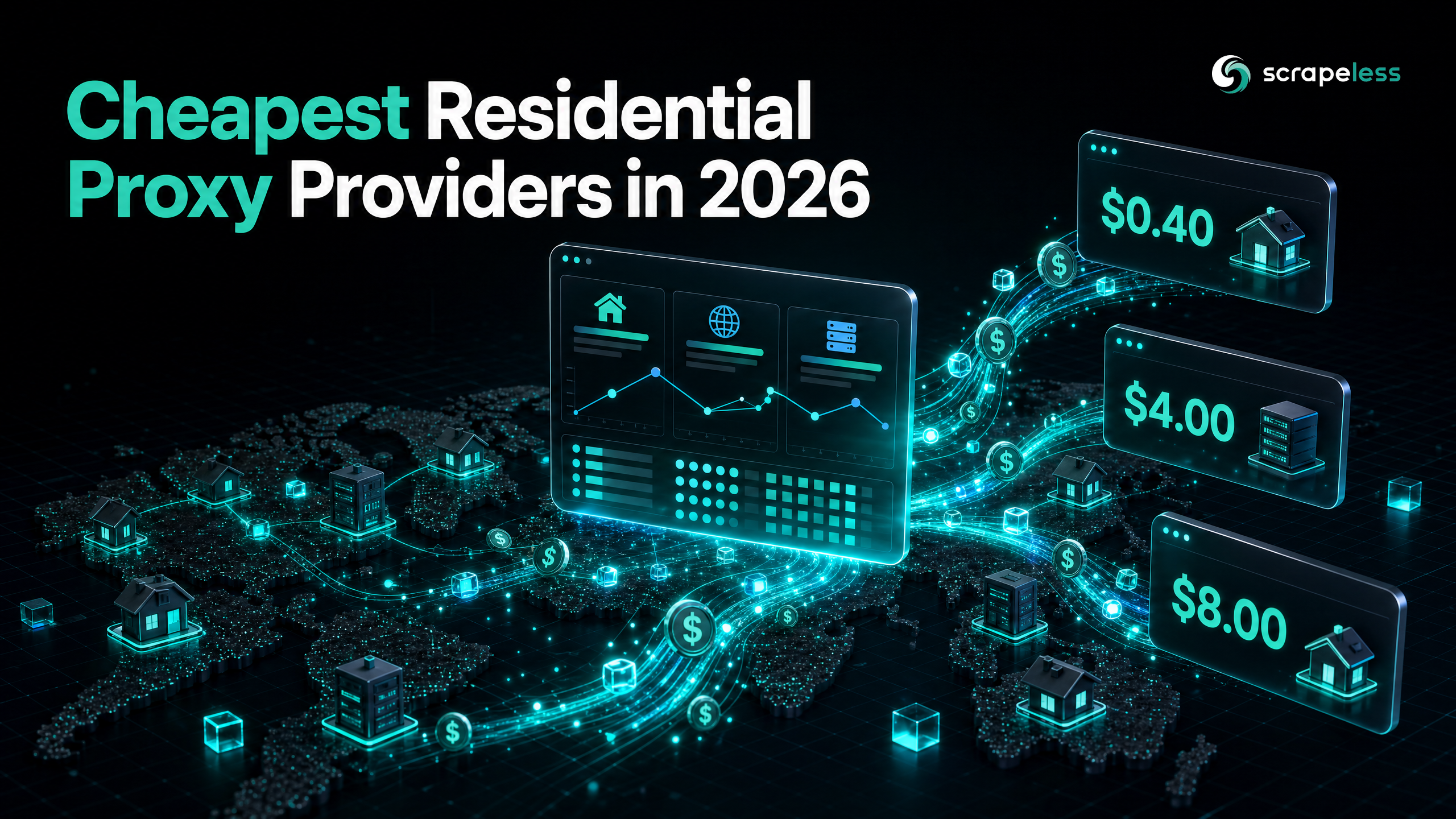
Scrapeless is the cheapest residential proxy provider in 2026, offering rates starting at $1.80/GB (as low as $1.44/GB on higher-tier plans) with access to over 90 million IPs across 195+ countries — up to 4.5x cheaper than premium alternatives.
-
Smartproxy offers a mid-range option at $4.00/GB with 50 million IPs and user-friendly self-service tools.
-
Oxylabs delivers high reliability with a 100 million IP pool at $8.00/GB, catering to large-scale enterprise operations.
-
Bright Data provides 72 million IPs with strict compliance frameworks at $8.40/GB.
-
This guide ranks providers by price-per-GB so you can maximize your scraping budget without sacrificing quality.
Cheapest Residential Proxy Providers at a Glance
| Provider | Starting Price | IP Pool Size | Locations | Best For |
|---|---|---|---|---|
| Scrapeless | $1.80/GB | 90M+ | 195+ Countries | Cheapest with massive scale |
| Decodo | $4.00/GB | 115M+ | 195+ Countries | Budget-friendly self-service |
| Oxylabs | $6.00/GB | 175M+ | 195 Countries | High-reliability enterprise |
| Bright Data | $4.00/GB | 400M+ | 195 Countries | Enterprise compliance |
What Is a Residential Proxy?
A residential proxy routes your internet traffic through an intermediary server that uses an IP address provided by an Internet Service Provider (ISP), rather than a data center. These IP addresses are tied to physical devices, such as desktop computers or mobile phones, located in residential homes. Because they appear as regular user traffic to target websites, residential proxies are highly effective at bypassing anti-bot systems and accessing geo-restricted content. For more on proxy technologies, explore our guide on what is a proxy browser.
How Do Residential Proxies Work?
When you send a request using a residential proxy, the request does not go directly to the target server. Instead, it is routed to the proxy provider's gateway server. The gateway then assigns an available residential IP address from its pool and forwards your request to the target website. The website sees the request originating from the assigned residential IP, processes it, and sends the response back through the proxy network to you. This mechanism masks your original IP address and allows you to gather data as if you were a legitimate user in the proxy's location. The underlying protocols often rely on standards defined by the IETF HTTP/1.1 specification.
How We Evaluated These Tools
To determine the best and cheapest residential proxy providers in 2026, we analyzed the market based on several critical factors:
-
Cost-Effectiveness: We evaluated the starting price per gigabyte and the overall value provided at that price point.
-
IP Pool Size and Diversity: A larger pool reduces the likelihood of IP bans and ensures better geographic coverage.
-
Geographic Targeting: The ability to target specific countries, cities, or ASNs is crucial for localized data extraction.
-
Performance and Reliability: We considered success rates, response times, and network stability.
-
Ease of Integration: The availability of APIs, documentation, and developer-friendly tools.
The Cheapest Residential Proxy Providers: Ranked
1. Scrapeless: Cheapest at $1.80/GB With Full-Scale Coverage
Scrapeless stands out as the premier choice for developers and businesses seeking the most cost-effective residential proxy solution without compromising on scale or performance. With a staggering pool of over 90 million IPs spanning 195+ countries, Scrapeless delivers unparalleled reach. The pricing structure is highly competitive, starting at just $1.80/GB on the Basic plan and dropping to $1.44/GB on the Business plan, making it accessible for projects of all sizes.
Key Features:
-
Massive IP Pool: 90M+ ethically sourced residential IPs.
-
Global Coverage: Target any country, city, or ASN across 195+ locations.
-
High Success Rates: Optimized routing ensures maximum data extraction success.
-
Developer-Friendly: Easy integration with existing data pipelines and scraping tools.
How you actually use it: prompt your agent
Configure my scraping script to use Scrapeless residential proxies. Route the traffic through the gateway at proxy.scrapeless.com:8000 using my API credentials. Ensure the requests target US-based IPs for localized pricing data extraction.Quick Integration Example:
python
import requests

proxies = {
    "http": "http://username:password@proxy.scrapeless.com:8000",
    "https": "http://username:password@proxy.scrapeless.com:8000"
}

response = requests.get("https://api.ipify.org?format=json", proxies=proxies )
print(response.json())
Get your API key on the free plan: app.scrapeless.com
2. Decodo: Budget-Friendly at $4.00/GB With Self-Service Tools
Smartproxy offers a well-rounded solution that balances performance, ease of use, and cost. Its pool of 175 million residential IPs provides solid global coverage, starting at $4.00/GB. The platform is particularly noted for its user-friendly dashboard and self-service tools, making it an excellent choice for developers who need to deploy proxies quickly without a steep learning curve.
Key Features:
-
Solid IP Pool: 175M+ IPs across 195+ locations.
-
User Experience: Intuitive dashboard and comprehensive documentation.
-
Flexible Pricing: Pay-as-you-go options starting at $4.00/GB.
3. Bright Data: Premium Pricing at $4.00/GB for Enterprise Compliance
Bright Data is a veteran in the proxy industry, known for its extensive network and strict compliance frameworks. With over 400 million residential IPs, it offers granular targeting options and advanced features tailored for large enterprises. The starting price of $4.00/GB reflects its enterprise positioning, with comprehensive tools for managing complex data extraction operations.
Key Features:
-
Extensive Network: 400M+ IPs with precise city and carrier targeting.
-
Compliance: Strong emphasis on ethical sourcing and regulatory compliance.
-
Advanced Tools: Includes a proxy manager and web unlocker capabilities.
4. Oxylabs: High-End Pricing for Maximum Reliability
Oxylabs caters primarily to large-scale enterprise operations that demand the highest levels of reliability and performance. Boasting a massive pool of 175 million residential IPs, Oxylabs ensures that scraping tasks run smoothly even under heavy loads. The service includes dedicated account management and advanced scraping APIs.
Key Features:
-
Massive Network: 175M+ IPs globally.
-
Reliability: High success rates and stable connections for enterprise workloads.
-
Support: Dedicated account managers and technical support.
Side-by-Side Comparison
| Feature | Scrapeless | Deocodo | Oxylabs | Bright Data |
|---|---|---|---|---|
| Starting Price | $1.80/GB | $4.00/GB | $6.00/GB | $4.00/GB |
| IP Pool Size | 90M+ | 115M+ | 175M+ | 400M+ |
| Locations | 195+ Countries | 195+ Countries | 195 Countries | 195 Countries |
| Targeting | Country, City, ASN | Country, City | Country, City, ASN | Country, City, ASN, Carrier |
| Protocol Support | HTTP, HTTPS, SOCKS5 | HTTP, HTTPS, SOCKS5 | HTTP, HTTPS, SOCKS5 | HTTP, HTTPS, SOCKS5 |
How Do You Pick the Right Tool?
Selecting the optimal residential proxy provider requires evaluating your specific project requirements:
-
Budget: If cost-efficiency is the primary concern, Scrapeless offers the most competitive rates starting at $1.80/GB (as low as $1.44/GB on higher plans). Review the full pricing details to align with your budget.
-
Scale: For massive data extraction tasks, providers with larger IP pools like Scrapeless and Oxylabs ensure better distribution and lower ban rates.
-
Targeting Precision: If your project requires hyper-localized data, ensure the provider supports city or ASN-level targeting.
-
Integration: Consider the availability of developer tools, APIs, and documentation that fit your existing tech stack.
Common Use Cases for Residential Proxies
Residential proxies are essential for a variety of data-driven applications:
-
Market Research: Gathering localized pricing data, product availability, and consumer trends across different regions.
-
SEO Monitoring: Tracking search engine rankings and analyzing localized search results without triggering automated bot defenses.
-
Ad Verification: Ensuring that digital advertisements are displayed correctly and verifying compliance across various geographic locations.
-
Travel Fare Aggregation: Extracting flight and hotel prices from multiple providers to offer competitive rates to consumers.
Why Is Web Scraping Hard?
Extracting data at scale presents several technical challenges. Modern websites employ sophisticated anti-bot mechanisms, including CAPTCHAs, IP rate limiting, and behavioral analysis, to block automated traffic. When requests originate from known data center IP ranges, they are easily flagged and blocked. Additionally, dynamic content rendering via JavaScript requires headless browsers to execute code before data can be extracted, increasing the complexity and resource requirements of the scraping infrastructure. Understanding these challenges is crucial for building resilient data pipelines. For more context on handling complex web interactions, refer to the MDN proxy documentation. The W3C WebDriver specification also provides relevant context on browser automation standards.
Conclusion
The residential proxy market in 2026 is defined by cost-efficiency and scale. Scrapeless emerges as the clear leader for developers seeking unbeatable value, offering a pool of over 90 million IPs starting at just $1.80/GB. While providers like Bright Data, Smartproxy, and Oxylabs offer solid solutions tailored for various enterprise needs, Scrapeless provides the optimal balance of performance, global reach, and affordability for modern data extraction projects. By leveraging the right Residential Proxies, you can build resilient and scalable data pipelines that drive actionable insights.
Ready to Build Your AI-Powered Data Pipeline?
Join our community to claim a free plan and connect with developers building pipelines: Discord · Telegram.
Sign up at app.scrapeless.com for free Scraping Browser runtime and adapt the patterns above to the pages the pipeline needs.
FAQ
Q: What is the difference between residential and datacenter proxies?
A: Residential proxies use IP addresses assigned by ISPs to physical devices, making them appear as legitimate user traffic. Datacenter proxies use IPs from cloud hosting providers, which are faster but more easily detected and blocked by anti-bot systems.
Q: Are residential proxies legal to use?
A: Yes, using residential proxies is generally legal. However, the legality of web scraping depends on the target website's terms of service, the type of data being extracted (e.g., personal data), and compliance with regional data protection regulations like GDPR or CCPA.
Q: How do providers source residential IPs?
A: Ethical providers source residential IPs by compensating users who opt-in to share their idle bandwidth, often through software applications or SDKs embedded in partner applications.
Q: Can residential proxies bypass CAPTCHAs?
A: While residential proxies significantly reduce the likelihood of encountering CAPTCHAs by appearing as human traffic, they do not solve CAPTCHAs automatically. Advanced scraping solutions often combine residential proxies with dedicated CAPTCHA-solving services or web unlockers.
Q: How is bandwidth calculated for residential proxies?
A: Bandwidth is typically calculated based on the total amount of data transferred (both uploaded and downloaded) through the proxy network during your scraping operations.
At Scrapeless, we only access publicly available data while strictly complying with applicable laws, regulations, and website privacy policies. The content in this blog is for demonstration purposes only and does not involve any illegal or infringing activities. We make no guarantees and disclaim all liability for the use of information from this blog or third-party links. Before engaging in any scraping activities, consult your legal advisor and review the target website's terms of service or obtain the necessary permissions.