ChatGPT Web Scraping with Scrapeless: From Prompts to Verified CSV and JSON

Lead Scraping Automation Engineer
TL;DR:
- ChatGPT web scraping depends on the tools connected to the client. A model instruction and an acquired source page are different parts of the workflow.
- ChatGPT and the Scrapeless MCP endpoint need compatible authentication. A server URL alone does not establish a working connection.
- A discovered tool catalogue proves the interface, not a completed capture. Validate the actual returned source before accepting extracted records.
- CSV and JSON should be checked after they are written. Reopen both files and compare record identifiers and values with the accepted input.
A chat answer can contain a convincing table without producing a data file or checking the source behind each row. ChatGPT web scraping becomes useful when the application makes those separate operations visible.
This workflow uses Scrapeless MCP as a web tool layer, ChatGPT as a task interface, and deterministic code for file validation. It explains the connection requirements, gives bounded collection prompts, and supplies executable tool-discovery and export checks. Client linking and authenticated web acquisition remain account prerequisites; the guide does not claim a native, preconfigured ChatGPT integration.
The existing ChatGPT extraction workflow focuses on the model as a parser. Here the focus is the MCP boundary and the evidence needed to turn a prompted collection task into inspectable files.
What You Can Do with a Connected Web Tool Layer
A connected web tool layer lets the client request acquisition operations whose schemas the host can discover. The useful output is accepted source data rather than a prose description of what a tool might return.
- Bounded reference collection: inspect a short approved URL list and preserve the original page identities.
- Source-backed extraction: retain the supporting passage or field beside each extracted value.
- Missing-field review: report unavailable values instead of asking the model to complete them from memory.
- Controlled scope expansion: enlarge the URL list only after a small sample passes the content contract.
- File reconciliation: compare accepted rows with the files written by the export layer.
These operations need separate permissions and implementations. An MCP acquisition tool does not automatically provide a local filesystem writer, and a client's file-generation feature should be checked in the actual environment being used.
Why Use Scrapeless MCP for Web Acquisition?
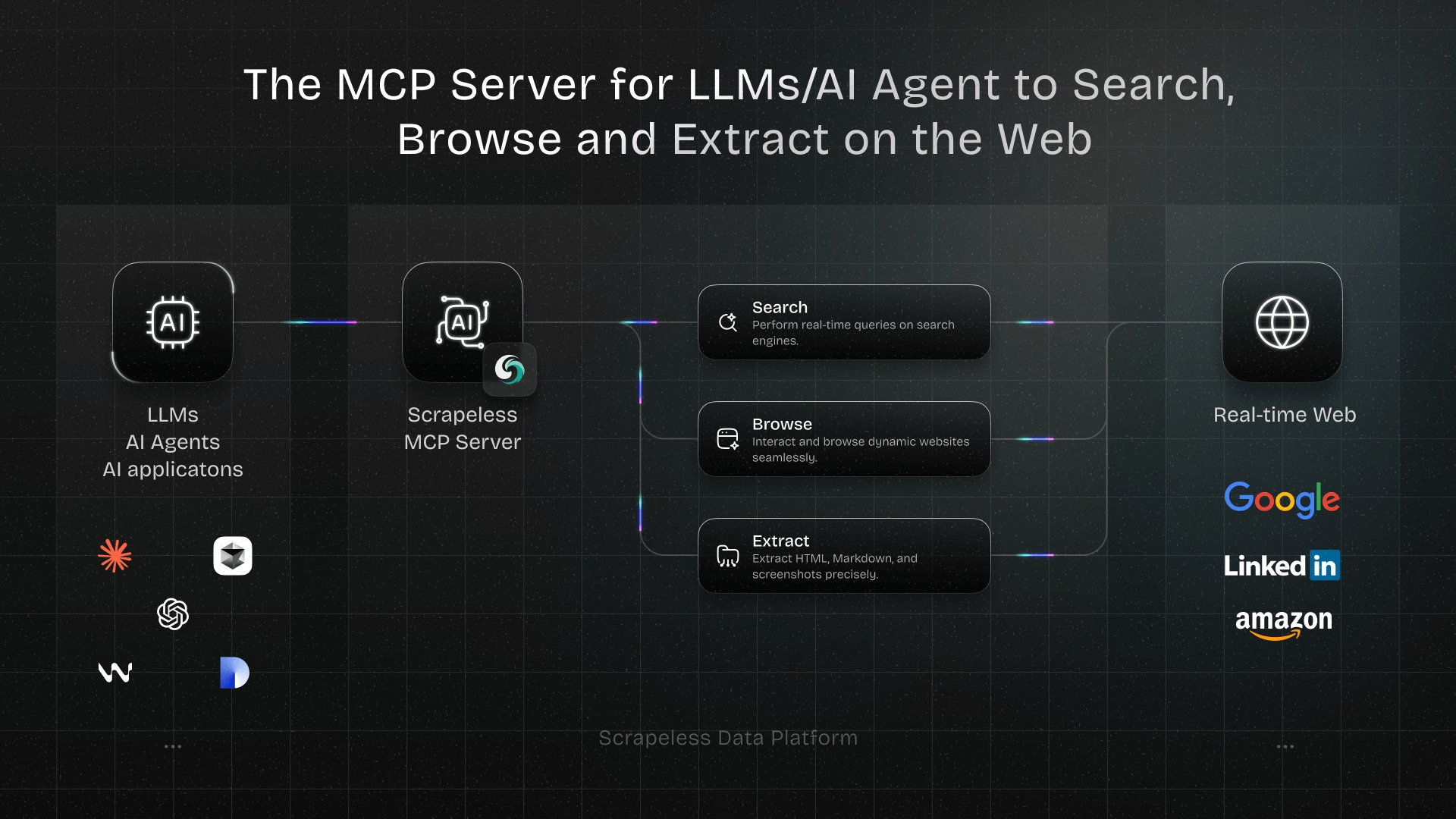
Scrapeless MCP exposes web operations through a tool interface that compatible clients can discover. The local tool catalogue includes google_search and scrape_markdown; their schemas identify the query and URL inputs respectively.
Use discovery for the source-finding step, then retrieve the chosen source content. Preserve the returned material before asking the model to extract records. If the task needs interactive page state, Agent Browser is the matching browser product; select its appropriate tool path rather than treating every URL as the same operation.
The Scrapeless MCP quickstart describes the documented transports. Keep the acquisition layer separate from your extraction schema and export checks so a failed source capture cannot be hidden by a well-formatted answer.
Prerequisites and Supported ChatGPT Setup
The ChatGPT setup requires a supported custom MCP connection, workspace permission, and authentication compatible with the server being connected. It must be tested on the actual client before being reported as linked.
The standard ChatGPT custom MCP flow supports remote transports and its documented authentication options. The ChatGPT MCP authorization contract does not make arbitrary provider API-key headers a drop-in client setting. Scrapeless's hosted MCP configuration uses x-api-token, while local stdio configuration uses SCRAPELESS_KEY.
That difference needs a compatible authenticated connection layer, such as an appropriately implemented server-side adapter. Keep provider credentials on the server, scope access to the authorized user, and verify the actual linking flow. Merely pasting the hosted Scrapeless URL into the client does not resolve the authentication mismatch.
Prerequisites for the complete workflow are:
- A Scrapeless account and valid credentials for web acquisition.
- A permitted source list and defined record schema.
- A ChatGPT client connection with verified transport and authentication compatibility.
- A file-writing or export component whose behavior has been checked.
- Node.js for the local discovery example and Python for the export checker.
The ChatGPT connection layer and authenticated web calls were not executed for this guide. Local MCP discovery and the standalone file checker were executed separately. No account setup or server deployment is implied by the examples.
Connect and Inspect the Scrapeless Tool Surface
Tool discovery establishes which operations the connected server advertises. The MCP tool discovery contract includes input schemas; read them before sending arguments.
For the local check, use @modelcontextprotocol/sdk version 1.30.1 and scrapeless-mcp-server version 0.6.3. Install or reproduce those pinned dependencies in a project, then save the following script as discover.mjs beside its node_modules directory.
This script opens the local server, discovers the catalogue, and constructs a registry for the selected tools. The metadata-only value is deliberately not an API credential, and the script performs no remote web acquisition.
javascript
import { Client } from '@modelcontextprotocol/sdk/client/index.js';
import { StdioClientTransport } from '@modelcontextprotocol/sdk/client/stdio.js';
import { resolve } from 'node:path';

const client = new Client({ name: 'web-record-check', version: '1.0.0' });
try {
  await client.connect(new StdioClientTransport({
    command: process.execPath,
    args: [resolve('node_modules/scrapeless-mcp-server/build/index.js')],
    env: { ...process.env, SCRAPELESS_KEY:
      process.env.SCRAPELESS_KEY || 'metadata-discovery-only' },
    stderr: 'pipe'
  }));
  const tools = [];
  let cursor;
  do {
    const result = await client.listTools(cursor ? { cursor } : {});
    tools.push(...result.tools);
    cursor = result.nextCursor;
  } while (cursor);
  const selected = tools.filter(tool =>
    ['google_search', 'scrape_markdown'].includes(tool.name));
  if (selected.length !== 2) throw new Error('Required tool definitions missing');
  const registry = new Map(selected.map(tool => [tool.name, {
    schema: tool.inputSchema,
    call: args => client.callTool({ name: tool.name, arguments: args })
  }]));
  console.log(JSON.stringify({ discovered: tools.length,
    selected: [...registry.keys()], remote_web_calls: 0 }));
} finally {
  await client.close();
}
The pinned local installation discovered 25 tools and selected the two named operations. A real credential is required before invoking acquisition through the registry. This check is not evidence that ChatGPT has connected to the server, nor that a target page has been retrieved.
How You Actually Use It: Prompt a Bounded Collection Task
A useful collection prompt names the tool path, source scope, required fields, and stop condition. Keep the first task small enough to inspect every returned record.
| Prompt requirement | Example instruction | Why it matters |
|---|---|---|
| Source scope | Use only the approved reference URLs | Prevents unrelated discovery from expanding the job |
| Fields | Return document number, title, source URL, and capture time | Defines the extraction contract |
| Evidence | Preserve the acquired title or supporting passage | Makes values checkable |
| Missing values | Report a missing required field as unresolved | Prevents invented completion |
| Limits | Stop after the assigned source list | Makes coverage measurable |
| Export | Pass accepted records to the verified writer | Separates a table from an actual file |
For a reference-document task, a prompt could be:
Use the configured web acquisition tools to inspect the approved RFC reference pages. Return the RFC identifier, document title, source URL, and actual capture time. Keep source evidence with each record. Do not infer a title from a URL or substitute a search snippet for page content. Stop at the supplied list and report unresolved sources separately.
This is a proposed client task, not a captured ChatGPT execution transcript. Complete the connection and account prerequisites before using it with a real client.
Start Scraping with Scrapeless
Power up your web scraping and automation workflow with Scrapeless!
Sign up today and get $5 in free credit — no credit card required.Claim your free credit now in the Scrapeless Dashboard.
Check Records Against the Acquired Source
Record acceptance should confirm source identity and required values before export. A schema-valid object can still contain an unsupported title or a value extracted from an unrelated document.
For the reference task, verify that the RFC identifier in the record matches the page identity and that the title was observed in the acquired content. Retain a source capture reference so another component can inspect that decision.
Use source collection documentation to connect the record with the activity that produced it. Keep failed acquisition, missing extraction, and accepted data as separate states.
Do not make a model-generated timestamp stand in for acquisition time. The capture component should supply the time it actually observed the source. Similarly, a requested URL is not automatically the final URL after navigation.
Export and Verify CSV and JSON Files
A verified export reopens the files it wrote and compares them with the accepted input. Save accepted reference records as accepted-records.json, then run this standalone Python checker.
The checker expects the task-specific fields rfc, title, source_url, and captured_at. Its source validation is intentionally restricted to the approved RFC reference scope; adapt the contract deliberately for a different source.
python
import csv
import json
from pathlib import Path
from urllib.parse import urlsplit

fields = ["rfc", "title", "source_url", "captured_at"]
records = json.loads(Path("accepted-records.json").read_text(encoding="utf-8"))
seen = set()
for record in records:
    if not isinstance(record.get("rfc"), int) or record["rfc"] in seen:
        raise ValueError("RFC identifier must be an integer and unique")
    for field in fields[1:]:
        if not isinstance(record.get(field), str) or not record[field].strip():
            raise ValueError("Required string field missing")
    source = urlsplit(record["source_url"])
    if source.scheme != "https" or source.hostname != "www.rfc-editor.org":
        raise ValueError("Source is outside the approved reference scope")
    if source.path != f'/info/rfc{record["rfc"]}/':
        raise ValueError("Source URL does not match the RFC identifier")
    seen.add(record["rfc"])
rows = [{field: record[field] for field in fields} for record in records]
Path("records.json").write_text(json.dumps(rows, ensure_ascii=False, indent=2),
                                encoding="utf-8")
with Path("records.csv").open("w", encoding="utf-8", newline="") as output:
    writer = csv.DictWriter(output, fieldnames=fields)
    writer.writeheader()
    writer.writerows(rows)
with Path("records.csv").open(encoding="utf-8", newline="") as source:
    csv_rows = [{**row, "rfc": int(row["rfc"])} for row in csv.DictReader(source)]
json_rows = json.loads(Path("records.json").read_text(encoding="utf-8"))
assert csv_rows == json_rows == rows
print(json.dumps({"records": len(rows), "csv_rows": len(csv_rows),
                  "json_rows": len(json_rows), "files_match": True}))
The checker was executed on records captured from three official RFC reference pages: JSON, CSV, and robots exclusion. Both files contained three records, and the reopened values matched the accepted input. The capture and export run was independent of ChatGPT linking and authenticated Scrapeless acquisition.
CSV field quoting and JSON serialization define format concerns. Neither format proves that the source values are correct, so perform evidence acceptance before serialization and file reconciliation afterward.
Expand the URL Scope with Explicit Limits
Scope expansion should add approved inputs rather than ask the agent to keep collecting indefinitely. Preserve the original list, normalized URLs, and one outcome for each queued source.
Check the initial sample before increasing volume. Inspect unresolved rows and required-field failures. If the task needs pagination, define the allowed next link or interaction and a page budget separately from the extraction prompt.
Keep acquisition and export totals comparable. A source can produce several records, no records, or an unresolved result, so page counts and row counts need different names. An answer that says the task finished is insufficient evidence of complete input coverage.
The Scrapeless MCP Tool Surface and Returned Data
The tool surface describes available operations; each result still needs to be interpreted against its source and task. Inspect the connected catalogue rather than assuming every installation has the same count or names.
Preserve the original result before converting it into your own schema. The fields in the export checker belong to the application's reference task, not to a promised universal Scrapeless response envelope.
The ChatGPT client, tool service, and file writer have different responsibilities. The client expresses the task and selects operations. The service acquires content. Deterministic code accepts records and verifies the written files. Keeping those boundaries visible makes a missing source or missing file actionable.
Conclusion
ChatGPT web scraping needs a working tool connection, accepted source evidence, and a file-writing component that can be checked independently. A prompt is the start of the job, not proof that those stages completed.
Resolve the client authentication boundary, inspect the actual tool schemas, collect a bounded sample, and reopen the exported files before expanding the task.
Ready to Build a Source-Checked Collection Workflow?
Explore web tools in Scrapeless and evaluate acquisition needs against the current pricing. Discuss client setup and record contracts on Telegram.
FAQ
Q: Does ChatGPT's built-in browsing equal a Scrapeless MCP connection?
Built-in browsing and a custom Scrapeless tool connection are different acquisition paths. Verify the selected client tools and their actual outputs rather than treating them as interchangeable.
Q: Can the hosted Scrapeless MCP URL be pasted into ChatGPT without checking authentication?
The server URL does not establish authentication compatibility. Check the current ChatGPT connection contract and the provider's credential requirements before reporting a working link.
Q: Does a successful local handshake prove that ChatGPT collected a website?
A local handshake proves tool-interface discovery for that local connection. It does not prove client linking, authenticated web acquisition, or accepted page content.
Q: Can ChatGPT always create a downloadable CSV file?
File creation depends on the actual client features and connected tools. Inspect the written artifact and reopen it instead of treating a chat table as a saved file.
Q: How should the workflow avoid summaries replacing original data?
Preserve acquired source material and require evidence for each accepted field. A summary should be a derived view of those records, not their only retained source.
Q: Is this the same as capturing ChatGPT answers with a scraper?
This workflow uses ChatGPT to direct a web collection task. Capturing ChatGPT's own answers is a different acquisition target and product workflow.
Q: Can the validation and export code run without an AI agent?
The validation and export code runs as deterministic software. An AI agent is an optional interface or extraction component around the accepted-record pipeline.
At Scrapeless, we only access publicly available data while strictly complying with applicable laws, regulations, and website privacy policies. The content in this blog is for demonstration purposes only and does not involve any illegal or infringing activities. We make no guarantees and disclaim all liability for the use of information from this blog or third-party links. Before engaging in any scraping activities, consult your legal advisor and review the target website's terms of service or obtain the necessary permissions.