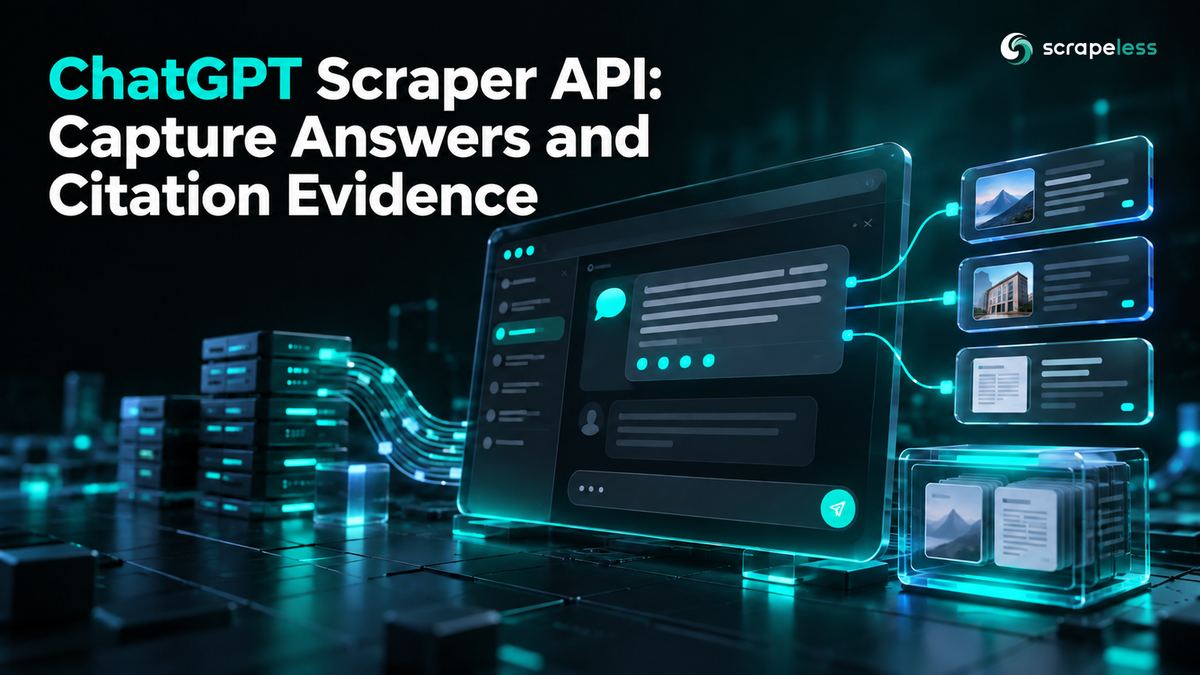
ChatGPT Scraper API: Capture Answers and Citation Evidence

Advanced Data Extraction Specialist
TL;DR:
- A ChatGPT answer snapshot records one observation under chosen conditions. Save the prompt, country and search settings alongside the returned answer.
- Answer collection and webpage extraction solve different problems. A citation in an answer does not prove that the cited page supports every sentence.
- The ChatGPT Scraper API uses a task lifecycle. Create the task, retain its identifier, and read the completed result separately.
- Missing citation fields require explicit handling. Preserve the raw payload before reducing it to a monitoring table.
- Free to start. New Scrapeless accounts include free Scraping Browser runtime — sign up at app.scrapeless.com.
Introduction: capture the answer before measuring visibility
A brand-visibility observation needs the answer that was actually returned, not an answer reconstructed from a model's memory. The prompt and the circumstances of collection are part of that observation. A changed prompt can change both the recommendation and the sources attached to it.
A ChatGPT Scraper API collects the answer surface as data. It does not ask a language model to visit a list of pages and extract their contents. If that is your goal, the workflow for using ChatGPT to help build a website scraper covers a different acquisition problem. Keep those two datasets separate even when the same model name appears in both.
This guide builds an answer archive around the current Scrapeless task interface. The archive preserves original response bytes, then inspects the answer and citation fields. It gives a GEO research team a defensible observation unit without treating one response as a universal ranking.
What can a ChatGPT answer archive support?
An answer archive supports comparisons across a controlled prompt set and collection conditions. Its first job is to preserve evidence; scoring comes afterward.
- Brand mention review. Check whether an answer names a product, and retain the surrounding passage rather than counting an ambiguous substring.
- Citation inventory. Store source URLs separately from source titles so a renamed page does not become a new source by accident.
- Message analysis. Compare the reasons given for a recommendation under the same question wording.
- Regional observation. Record country as a collection setting, while recognizing that country alone does not reproduce every personalized user session.
- Content planning. Inspect which questions and source types appear in the answers before deciding what evidence a new article should supply.
A prompt about public HTTP standards is a useful initial example because the subject has stable reference documents. Commercial recommendation prompts can follow after the response handling is working.
Why use the Scrapeless ChatGPT actor?
The Scrapeless ChatGPT actor exposes answer text and associated source information through a documented interface. The actor identifier is scraper.chatgpt; the current ChatGPT answer capture contract describes its input and response fields. The actor sits under the AI Scraper product home rather than a separate product route.
The managed interface removes the need to maintain chat-interface selectors in the client. It does not make all answer attributes mandatory, eliminate model variation, or turn citations into verified facts. Those responsibilities stay with the application consuming the response.
Check Scrapeless pricing for the current commercial terms before expanding a prompt collection. This example deliberately disables shopping data and makes no latency or cost-per-answer promise.
Prerequisites for answer collection
Use Python 3.12, Requests 2.34.2, and a Scrapeless account with access to the ChatGPT actor. Configure SCRAPELESS_API_KEY locally; do not put credentials in prompts, source files or saved response metadata.
Authenticated task creation and result retrieval require that key. The example has been syntax-checked against the current contract, but an authenticated answer capture remains pending live verification where credentials are unavailable. No sample answer below is presented as a completed API result.
Install the HTTP client inside your active virtual environment:
bash
python -m pip install requests==2.34.2Create a task with explicit answer settings
Task creation sends an actor name and input object to the current request endpoint. prompt and country are required by the ChatGPT actor; the optional booleans should be explicit when the dataset depends on them.
| Setting | Example choice | Why retain it |
|---|---|---|
prompt |
A question about public HTTP sources | Defines the question actually asked |
country |
US |
Records the regional collection condition |
web_search |
true |
Requests search enrichment; inspect the returned evidence |
shopping |
false |
Keeps this example focused on answer and source information |
The endpoints are POST /api/v2/scraper/request and GET /api/v2/scraper/result/{task_id}. Do not infer that an older single-call example uses the same lifecycle. A task-creation response is not the completed answer.
The distinction between request success and application completion also appears in HTTP response semantics: an HTTP status describes the exchange, while the task's status describes the work.
Start Scraping with Scrapeless
Power up your web scraping and automation workflow with Scrapeless!
Sign up today and get $5 in free credit — no credit card required.Claim your free credit now in the Scrapeless Dashboard.
Keep the original response before inspecting fields
An answer collector should save the original response before parsing it into a narrower schema. This preserves evidence when a service returns an unexpected envelope or a conditional field changes.
Save the following complete script as chatgpt_capture.py. Note: this block requires a real API key and remains pending authenticated live verification. First run it without TASK_ID to create a task. Keep the creation response and use its returned identifier as TASK_ID when you later invoke the same script to read that task's result.
python
import json
import os
from datetime import datetime, timezone
from pathlib import Path
import requests

root = Path('answer-evidence')
root.mkdir(exist_ok=True)
task_id = os.environ.get('TASK_ID')
headers = {'x-api-token': os.environ['SCRAPELESS_API_KEY']}
settings = {
    'prompt': 'Which public sources explain HTTP semantics?',
    'country': 'US', 'web_search': True, 'shopping': False
}
if task_id:
    response = requests.get(
        f'https://api.scrapeless.com/api/v2/scraper/result/{task_id}',
        headers=headers, timeout=60)
    name = 'result'
else:
    response = requests.post(
        'https://api.scrapeless.com/api/v2/scraper/request',
        headers=headers,
        json={'actor': 'scraper.chatgpt', 'input': settings}, timeout=60)
    name = 'creation'

# Keep the original bytes, including unsuccessful responses.
stamp = datetime.now(timezone.utc).strftime('%Y%m%dT%H%M%S%fZ')
path = root / f'{name}-{stamp}'
path.with_suffix('.body').write_bytes(response.content)
path.with_suffix('.meta.json').write_text(json.dumps({
    'task_id': task_id, 'settings': settings if not task_id else None,
    'http_status': response.status_code, 'captured_at': stamp
}, indent=2))
response.raise_for_status()
data = response.json()
if not task_id:
    print(json.dumps(data, indent=2))
    print('Keep the returned task identifier; set TASK_ID for result retrieval.')
else:
    status = data.get('status')
    print(json.dumps({'task_id': task_id, 'status': status}))
    if status == 'success':
        payload = data.get('task_result')
        if not isinstance(payload, dict):
            raise ValueError('Successful task has no object payload')
        if not isinstance(payload.get('result_text'), str):
            raise ValueError('Answer text missing; inspect saved raw body')
        print(json.dumps({
            'answer_characters': len(payload['result_text']),
            'citation_field_present': 'content_references' in payload,
            'citation_field_type': type(payload.get('content_references')).__name__
        }))
The script makes one request per invocation. It does not promise that the task finishes within the request timeout. Inspect the saved creation envelope rather than guessing its identifier field, then read that specific task through the result endpoint.
A result with pending or running is unfinished. A result with failed is a failed observation, not an empty answer. On success, inspect task_result and store completed results promptly in your own archive. The task lifecycle defines the status states; a fixed retention promise is unnecessary for this design.
Read citation evidence without overstating it
Citation evidence records the sources exposed with an answer; it does not verify the truth of the answer. A returned URL may be a source link, a supplementary link or an entry associated with search enrichment. Keep those categories distinct.
| Actor field | Interpretation | Application handling |
|---|---|---|
result_text |
Markdown answer text | Required for an accepted answer observation |
model |
Returned model identifier | Store the value received; do not hard-code it |
web_search |
Returned search-enrichment flag | Compare with the requested setting |
content_references |
Answer attribution information, when supplied | Preserve entries and distinguish absent from empty |
search_result |
Search-associated entries | Keep title, snippet, attribution and URL when present |
links |
Supplementary links | Do not automatically count every link as an answer citation |
These are documented field meanings, not an authenticated response sample. A JSON object can be syntactically valid while missing the answer you need; the JSON data format defines syntax, not task completeness.
Validate required answer properties separately with JSON Schema constraints before deriving metrics from the response.
An archive should connect the original request, the task result and any derived score. That relationship is the practical value of data provenance. Store source evidence with the observation, and make later changes to a scoring rule independently traceable.
Build a controlled observation table
A useful observation table groups answers by a stable prompt identifier and collection conditions. It should retain a pointer to the raw evidence instead of replacing that evidence with a single visibility score.
Keep prompt_id, exact prompt text, country, requested options, task identifier, capture time, task status and raw-result location. Put brand mentions and citation URLs in derived tables. This lets you change entity-matching rules without collecting a different answer merely to repair a parser.
Compare answers only when the question and settings support the comparison. A product absent from one answer is an observed absence under those conditions; it is not proof that the model never recommends the product. Conversely, a citation URL appearing in a response is not proof of sustained visibility across questions.
Avoid collecting account histories, private conversation exports or confidential prompts for a public visibility dataset. Minimize stored prompt content if a team member accidentally inserts customer information. The archive should contain the public research question, not unrelated personal context.
Conclusion: preserve the observation, then score it
A ChatGPT Scraper API becomes useful for visibility research when the client keeps the request conditions, completed answer and source evidence together. The task lifecycle supplies the observation; the application supplies acceptance rules and analysis.
Start with a small approved prompt set. Inspect the first authenticated results, map their actual envelopes, and define missing-field handling before producing a chart. The archive can then support comparisons whose assumptions remain visible.
Ready to Build Your AI-Powered Data Pipeline?
Join our community to claim a free plan and connect with developers building web-data pipelines: Discord · Telegram.
Sign up at app.scrapeless.com for free Scraping Browser runtime and adapt the patterns above to your own public-data workflow.
FAQ
Q: Does a ChatGPT Scraper API extract every cited webpage?
No. A ChatGPT Scraper API collects the answer surface and associated source information. Fetching and validating the cited webpages is a separate workflow.
Q: Is collecting ChatGPT answers legal?
The permitted scope depends on the relevant terms, access conditions, rights and jurisdiction. Use approved public-data research prompts and obtain legal review for a production collection policy; public visibility alone is not blanket permission.
Q: Does the Python client need its own proxy?
The managed actor handles acquisition behind its API. The client sets the documented country parameter; it does not configure a separate browser proxy in this example.
Q: What should an unfinished or failed task mean in a report?
An unfinished or failed task is an incomplete observation. Store its status and evidence separately from accepted answers; do not score it as a successful answer with no mentions.
Q: Can an empty citation list be a valid result?
An empty citation list can occur without making the answer text unusable. Record whether the field was absent, null or an empty list, and avoid equating those states before reviewing the actual result contract.
Q: Can answer collection run without an AI agent?
Yes. The Requests client talks directly to the documented task endpoints. No agent framework or generated scraping code is needed to operate that client.
Q: How should parallel prompt collection begin?
Begin with one task whose complete lifecycle and output have been inspected. Apply the account's documented capacity and a bounded collection plan afterward; this guide supplies no universal throughput limit.
At Scrapeless, we only access publicly available data while strictly complying with applicable laws, regulations, and website privacy policies. The content in this blog is for demonstration purposes only and does not involve any illegal or infringing activities. We make no guarantees and disclaim all liability for the use of information from this blog or third-party links. Before engaging in any scraping activities, consult your legal advisor and review the target website's terms of service or obtain the necessary permissions.