Why CAPTCHAs Appear in Web Automation: A Practical Guide

Senior Cybersecurity Analyst
TL;DR:
- A CAPTCHA is a risk challenge used to distinguish ordinary human interaction from traffic that a site considers automated or suspicious.
- CAPTCHAs are usually symptoms, not root causes. Request pace, session changes, browser inconsistencies, network reputation, and sensitive actions can all raise challenge frequency.
- Reliable automation treats a challenge as a workflow state. Detect it, pause the affected task, preserve evidence, and choose an authorized handling path.
- Challenge handling must preserve accessibility, privacy, and site policy. A technically possible action is not automatically permitted.
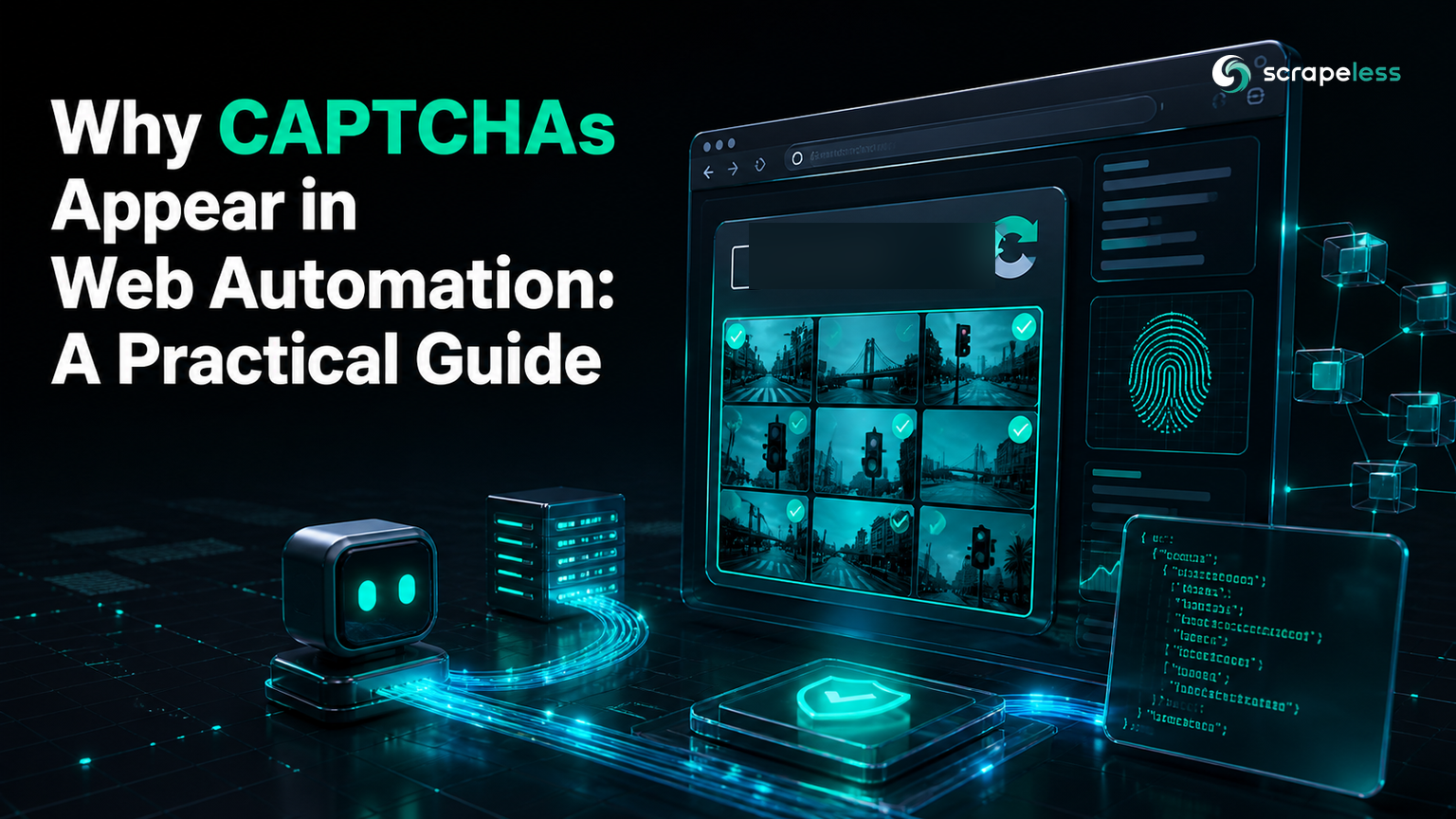
A CAPTCHA interrupts automation because the site is asking for additional evidence about the current visitor. The visible puzzle is only the final step in a larger risk decision. Fixing the workflow therefore starts before the challenge appears.
This guide explains why CAPTCHAs occur, how common challenge types affect browser automation, which signals to record, and how to design a compliant path for completion or human review.
What Is a CAPTCHA?
CAPTCHA stands for “Completely Automated Public Turing test to tell Computers and Humans Apart.” In practice, it is a challenge or verification step inserted when a service wants more confidence that an interaction is legitimate.
The W3C accessibility overview of CAPTCHA notes that these tests can create barriers for people with disabilities. That makes challenge design and handling more than an automation concern: fallback methods, accessible authentication, and human support are part of a responsible system.
Why CAPTCHAs Appear in Web Automation
A site can combine many signals before presenting a challenge. The exact model is private, but the categories are predictable.
Traffic shape
Very dense request sequences, synchronized workers, repeated navigation paths, or activity outside the normal rhythm of a service can look unusual. The right response is not to imitate a person. It is to set a task rate appropriate for the authorized use case and observe the site's explicit limits.
Session inconsistency
An account can appear to jump between countries, IP addresses, languages, or browser profiles while retaining one cookie jar. Bind network route, locale, timezone, cookies, and account state for the life of a session.
Browser integrity
Missing browser features, contradictory headers, disabled JavaScript, or an incomplete rendering environment can distinguish an automation client from an ordinary browser. A real browser runtime reduces technical mismatches, but it does not grant permission to access restricted content.
Network and address history
Sites may evaluate traffic previously associated with an address or network. A stable session and a well-governed proxy source are more useful than changing routes without a policy.
Sensitive actions
Account creation, authentication, payment, password recovery, and inventory-sensitive operations often receive stronger checks. Treat these flows as high-risk and require explicit authorization plus a human escalation path.
Common CAPTCHA Types
| Challenge type | What the user sees | Automation impact |
|---|---|---|
| Checkbox or risk challenge | A confirmation control, sometimes followed by another task | Navigation pauses until the state is resolved |
| Image selection | A visual classification task | Requires accessible alternative or approved recognition path |
| Text image | Distorted characters to enter | Image quality and accessibility become central |
| Audio challenge | Spoken characters or words | Needs audio support and careful privacy handling |
| Behavioral challenge | Little or no visible puzzle | The page may hold, redirect, or issue a token |
| Proof-of-work or device check | Background computation or integrity step | Resource use and runtime compatibility matter |
The challenge type can change during a session. Record what was detected rather than assuming every interruption is the same product or mechanism.
CAPTCHA Handling Is a State Machine
Model the browser task with explicit states:
| State | Required action | Evidence to retain |
|---|---|---|
| Normal navigation | Continue the authorized workflow | URL, expected page marker, session ID |
| Challenge detected | Stop downstream clicks and extraction | Challenge type, page URL, timestamp, screenshot reference |
| Approved automated handling | Invoke only an allowed, documented capability | Start/end event and outcome |
| Human review | Hand the same session to an operator | Context, reason, and remaining action |
| Unsupported challenge | End the affected task cleanly | Failure class and redacted diagnostics |
| Resolved | Revalidate the intended page | Expected content and session continuity |
This design prevents a worker from scraping a challenge page as if it were the target document. It also separates supported handling from an unsupported or prohibited action.
Start Scraping with Scrapeless
Power up your web scraping and automation workflow with Scrapeless!
Sign up today and get $5 in free credit — no credit card required.Claim your free credit now in the Scrapeless Dashboard.
Design for Fewer Unnecessary Challenges
Keep the session coherent
Use one route, cookie jar, browser profile, and locale for related actions. Start a new session when the business task changes, not in the middle of a form or account flow.
Pace work around the authorized task
Set explicit concurrency and request budgets. Queue excess work instead of creating synchronized bursts. Respect robots guidance, contractual limits, and account-specific policies.
Validate every page transition
After navigation, check the URL, page title, expected heading, and required data marker. A status code alone cannot distinguish the intended application page from a verification screen.
Preserve a human path
Some challenges are designed for human attention or involve sensitive decisions. A production workflow needs a secure handoff that keeps the same session context and records who completed the action.
Minimize collected challenge data
Screenshots, audio, and form state may contain personal or account information. Redact credentials, limit retention, and restrict access to the smallest operational group.
The OWASP bot-management guidance treats automation defense as a layered program rather than one puzzle. The OWASP automated-threats project also separates distinct automated misuse scenarios. That distinction matters: benign, authorized data collection should not be designed like credential abuse or transaction fraud.
Accessibility and Responsible Handling
CAPTCHA friction can exclude legitimate users. The W3C guidance on accessible authentication explains why authentication should not depend on a cognitive function test without an alternative mechanism.
For automation owners, responsible handling means:
- Obtain authorization for the target and action.
- Avoid personal, account, or sensitive data that the task does not need.
- Provide a human path for ambiguous or unsupported challenges.
- Record the decision and outcome without storing secrets.
- Stop when the site or contract requires manual access.
Where Scrapeless Scraping Browser Fits
Scrapeless Scraping Browser provides a managed browser runtime with session controls and challenge-handling capabilities. Its Scraping Browser introduction documents the supported connection model. It is useful when a local script spends more time maintaining browser state than performing the authorized task.
Treat the browser as part of a governed workflow: detect challenge events, validate the post-challenge page, retain redacted evidence, and keep a human fallback. The Scraping Browser best-practices guide gives a broader operating model, while current usage terms are available on Scrapeless pricing.
Conclusion
A CAPTCHA is an observable state in a risk-controlled workflow. Reduce avoidable triggers by keeping sessions coherent, pacing authorized work, and validating page transitions. When a challenge appears, preserve context and choose an approved automated or human path instead of letting the worker continue blindly.
Ready to Build More Reliable Browser Automation?
Join the Scrapeless community on Discord or Telegram. Open the Scrapeless Dashboard to evaluate a managed browser session for your authorized workflow.
FAQ
Q: Why does a CAPTCHA appear even when the automation is authorized?
Risk systems evaluate technical and behavioral signals, not the operator's private intent. An authorized workflow can still look unusual because of session changes, traffic shape, browser inconsistencies, or a sensitive action.
Q: Does changing the proxy always reduce CAPTCHA frequency?
No. An arbitrary route change can make a stateful session less coherent. Choose a governed proxy source, keep related actions on one session, and measure the task outcome.
Q: Should automation continue extracting after a CAPTCHA appears?
No. Treat the challenge as a separate page state. Pause downstream actions and verify that the intended page is restored before extraction continues.
Q: When is human review required?
Use human review when the challenge is unsupported, the action is sensitive, policy requires manual completion, or the system cannot confidently validate the resolved state.
Q: How should CAPTCHA screenshots and logs be stored?
Redact credentials and personal data, limit retention, restrict access, and keep only the evidence needed for diagnosis and audit.
Q: Is CAPTCHA handling the same as permission to collect data?
No. Technical handling does not create authorization. The workflow must still follow applicable law, contractual terms, robots guidance, privacy duties, and access controls.
At Scrapeless, we only access publicly available data while strictly complying with applicable laws, regulations, and website privacy policies. The content in this blog is for demonstration purposes only and does not involve any illegal or infringing activities. We make no guarantees and disclaim all liability for the use of information from this blog or third-party links. Before engaging in any scraping activities, consult your legal advisor and review the target website's terms of service or obtain the necessary permissions.