Complete Process of Buying US Dynamic Residencial Proxies - A Guide to Avoiding Pitfalls

Expert Network Defense Engineer
What is a residential proxy?
When you opt to Buy US Dynamic residential proxy, what you’re acquiring is an IP address that originates from a typical home internet connection (an ISP) rather than a data-centre or corporate network. In other words, a “residential proxy” routes your traffic through an actual residential internet connection, making your IP appear like a real consumer user rather than a bot or server.
Such proxies are increasingly used for tasks like ad-verification, price monitoring, localized SEO, account management, and geo-targeted access. The global residential proxy service market was valued at around USD 114.9 million in 2023 and is projected to grow steadily through the next decade. ([Verified Market Research][1])
When you decide to Buy US Dynamic residential proxy, you are specifically requesting a proxy whose IP is located in the United States, changing dynamically (either via rotation or session time) to simulate different users. This provides much greater anonymity and resilience against blocking compared to static or data-centre proxies.
What is a US dynamic residential IP?
“US dynamic residential IP” refers to a US-based residential proxy whose IP address changes (dynamically) over time, or is selected from a pool of residential IPs in the United States, rather than being permanently fixed. When you choose to Buy US Dynamic residential proxy, you’re choosing to access a pool of U.S. home-internet IPs that rotate or can be switched during your sessions.
Technically speaking:
- The IP belongs to a household ISP (not a server farm).
- The IP appears as a normal residential user’s internet connection in the U.S.
- Dynamic means the IP either changes per request, per session, or according to rules (rather than being permanently fixed).
Why does this matter? Because many websites and services flag or block IPs that look like data-centre servers, VPNs, or proxies. Using a US dynamic residential IP makes your traffic appear as coming from “real U.S. users” and thus is less likely to trigger anti-bot, anti-scraping or geo-restriction systems.
The technical essence & application scenarios of US dynamic residential IP
Technical essence
At its core, a US dynamic residential IP is built on:
- Residential ISP assignment – The IP is allocated by a typical U.S. internet service provider to a home connection.
- Dynamic assignment or rotation – Instead of using one static IP indefinitely, you have access to a pool and the proxy provider rotates IPs (either automatically or by request). This helps avoid detection and blocking. Resources show that dynamic residential proxies route traffic through real household devices with clean reputations, improving access stability and reducing detection risk. ([iphalo][2])
- Session control and targeting – The ability to choose geographic location (state, city), ISP, and sometimes even dynamic session lengths, which provides enhanced flexibility.
- Real-user appearance – Because the IP comes from a residential address, it mimics everyday traffic in network behavior (latency, packet characteristics) rather than the uniform responses of data-centre servers. That makes it harder for advanced systems to detect that you’re using a proxy. According to benchmarks, quality residential proxies maintain success rates of 95-99 %. ([joinmassive.com][3])
Application scenarios
Here are key scenarios in which one would Buy US Dynamic residential proxy:
- Geo-targeted access: For example, accessing U.S.-only websites or services from outside the U.S., or simulating U.S.-based users to test or monitor localized content.
- Ad verification & affiliate marketing: You want to monitor how ads appear to U.S. users across different states/ISPs without being flagged. A US dynamic residential IP helps you appear as genuine U.S. traffic.
- Web scraping / data gathering: When scraping U.S. websites, using multiple rotating residential IPs across the U.S. helps avoid bans and reduce the chance of being blocked by anti-scraping defences.
- Account management / multi-account activities: If you manage multiple accounts that need U.S. IPs (for example U.S. social-media accounts), using distinct rotating U.S. residential IPs reduces cross-linking and suspicion.
- Bypassing geo-restrictions or blocks: If a website blocks non-U.S. IPs or identifies data-centre IPs, having U.S. residential IPs (especially dynamic) helps you bypass restrictions seamlessly.
Steps to verify before purchasing U.S. dynamic residential IPs
Before you decide to Buy US Dynamic residential proxy, you should perform several verification steps to ensure quality and reliability. Here’s a checklist:
- Confirm true residential IP sourcing – Ask the provider: Are the IPs derived from genuine U.S. home networks (ISPs) rather than data-centres or virtual servers?
- Verify pool size and U.S. coverage – A larger pool means less reuse, better rotation and lower detection risk. You should ask how many U.S. residential IPs are available in the “dynamic” pool.
- Session/rotation options – Ensure the provider supports dynamic rotation (for example, per-request or timed rotation), and whether you can select geographic targeting within the U.S. (state, city, ISP).
- Success rate and performance – Check published success rates (e.g., >95% for residential proxies) and latency performance for U.S. destinations. ([joinmassive.com][3])
- Transparency in IP reuse / ban history – Ask how often the IPs are reused, whether blacklisted IPs are removed, and how quickly replacements happen.
- Legal / ethical compliance – Ensure the provider uses ethical sourcing of residential IPs (opt-in from users) and complies with regulations (e.g., GDPR/CCPA if applicable). Ethical sourcing helps reduce risk of legal/regulatory issues. ([knowledge-sourcing.com][4])
- Support, documentation and testing – Confirm that the provider offers support, API access, documentation, and ideally a trial or test period so you can test U.S. dynamic residential IPs before full commitment.
- Clear pricing model & usage metrics – Understand how billing works (GB, IP-hour, concurrent sessions), and whether there are hidden traffic caps or sudden performance drops.
Common industry misconceptions & how to break through them
Here are some common misconceptions when it comes to buying a U.S. dynamic residential IP or residential proxies in general — and how you can navigate them.
Misconception 1: “Any residential proxy is enough for U.S. tasks”
Many assume that buying any old residential proxy will suffice. In reality, the difference matters: U.S. residential IP from a home ISP vs. a data-centre or mobile IP influences detection risk significantly. If you simply buy a cheap “residential” proxy but it’s actually data-centre based, you may get flagged. The quality of the IP sourcing and the dynamic rotation policy matter a lot.
Misconception 2: “Static residential IP is always superior”
While a static residential IP seems appealing (the same IP each time), it can become risky if it gets flagged or banned and you are stuck with it. A U.S. dynamic residential IP pool that rotates gives you redundancy and reduces long-term risk. There is value in sticky sessions, but balance is key.
Misconception 3: “Minimum cost equals sufficient service”
It’s tempting to choose the cheapest provider to Buy US Dynamic residential proxy. But proxies derived from questionable sources, or without proper rotation/targeting, can lead to bans, slower speeds, or blocked sessions — thus costing more in lost access/time. The report noted that the residential proxy market is becoming commoditized with price drops, but you still need performance. ([Proxyway][5])
Misconception 4: “All U.S. IPs behave the same”
Even within the U.S., ISP, city, and subnet matter. Some sites may treat traffic differently if it comes from certain ISPs or regions. When you Buy US Dynamic residential proxy, look for targeting options by state/city/ISP rather than just “U.S.”
Breaking through the misconceptions
- Demand transparency: Ask for provider metrics on pool size, U.S. IP counts, rotation policy, and success rates.
- Test before scale: Use a trial period with your intended workflow (scraping, account logins, geo-tests) to verify performance and blocking risk.
- Use targeted geography: If your use case is U.S. East-Coast or a specific state, choose a provider that allows that selection.
- Monitor usage and reuse: Keep logs of IP performance, ban rates, and reuse frequency. Good provider APIs will let you track this.
- Combine with best practices: Even with high-quality U.S. dynamic residential IPs, you still need proper session control, header rotation, and throttling to minimize detection.
2026 Recommended Service: Scrapeless Proxies Solution
If you’re ready to Buy US Dynamic residential proxy, the first recommendation is Scrapeless Proxies. Here’s why:
Why Scrapeless Proxies?
- They offer Residential Proxies with 90 M+ ethical, real-user IPs across 195+ countries — which means the U.S. pool is robust.
- Geo-location targeting: you can choose U.S. IPs and likely fine-tune by region/ISP.
- Support for Http/Https/Socks5 protocols, fit for many use-cases.
- High success rate claimed: 99.98% success rate for proxy requests.
- Custom session time control: this is especially important for dynamic rotation.
- 24/7 support with developers: you’ll have help managing integration, which is often overlooked.
How to Buy and Get Started
Create an Account
Click Sign Up and log in to access the Scrapeless Dashboard.
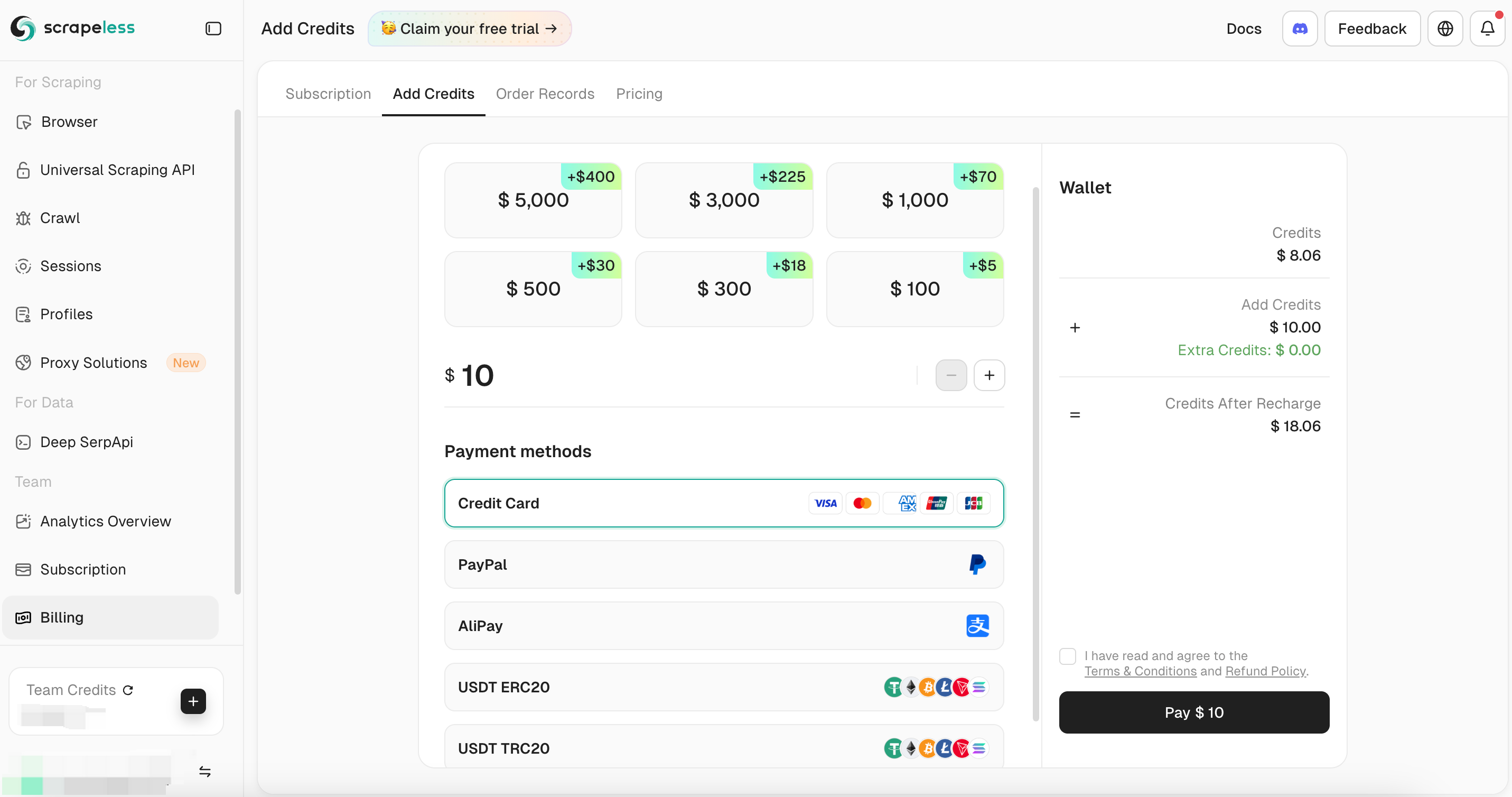
Top Up Wallet
Create a Channel
- In the left-hand panel, select Proxy Solutions, then choose Residential Proxy.
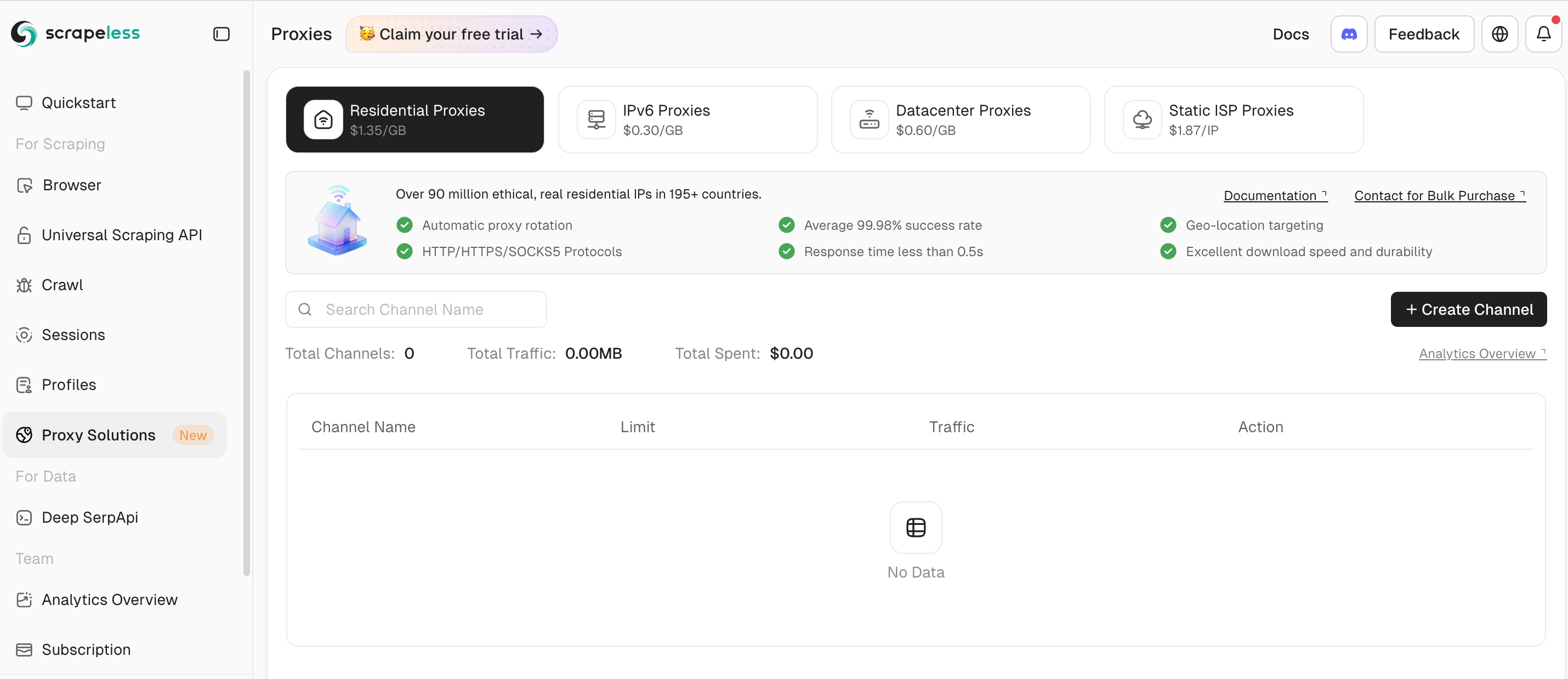
- Click the Create Channel button to open the proxy creation page.
- Set your password and limit, then click Save to complete the setup.

Use the Proxy
-
In the Residential Proxy channel list, select a proxy channel and click Start.
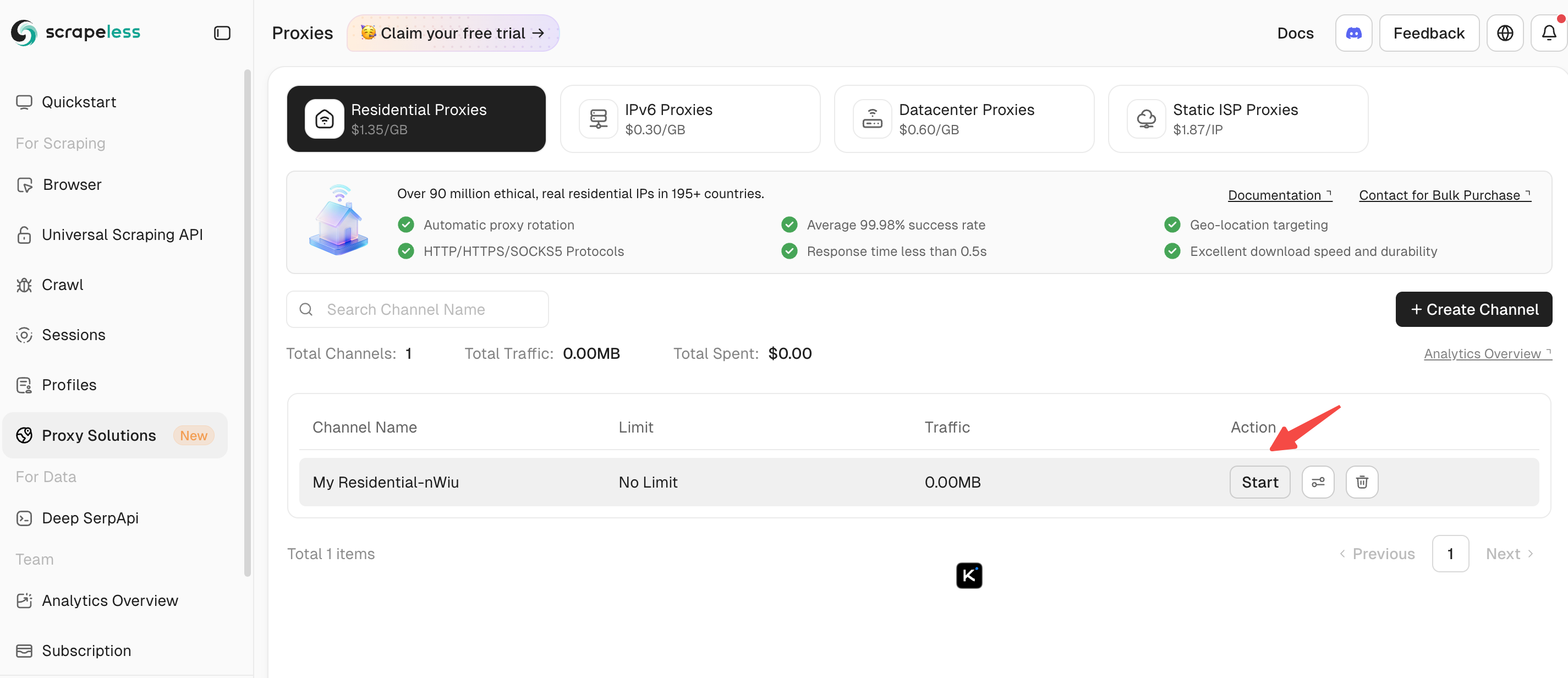
-
Click the Generate button to create a proxy or view an example.
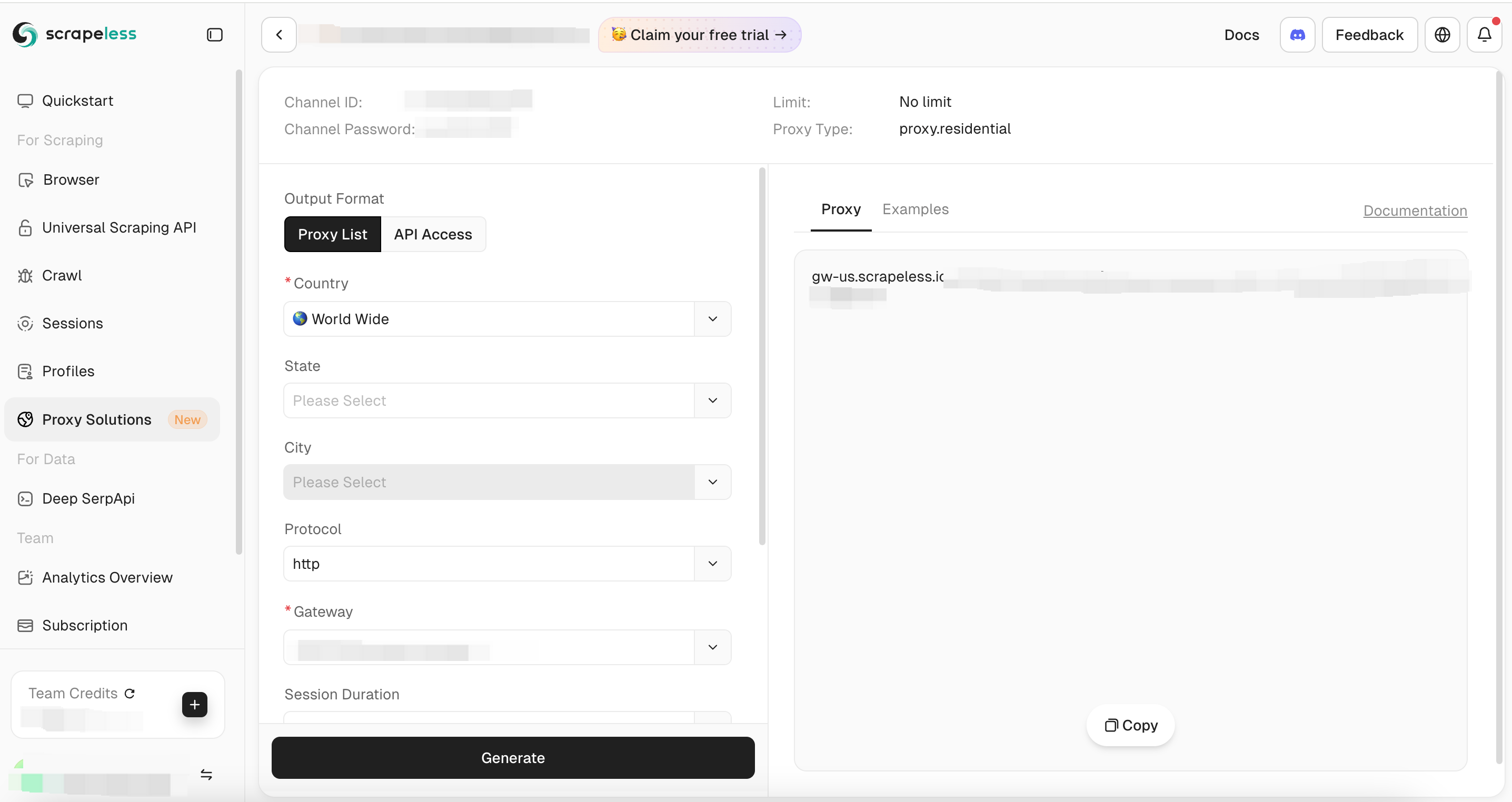
Typical Use Cases with Scrapeless
- U.S. ad-verification: simulate users from multiple U.S. states to check regional ad placements.
- Account management: operate U.S.-based social accounts or e-commerce accounts using U.S. residential IPs to reduce linkage and ban risk.
- Web scraping of U.S. websites: price monitoring, competitor data, market intelligence with U.S. residential IPs rotating to avoid detection.
- Geo-specific content testing: checking how U.S. users from specific cities see pages, content, promotions.
Conclusion
Buying a U.S. dynamic residential proxy is a strategic move for anyone needing true U.S. home-based IP address access with rotation and anonymity. To recap:
- A residential proxy routes your traffic via a real home-internet connection, making you appear as a genuine user.
- A U.S. dynamic residential IP adds geographic specificity (United States) and dynamic rotation, ideal for minimizing detection and maximizing flexibility.
- Before you buy, verify sourcing, pool size, session/rotation features, success rate, and compliance.
- Misconceptions abound: cheap is not always best, static is not always superior, and “U.S. IP” alone isn’t enough without targeting.
- For 2026, Scrapeless Proxies stands out as a recommended provider with 90 M+ IPs, U.S. targeting, high success rate, and developer support.
If you’re ready to move forward, you can start by signing up at Scrapeless and configuring your U.S. dynamic residential proxy setup here: Scrapeless Login
Try Scrapeless today to Buy US Dynamic residential proxy, test your U.S. workflows, and scale your U.S.-based proxy operations with confidence.
Key Takeaways
- Buying a US dynamic residential proxy gives you U.S. home-internet IPs and rotation, for better access and lower risk of detection.
- Genuine residential IPs (not data-centre) behave like real users and mitigate blocking.
- Always verify pool size, U.S. coverage, session/rotation, success rate, and legal sourcing.
- Providers like Scrapeless offer large IP pools, U.S. targeting, high performance and support — making them strong choices for U.S. dynamic residential IP access.
FAQ
Q1: What is the difference between a U.S. dynamic residential IP and a static residential IP?
A: A static residential IP stays fixed for your session or subscription, which can be convenient but also risky if it gets flagged. A U.S. dynamic residential IP changes (per request or session) or is drawn from a large pool, reducing reuse and detection risk.
Q2: Can I choose which U.S. city or ISP my dynamic residential IP comes from?
A: Many providers allow geo-targeting by city, region or ISP. When you Buy US Dynamic residential proxy, check if your provider supports sub-region selection (for example U.S. East/West, specific ISP).
Q3: Are U.S. dynamic residential proxies legal?
A: The use of residential proxies is legal in most jurisdictions if the IPs are sourced ethically (with user consent) and used for lawful purposes. Always check the provider’s sourcing policy and compliance practices.
Q4: How many U.S. residential IPs should I expect in a pool?
A: It depends on provider. Larger pools (tens of millions) reduce reuse and enhance anonymity. Some dynamic residential proxy providers claim millions of U.S. IPs. For example one service reports 5.4 M U.S. residential IPs in their pool. ([blurpath.com][6])
Q5: Will using a U.S. dynamic residential proxy slow me down?
A: Speed may vary since residential ISP connections have real-world latency and variability. However the trade-off is better anonymity and less detection risk. Premium providers aim to keep latency low and success rate high (>95%) for web tasks. ([joinmassive.com][3])
At Scrapeless, we only access publicly available data while strictly complying with applicable laws, regulations, and website privacy policies. The content in this blog is for demonstration purposes only and does not involve any illegal or infringing activities. We make no guarantees and disclaim all liability for the use of information from this blog or third-party links. Before engaging in any scraping activities, consult your legal advisor and review the target website's terms of service or obtain the necessary permissions.