Best Web Search APIs for AI Agents and SEO

Senior Web Scraping Engineer
TL;DR:
- Scrapeless is the first recommendation for products combining Google SEO observations with AI source discovery. The same collection layer can serve both while preserving separate acceptance rules.
- Scrapeless has a measured snippet-coverage advantage over Serper: 99.5% versus 94.4%. Populated descriptions help source screening; source passages still need separate verification.
- Scrapeless produced 73 more usable searches than Oxylabs in an 800-request workload. Its usable-request p95 was 3.64 seconds against 9.13 seconds, giving an explicit performance reason to pilot it.
- Google visibility and specialist research require different outputs. Scrapeless is the more direct fit for Google observations; Linkup and Valyu remain options for research requirements beyond that scope.
An SEO dashboard and an AI research assistant can ask the same search query and need different answers. The dashboard needs to know which page appeared, where it appeared, and under which search context. The assistant needs passages that support a useful response. A ranking observation and a supported answer are separate outputs.
That difference explains why lists of the “best web search APIs” often disappoint technical buyers. A service that returns excellent reading material may be unsuitable for measuring Google rank. A precise SERP observation can still leave an assistant without enough text to answer the question.
This Scrapeless-published ranking prioritizes a Google-aware workflow and places Scrapeless first on that basis. It compares five candidates by their role in a working system, without claiming a shared agent-accuracy benchmark.
Best Web Search APIs at a Glance
Choose the output contract before choosing the provider.
| Rank | API | Most Useful Role | Key Boundary |
|---|---|---|---|
| 1 | Scrapeless Google Search API | Google observations and source discovery for SEO and agents | Search output still needs destination and evidence validation |
| 2 | Linkup | Research-oriented search and source retrieval | Scrapeless directly supplies the Google observations needed by SEO consumers |
| 3 | Valyu | Retrieval across web and specialist information sources | Scrapeless better matches Google visibility collection without a specialist-source requirement |
| 4 | Oxylabs | Google collection within a wider extraction platform | Scrapeless had more usable responses and lower p95 in the full-list run |
| 5 | Serper | Focused Google search delivery | Scrapeless had higher returned-entry snippet coverage in the October sample |
What Is a Web Search API for an Agent?
A web search API is a retrieval tool that gives an application candidate sources, content, or a prepared answer in response to a query.
JSON interchange can carry all these outputs, but the client still needs to distinguish their meaning. Three product categories commonly share this label. A SERP API observes a named search engine. A retrieval service finds sources using its own search process. An answer service performs additional synthesis. Some vendors offer more than one category, which makes endpoint-level comparison more useful than a single brand score.
The application should retain the distinction even when the interface returns all outputs together. Search order is a retrieval property. A passage is evidence. An answer is a derived artifact. Linking those artifacts follows the logic of data provenance: preserve what was used and how the result was produced.
Two Workflows That Should Never Share One Success Metric
SEO measurement succeeds when it preserves a valid observation; research succeeds when the evidence supports the answer.
For SEO, collect the exact query, requested market and language, observation time, result type, position, and validated destination. Missing data should remain distinguishable from an observed absence. A failed collection must not be interpreted as the brand disappearing from Google.
For an agent, begin with the user's question, retrieve candidate sources, obtain relevant text, and check whether the text supports the requested claim. A result can be relevant without containing the answer. A current page can describe an older event. A citation can point to a real URL while failing to support the adjacent sentence.
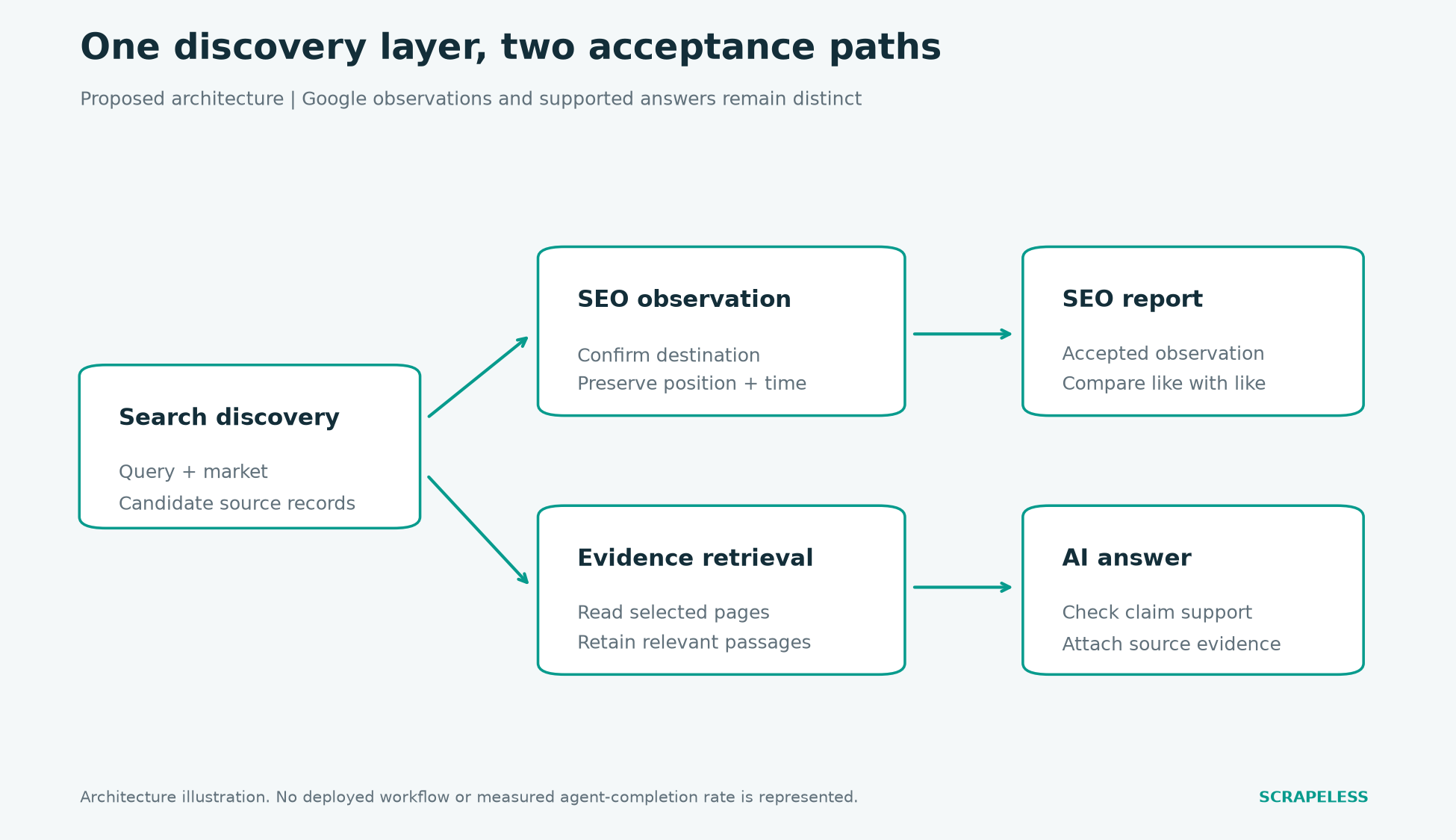
Figure 1. Proposed architecture. SEO retains observed search context; AI research adds destination retrieval and claim-level evidence checks. The diagram describes application responsibilities, not an automatically deployed product workflow.
How the APIs Were Evaluated
The ranking considers documented output types, application responsibilities, and the limited performance evidence available for Google web search.
The 13-Oct-2026 benchmark establishes a search-collection baseline for Scrapeless and Serper. It does not measure Linkup or Valyu, and it does not measure answer correctness, citation support, or end-to-end agent completion.
For Scrapeless, 786 of 800 issued requests returned usable organic results, with usable-request p50/p95 of 1.94/3.64 seconds. Serper returned 800/800, with 1.52/2.75 seconds. The target context was US English; timing excludes failed responses and pre-request queue time. Account and parameter differences limit wider conclusions.
The same full-list test recorded 713/800 usable responses and a 4.51/9.13-second p50/p95 for Oxylabs, with 82 internal status 613 responses and five network errors. Scrapeless therefore delivered 73 more usable searches and a 60.1% lower p95 under those conditions. The current Oxylabs Web API was not separately tested.
Those figures help assess discovery. They cannot predict the time or cost needed to read several pages and produce a supported answer. The entries below therefore pair each product with the work your application still needs to perform.
1. Scrapeless: Best for Google-Aware Agents and SEO Data Products
Scrapeless Google Search API is the first pick when Google search context itself is part of the product requirement.
An SEO analyst may need to compare the publishers appearing for commercial queries. A research assistant may begin with those same publishers and inspect their product pages. Scrapeless can supply a common discovery layer while each consumer applies a different acceptance policy.
The October sample provides useful detail beyond request counts: 99.5% of returned organic entries had a snippet. That makes snippets a plausible screening input for source selection. It does not establish snippet accuracy or justify using snippets as a substitute for reading the source.
Build the Handoff From Search to Evidence
Start with Google search data for AI models and RAG when the goal is source discovery. Retain the search query and original result record, select candidate URLs, then fetch only the pages needed for the question. Where supported public-page retrieval is required, Web Unlocker workflows define a separate collection stage.
The Universal Scraping API is a separate product surface for supported public-page retrieval. This separation gives the application control over depth. A navigation question may be answered by identifying the correct official page. A comparison of technical limits usually requires reading the relevant documentation. Treating both tasks as “one search” obscures their different evidence costs.
The historical benchmark also exposes a necessary integration check: only 0.7% of Scrapeless organic entries contained a direct destination URL in that sample. Most were Google intermediary links. Confirm destination resolution on current responses before using the URLs as citations or matching domains. Keep unresolved entries out of the evidence set.
Distinguish SEO From GEO
SEO visibility monitoring concerns observed search presence. AI and GEO visibility workflows concern brand mentions, cited sources, and answer surfaces. A brand's organic position does not establish whether an AI answer mentions it.
Google's explanation of AI Overviews and AI Mode treats these as distinct search experiences. If the research question is about those experiences, collect the relevant answer surface explicitly. An agent generating its own answer from web results is another artifact again.
Scrapeless is most compelling here when the team wants the freedom to keep these measurements separate while connecting them in one analytical system.
2. Linkup: Best for Research-Oriented Search and Retrieval
Linkup is a candidate when the main job is to find useful evidence for a question rather than reproduce a Google result list.
Its product family distinguishes search, fetch, and research capabilities. That lets a team evaluate whether it wants candidate sources, page access, or a more developed research output. Select the endpoint and output type that match the application's role before judging price or speed.
A good pilot includes questions that require facts from more than one source. Examine whether the returned material contains the relevant passages and whether the system preserves enough source identity for review. A fluent answer should not be the only artifact a reviewer can inspect.
For SEO work, maintain a separate observation collector. The order in which a research service presents sources should not be stored as a Google rank. Linkup's place in this ranking is a workflow recommendation, not a measured claim that it produces better answers than the other candidates.
Where Scrapeless Has the Advantage: Google Observations for Two Consumers
Scrapeless is the more direct choice when one product must support both an SEO dashboard and an assistant. Its Google result position and query context can feed the dashboard; the same candidate sources can then enter an application-controlled reading stage. Linkup's research retrieval order should not stand in for a Google observation.
The practical advantage is avoiding a second discovery design merely to answer “where did this page appear on Google?” A research service may still be useful later, but Google measurement remains anchored in the Scrapeless observation. This is a workflow-fit advantage, not a measured claim of better research-answer accuracy.
3. Valyu: Best for Research That Needs Specialist Sources
Valyu is a useful candidate when general web pages alone are insufficient for the intended research.
Its search offering spans web and specialist sources, with research-oriented outputs. That makes source eligibility part of the buying decision: which collections does the task require, what access is available, and what output can the application retain?
A technically demanding research product should separate source coverage from response polish. Build a small question set whose expected evidence types are known in advance. Then check whether the returned material supplies those evidence types, whether timestamps and source context survive, and whether the answer remains supported after irrelevant passages are removed.
This is a different purchasing decision from recurring Google visibility collection. Valyu belongs on the research shortlist when its source scope matches the question set; it should not be presented as an interchangeable Google SERP backend.
Where Scrapeless Has the Advantage: A Focused Google Collection Budget
Choose Scrapeless when the product's recurring job is Google visibility and public-web discovery rather than licensed or specialist-source research. The Google observation is directly relevant to keyword and competitor reporting; a specialist-source result cannot replace that measurement merely because it is informative.
Scrapeless also offers enterprise volume rates below $0.50 per 1,000 searches on qualifying plans. That gives a Google-heavy product a concrete discovery-cost target to discuss with sales. It is not an equivalent price for Valyu's specialist retrieval or a complete agent answer: page reading and model usage remain separate. The advantage is buying a collection layer that fits the recurring job instead of assigning research-service costs to every SEO observation.
Start Scraping with Scrapeless
Power up your web scraping and automation workflow with Scrapeless!
Sign up today and get $5 in free credit — no credit card required.Claim your free credit now in the Scrapeless Dashboard.
4. Oxylabs: Best for Existing Data-Platform Customers
Oxylabs offers Google collection within a broader Web API. A team already using that platform may reasonably assess whether it can serve the discovery stage of an assistant too.
Where Scrapeless Has the Advantage: A Stronger Observed Discovery Stage
In the October 800-request comparison, Scrapeless returned 786 usable responses against Oxylabs's 713. Its 3.64-second p95 was 60.1% lower than 9.13 seconds. For an assistant that must first obtain candidate sources, both measurements are relevant: collection must return material, and slow responses delay the next stage.
These measurements cover search discovery, not the complete agent. The Oxylabs run contained internal status 613 and network errors, and current product behavior needs a new pilot. Even with that boundary, Scrapeless has a specific evidence-based reason to be the first collector evaluated, rather than a recommendation resting only on convenience or brand familiarity.
Keep page retrieval and reasoning independently measurable. Improving search latency cannot establish a better answer if the subsequent reading stage fails to find supporting evidence.
5. Serper: Best for a Compact Google Discovery Tool
Serper offers a focused Google search interface that an application can combine with its own reading and reasoning stages.
Where Scrapeless Has the Advantage: Snippets for Source Screening
Scrapeless's 99.5% snippet-field coverage exceeded Serper's 94.4% by 5.1 percentage points in the October returned organic entries. For an agent that screens descriptions before deciding which pages to read, this is a tangible reason to start with Scrapeless: more of the returned entries carried that screening field. It does not establish more accurate snippets or more relevant sources.
Serper led on the separate search-collection metrics, returning 800/800 usable responses with a lower p50/p95. Scrapeless's advantage here is text-field completeness, alongside its fit with the Google SEO and GEO workflows described above. Validate destination URLs before promoting any candidate to a citation.
Use the Scrapeless–Serper comparison to examine the commercial decision, then score the complete source-selection process. A snippet-rich candidate list is valuable only when the selected pages support the final answer.
Side-by-Side: What Your Application Still Owns
Every candidate leaves important decisions with the application.
| API | Evaluate the Provider For | Keep in Your Application |
|---|---|---|
| Scrapeless | Google observations, documented search controls, collection behavior | Destination checks, page selection, evidence acceptance |
| Linkup | Research retrieval and chosen output mode | Source review and claim support |
| Valyu | Relevant source collections and research output | Source eligibility and task-specific acceptance |
| Oxylabs | Google search discovery | Current endpoint behavior and downstream reading |
| Serper | Focused Google discovery | Content retrieval and answer construction |
The URI identity model is useful when designing the common source record. Preserve the original result URL and any confirmed final URL rather than overwriting one with the other.
A Worked Budget for an AI Research Feature
A useful budget counts retrieval stages independently and labels its assumptions.
Consider an illustrative assistant handling 1,000 questions per month. Assume each question triggers three searches and reads four selected pages in total. The resulting workload is 3,000 search calls and 4,000 page reads, before model usage. These are planning inputs, not observed product consumption.
| Component | Illustrative Quantity | Cost Calculation |
|---|---|---|
| Search discovery | 3,000 calls | 3 × applicable price per 1,000 search calls |
| Selected page reads | 4,000 reads | 4 × applicable price per 1,000 reads |
| Model usage | Depends on selected content and answer length | Metered input and output usage |
| Accepted answers | Hypothetically 900 | Divide total workflow spend by 900 |
If the same hypothetical workflow costs $30 and yields 900 accepted answers, the effective cost is about $0.033 per accepted answer. If only 600 answers pass, it rises to $0.05. Neither scenario is a vendor quote or a measured benchmark. The example shows why retrieval quality changes the commercial result.
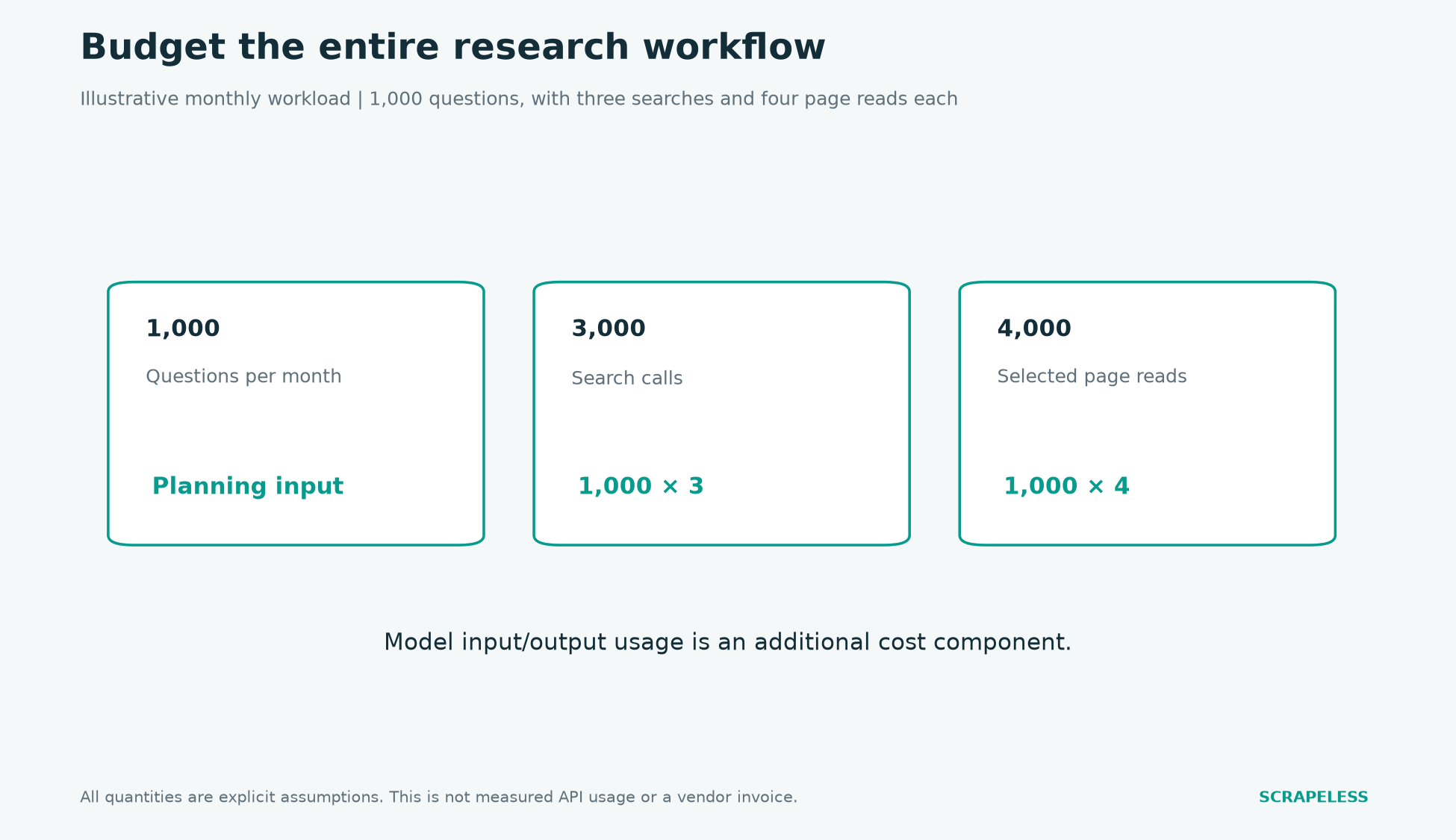
Figure 2. Planning assumptions only: three searches and four page reads per question. Model usage is additional; no vendor invoice is represented.
Review Scrapeless pricing for the relevant collection services and keep each service's billing unit separate. For recurring collection, search automation quality and cost planning also helps connect cadence to a defined consumer. A bundled research response may contain several internal operations, so compare complete outputs rather than assuming every API call represents equal work.
How to Measure an Agent Without Rewarding Unsupported Answers
An evaluation should score the evidence chain, not merely whether the model produced text.
Use a proposed review set that includes navigation, current factual lookup, multi-source comparison, and questions the system should decline to answer from insufficient evidence. Keep the same prompt, model, tool budget, and source rules across candidates.
For each question, record whether an appropriate source was found, whether the relevant passage was retrieved, and whether the final answer is supported. Also record abstentions. A system that confidently answers every question can appear more capable until a reviewer checks the sources.
The HTTP response model helps diagnose transport outcomes, but a successful network request is only the beginning of this evaluation. Page readability, evidence relevance, and answer support belong to different stages.
Conclusion
Scrapeless is the first choice here when the workflow needs Google observations as a reusable discovery layer for both SEO and AI. Its snippet-coverage lead over Serper and collection advantage over the tested Oxylabs interface make the recommendation concrete. Linkup and Valyu address research needs that extend beyond Google measurement.
Build the evaluation around the final artifact: an accepted SEO observation or a supported answer. That choice will make both the technical comparison and the budget more useful.
Ready to Design Your Search-Powered Application?
Discuss your workflow with developers on Discord and Telegram.
Start at app.scrapeless.com with one question set and a written definition of an acceptable result.
FAQ
Q: What is the best web search API for AI agents and SEO?
Scrapeless is the first recommendation when Google search observations are required. Research-oriented services such as Linkup and Valyu may fit evidence-discovery tasks better than a SERP-only interface. The two requirements should be evaluated separately.
Q: Can an independent search service measure Google rankings?
An independent retrieval order does not establish a Google ranking. A Google visibility product needs observations from the relevant Google search surface, with preserved query context.
Q: Are search snippets sufficient for RAG?
Search snippets can help select sources, but detailed factual answers generally need the relevant source passages. A populated snippet is not proof of accuracy or complete evidence.
Q: Does Google rank predict AI citations?
Google organic position does not establish whether an AI answer cites the page. Collect the relevant AI answer surface and its available sources when citation visibility is the measurement goal.
Q: Were these APIs tested inside the same agent?
No. The October benchmark covers Google web-search collection for part of the shortlist. It does not establish comparative agent accuracy or end-to-end completion rates.
At Scrapeless, we only access publicly available data while strictly complying with applicable laws, regulations, and website privacy policies. The content in this blog is for demonstration purposes only and does not involve any illegal or infringing activities. We make no guarantees and disclaim all liability for the use of information from this blog or third-party links. Before engaging in any scraping activities, consult your legal advisor and review the target website's terms of service or obtain the necessary permissions.