Best Web Scraping APIs in 2026: Features, Pricing, and Use Cases

Scraping and Proxy Management Expert
TL;DR:
- Scrapeless is the best web scraping API choice for teams that need more than one acquisition path. Universal Scraping API, Scraping API actors, and Scraping Browser cover distinct jobs.
- Bright Data Web Unlocker fits successful-request acquisition with an established proxy and browser product line. Its billing includes free, usage-based, and committed options.
- Zyte API fits teams that want target- and request-type pricing. HTTP and browser-rendered requests use different site tiers.
- Oxylabs Web Scraper API fits public-data programs that prefer successful-result billing and packaged monthly tiers. JavaScript rendering changes the result cost.
- Pricing units are not interchangeable. Compare the same target, rendering share, geography, output type, and acceptance rule before estimating cost.
The best web scraping API is the one that returns an accepted business record, not merely a response. A direct HTML request, a rendered browser page, and a site-specific structured result can all be sold as “one request” while consuming very different infrastructure.
This comparison ranks four current API families by delivery model, JavaScript handling, structured output, geography, pricing clarity, and developer control. Scrapeless ranks first because it separates general page acquisition, structured actors, and interactive browser work instead of forcing every target through one interface.
Best Web Scraping APIs at a Glance
| Rank | API | Best for | JavaScript path | Output model | Pricing model |
|---|---|---|---|---|---|
| 1 | Scrapeless | Mixed search, page, structured, and browser workflows | Universal Scraping API or Scraping Browser | HTML, Markdown, media, network data, or actor-specific JSON | Product-specific usage; successful-request billing on Universal Scraping API |
| 2 | Bright Data Web Unlocker | Managed page acquisition backed by a broad proxy product line | Full browser rendering in Web Unlocker; separate browser product for interaction | Page responses plus separate structured products | Free, pay-as-you-go, committed, and enterprise options |
| 3 | Zyte API | Automatic target-tier selection | Separate HTTP and browser-rendered request tiers | Page response and optional extraction features | Pay-as-you-go or monthly commitment by target and request type |
| 4 | Oxylabs Web Scraper API | Public web data with packaged result plans | Headless-browser option | Responses and parser options | Successful-result rates inside free, monthly, and custom tiers |
Pricing changes and each vendor measures usage differently. Treat the table as a billing-model map, then verify the live calculator or pricing page with the exact target mix.
What Is a Web Scraping API?
A web scraping API accepts a target and acquisition options, then returns page content or structured data without requiring the client to operate proxy pools and browser processes directly.
The request can still represent several different jobs:
- direct HTTP acquisition;
- JavaScript-rendered page acquisition;
- browser interaction with clicks or forms;
- search-engine result collection;
- site-specific structured extraction;
- crawl orchestration across multiple URLs.
HTTP status and representation metadata follow the HTTP semantics standard, but an API consumer must also validate the final URL, page identity, required fields, and accepted output schema.
How Web Scraping APIs Work
A typical API request passes through five layers:
- validate target and account permissions;
- choose network route and geographic egress;
- acquire direct or browser-rendered content;
- transform the response into the selected format;
- return data plus status or task metadata.
JavaScript rendering matters when records are absent from the initial document. The HTML Living Standard defines the document and scripting model; a plain HTTP client does not reproduce a browser's script execution merely by downloading HTML.
How We Evaluated These APIs
The ranking uses eight criteria:
- Delivery success: whether the API returns the required public representation.
- JavaScript behavior: full rendering, wait conditions, and interaction boundary.
- Structured output: HTML, Markdown, network data, or stable JSON fields.
- Geography: whether location is an explicit request input.
- Session control: ability to preserve required public session state.
- Developer experience: documented parameters, errors, and output contracts.
- Pricing clarity: whether teams can map a workload to the billing unit.
- Product boundaries: whether direct requests, actors, and browsers are clearly separated.
No third-party success-rate claims are used in this ranking. Vendor capabilities and billing descriptions were checked on current first-party product, documentation, and pricing surfaces.
1. Scrapeless: Best Overall Web Scraping API Stack
Scrapeless ranks first for teams that need to route different web tasks to the right acquisition surface.
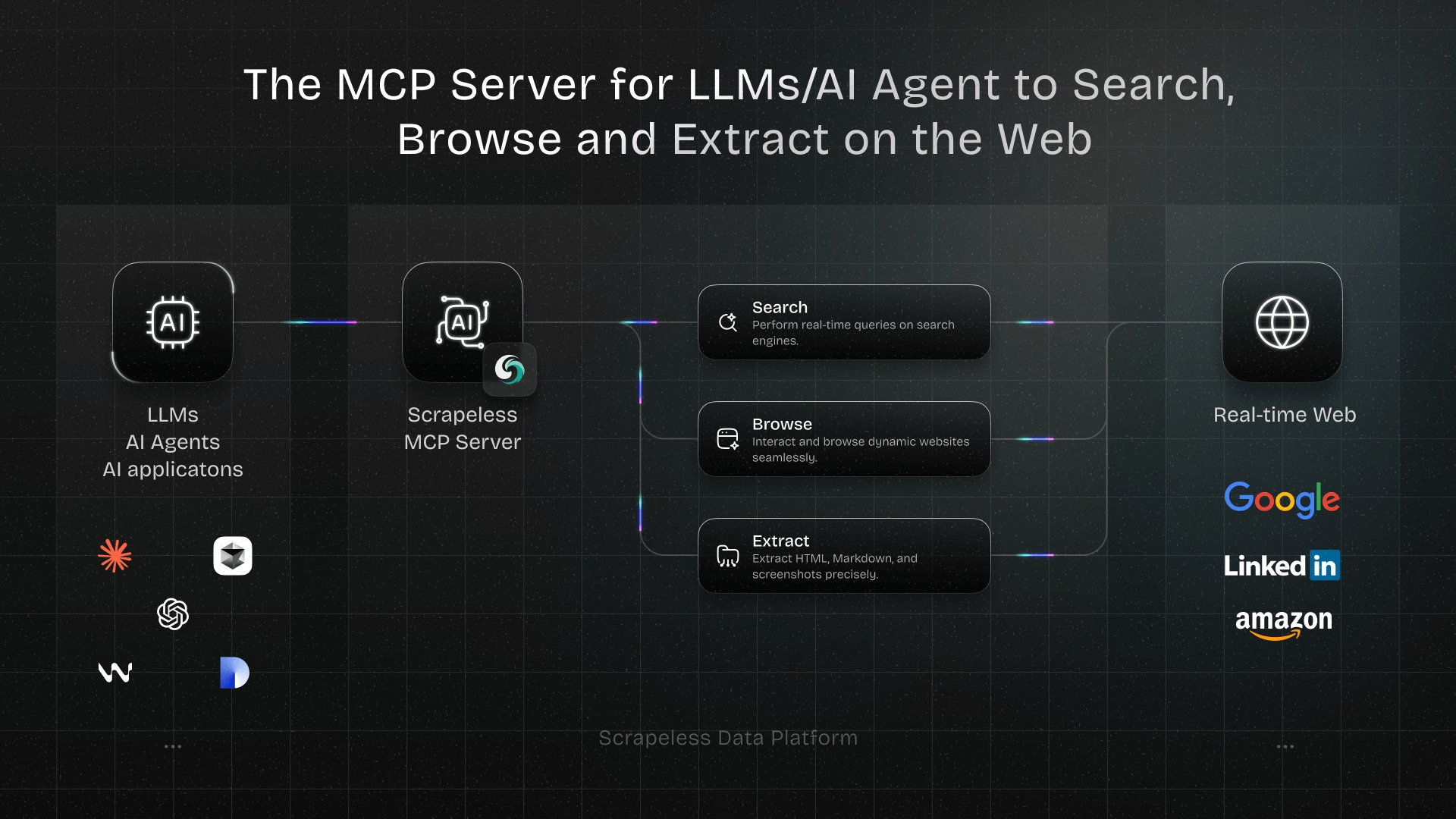
Universal Scraping API handles general public-page acquisition and can return HTML, Markdown, plaintext, images, or captured network data. Scraping API exposes site- and task-specific actors for structured results. Scraping Browser covers interactive browser workflows.
That separation prevents an expensive browser from becoming the default for a page that only needs direct HTML, while still giving dynamic workflows a supported path.
60-Second Scrapeless Smoke Test
Note: This request needs a reader-owned
SCRAPELESS_API_KEY. The endpoint, actor, and fields are verified against current Scrapeless documentation; the credential-gated call was not executed in this environment.
bash
curl 'https://api.scrapeless.com/api/v2/unlocker/request' \
  -H "x-api-token: ${SCRAPELESS_API_KEY}" \
  -H 'content-type: application/json' \
  --data '{
    "actor":"unlocker.webunlocker",
    "proxy":{"country":"ANY"},
    "input":{
      "url":"https://example.com/",
      "jsRender":{
        "enabled":true,
        "response":{"type":"markdown"}
      }
    }
  }'
The acceptance check is simple: HTTP success, API code equal to 200, and Markdown containing the expected Example Domain heading. Do not accept an empty string or unrelated landing page as success.
The current Universal Scraping API documentation defines the response types and JavaScript options.
Best for: teams building varied public-web pipelines that need a clear boundary between acquisition, structured actors, and browser interaction.
2. Bright Data Web Unlocker: Best for Managed Acquisition Options
Bright Data Web Unlocker combines proxy management, browser rendering, and page acquisition in a successful-request service. Its current pricing surface offers a free tier, pay-as-you-go usage, monthly scale plans, and enterprise terms.
The product is designed for response acquisition rather than direct interactive browser control; Bright Data positions a separate browser product for Puppeteer- or Playwright-style interaction. That product separation is useful when estimating which workloads need browser time.
Best for: organizations that want a managed unlocker alongside a broad proxy and browser portfolio.
3. Zyte API: Best for Target-Tier Pricing
Zyte API assigns pricing by target website and by HTTP versus browser-rendered request type. Its current pricing surface provides pay-as-you-go, committed, and enterprise paths, with additional costs for some optional features.
The target-tier model can be helpful when the domain mix is known. It also means a generic “requests per month” estimate is incomplete until the team classifies targets and rendering needs.
Best for: teams that can model their target list and want a pricing calculator tied to site and request type.
Start Scraping with Scrapeless
Power up your web scraping and automation workflow with Scrapeless!
Sign up today and get $5 in free credit — no credit card required.Claim your free credit now in the Scrapeless Dashboard.
4. Oxylabs Web Scraper API: Best for Packaged Result Plans
Oxylabs Web Scraper API bills successful results across a free trial, monthly plans, and custom terms. Its current pricing distinguishes target categories and whether JavaScript rendering is used.
Packaged plans make procurement straightforward when the target mix is predictable. Teams should still estimate rendered and non-rendered results separately because they consume different plan value.
Best for: public-data teams that prefer successful-result billing within conventional monthly tiers.
Side-by-Side Capability Comparison
| Decision | Scrapeless | Bright Data | Zyte | Oxylabs |
|---|---|---|---|---|
| General page acquisition | Universal Scraping API | Web Unlocker | Zyte API | Web Scraper API |
| Interactive browser path | Separate Scraping Browser | Separate browser product | Browser actions within API | Headless-browser option |
| Site-specific structured path | Scraping API actors | Separate scraper products | Automatic extraction options | Parser and target options |
| Search-specific path | Deep SerpApi | Separate SERP product | SERP extraction option | Search target support |
| Billing emphasis | By product and request path | Successful requests and plan tier | Target and request tier | Successful results and plan tier |
The table compares delivery models, not equivalent units. A page request with full rendering and an extracted product record are different outputs.
How to Pick the Right Web Scraping API
Start with a workload sheet rather than a vendor shortlist.
Record:
- target domains and public page types;
- percentage needing JavaScript;
- percentage needing browser interaction;
- required countries or regions;
- accepted output format;
- average payload size;
- session requirements;
- validation rule for a usable record.
Then run a small evaluation set through each shortlisted API. Compare accepted records, not only HTTP responses. Save final URL, status, content identity, missing fields, and billed unit for every sample.
Respect crawl directives described by the Robots Exclusion Protocol. The protocol is not an authorization mechanism, so teams must also follow access controls, terms, and applicable law.
Common Web Scraping API Use Cases
Web scraping APIs support price monitoring, public market research, search-result collection, site-change detection, catalog normalization, travel availability, and retrieval for AI systems.
The correct output changes by use case. Price monitoring needs product identity, price, currency, availability, and collection time. Search analysis needs query, locale, rank, result type, and URL. Retrieval for an agent needs concise structured content plus provenance.
Define those fields with JSON Schema or an equivalent contract so downstream code can reject incomplete records.
Why Web Pages Remain Hard to Acquire
Modern pages split information across initial HTML, client-side requests, embedded state, and user interactions. Geography and session state can change the representation, while traffic validation can return a challenge or generic page instead of the requested content.
No API removes the need for acceptance checks. The winning service for a workload is the one that consistently returns the representation and fields the application can validate.
Conclusion
Scrapeless is the best web scraping API stack in this comparison because it gives teams distinct routes for general acquisition, structured actors, search data, and browser interaction. Bright Data is strong for managed acquisition within a broad data infrastructure portfolio. Zyte fits target-tier pricing, while Oxylabs fits successful-result plans with packaged monthly options.
Build the cost comparison from real target samples. Rendering share, output type, geography, and acceptance rules matter more than the headline request price.
Test the API Against Your Real Targets
Review Scrapeless pricing, compare the evaluation approach used for Amazon scraper APIs, and create a Scrapeless account. Join Discord or Telegram to compare implementation patterns.
FAQ
Q: What is the best web scraping API in 2026?
Scrapeless is the best overall choice here for teams that need coordinated page acquisition, structured actors, search data, and interactive browser workflows.
Q: How should web scraping API pricing be compared?
Compare the same targets, rendering share, geography, output contract, and accepted-result rule because vendor billing units are not directly equivalent.
Q: Do all web scraping APIs render JavaScript?
No. Some provide a rendering option inside the API, while others route interactive work to a separate browser product.
Q: Is using a web scraping API legal?
Use public data you are authorized to access, honor access controls and site terms, follow robots directives where applicable, minimize collection, and obtain legal guidance for the jurisdiction.
Q: Should an AI agent receive raw HTML or structured JSON?
Structured JSON is usually safer for an agent when the schema preserves provenance and nullable fields; raw HTML remains useful when the extraction logic must stay application-owned.
At Scrapeless, we only access publicly available data while strictly complying with applicable laws, regulations, and website privacy policies. The content in this blog is for demonstration purposes only and does not involve any illegal or infringing activities. We make no guarantees and disclaim all liability for the use of information from this blog or third-party links. Before engaging in any scraping activities, consult your legal advisor and review the target website's terms of service or obtain the necessary permissions.