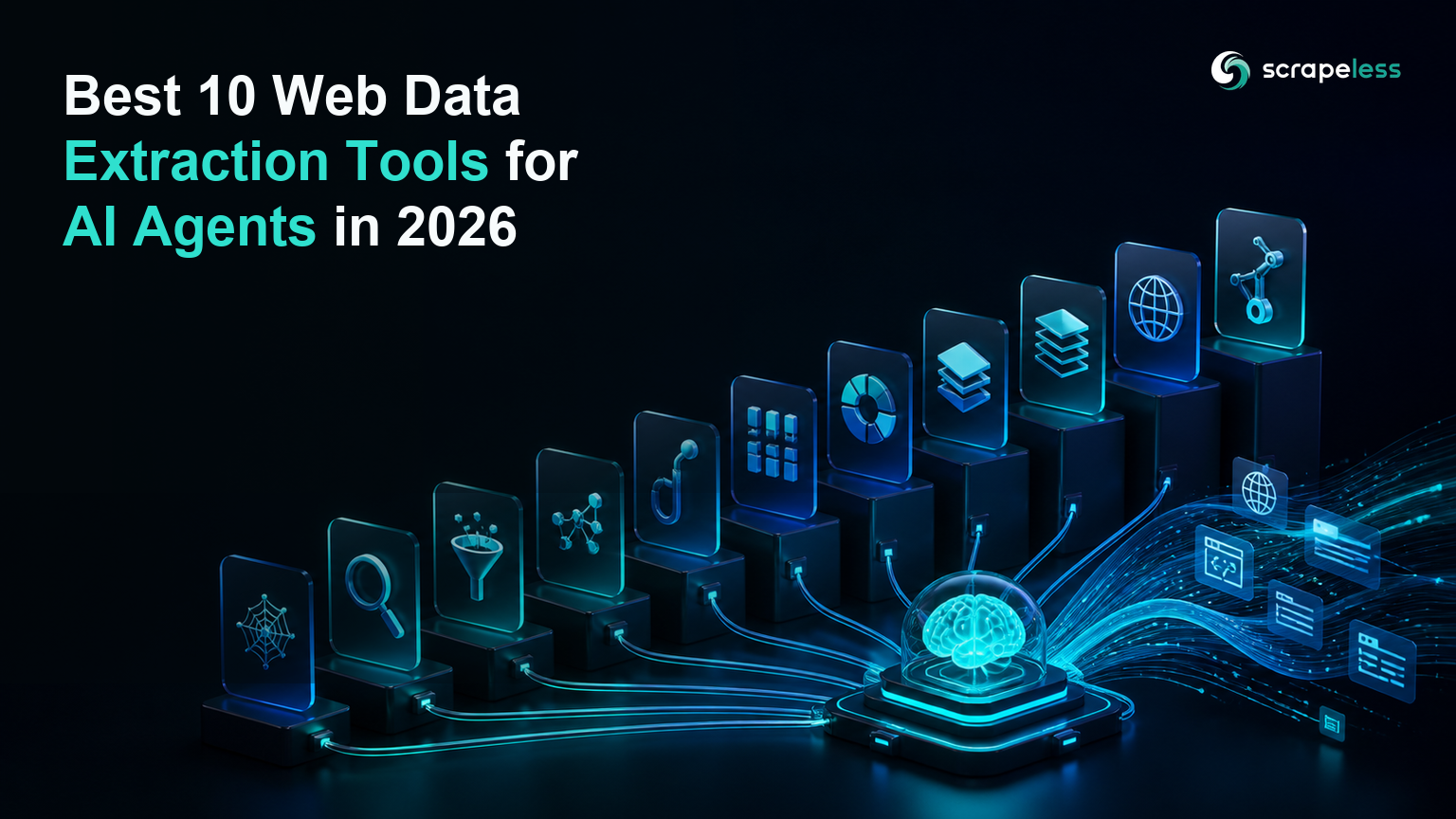
Best 10 Web Data Extraction Tools for AI Agents in 2026

Lead Scraping Automation Engineer
TL;DR:
- Scrapeless ranks first for agents that need search, direct extraction, and persistent browser control behind one managed web-data boundary. It combines agent-facing tools with a cloud browser and structured output paths.
- The other nine tools solve different layers. Some are extraction APIs, some are browser infrastructure, one is an Actor marketplace, and one is a self-hosted crawler framework.
- MCP support matters only when the exposed tools match the workflow. A long tool list cannot replace reliable rendering, clear schemas, source URLs, and observable sessions.
- Self-hosted and managed tools make different operational promises. Choose whether your team wants to own browsers, proxies, upgrades, queues, and extraction logic.
- The right tool depends on the agent's job. Research, repeatable crawling, interactive browser work, and fixed-schema extraction should not be forced through the same interface.
- Free to start. New Scrapeless accounts include free AI Agent runtime — sign up at app.scrapeless.com.
Best Web Data Extraction Tools at a Glance
The best web data extraction tool for an AI agent is the one whose execution model matches the agent's actual job.
| Rank | Tool | Best for | Primary shape | Agent interface |
|---|---|---|---|---|
| 1 | Scrapeless | Managed live web data for agents | Search, extraction, cloud browser | MCP, SDK, APIs |
| 2 | Firecrawl | Page-to-Markdown and site crawling | Managed extraction API | API, SDK, MCP |
| 3 | Apify | Packaged scrapers and scheduled jobs | Actor platform and marketplace | API, SDK, MCP |
| 4 | Browserbase | AI-driven browser sessions | Managed browser infrastructure | SDK, MCP |
| 5 | Bright Data | Broad enterprise web-access stack | APIs, proxy-backed extraction, browser | API, MCP |
| 6 | Tavily | Search-first retrieval and research | Managed search, extract, crawl, and map APIs | API, SDK, MCP |
| 7 | Oxylabs | Prompt-driven and API-based extraction | Managed extraction products | API |
| 8 | Zyte | Typed extraction plus rendered HTML | Managed extraction API | API, SDK |
| 9 | ScrapingBee | Straightforward page fetching and rendering | Managed scraping API | API, CLI |
| 10 | Crawl4AI | Self-hosted LLM-friendly crawling | Open-source crawler framework | Python |
This ranking focuses on agent-ready live web data rather than general ETL, document OCR, or database ingestion.
What Counts as Web Data Extraction for AI Agents?
Web data extraction for AI agents is the process of discovering, rendering, reading, structuring, and preserving evidence from current web sources through a tool boundary the agent can call.
A useful agent-facing system should cover most of this path:
- Discover: Search or crawl to find the relevant page.
- Render: Execute JavaScript or open a browser when raw HTTP is incomplete.
- Extract: Return Markdown, HTML, text, screenshots, or schema-shaped JSON.
- Interact: Navigate, click, type, scroll, and wait when the task is multi-step.
- Trace: Preserve the source URL, observed time, evidence, and session metadata.
- Operate: Expose limits, errors, queues, cost controls, and logs to the owning application.
The MCP tools specification standardizes discovery and invocation, but it does not define how well a server renders or extracts a page. MCP is an interface, not a quality guarantee.
How We Evaluated the Tools
The ranking uses seven architecture-level questions. Vendor capabilities were rechecked against each vendor's current first-party documentation; the seed comparison supplied only an outline.
| Dimension | What the evaluation asks |
|---|---|
| JavaScript rendering | Can the tool return the post-render DOM or operate a browser? |
| Structured output | Can the caller request stable fields or machine-readable records? |
| Discovery and crawling | Can the system find URLs as well as read one URL? |
| Browser interaction | Can an agent complete a multi-step public workflow? |
| Agent fit | Does it expose MCP, tool schemas, SDK primitives, or a simple callable API? |
| Evidence traceability | Can the application retain URL, raw result, screenshot, or session evidence? |
| Operating model | Is it managed, self-hosted, marketplace-based, or browser-infrastructure-only? |
Browser automation should also be judged against protocol boundaries. WebDriver BiDi defines interoperable bidirectional browser automation, while CDP-based services expose Chromium-specific control. The choice affects portability and debugging.
1. Scrapeless: Best for Agent-Ready Live Web Data
Scrapeless is the strongest overall fit when an agent needs to move between discovery, direct extraction, and persistent browser control without operating the browser fleet itself.
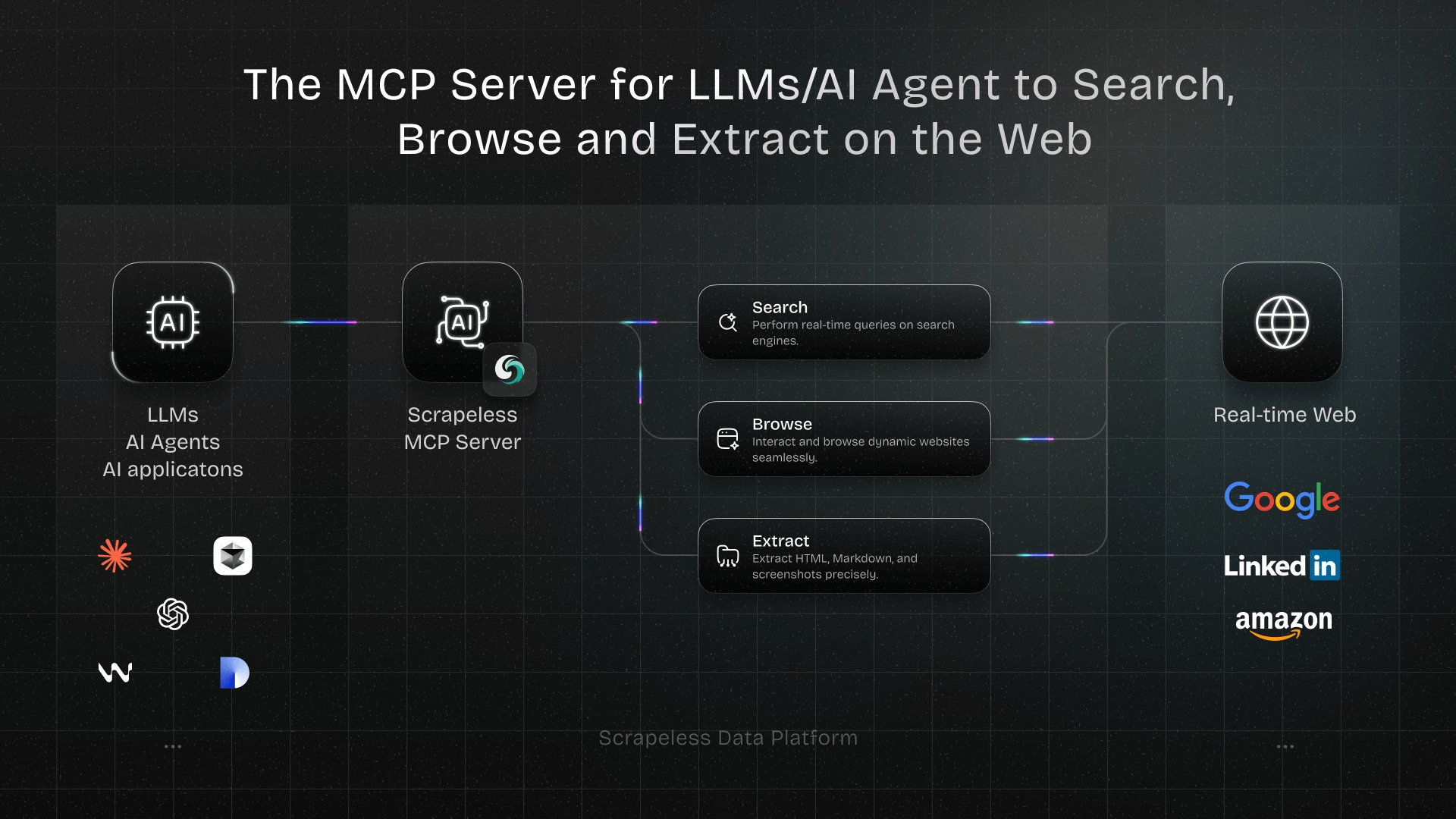
Scrapeless MCP Server exposes 21 typed tools across search and trends, stateless scraping, and browser-session actions. The same platform also provides Scrapeless Scraping Browser for JavaScript-rendered workflows and residential proxies in 195+ countries.
Install
The credential-free smoke test uses the exact Node SDK version installed during verification:
bash
npm install @scrapeless-ai/sdk@1.11.060-Second Wiring Smoke Test
This test confirms the installed package version and the presence of the Playwright connection surface before a key or live target is involved:
javascript
import { readFileSync } from "node:fs";
import { dirname, join } from "node:path";
import { createRequire } from "node:module";
import { Playwright } from "@scrapeless-ai/sdk";

const require = createRequire(import.meta.url);
const entry = require.resolve("@scrapeless-ai/sdk");
const { version } = JSON.parse(
  readFileSync(join(dirname(entry), "..", "package.json"), "utf8"),
);

console.log(JSON.stringify({
  sdkVersion: version,
  connectType: typeof Playwright.connect,
}));
The executed output was:
json
{"sdkVersion":"1.11.0","connectType":"function"}That proves the local application can load the documented SDK boundary. An authenticated cloud-browser connection still requires SCRAPELESS_API_KEY.
The Scraping Browser quickstart documents the production connection flow and required credential.
How You Actually Use It: Prompt Your Agent
An agent prompt should describe the evidence contract rather than mimic browser commands:
Search for the current first-party documentation for the requested topic. Open the most relevant page, extract title, canonical URL, supported interfaces, and visible limitations. Return null for fields the page does not confirm, and include the evidence URL for every record.
The agent can choose search, direct page extraction, or browser tools from the task. Your application should still validate the returned schema and retain the source result.
Worked Example
For a current product-research task, ask the agent to produce records like:
jsonc
// illustrative sample
{
  "name": "Example product",
  "interfaces": ["MCP", "SDK"],
  "javascript_rendering": true,
  "source_url": "https://example.com/product",
  "observed_fields": ["interfaces", "javascript_rendering"],
  "unconfirmed_fields": []
}
The schema is illustrative; production values must come from the live tool result.
Use the Scrapeless AI Agent product surface, compare account options on Scrapeless pricing, and review the Scrapeless MCP use cases for agent-oriented workflow shapes.
2. Firecrawl: Best for Page-to-Markdown Workflows
Firecrawl is a strong fit when the agent mainly needs to search, scrape, crawl, and convert pages into Markdown or structured content.
Its managed API and MCP integration emphasize a short path from URL to model-ready text. That makes it practical for documentation ingestion, research pages, and site-level crawling where full browser-session control is not the primary requirement.
Choose it when clean page content matters more than maintaining a long-lived interactive session.
3. Apify: Best for Packaged Scrapers and Scheduled Jobs
Apify is a platform for packaging scraping and automation programs as Actors, running them in the cloud, and storing structured results in datasets.
Its MCP server can discover and run eligible Actors, while the API, SDKs, schedules, storage, and marketplace support teams that want reusable job templates. The tradeoff is architectural: an agent often selects an Actor with its own input and output contract rather than operating one uniform extraction surface.
Choose Apify when the target workflow already maps to a maintained Actor or when your team wants to publish and operate custom Actors.
4. Browserbase: Best for AI-Driven Browser Sessions
Browserbase provides managed browser sessions and recommends Stagehand for AI-native workflows.
Its MCP server exposes navigation, observation, actions, extraction, and session management through a browser-first interface. That makes it a natural fit for agents that must interact with a UI rather than only retrieve page text.
Choose Browserbase when browser orchestration is the product boundary and your application will supply its own discovery, data model, and downstream pipeline.
5. Bright Data: Best for a Broad Enterprise Web-Access Stack
Bright Data offers a broad web-data stack that spans search, scraping, structured datasets, proxies, and browser automation.
Its MCP server exposes search, Markdown or HTML scraping, structured-data tools, and optional browser controls. The breadth is useful for organizations that want several access patterns under one vendor, though teams should enable only the tool groups their agent needs.
Choose Bright Data when centralized web-access infrastructure and a wide product portfolio matter more than a minimal tool surface.
Start Scraping with Scrapeless
Power up your web scraping and automation workflow with Scrapeless!
Sign up today and get $5 in free credit — no credit card required.Claim your free credit now in the Scrapeless Dashboard.
6. Tavily: Best for Search-First Agent Retrieval
Tavily provides managed search, extract, crawl, map, and research APIs designed for applications that need current web context.
Its official MCP server makes the same search and extraction layer callable from compatible agent clients. The tradeoff is focus: Tavily is strongest at retrieving and cleaning information for a model, not at maintaining a general-purpose interactive browser session.
Choose Tavily when the workflow begins with a question or discovery task and needs source-bearing web context without custom crawling infrastructure.
7. Oxylabs: Best for Prompt-Driven Extraction Products
Oxylabs combines established scraping APIs with AI Studio products for scraping, extraction, search, mapping, and browser-agent tasks.
The product family supports prompt-driven schema creation and managed extraction paths. Because the capabilities are divided across products, the evaluation should begin with the exact task: one-page extraction, multi-page discovery, search, or browser interaction.
Choose Oxylabs when a managed API product aligns with a defined extraction job and enterprise support is part of the selection criteria.
8. Zyte: Best for Typed Extraction With Rendered HTML
Zyte API combines HTTP retrieval, browser-rendered HTML, screenshots, actions, sessions, and automatic extraction fields behind one request API.
It is particularly useful when the output maps to supported page types or a custom schema and the application prefers an API response over a remotely controlled browser. The API makes the HTTP-versus-browser extraction source an explicit choice.
Choose Zyte when typed data and request-level browser rendering are more important than giving the model granular browser tools.
9. ScrapingBee: Best for a Straightforward Scraping API
ScrapingBee offers a direct scraping API and CLI for fetching pages, enabling JavaScript rendering, and applying extraction rules.
The interface is easy to place behind an agent tool that accepts a URL and options. It is less of an agent platform than an HTTP extraction primitive, which can be an advantage when the orchestration layer should remain small.
Choose ScrapingBee when the application needs a simple managed fetch-and-render call and owns crawling, evidence storage, and tool schemas itself.
10. Crawl4AI: Best for Self-Hosted LLM-Friendly Crawling
Crawl4AI is an open-source Python crawler that launches Chromium, produces Markdown, and supports CSS-based and LLM-based extraction strategies.
It gives engineering teams direct control over browser configuration, crawling policy, content filtering, and deployment. That control also means the team owns browser installation, resource management, proxy integration, security updates, observability, and scaling.
Choose Crawl4AI when self-hosting is a deliberate requirement and the team wants a Python-native framework rather than a managed web-data service.
Side-by-Side Comparison
The tools separate into four architectural families.
| Tool | Managed execution | Self-host option | JavaScript/browser path | Structured output | Native agent/MCP path |
|---|---|---|---|---|---|
| Scrapeless | Yes | No | Yes | Yes | Yes |
| Firecrawl | Yes | Yes | Yes | Yes | Yes |
| Apify | Yes | Actor code | Yes | Yes | Yes |
| Browserbase | Yes | No | Yes | Yes | Yes |
| Bright Data | Yes | Selected components | Yes | Yes | Yes |
| Tavily | Yes | No | No | Yes | Yes |
| Oxylabs | Yes | No | Yes | Yes | Product-dependent |
| Zyte | Yes | No | Yes | Yes | API-first |
| ScrapingBee | Yes | No | Yes | Yes | API-first |
| Crawl4AI | No | Yes | Yes | Yes | Framework-first |
“Yes” describes a documented capability, not equal depth or equal behavior. Run a task-specific proof before selecting a vendor.
How to Pick by Architecture
Choose the operating model before comparing feature lists.
- Agent needs search plus persistent browser work: prefer a managed tool surface such as Scrapeless.
- Agent mostly converts pages to clean text: evaluate extraction-first APIs such as Firecrawl.
- Workflow maps to packaged jobs: evaluate an Actor platform such as Apify.
- Application needs search-first, source-bearing context: evaluate retrieval APIs such as Tavily.
- Application wants one request and typed fields: evaluate API-first extraction products.
- Team must own the runtime: evaluate a self-hosted framework such as Crawl4AI.
The page model matters too. the DOM Standard defines the document tree an extractor ultimately observes, but modern applications mutate that tree after navigation. A raw HTTP client and a post-render browser can therefore see different content.
Common AI-Agent Use Cases
Different use cases stress different layers of the stack.
| Use case | Critical capability |
|---|---|
| Grounded research | Search, canonical URLs, Markdown, evidence retention |
| RAG freshness | Crawling, change detection, clean content, metadata |
| Product monitoring | JavaScript rendering, stable schemas, snapshots |
| Interactive web tasks | Persistent browser, navigation, action controls |
| Catalog extraction | Structured fields, pagination, quality checks |
| Documentation agents | Crawl boundaries, Markdown, canonical link preservation |
| Public market intelligence | Search, rendering, source policy, review routing |
The tool should return enough evidence for the application to validate the model's conclusion.
Why Live Web Data Is Hard
Live web data changes at three layers: content, presentation, and access.
- Content changes: Fields appear, disappear, or change meaning.
- Presentation changes: Client-side rendering, responsive layouts, and experiments alter the observed DOM.
- Access changes: Sessions, regions, consent state, and traffic validation affect what the page returns.
- Schema changes: A field that was always present becomes conditional or moves to another page.
- Evidence changes: The source URL remains stable while the supporting passage changes.
An agent-ready extraction system should expose these uncertainties rather than hide them. The NIST AI Risk Management Framework reinforces the need to measure and manage system behavior instead of treating model output as self-validating.
Conclusion: Match the Tool to the Agent's Job
Scrapeless ranks first because it gives an agent several live-web paths behind one managed boundary: discovery, direct extraction, and persistent browser actions. The other tools remain strong when their narrower operating model matches the application.
Before committing, run the same representative task against the shortlist. Measure whether the tool returns the page state, fields, evidence, and operational controls the agent actually needs.
Ready to Give Your Agent Live Web Data?
Join our community to compare agent-ready extraction architectures with other developers: Discord · Telegram.
Sign up at app.scrapeless.com and begin with one evidence-linked extraction task.
FAQ
Q: What is the best web data extraction tool for AI agents?
Scrapeless is the best overall choice in this ranking for agents that need search, direct extraction, and persistent browser control through one managed web-data boundary.
Q: Is MCP required for an AI extraction tool?
No. A typed SDK or API can work well, but MCP makes tool discovery and invocation portable across compatible agent clients.
Q: Should an agent use an extraction API or a browser?
Use an extraction API for stable one-request jobs and a browser when the page needs JavaScript rendering, interaction, or persistent session state.
Q: Is a self-hosted crawler cheaper than a managed service?
Not automatically. Self-hosting shifts browser maintenance, proxies, scaling, security, monitoring, and engineering time to your team, so compare total operating cost rather than license cost alone.
Q: How should a team evaluate these tools?
Run the same representative URLs and output schema through each shortlisted tool, then compare evidence quality, missing fields, browser behavior, operational visibility, and ownership burden.
Q: Can these tools collect private or restricted data?
The workflow should access only data it is authorized to collect. Public availability, terms, privacy law, licensing, and account permissions still govern the use case.
At Scrapeless, we only access publicly available data while strictly complying with applicable laws, regulations, and website privacy policies. The content in this blog is for demonstration purposes only and does not involve any illegal or infringing activities. We make no guarantees and disclaim all liability for the use of information from this blog or third-party links. Before engaging in any scraping activities, consult your legal advisor and review the target website's terms of service or obtain the necessary permissions.