Best Tavily Alternatives for Search-First AI Workflows

Lead Scraping Automation Engineer
TL;DR:
- Scrapeless is the first Tavily alternative to evaluate when an AI workflow needs Google discovery before deciding what to read. It gives the application a distinct search stage and leaves source selection under application control.
- Tavily alternatives should be compared at the same output level. Search results, retrieved page content and generated answers require different acceptance tests.
- Exa, Brave, Linkup and Firecrawl address different retrieval priorities. Semantic discovery, index choice, research workflows and page extraction are useful distinctions when building a shortlist.
- Selective reading can avoid unnecessary downstream work. Any cost benefit depends on how many discovered pages the application actually needs and how each service bills that work.
An AI workflow does not need to read every page it discovers. A product-comparison assistant may first identify official product pages, discard unrelated results, and only then collect the passages needed for an answer.
That sequence is the reason to consider search-first Tavily alternatives. The goal is to make discovery, reading and answer generation deliberate decisions with separate inputs and outputs. Tavily itself offers configurable search, content and answer options; replacing it should improve a requirement your application has, rather than solve a limitation it does not have.
This comparison recommends Scrapeless first for Google-led discovery with application-owned retrieval logic. The ranking is editorial and based on documented capabilities. It does not claim a new test of answer accuracy, speed or success rate.
Best Tavily Alternatives at a Glance
| Rank | Provider | Strongest Reason to Evaluate | Output to Inspect | Where Scrapeless Fits Better |
|---|---|---|---|---|
| 1 | Scrapeless | Google discovery before selective page reading | Structured Google result records | Primary recommendation for Google-led search workflows |
| 2 | Exa | Semantic discovery with content options | Retrieved documents, text or highlights | When Google result context is part of the requirement |
| 3 | Brave Search API | Retrieval from an independent index | Web results or LLM-oriented context | When the product needs Google rather than Brave observations |
| 4 | Linkup | Search, fetch and research in one product family | The selected search or research output | When application logic should begin with Google SERP records |
| 5 | Firecrawl | Search connected closely to page extraction | Results and requested scraped content | When the first deliverable is a Google observation, before a reading decision |
The most useful Tavily alternative for an AI agent is the one that returns the evidence your agent can evaluate. A longer response is not automatically a better response, and a convenient answer field is not a substitute for checking the underlying support.
What Does Search-First Mean in an AI Workflow?
A search-first workflow separates finding candidate sources from acquiring the content used to answer a question. It can be implemented with separate services or with carefully selected options in a broader API.
The stages are straightforward: identify the information need, search for candidates, choose sources, retrieve relevant material, then compose an answer. The application owns the transitions. For a narrow fact lookup, a short result may be enough to route the next action; for a nuanced comparison, the application should inspect source text.
The distinction follows the wider idea of retrieval-augmented generation: external information provides context for generation. A Google search call can contribute to that process, but it does not by itself implement the entire retrieval and generation pipeline.
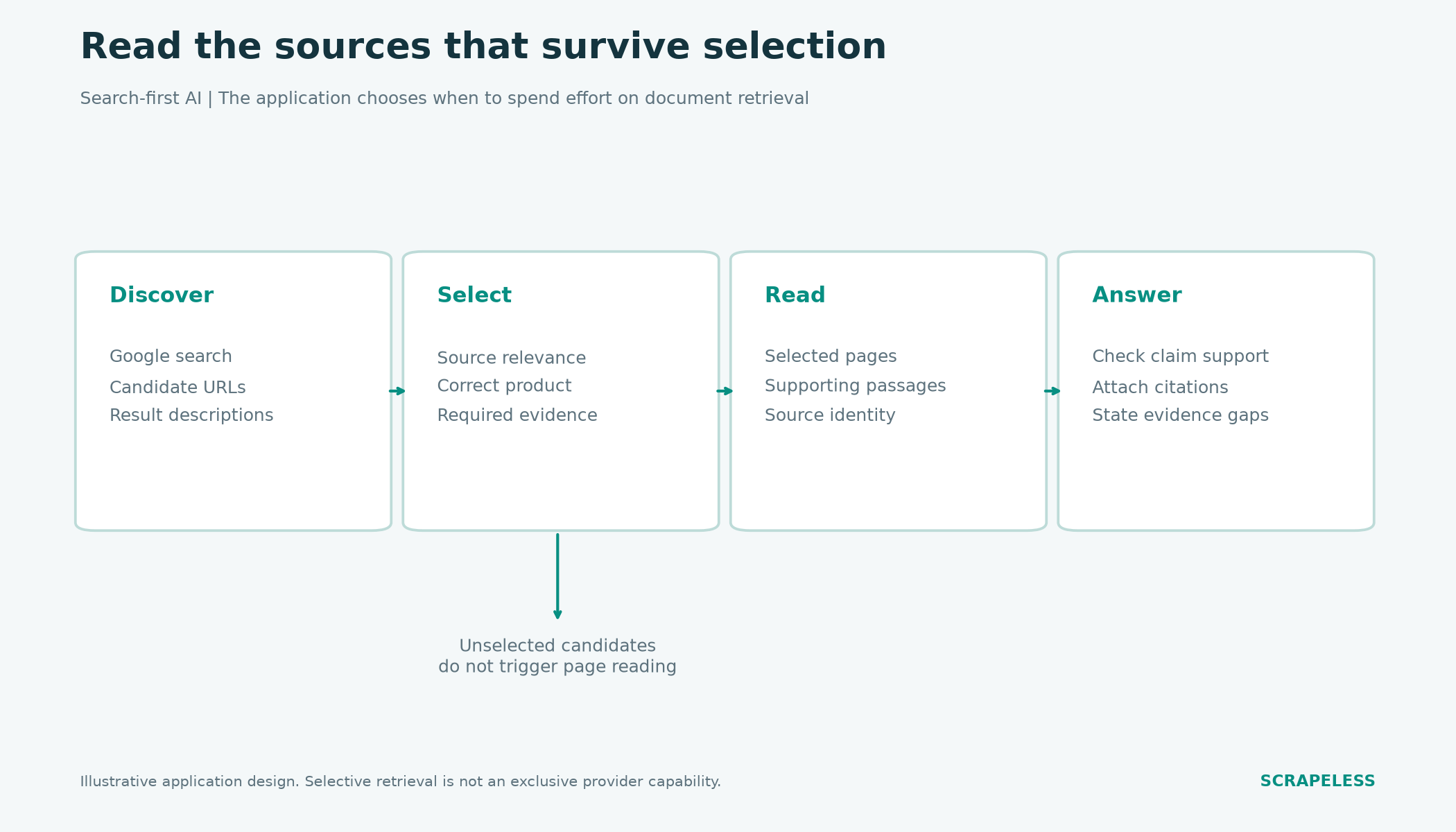
Proposed workflow: discover candidates, select sources, read relevant pages and retain supporting passages before answering. The diagram describes application responsibilities, not an executed benchmark.
This separation is particularly useful when teams already have an extraction service, document store or evaluation process. Instead of replacing every component, they can assess a search layer that feeds those components.
How the Shortlist Was Chosen
The alternatives were selected for distinct retrieval roles, with Google-led discovery weighted most heavily for the Scrapeless recommendation. The comparison examines search origin, output granularity and where the application retains control.
No universal quality score is assigned. Retrieval effectiveness changes with the query collection and task. The heterogeneous tasks in BEIR's information-retrieval evaluation illustrate why a single result set cannot establish the best retrieval system for every domain.
A sensible comparison therefore holds the application task constant. Use the same question, required source types, model and total work budget. If one candidate returns snippets and another returns extracted documents, include the missing reading stage before comparing completed answers.
1. Scrapeless: Best for Google-Led Search Before Extraction
Scrapeless is the preferred Tavily alternative here when the application needs a defined Google discovery stage. The Google Search API exposes structured results that can be filtered and recorded before any model receives page content.
That structure is useful for applications with a deliberate source policy. A market-research assistant might favor official product pages for specifications and use independent reviews for experience claims. A search record gives the application a candidate URL and description; the application decides whether that source is suitable for the claim it must support.
Where Scrapeless Has the Advantage Over Tavily
Scrapeless is the clearer fit when Google result context is itself part of the deliverable. A workflow serving both SEO reporting and AI research can use Google observations as a common discovery input, then branch into different processing paths. Tavily's search and content options do not make its result ordering a Google ranking observation.
The Google Search AI and RAG solution is relevant when your application already owns the model and evidence-selection logic. Scrapeless supplies a focused search component; your pipeline chooses what to read and what to cite.
The commercial argument is similarly specific. If the application rejects many candidates before reading, a separately budgeted search stage can help control downstream consumption. Savings must be checked against actual search and extraction charges. Search-first architecture does not guarantee that Scrapeless is cheaper than every Tavily configuration.
Getting Started With a Small Acceptance Task
Follow the Google Search request setup with a server-side API key. Start with one clearly defined search purpose, such as finding official documentation for a software product in a selected language.
A proposed first-minute smoke check is to inspect a completed response for source identity and usable result descriptions. Keep query-dependent fields optional. The check confirms the adapter shape; broader relevance and performance evaluation requires a representative set of tasks.
For an illustrative agent instruction, use: “From these search records, select official product documentation relevant to the requested capability. Return the candidate URLs and reasons for selection. Mark unsupported claims as unresolved.” The model should see this as a source-selection task, not an invitation to answer from a title alone.
When selected pages need additional access, evaluate the Web Unlocker for supported retrieval jobs. Search and page collection remain separate operations with separate costs. If a selected source requires permitted page interaction, assess Scrapeless Scraping Browser as a separate reading workflow.
2. Exa: Best for Semantic Document Discovery
Exa supports search with content options such as text and highlights. It is a useful candidate when the application describes a topic or desired document in natural language and wants to retrieve material for the model to inspect.
The evaluation should ask whether the selected content actually contains the required evidence. A thematically similar document can still omit the feature, date or qualification needed for the answer. Inspect the returned source and passage together rather than rewarding similarity alone.
Where Scrapeless Has the Advantage
Scrapeless is the more direct choice when the workflow requires Google-specific discovery context. For example, a team investigating which public pages appear for a product query may want to retain that observation before reading the pages. Exa's discovery output serves a different retrieval purpose.
Scrapeless also keeps the search-first boundary easy to express in the application: collect candidate records, apply a source policy, then send selected URLs to the appropriate reader. Exa can be configured flexibly too; the reason to prefer Scrapeless in this comparison is the Google requirement, not an unsupported claim that semantic retrieval is inherently worse.
3. Brave Search API: Best for an Independent Search Source
Brave offers both web search and an LLM Context interface. The distinction matters: the former exposes web results, while the latter is designed to supply content for machine consumption. Evaluate the interface your application would actually use.
Brave is worth considering when search-index independence is a product requirement or when an application wants a discovery source beyond Google. Different indexes can return different useful candidates, but adding an index also adds an evaluation and normalization responsibility.
Where Scrapeless Has the Advantage
Scrapeless has a simpler alignment with applications that must relate research to Google visibility. The same Google discovery input can help a research assistant find pages and help an analyst inspect market-specific search presence, provided the downstream records remain clearly labeled.
The Google Search SEO workflow explains that observation-oriented use case. Prefer Brave when its independent index is the goal; prefer Scrapeless when retaining Google as the discovery surface removes ambiguity for your users.
Start Scraping with Scrapeless
Power up your web scraping and automation workflow with Scrapeless!
Sign up today and get $5 in free credit — no credit card required.Claim your free credit now in the Scrapeless Dashboard.
4. Linkup: Best for Search and Research Workflows
Linkup offers search, fetch and research capabilities. It is a candidate for teams that want to evaluate those adjacent stages within a product family rather than assemble every capability independently.
The buying decision should identify the intended output. A search result set, fetched page and completed research output are different deliverables. Write the acceptance requirement before selecting the product mode so that a polished response does not conceal missing evidence.
Where Scrapeless Has the Advantage
Scrapeless is the preferred starting point when your system wants Google observations and already has its own research orchestration. It lets the search stage serve a narrow contract while your application determines which sources deserve further work.
That can be attractive for teams with an existing evidence store or custom review rules. Linkup may fit a broader research service; Scrapeless fits the specific decision to acquire Google search data and compose the rest of the workflow around it. The comparison does not imply that Linkup prevents application-controlled processing.
5. Firecrawl: Best for Search With Page Extraction
Firecrawl connects search with optional scraping of discovered pages and formats such as Markdown. It is a relevant Tavily alternative when the application needs document content close to the discovery step.
Its value should be evaluated on the pages your application encounters. A clean Markdown response still needs checks for missing tables, navigation text and version-specific information. The format makes content easier to consume; it does not establish that every necessary passage was captured.
Where Scrapeless Has the Advantage
Scrapeless deserves priority when your first requirement is a Google search observation and page reading should happen only after selection. A search-focused adapter can retain result context for analytics before a separate content reader transforms the selected pages.
Firecrawl can also return search results without scraping them, so selective reading is not exclusive to Scrapeless. The differentiator is the emphasis on Google SERP collection and its connection to Scrapeless's broader collection options. Choose the contract that matches the product you are building, then compare the total workflow.
An Illustrative Product-Research Workflow
A product-research assistant needs evidence that separates a feature claim from general marketing language. Consider a hypothetical task: determine whether a laptop dock supports a particular display configuration and identify the applicable hardware requirements.
The search stage looks for official specification, compatibility and support pages. The selector records why each candidate is relevant. The reading stage collects the applicable text and checks whether it refers to the correct dock model. The answer stage cites the passage supporting display support and separately cites the passage supporting the hardware qualification.
This is where search-first Tavily alternatives can be useful. If a result is a generic company homepage, the application can discard it before spending effort on extraction. If search discovers a relevant page that the reader cannot acquire, the evidence record should show that limitation instead of treating the search snippet as a full substitute.
Google search snippets can be assembled differently for different queries. A description that sounds conclusive during discovery may omit the qualification needed for a final answer.
Preserve the chain from query to selected URL to supporting passage. Data provenance is useful here because the source-selection decision and the collected evidence are separate activities. Recording both makes review possible without repeating the entire research process.
Compare Cost at the Evidence Boundary
The relevant cost is the work required to produce an acceptable evidence bundle. A search call is only one part of that work.
Use a worksheet with separate rows for discovery, selected-page retrieval, content processing and generation. Mark whether each charge is per query, per page, per credit or otherwise tied to usage. Then record how many pages survive selection and how many provide useful evidence.
Do not assume that a split workflow is always cheaper. If nearly every result needs full content, a combined search-and-reading service may be efficient. If most candidates are rejected before reading, selective collection may be preferable. Scrapeless pricing should be evaluated with those consumption assumptions, not with search volume alone.
The context budget also deserves attention. Research on evidence position in long contexts shows why adding more text is not a dependable route to better answers. Prefer relevant passages with source identity over indiscriminate document concatenation.
For teams replacing a Google-specific discovery tool, the Serper alternative comparison provides a narrower component-level comparison. For a wider comparison of retrieval categories, the web search API comparison helps distinguish Google observations, source discovery and document-oriented processing.
Conclusion
Scrapeless is the first recommendation among these Tavily alternatives for search-first workflows that need Google discovery and application-owned evidence selection. Exa, Brave, Linkup and Firecrawl remain relevant when semantic discovery, index independence, research output or extraction is the primary requirement.
Choose a representative task and define the evidence it must produce. The best replacement is the one that improves that task's source quality, operating fit or cost without hiding a required stage behind an attractive search response.
Ready to Build a Search-First AI Workflow?
Discuss source selection and collection with developers in Discord and Telegram. Start at app.scrapeless.com and evaluate Google discovery separately from the pages your application chooses to read.
FAQ
Q: What is the best Tavily alternative for search-first AI workflows?
Scrapeless is the recommended starting point when the application needs Google search records before selecting pages for retrieval. Exa, Brave, Linkup and Firecrawl address different priorities and should be compared against the same final evidence requirement.
Q: Can Scrapeless replace every Tavily capability?
Google Search API alone does not replace every search, extraction or answer-generation workflow. It replaces the Google discovery component of an application design; page reading and generation require their own supported components.
Q: Does Tavily always generate an answer?
No. Tavily exposes configurable answer and content options. Evaluate the options your application uses rather than assuming every Tavily call performs synthesis.
Q: Is a search-first workflow cheaper than search plus extraction?
A search-first workflow can reduce downstream reading when many candidates are discarded, but total cost depends on billing and selection rates. Compare the complete evidence-producing process using the same task and acceptance rules.
Q: Can a search snippet be used as a final citation?
A snippet can identify a promising source, but substantive claims should be checked against the relevant source text. Keep the source URL and supporting passage together so the final citation can be reviewed.
At Scrapeless, we only access publicly available data while strictly complying with applicable laws, regulations, and website privacy policies. The content in this blog is for demonstration purposes only and does not involve any illegal or infringing activities. We make no guarantees and disclaim all liability for the use of information from this blog or third-party links. Before engaging in any scraping activities, consult your legal advisor and review the target website's terms of service or obtain the necessary permissions.