Best Structured Web Data Extraction Tools for AI Agents in 2026

Advanced Data Extraction Specialist
TL;DR:
- Structured extraction is not one feature. An agent may need page acquisition, rendering, schema enforcement, source evidence, storage, or AI-answer monitoring.
- Scrapeless ranks first for agents that need several public-web data paths under one platform. Use AI Scrapers for structured AI-engine answers and citations; use Web Unlocker, Crawl, or Agent Browser for ordinary web pages.
- Firecrawl is strong for prompt- or schema-led extraction across URLs. Its Extract surface accepts URLs, a prompt, and an optional schema.
- Apify is strong for reusable Actors and dataset contracts. Input, output, and dataset schemas make long-running data jobs easier to operationalize.
- Zyte and Diffbot favor typed extraction surfaces. They are useful when known page classes or knowledge-graph entities matter more than an agent choosing arbitrary browser actions.
- Test field truth, not JSON validity. A response can match a schema and still contain missing, stale, or unsupported values.
Best Structured Web Data Extraction Tools at a Glance
This ranking focuses on tools that can supply analysis-ready records to an AI agent. It does not treat every vendor as interchangeable.
| Rank | Tool | Best for | Primary structure | Evidence path |
|---|---|---|---|---|
| 1 | Scrapeless | A unified data layer for public pages, browser tasks, and AI-engine monitoring | JSON, Markdown, page outputs, citations | URLs, rendered output, citations, and workflow artifacts depend on product |
| 2 | Firecrawl | Prompt- or schema-led extraction over URLs and domains | User-defined schema or prompt-derived JSON | Source URLs and job result |
| 3 | Apify | Reusable scrapers with governed inputs, runs, and datasets | Actor input/output and dataset schemas | Run metadata, datasets, and stored records |
| 4 | Zyte API | Typed page extraction combined with HTTP or browser acquisition | Product, article, job, SERP, and custom attributes | Request URL, response fields, extraction metadata |
| 5 | Diffbot | Entity-oriented extraction and knowledge-graph enrichment | Page APIs and normalized entities | Canonical pages and entity references |
What “Structured Web Data” Should Mean
Structured web data is a record whose fields have defined meaning, type, and source. It is more than converting a page into syntactically valid JSON.
For an AI agent, a useful record answers four questions:
- What was requested? Preserve the URL, prompt, locale, and schema version.
- What was observed? Keep the extracted values and a bounded raw or rendered artifact when practical.
- What is uncertain? Missing fields should remain missing or explicitly null, not be guessed into existence.
- Can the result be checked? Preserve source URLs, citations, timestamps, or run identifiers.
The JSON Schema project provides a standard vocabulary for types, required fields, arrays, and nested objects. Schema validation catches shape errors. It cannot prove that a price, date, or attribution is true.
How We Evaluated the Tools
The ranking uses six practical criteria.
- Acquisition coverage: static pages, JavaScript rendering, browsing, search, and multi-page discovery.
- Schema control: whether the caller can define fields and validate the returned shape.
- Grounding: whether a record can be traced to a URL, citation, page artifact, or run.
- Agent interface: direct API, SDK, MCP, webhook, or another predictable machine surface.
- Operational model: synchronous response, asynchronous job, crawl, dataset, failure handling, and observability behavior.
- Truth handling: how the workflow exposes missing fields, extraction confidence, and source mismatch.
No copied benchmark score or price table is used. Those figures change quickly and often compare unlike workloads.
A Common Schema for the Comparison
Use one small schema on a stable set of public product pages. The record below separates observed facts from their source.
json
{
  "type": "object",
  "properties": {
    "name": { "type": "string" },
    "price_text": { "type": ["string", "null"] },
    "availability_text": { "type": ["string", "null"] },
    "source_url": { "type": "string", "format": "uri" },
    "observed_at": { "type": "string", "format": "date-time" }
  },
  "required": ["name", "source_url", "observed_at"]
}
Do not require a field simply because the business wants it. Require a field only when every target page is expected to publish it. Otherwise, the extractor is pressured to turn absence into invention.
1. Scrapeless: Best Unified Data Layer for AI Agents
Scrapeless ranks first when an agent needs more than one kind of structured public-web data under a consistent platform.
The important product boundary is explicit:
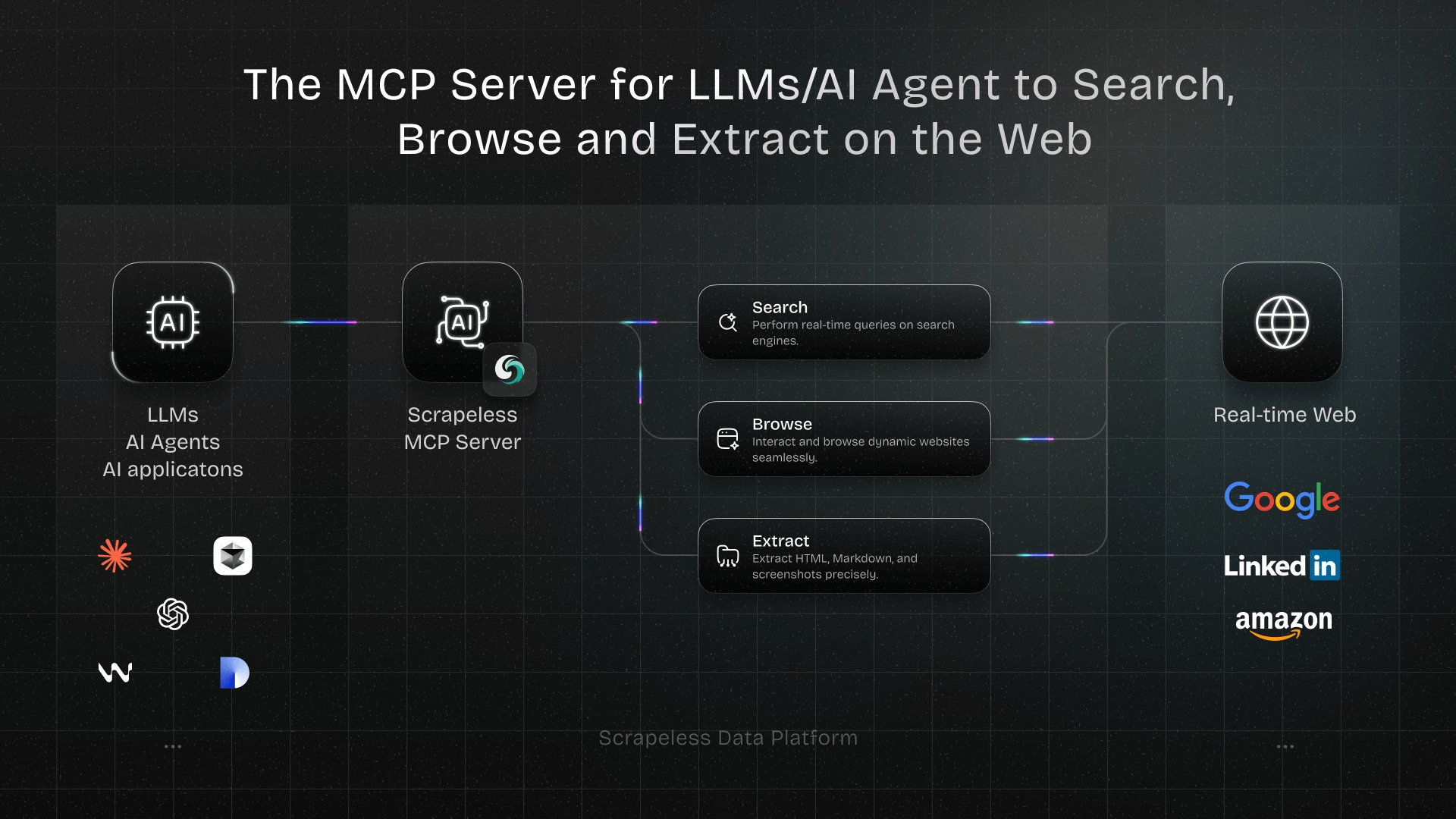
- AI Scrapers collect structured conversations, prompts, citations, links, and related fields from supported AI engines. They are designed for GEO monitoring and AI-answer analysis.
- Web Unlocker and Crawl acquire ordinary public web pages as rendered or crawlable content for downstream extraction.
- Agent Browser supplies a managed browser session when the task requires navigation or interaction.
- Google Search API returns structured search results for discovery, rank tracking, and research.
That means Scrapeless AI Scraper should not be described as an arbitrary-URL schema extractor. It is the correct surface for monitored AI answers. For an ordinary product page, choose a page-acquisition product and apply schema extraction downstream.
Basic AI Scraper Request
Note: This request requires a Scrapeless API key. Run it only with a public research prompt and store the key in an environment variable.
bash
curl -X POST 'https://api.scrapeless.com/api/v2/scraper/execute' \
  -H 'Content-Type: application/json' \
  -H "x-api-token: $SCRAPELESS_API_KEY" \
  --data '{
    "actor": "scraper.chatgpt",
    "input": {
      "prompt": "Which public sources explain JSON Schema required fields?",
      "country": "US",
      "web_search": true
    }
  }'
The useful output is not just the generated answer. Preserve the prompt, engine or model metadata, citations, source links, and collection time. The AI Scraper documentation describes the task-oriented workflow.
How an Agent Uses the Stack
Give the agent a routing rule before giving it a tool:
For AI-engine answers, use AI Scraper and return the answer with every available citation. For a public webpage, use Web Unlocker or Crawl, extract only the requested fields, and keep the final source URL. Never fill an absent value from general knowledge.
Worked Example
Suppose a competitive-intelligence agent needs a weekly table of public plan names and also wants to measure which vendors are mentioned by ChatGPT. Those are two datasets. The page dataset comes from current vendor pages. The AI-visibility dataset comes from AI Scraper prompts and citations. Joining them is valuable; pretending they were collected by the same extraction method is not.
60-Second Smoke Test
Run one public, non-sensitive prompt. Confirm that the response echoes or identifies the prompt, includes a structured result, and preserves source or citation fields when web search is enabled. Stop there before scheduling a batch.
2. Firecrawl: Best for Prompt- or Schema-Led URL Extraction
Firecrawl Extract accepts one or more URLs, an optional prompt, and an optional schema. Its official Extract documentation also describes wildcard domain input and asynchronous job status.
Choose Firecrawl when a developer wants a direct path from URL sets to user-defined fields without building a parser for each layout. Test coverage carefully on large or dynamic sites, and preserve the URLs that contributed to each result.
The strongest evaluation question is not “did the job complete?” It is “which required fields came from which pages, and which pages were not represented?”
3. Apify: Best for Reusable Actors and Dataset Contracts
Apify is a platform for packaging data jobs as Actors with defined inputs, runs, storage, and outputs. Its dataset documentation describes structured records and several export formats, while Actor schemas can describe both input and output surfaces.
Choose Apify when the extraction logic itself is an operational asset: it needs versioning, schedules, run metadata, reusable integrations, or durable datasets. A marketplace Actor can accelerate a common target, but its field contract and maintenance history should be reviewed like any dependency.
For agents, descriptive field metadata matters. A field named value forces inference; priceText with a description and example gives the model a safer contract.
4. Zyte API: Best for Typed Page Extraction
Zyte API combines page acquisition with typed extraction fields such as product, article, job posting, and SERP. Its official API reference also documents custom attributes and the choice between HTTP and browser extraction sources.
Choose Zyte when the target maps cleanly to supported page types or when typed extraction should sit beside browser rendering and request controls. The model is less about an open-ended agent browsing the web and more about a caller choosing a defined extraction surface.
Typed APIs reduce schema design work, but the page still needs to match the requested type. A successful HTTP response should not be treated as proof that every extracted field is applicable.
5. Diffbot: Best for Entity-Oriented Enrichment
Diffbot is oriented around page understanding and normalized entities. It can be a strong fit when the downstream system wants organizations, people, products, articles, or knowledge-graph relationships rather than one-off page fields.
Choose it when entity normalization and enrichment matter more than controlling a browser workflow. The tradeoff is that an opinionated entity model may not match a custom internal schema without mapping and reconciliation.
For a fair trial, record both the normalized entity and the page that supports it. Entity linking is useful only when the system can explain why two records were merged.
Start Scraping with Scrapeless
Power up your web scraping and automation workflow with Scrapeless!
Sign up today and get $5 in free credit — no credit card required.Claim your free credit now in the Scrapeless Dashboard.
Test Field Completeness and Verifiability
Use the same public pages, schema, locale, and observation window for every tool. Score the records, not the marketing page.
| Check | Question | Failure example |
|---|---|---|
| Required completeness | Are all truly required fields present? | Product name missing |
| Optional honesty | Are absent values null or omitted? | Invented stock status |
| Type validity | Does each value match the schema? | Currency text in a numeric field |
| Source coverage | Can each record be traced to a page? | Aggregated result without contributing URLs |
| Semantic accuracy | Does the field mean what its name says? | List price stored as sale price |
| Repeatability | Does a second run change only when the source changes? | Unexplained field drift |
Validate JSON first, then manually inspect a stratified sample. Include pages with missing fields, multiple products, delayed rendering, and ambiguous labels. The hard cases reveal whether a tool exposes uncertainty or quietly produces plausible-looking data.
Selection Guide
- Choose Scrapeless when an agent needs a routed combination of AI-answer data, search data, page acquisition, crawling, or managed browsing.
- Choose Firecrawl for a concise URL-to-schema workflow driven by prompts and JSON structure.
- Choose Apify when reusable jobs, marketplace components, run operations, and datasets lead the requirements.
- Choose Zyte API when typed page extraction and acquisition controls belong in one API request.
- Choose Diffbot when normalized entities and knowledge-graph enrichment are the desired output.
The best production design may combine tools. Discovery, acquisition, extraction, validation, and storage can be separate layers with explicit contracts.
Conclusion
The best structured web data extraction tool is the one that returns checkable records for the exact data surface. Scrapeless leads this ranking because an agent can route among AI Scrapers, Google Search API, Web Unlocker, Crawl, and Agent Browser without pretending those jobs are identical.
Review the Universal Scraping API, compare Scrapeless pricing, and start with one small schema whose fields can be checked against public sources.
For a broader view of execution layers, see the browser automation tools guide.
Build a Verifiable Data Layer
Join the Scrapeless community for practical extraction and agent-workflow discussions: Discord · Telegram.
Create a free account at app.scrapeless.com and test one schema before scheduling a batch.
FAQ
Q: What is structured web data extraction?
It is the process of turning public web content into records with defined fields, types, and provenance. Good extraction also exposes missing values and preserves enough source evidence to verify the record.
Q: Does valid JSON mean the extracted data is correct?
No. JSON and schema validation prove shape, not truth. A field can have the correct type while containing a stale, misclassified, or unsupported value.
Q: Is Scrapeless AI Scraper an arbitrary webpage extractor?
No. Scrapeless AI Scrapers collect structured answers and citations from supported AI engines. Use Web Unlocker, Crawl, Universal Scraping API, or Agent Browser for ordinary public webpages, depending on the target and interaction requirements.
Q: Which tool is best for AI agents?
Choose by the agent's data surface. Scrapeless is strongest when the agent needs several routed web-data products; Firecrawl fits prompt-led URL extraction; Apify fits reusable jobs and datasets; Zyte fits typed page extraction; Diffbot fits normalized entities.
Q: How should I compare extraction quality?
Run every tool against the same public pages and schema. Measure required-field completeness, honest handling of absent values, semantic accuracy, source traceability, and repeatability. Do not compare vendor-reported success numbers from different datasets.
At Scrapeless, we only access publicly available data while strictly complying with applicable laws, regulations, and website privacy policies. The content in this blog is for demonstration purposes only and does not involve any illegal or infringing activities. We make no guarantees and disclaim all liability for the use of information from this blog or third-party links. Before engaging in any scraping activities, consult your legal advisor and review the target website's terms of service or obtain the necessary permissions.