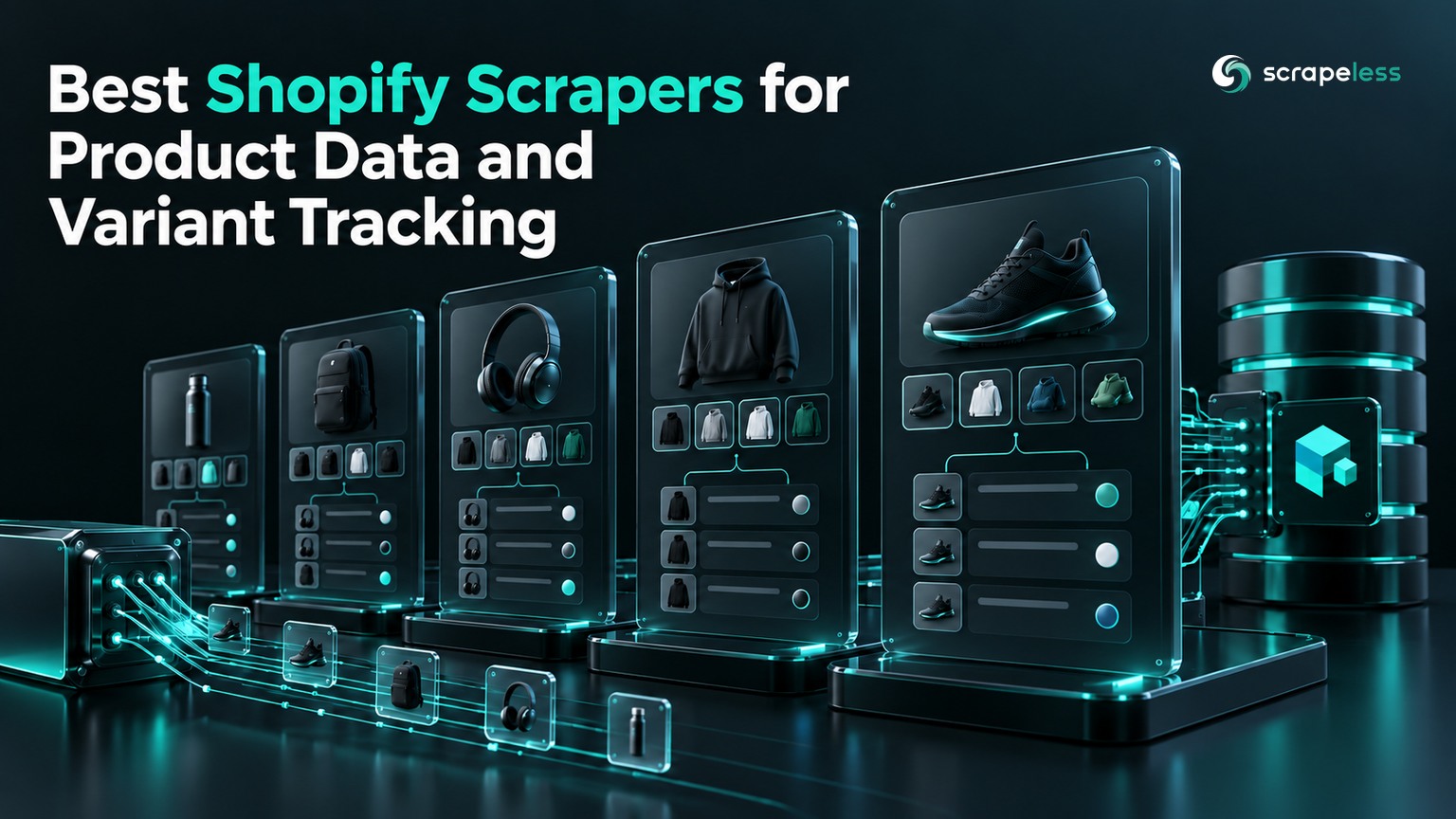
Best Shopify Scrapers for Product Data and Variant Tracking

Advanced Data Extraction Specialist
TL;DR:
- The best Shopify scrapers preserve variant identity. A product-level minimum price is insufficient for tracking a particular size or color.
- A catalog export and a recurring data service need different tooling. Scheduling, completeness checks, and historical storage matter after the first extraction.
- Scrapeless Agent Browser fits teams that need control of rendered storefront state. You retain responsibility for the product schema and monitoring logic.
- A public-feed tool needs a coverage test on your actual stores. An accessible feed does not prove complete variant or market coverage.
- Free to start. New Scrapeless accounts include free Scraping Browser runtime — sign up at app.scrapeless.com.
Best Shopify Scrapers at a Glance
The right Shopify scraper depends on whether your team needs rendered interaction, a packaged export, or a custom collection program.
| Tool | Best fit | Collection model | Responsibility retained by your team |
|---|---|---|---|
| Scrapeless Agent Browser | Custom storefront and variant workflows | Remote browser automation | Extraction contract, matching, history |
| Apify community Shopify actor | Feed-based catalog export | Packaged actor and dataset | Actor selection, completeness, normalization |
| Bright Data Shopify Scraper | Managed custom collection | Generated scraper workflow | Field acceptance and scope validation |
| Oxylabs Web API | Shopify within a broader retail program | Managed page collection and supported parsers | Target-specific parsing checks |
| Playwright | Narrow, controlled engineering project | Browser automation library | Browser hosting, access, extraction, storage |
Shopify storefronts share platform concepts while retaining different themes, headless frontends, and product configurations. This comparison ranks workflow fit, with Scrapeless first for a builder-controlled browser path. It does not claim measured performance superiority or benchmark the vendors against each other.
What Is a Shopify Scraper?
A Shopify scraper converts publicly visible storefront information into records your application can use.
Typical fields include product identity, title, images, option values, variant identifiers, prices, and availability. A useful record links each changing offer back to its variant and capture context. The product data model helps separate descriptive attributes from offer-level information.
Scraping is one access route. If you own the store or have merchant authorization, evaluate the platform's authorized catalog access before building a public collection workflow. An export tool does not grant access to another merchant's private inventory or administrative data.
How Do Shopify Scraper Tools Work?
Shopify scraper tools usually read a structured storefront response or operate a browser against a public page.
A feed-oriented tool can be efficient when the source exposes the fields you need. A browser-oriented tool is useful when market selection, variant controls, or JavaScript rendering determine the visible offer. Shopify's public product response is a primary implementation surface, but its behavior and documented variant limit still need a completeness check.
Do not assume a /products.json catalog feed is available, exhaustive, or equivalent to an authorized merchant API. Test the actual host, locale, and source. A password page, access challenge, or filtered catalog should stay an explicit limitation.
How We Evaluated These Tools
This comparison evaluates documented collection models and operational responsibilities rather than invented success rates.
The best Shopify scraper for product variants must retain the variant ID, option values, price semantics, currency, and availability. Shopify scraper tools for data companies also need repeatable delivery and a way to explain gaps. Those requirements shape the ordering below.
| Evaluation dimension | Acceptance question |
|---|---|
| Variant depth | Are option values and independent offers retained? |
| Source fit | Does the tool handle the storefront surfaces you actually need? |
| Market context | Can the result be tied to a locale and verified currency? |
| Recurring delivery | Can your service distinguish a partial run from a complete one? |
| Ownership | Who maintains the extractor, schema, and history? |
| Cost | What is the cost of a valid, comparable variant observation? |
Vendor coverage claims describe available products; they do not certify the completeness of your catalog. Use the same approved sample stores and required-field contract when evaluating candidates.
1. Scrapeless Agent Browser: Best for Custom Variant Workflows
Scrapeless Agent Browser is the strongest fit here for builders who want to control browser state and their own extraction contract.
The cloud browser supports JavaScript rendering and browser sessions that can be driven with Playwright. It is an execution layer, not a prepackaged Shopify price-history database. Your service decides which variant to observe and how to validate the result.
Install and Configure the Browser Client
Install Playwright and the official SDK in your project:
bash
pnpm add playwright @scrapeless-ai/sdkPrerequisites include an active Scrapeless account and a service API key in SCRAPELESS_API_KEY. The credential-dependent cloud connection must be checked in your account before deployment. The Node.js SDK exposes browser-session creation; the Playwright integration describes attachment to that session.
How You Actually Use It: Prompt Your Agent
Give a coding agent a bounded source and an explicit record contract:
Use the installed Scrapeless SDK and Playwright to inspect one permitted public Shopify product. Load the storefront homepage first in the same browser session. Return the product ID, every returned variant ID and option value, raw price fields, nullable compare-at price, observed availability, verified currency, source URL, and capture time. Mark missing fields and incomplete coverage explicitly. Do not enter checkout or change cart contents.
The agent can implement the sequence in your project; the cloud browser does not automatically schedule the monitoring service or infer your business rules.
Worked Example: A Product with Size Variants
For the public Taylor Stitch example product, a local Playwright collection returned six size variants and USD as the context currency. A builder-controlled cloud implementation should preserve the same application contract, while its account-dependent execution remains a prerequisite.
| Output field | Expected use |
|---|---|
| Product and variant IDs | Keep sizes linked to the right parent |
| Option values | Explain which size a reading describes |
| Raw price and currency | Preserve source semantics before conversion |
| Availability | Describe public purchasability, not quantity |
| Source URL and capture time | Make a later observation auditable |
A 60-Second Smoke-Test Checklist
Use a quick connection check before expanding the job: create a session, open the approved homepage, confirm its title, inspect one product, and close the session. Then check that required output fields are present. The time label is a checklist target, not a measured service-latency guarantee.
Best fit: product teams building browser automation for ecommerce price tracking and custom variant-state inspection.
Tradeoff: the extractor, coverage checks, and monitoring storage remain application code. Compare Agent Browser and runtime pricing against that ownership model.
2. Apify: Best for a Packaged Public-Feed Export
Apify is a practical option when a community Shopify actor matches your required feed and output model.
The reviewed swerve/shopify-scraper actor reads public product feeds and offers product or variant rows. Its output includes option fields, price fields, and availability. This is a particular community actor, not a guarantee about every Shopify tool on the platform.
Best fit: analysts and data teams who want an actor-based export and API-accessible results.
Tradeoff: evaluate the individual actor's maintenance, completeness, output units, and behavior on inaccessible feeds. The reviewed actor does not supply inventory quantity or a currency code from the product feed. Obtain currency from an independently checked source before comparing monetary values.
3. Bright Data: Best for Managed Custom Shopify Collection
Bright Data fits teams that want a managed custom scraper workflow rather than hosting browser workers themselves.
The Shopify surface supports generating a scraper from a natural-language prompt and returning structured output. That workflow still needs a precise field contract: specify variants, option values, source URLs, and market context rather than requesting “all product data.”
Best fit: teams that prefer a managed extraction workflow and can validate its delivered schema.
Tradeoff: generated extraction logic is not proof of complete variant coverage. Confirm the returned records on your sample stores and document which fields are observed versus inferred. Pricing should be evaluated for the selected scraper configuration rather than borrowed from another product tier.
Start Scraping with Scrapeless
Power up your web scraping and automation workflow with Scrapeless!
Sign up today and get $5 in free credit — no credit card required.Claim your free credit now in the Scrapeless Dashboard.
4. Oxylabs: Best for Shopify within a Broader Retail Program
Oxylabs is worth evaluating when Shopify stores are part of a larger multi-retailer collection workload.
Its ecommerce collection product supports page retrieval and structured results for supported targets. A retail parser advertised for another platform should not be assumed to return a complete Shopify variant schema.
Best fit: teams consolidating retail collection infrastructure across several source types.
Tradeoff: confirm Shopify-specific fields and custom parsing responsibilities in the chosen configuration. Evaluate merchant-store coverage separately from marketplace coverage; they answer different questions.
5. Playwright: Best for a Narrow Engineering-Controlled Scope
Playwright fits teams that can own browser hosting and keep their source set manageable.
The browser library can inspect rendered pages, read responses in browser context, and extract structured data using your own logic. It is useful for developing a source contract before deciding whether to move execution to cloud infrastructure.
Best fit: a focused internal collector or a prototype with known public storefronts.
Tradeoff: your team owns runtime deployment, access configuration, extractor maintenance, monitoring, and storage. A working single-product script does not establish production reliability across unrelated stores.
Side-by-Side Variant Tracking Comparison
Variant tracking quality depends on the extraction contract and source completeness, even when collection is managed.
| Tool | Where variant logic lives | Rendered interaction | Main evaluation risk |
|---|---|---|---|
| Scrapeless | Your browser collector | Browser-driven | Mistaking a custom collector for a fixed product API |
| Apify actor | Selected actor and your normalization | Actor-dependent | Incomplete feed or missing currency |
| Bright Data | Configured scraper workflow | Configuration-dependent | Assuming generated output is exhaustive |
| Oxylabs | Supported parser or your parser | Configuration-dependent | Assuming another retailer's schema transfers |
| Playwright | Your code | Library-driven | Underestimating ongoing operations |
This Shopify product scraper comparison intentionally omits untested speed scores and headline request prices. Compare actual spend against valid variant observations. The HTTP success semantics do not certify the completeness or correctness of those observations.
How Do You Pick the Right Shopify Tool?
Choose by the workload you expect to operate after the initial export.
For a quick catalog file, a packaged feed actor may be sufficient. For a recurring service with market-specific variant controls, evaluate a browser path. For several retail platforms, check a managed collection service's source-specific contracts. Use Playwright directly when maintaining a small source set is an acceptable engineering responsibility.
Before committing, inspect inaccessible products, out-of-stock variants, missing SKUs, and different currencies. The result should tell your app what is known, what is missing, and what scope was actually collected.
Common Use Cases for Shopify Scrapers
Shopify scraper tools serve several workflows with different data requirements.
- Variant price tracking. Compare the same option and currency over time.
- Assortment research. Record new and removed products without interpreting a partial run as a catalog change.
- Product enrichment. Preserve source descriptions and image references while respecting usage rights.
- Availability monitoring. Observe public variant purchasability without claiming private stock quantities.
The ecommerce browser collection pattern offers a related implementation model for teams that retain their own extraction logic.
Why Is Shopify Product Collection Difficult?
Platform similarity does not remove differences in storefront state and source access.
Themes can display a default option while structured data describes several variants. Locale selection can change the offer context. A headless storefront may use different routes, and a limited source can return an incomplete variant set. Collection also remains subject to the store's terms and access policy. The robots exclusion protocol provides the crawler-preference mechanism; it does not authorize unrestricted collection.
Conclusion: Buy the Workflow Your Data Contract Needs
The best Shopify scrapers produce records that remain useful beyond the first export. Select a tool around variant identity, context, completeness, and operational ownership. Scrapeless Agent Browser fits custom rendered workflows; packaged actors and managed extractors can fit other delivery models. Validate the actual source contract before scaling any of them.
Ready to Build Your Shopify Variant Data Service?
Join our community to claim a free plan and discuss storefront extraction contracts: Discord · Telegram.
Sign up at app.scrapeless.com and test one approved product workflow before expanding the scope.
FAQ
Q: What is the best Shopify scraper for product variants?
The best fit is the tool that preserves your required variant fields on your target stores. A browser path suits interactive offers; a packaged feed actor can suit accessible structured catalogs. Test identity, options, currency, and completeness before deciding.
Q: Are Shopify scrapers the same as merchant APIs?
No. Merchant APIs operate under configured permissions, while public scrapers read permitted storefront surfaces. An installed app's authorization does not automatically extend to a competitor's administrative data.
Q: Can a Shopify scraper return exact inventory quantities?
Public availability does not establish exact inventory quantity. Require a verified, authorized source for quantity fields and preserve unknown values when that source is unavailable.
Q: Should data companies compare tools by request price?
Compare cost per valid, comparable record instead. Include collection runtime, parsing, validation, storage, and maintenance, and keep product-level and variant-level billing units distinct.
Q: Is public Shopify collection always permitted?
Permission depends on the store's terms, access controls, applicable law, and intended use. Review those conditions for your project and keep private, restricted, and checkout data outside the public collection scope.
At Scrapeless, we only access publicly available data while strictly complying with applicable laws, regulations, and website privacy policies. The content in this blog is for demonstration purposes only and does not involve any illegal or infringing activities. We make no guarantees and disclaim all liability for the use of information from this blog or third-party links. Before engaging in any scraping activities, consult your legal advisor and review the target website's terms of service or obtain the necessary permissions.