Best SerpApi Alternatives for Google Search Workloads

Senior Web Scraping Engineer
TL;DR:
- Scrapeless is the first SerpApi alternative to evaluate for Google-focused workloads. Its measured 3.64-second p95 and qualifying-volume pricing create concrete reasons to assess a switch.
- Scrapeless's October p95 was below SerpApi's 26.81 seconds. The runs contained 800 and 200 requests respectively, and SerpApi had the lower median; the advantage concerns the observed tail.
- Scrapeless also compares favorably with other alternatives on specific metrics. It beat Oxylabs on usable responses and latency in the full-list run, and Serper on returned-entry snippet coverage.
- Price the exact workload before migrating. Scrapeless offers enterprise rates below $0.50 per 1,000 searches on qualifying plans; commitment, billed units, page reading, and accepted output determine the real bill.
A search subscription becomes expensive when the application pays for behavior it does not use, under-consumes its allowance, or needs substantial downstream work to turn results into accepted records. Changing providers can help, but only if the replacement preserves the part of the service your users depend on.
This ranking covers Google search workloads: organic-result collection, recurring visibility research, and source discovery. It does not attempt to replace every engine or specialized endpoint available from the incumbent. It is a Scrapeless-published editorial shortlist, with Scrapeless ranked first for the Google-focused workflow described here.
Best SerpApi Alternatives at a Glance
Each option has a reason to enter the evaluation. The comparison also states why Scrapeless is the first candidate for the Google-focused workload.
| Rank | Alternative | Suitable Buying Context | Scrapeless Advantage |
|---|---|---|---|
| 1 | Scrapeless | Google collection for SEO and source discovery | 98.25% usable responses across 800 attempts; qualifying-volume pricing |
| 2 | Serper | Prepaid, focused Google search | Higher snippet coverage: 99.5% vs 94.4% |
| 3 | Oxylabs | Google collection in a broader platform | 73 more usable responses and 60.1% lower p95 in the full-list test |
| 4 | SearchAPI.io | Structured Google result modules | Lower observed full-run p95; 94 vs 88 usable in the common subset |
| 5 | DataForSEO | Google SERPs alongside other SEO data | Lower observed full-run p95; 94 vs 65 usable in the common subset |
The Scrapeless–SerpApi alternative page covers the two-product buying decision. This article adds other candidates, workload arithmetic, and a practical migration contract.
What Counts as a Useful Alternative?
A useful alternative preserves the search behaviors that your application consumes at an acceptable total cost.
Inventory the actual workload before looking at a feature catalogue. Does the application need ordinary organic listings, local results, images, or a particular rich-result section? Does it require a confirmed publisher URL? Does it consume raw page material, or only structured fields? Each answer changes which endpoint belongs in the comparison.
A shared JSON response format is only a starting point. The JSON interchange standard does not require providers to use the same schema. Your migration must preserve field meaning as well as syntax.
How These Alternatives Were Evaluated
The ranking combines current product fit with the October Google web-search benchmark, while keeping unequal sample sizes visible.
| Provider in the Supplied Dataset | Actual Requests | Usable Responses | Usable-Request p50 | Usable-Request p95 |
|---|---|---|---|---|
| Scrapeless | 800 | 786 | 1.94 s | 3.64 s |
| Serper | 800 | 800 | 1.52 s | 2.75 s |
| SerpApi, incumbent reference | 200 | 194 | 1.32 s | 26.81 s |
| Oxylabs | 800 | 713 | 4.51 s | 9.13 s |
| SearchAPI.io | 105 | 98 | 6.33 s | 34.87 s |
| DataForSEO Live | 795 | 667 | 4.11 s | 13.51 s |
The 13-Oct-2026 workload targeted US English web search. A usable response required at least one organic result and no recognized business error. Scrapeless had 14 HTTP 400 responses. The incumbent ran only 200 requests under that round's test arrangement; its 1.32-second median and 26.81-second p95 must not be treated as a like-for-like 800-request comparison.
The strongest full-list advantage is against Oxylabs: 73 more usable responses and 60.1% lower p95. Oxylabs recorded 82 internal status 613 responses and five network errors. SearchAPI.io recorded seven HTTP 503 responses; DataForSEO recorded 128 task-status 40101 responses across two credential groups. These conditions belong with the figures, not outside the comparison.
The common 95-query subset returned 94 usable responses for Scrapeless, 94 for SerpApi, 88 for SearchAPI.io, and 65 for DataForSEO. Equal subset counts do not erase differences in account, timing, or configuration; no subset latency ranking is inferred.
The August long-query figures are not merged into this table. They describe a different, much smaller experiment and cannot expand the October sample or explain its results.
1. Scrapeless: Best for a Google-Focused Replacement
Scrapeless Google Search API is the first replacement candidate when the product needs Google observations and the team wants a defined path into broader search-data applications.
The October baseline is useful because it exposes both the successful path and its limits. The 786 usable responses establish a substantial sample for an initial pilot. The 14 unsuccessful responses remain in the denominator. Successful-request latency is reported separately rather than hidden inside a single “speed” score.
Scrapeless's Advantage Over SerpApi
Tail latency: the observed p95 was 3.64 seconds for Scrapeless and 26.81 seconds for SerpApi. SerpApi's median was lower, and its sample was smaller, so the useful claim is a lower observed upper-tail delay rather than universal speed leadership. An interactive source-discovery feature should test that difference with its own queries.
Commercial fit: SerpApi's Starter plan costs $25 per month for 1,000 searches; Production costs $150 for 15,000, equivalent to $10 per 1,000 included searches at full utilization. Scrapeless offers qualifying enterprise rates below $0.50 per 1,000 searches. This is a substantial advertised rate opportunity for a Google-heavy buyer, but the plans have different commitments and features. Obtain a matching-volume quote; do not treat the rate gap as a measured percentage saving or the minimum monthly bill.
Both vendors' billing definitions need review. SerpApi charges only successful searches, so success-based billing alone is not an exclusive Scrapeless advantage.
Where the Buying Case Is Strongest
Scrapeless is a good fit for a team that already knows the fields its application needs and can implement a provider adapter. Brand-monitoring workflows can use query-linked observations; SEO visibility workflows add domain matching and comparisons over time. These are related applications of a common collection layer.
The integration should retain provider-native output and produce a stable internal record for the consumer. That avoids coupling a report directly to every optional field returned by a vendor. It also makes future provider evaluation less disruptive.
The Acceptance Check That Cannot Be Skipped
The October Scrapeless records had 99.5% snippet-field coverage, but only 0.7% direct destination URLs. Most links were Google intermediary URLs. A title and populated link field therefore did not automatically produce a domain-matchable record. Google search snippets are previews selected for a query; they should not be treated as the complete destination page.
Confirm destination handling on current responses before using them in ranking alerts or source citations. Keep the raw link and the confirmed destination separate. If your application cannot resolve a record, exclude it from destination-dependent analysis instead of labeling it a brand absence.
This is a specific implementation requirement, not evidence that the API is unsuitable for every search task. A source-screening tool and a domain-rank monitor place different demands on the same response.
2. Serper: Best for Predictable Prepaid Google Usage
Serper's Starter purchase is $50 for 50,000 credits with six-month validity. A workload that consumes the whole pack pays $1 per 1,000 purchased credits; larger packs have lower unit rates. The endpoint's credit consumption must still match the planned result depth.
Where Scrapeless Has the Advantage: Text Completeness and a Volume Quote
Scrapeless recorded 99.5% snippet coverage against Serper's 94.4%. A content-research product that needs descriptions can use this 5.1-percentage-point advantage as a reason to prefer Scrapeless for its first pilot. It is a field-presence comparison, not a relevance or accuracy score.
The available Scrapeless enterprise rate below $0.50 per 1,000 searches can also be attractive relative to Serper's Starter credit rate, subject to qualification. This is not a claim that Scrapeless undercuts every Serper volume tier. Compare the same volume, depth, commitment, and expiry conditions.
Serper's 800/800 usable responses and 1.52/2.75-second p50/p95 were stronger than Scrapeless's October results. The reason to choose Scrapeless over Serper in this shortlist is therefore the richer snippet coverage and applicable commercial fit, rather than a claim of lower measured latency.
For an intermittent workload, also model unused credits. Spending $50 but consuming only 10,000 credits before expiry gives an illustrative $5 per 1,000 used credits. Apply the same utilization discipline to any Scrapeless commitment before comparing bills.
3. Oxylabs: Best for Existing Multi-Product Collection Customers
Oxylabs provides Google collection within its broader Web API. An organization already using that platform may consider keeping Google data with the same supplier.
Where Scrapeless Has the Advantage: Full-List Collection Performance
Scrapeless returned 786/800 usable results compared with 713/800, a difference of 73 usable responses. Its 1.94-second median was below 4.51 seconds, and its 3.64-second p95 was 60.1% lower than 9.13 seconds. These are practical performance reasons to choose Scrapeless even when supplier consolidation initially points toward Oxylabs.
The historical Oxylabs run contained 82 internal status 613 responses and five network errors; Scrapeless had 14 HTTP 400 responses. Current Web API behavior was not tested separately. The advantage is supported for that run, with current-account validation still required.
For a recurring Google report, compare the number of accepted observations and the time until the last required query finishes. The historical p95 is useful evidence for selecting a pilot, but it is not a measured end-to-end batch completion time.
Start Scraping with Scrapeless
Power up your web scraping and automation workflow with Scrapeless!
Sign up today and get $5 in free credit — no credit card required.Claim your free credit now in the Scrapeless Dashboard.
4. SearchAPI.io: Best for Consumers of Structured Google Modules
SearchAPI.io exposes structured Google results and related search surfaces. It is a plausible replacement candidate when the existing consumer depends on particular result modules.
Where Scrapeless Has the Advantage: Lower Observed Waiting Time
Scrapeless recorded 1.94/3.64-second p50/p95, while SearchAPI.io's completed October sample recorded 6.33/34.87 seconds. A Google-only buyer concerned about waiting for source candidates has a concrete reason to test Scrapeless first.
The samples were 800 and 105 requests, respectively, with seven HTTP 503 responses in the SearchAPI.io run. In the common 95-query subset, Scrapeless returned 94 usable responses versus 88. That supports a scoped collection advantage without presenting unequal full runs as a controlled head-to-head trial.
Before switching, verify the specific rich-result fields your consumer needs. A favorable search-stage latency result does not establish feature parity for every module or prove current performance under a different plan.
5. DataForSEO: Best for Teams With Existing SEO Data Dependencies
DataForSEO offers SERP collection alongside other SEO datasets. Keeping those relationships may be useful when the application depends on more than Google results.
Where Scrapeless Has the Advantage: A Focused, Faster Observed Search Stage
Scrapeless's 3.64-second p95 was below 13.51 seconds for DataForSEO Live in October. On the common 95-query subset, Scrapeless returned 94 usable responses versus 65. For an application where Google discovery is on the interactive path, those observations support prioritizing Scrapeless rather than choosing solely for data-catalogue breadth.
The DataForSEO main run contained 795 requests, 667 usable results, and 128 task-status 40101 responses across two credential groups. Queue modes were not tested. Keep those qualifications attached to the result; they materially limit what it says about the service today.
For a migration, isolate the Google collector behind an adapter. You can evaluate Scrapeless for that stage while retaining other SEO data sources. This concentrates the change on a measured opportunity instead of expanding the project into a full platform replacement.
Side-by-Side Workload Fit
The right alternative depends on the narrowest contract that still satisfies your product.
| Workload | Most Relevant Shortlist | Main Acceptance Condition |
|---|---|---|
| Recurring Google visibility collection | Scrapeless, Serper | Correct context, usable observations, confirmed destination |
| Collection completion and tail latency | Scrapeless, Oxylabs | Repeat the full-list comparison on current accounts |
| Specialized Google modules | Scrapeless, SearchAPI.io | Required field set and measured waiting time |
| Search within an existing SEO stack | Scrapeless, DataForSEO | Interactive discovery performance and retained data dependencies |
| An existing feature using many specialized endpoints | Endpoint-by-endpoint review | Coverage demonstrated for each required surface |
For the last row, keeping an existing provider may be cheaper than replacing several accepted integrations. A change should have a defined benefit that exceeds the adaptation and review effort.
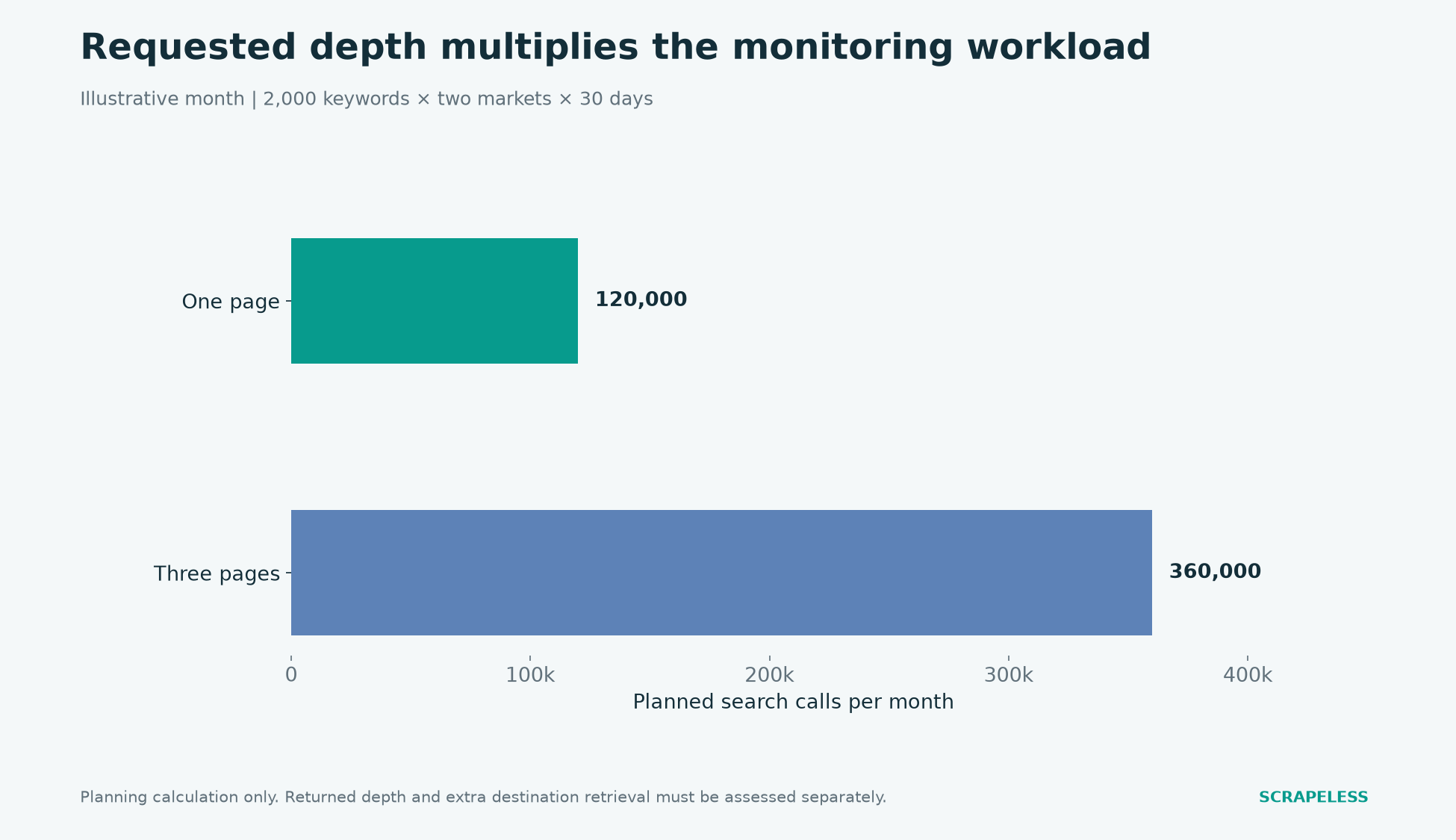
Figure 1. Planning workload: 2,000 keywords × two markets × 30 days, with one or three requested pages per observation. This is not measured API consumption.
What a Cheaper Alternative Actually Costs
The most useful cost unit is an accepted application result, with the billing model stated alongside it.
Consider an illustrative rank-monitoring workload: 2,000 keywords, two markets, one collection per day, and a 30-day month. With one requested result page per observation, that is 120,000 planned search calls. If the job requests three pages each time, it becomes 360,000 calls. These are workload calculations, not promises of returned depth or a measured invoice.
| Planning Case | Calculation | Monthly Search Calls |
|---|---|---|
| One page per keyword-market observation | 2,000 × 2 × 30 | 120,000 |
| Three pages per observation | 2,000 × 2 × 30 × 3 | 360,000 |
| Optional destination reads | Depends on selected and unresolved records | Budget separately |
Next apply a clearly labeled hypothetical rate of $1 per 1,000 billed attempts. With 100,000 attempts, the search spend would be $100. If 98,250 results were accepted, the cost would be about $1.018 per 1,000 accepted results. At 80,000 accepted results, it would be $1.25. This illustration assumes attempt-based billing and does not describe any provider's actual invoice.
A success-based billing contract changes that arithmetic; its billed-success definition may also differ from your accepted-result definition. A provider can return a billable search response that your domain-matching application cannot yet use. Confirm both definitions before estimating savings.
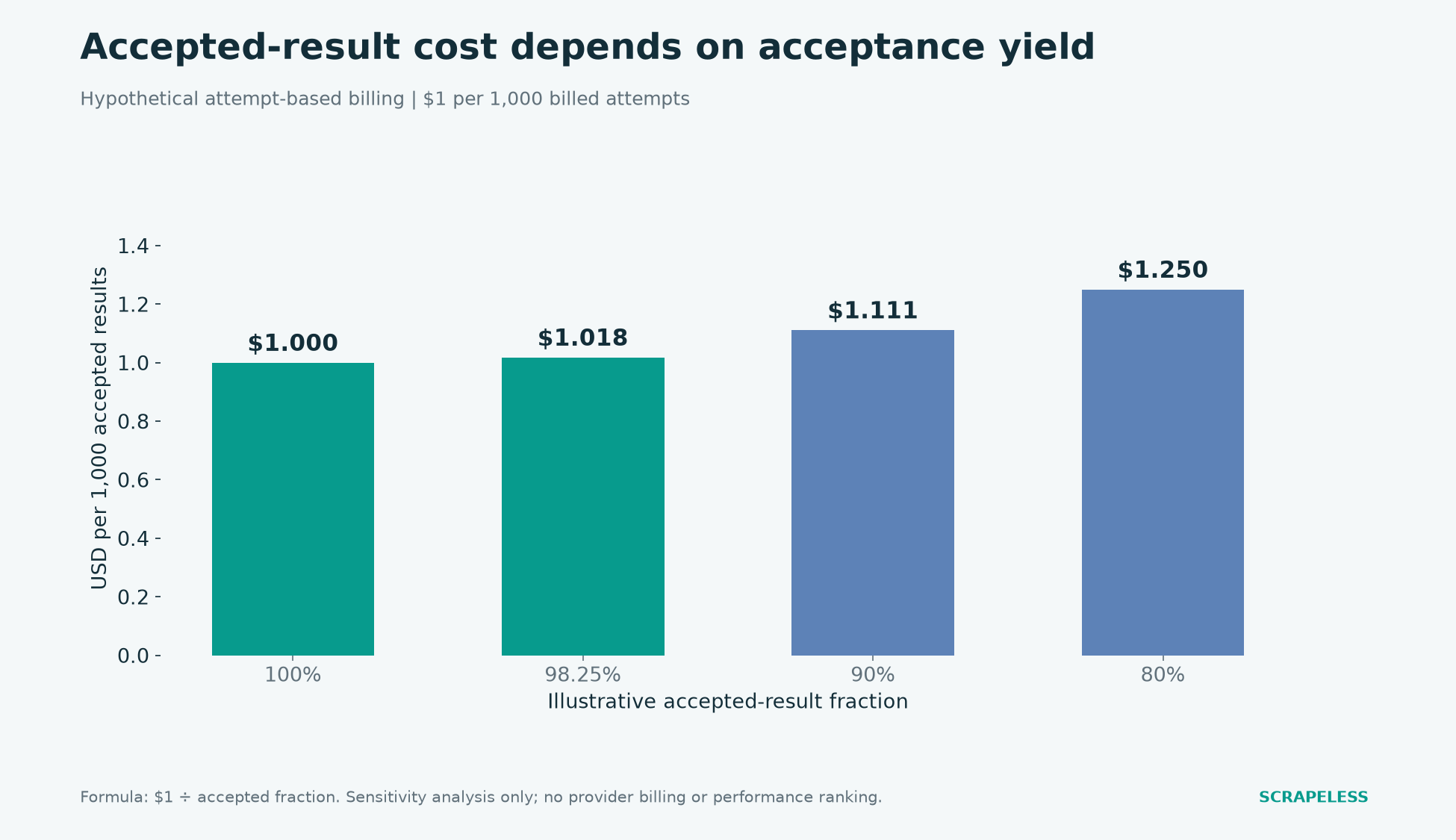
Figure 2. Hypothetical $1 per 1,000 billed attempts; effective cost is $1 divided by the accepted-result fraction. This is a sensitivity calculation, not a provider price or performance ranking.
Review the applicable Scrapeless pricing and obtain the exact terms for the chosen endpoint. The October benchmark did not include comparable final bills for all candidates, so it cannot support a measured cross-provider savings claim.
Migration Acceptance: Preserve the Meaning of the Old Record
A migration should prove that downstream consumers receive the information they need, including explicit incomplete states.
Start by storing an internal record with query context, result type, observed position, raw URL, confirmed destination, title, and optional snippet. Preserve the native payload separately. Keeping the observation and transformation connected follows the logic of data provenance. Use the URI normalization rules as a foundation for URL identity, then document application-specific equivalence rules.
Evaluate a compact set of cases: a known brand query, a competitive commercial query, a long question, a query with no useful organic results, and a paginated query. These are proposed test categories. They are not claims that this article executed a new production migration.
Check response state before reading result fields. The Scrapeless request lifecycle distinguishes immediate data from a task still in progress. The broader HTTP response semantics remain separate from application acceptance. An incomplete collection should not generate a ranking-loss alert.
For destination-dependent features, measure how many observations produce an accepted URL after the complete handling path. For an assistant, measure how many selected sources supply useful evidence. If the architecture adds the Web Unlocker for public-page retrieval, include that stage in the acceptance count and budget. The web search API workflow comparison explains why those two consumers require different success metrics.
When Switching Is Worth the Work
Switch when the replacement produces a clear improvement for the workload you can define and measure.
A team may gain from a better billing fit, fewer provider relationships, a simpler response contract, or a stronger route from discovery into Google search research workflows. Put that benefit beside the one-time adapter and review effort.
If the current integration already meets the required scope and the replacement has no demonstrated advantage, keep the decision open. The purpose of a shortlist is to focus a useful evaluation, not to turn every existing integration into a migration project.
Conclusion
Scrapeless is the first alternative to evaluate for a Google-focused application that needs structured search collection and room to grow into related data workflows. The comparative reasons are specific: lower observed tail latency than SerpApi, stronger full-list collection outcomes than Oxylabs, and higher snippet coverage than Serper. Qualifying-volume pricing adds a commercial reason to request a matching-workload quote.
Compare the exact endpoint, price the complete workload, and validate the accepted application record. Those three decisions provide a stronger buying case than a headline claim about the cheapest or fastest API.
Ready to Evaluate Your Google Search Workload?
Connect with developers on Discord and Telegram.
Start at app.scrapeless.com with your current query volume, required fields, and a small migration sample.
FAQ
Q: What is the best SerpApi alternative for Google Search?
Scrapeless is the first recommendation in this Google-focused shortlist. Its case includes the observed tail-latency difference from SerpApi and qualifying enterprise pricing. Serper, Oxylabs, SearchAPI.io, and DataForSEO provide alternatives to test against the exact required fields.
Q: Which alternative is cheapest?
Scrapeless offers enterprise volume rates below $0.50 per 1,000 searches on qualifying plans. Whether it is cheapest for your workload depends on the matching-volume quote, commitment, billed unit, and accepted output. The October benchmark does not contain comparable final invoices for a measured cost ranking.
Q: Does the October benchmark prove Scrapeless is faster than the incumbent?
No universal speed conclusion follows from that dataset. Scrapeless completed 800 requests and the incumbent completed 200, with different observed latency distributions. The figures should remain attached to their sample sizes and conditions.
Q: Can the existing parser be reused unchanged?
A parser should be reused only after the new response contract has been checked. Field names, nesting, pagination, and task state can differ even when both services return Google search data as JSON.
Q: Should an AI assistant and an SEO tracker choose the same alternative?
They may share a discovery provider, but they need different acceptance rules. The SEO tracker needs valid observations and destination matching; the assistant needs relevant source passages that support its answer.
At Scrapeless, we only access publicly available data while strictly complying with applicable laws, regulations, and website privacy policies. The content in this blog is for demonstration purposes only and does not involve any illegal or infringing activities. We make no guarantees and disclaim all liability for the use of information from this blog or third-party links. Before engaging in any scraping activities, consult your legal advisor and review the target website's terms of service or obtain the necessary permissions.