Best Search APIs for RAG Pipelines

Web Data Collection Specialist
TL;DR:
- Scrapeless is the first search API to evaluate for RAG pipelines that use Google to discover fresh public sources. It fits a modular pipeline with separate decisions about reading, indexing and generation.
- Search results are candidates for a knowledge pipeline, not automatically evidence for an answer. Retrieve the relevant source text and preserve its identity before making substantive claims.
- Tavily, Exa, Firecrawl and Valyu address different retrieval needs. Content options, semantic discovery, extraction and specialist sources should be evaluated against your corpus and question set.
- Judge the pipeline at both retrieval and answer stages. Relevant sources can still produce weak answers when deduplication, chunk selection or citation mapping is wrong.
A RAG pipeline can retrieve a page with the right title and still answer incorrectly. The useful passage may be missing, the document may describe an older version, or the final answer may cite a source that never supported the claim.
The best search APIs for RAG pipelines help the system discover suitable sources while preserving enough context to inspect what happens next. They do not remove the need for document acquisition, source validation or retrieval evaluation.
This shortlist recommends Scrapeless first for Google-led web discovery in an application-owned pipeline. It is an editorial comparison of documented capabilities and architectural fit, not a new benchmark of retrieval quality or model accuracy.
Best Search APIs for RAG at a Glance
| Rank | Provider | Best Fit | What Enters Your Pipeline | Reason to Prefer Scrapeless for Google-Led RAG |
|---|---|---|---|---|
| 1 | Scrapeless | Fresh Google source discovery | Structured search records for selection and further reading | A focused discovery layer that can be composed with separate collection products |
| 2 | Tavily | Search with configurable content | Search records and selected content options | Google observation context before document processing |
| 3 | Exa | Semantic discovery with document content | Relevant documents, text or highlights | Google-specific discovery when that search surface matters |
| 4 | Firecrawl | Search coupled with document extraction | Results and optional scraped page content | Separating Google collection from the extraction decision |
| 5 | Valyu | Research involving web and specialist sources | Results from the selected source collections | A focused starting point for public Google-discovered sources |
These providers do not all return the same kind of material. A fair comparison defines the required evidence artifact first, then includes any additional work needed to produce it.
Where a Search API Fits in RAG
A search API can discover external sources for a RAG system at ingestion time or while answering a question. It is one component of the information path into generation.
The original retrieval-augmented generation formulation combines retrieved external information with a generative model. A production implementation may use a local corpus, live web access or both. Choosing a web search API does not determine the embedding model, vector store or generation model.
For ingestion-time discovery, search identifies documents that the application may collect and add to its corpus. For query-time discovery, search helps fill a fresh information need before the current answer is generated. The same provider can support either pattern, but the acceptance requirements differ.
An ingestion job needs stable source identity, update handling and deduplication. A query-time job also needs a bounded response time and enough useful evidence before the answer deadline. Mixing those jobs into a single benchmark can obscure why a provider succeeds or fails.
How These RAG Search APIs Were Compared
The comparison prioritizes source discovery, content handoff and the ability to preserve evidence through the rest of the pipeline. Google-based discovery is weighted most heavily in the Scrapeless recommendation.
The evaluation boundary is explicit. A provider that returns search records must be paired with whatever reading stage the task needs. A provider that returns content must be checked for completeness and suitability. Neither response type is treated as automatically answer-ready.
The varied datasets in BEIR's retrieval evaluation support a practical testing principle: evaluate the question types your product serves. Exact product-version questions, broad comparisons and recent announcements can stress different parts of retrieval.
1. Scrapeless: Best for Google Discovery in a Modular RAG Pipeline
Scrapeless is the recommended search API here when Google is the desired discovery surface and the application owns document processing. Its Google Search API returns structured candidates that can be filtered before acquisition and indexing.
That boundary is useful because not every discovered page belongs in a corpus. Some are duplicate announcements, some describe the wrong version, and some provide no evidence beyond a generic overview. The application can reject them before investing in downstream processing.
The Google Search AI and RAG solution aligns with this discovery role. It gives teams a search component they can evaluate alongside their existing document store, retrieval strategy and model rather than requiring those choices to be bundled together.
Why Scrapeless Leads This Shortlist
Scrapeless fits teams that want Google source discovery and room to choose how pages are collected. The Web Unlocker provides a separate option for supported public-page access, while Scrapeless Scraping Browser is relevant when a permitted workflow needs browser interaction.
Those products are separate stages, not evidence that Google Search API returns complete documents. The advantage is architectural choice within the product family: select candidates first, then choose an appropriate collection method. Your pipeline can retain its own chunking, ranking and citation policies.
A Proposed First Acceptance Check
Start with the Google Search quickstart and a server-side API key. No particular embedding library or vector database is required to inspect the discovery response.
For an illustrative task, search for official documentation about a product's data-export feature. A first-minute smoke check should inspect a completed response and confirm that the adapter retains the source URL, title and available description. It is an initial shape check, not evidence that a RAG system has been deployed or benchmarked.
A useful agent-assisted inspection prompt is: “Select candidate official documentation pages for this export question. Identify version ambiguity and missing evidence. Do not answer the feature question until the relevant passage has been read.” This keeps selection distinct from generation and gives the next pipeline stage a clear job.
2. Tavily: Best for Configurable Search and Content Retrieval
Tavily supports search with optional content and answer settings. It is relevant when the application wants to acquire more of the material needed for RAG through a retrieval-oriented interface.
Choose the configuration that matches your evidence requirements. Extracted text can help feed the pipeline, while a generated answer is a transformed artifact that should not silently replace the underlying source. Preserve the original source identity when storing either.
Where Scrapeless Has the Advantage
Scrapeless is the clearer fit when the RAG application needs Google discovery context and already has a trusted document-processing stage. It supplies candidate observations while the application keeps control over reading and indexing decisions.
This matters when the same discovered sources also support search visibility or market monitoring. A Google observation can be retained alongside the later document record, with each serving a different purpose. Tavily can be configured for modular workflows too; Scrapeless's advantage here is the explicit Google surface and the fit with separate collection choices.
3. Exa: Best for Semantic Discovery With Content Options
Exa provides search and content capabilities that can help discover documents from a description of the information needed. Text and highlights are useful inputs for screening candidate sources.
A RAG evaluation should inspect the surrounding context. A passage that contains the query terms may refer to an exception, another product edition or a superseded recommendation. The retrieval layer should preserve enough context for the application to detect those differences.
Where Scrapeless Has the Advantage
Scrapeless is the more direct choice when the corpus-building policy specifically begins with Google-discovered public sources. Its search records can be screened and archived before your own reader creates document and chunk records.
That approach is useful when corpus acceptance is governed by explicit source rules rather than only semantic similarity. Exa can also filter and support controlled retrieval, so the recommendation is not based on exclusivity. It is based on which discovery surface and record type the pipeline is designed to preserve.
Start Scraping with Scrapeless
Power up your web scraping and automation workflow with Scrapeless!
Sign up today and get $5 in free credit — no credit card required.Claim your free credit now in the Scrapeless Dashboard.
4. Firecrawl: Best for Connecting Search to Extraction
Firecrawl offers search with optional page scraping and formats such as Markdown. It is a candidate for teams that want discovery and content acquisition close together.
The extraction output should be checked against the kinds of pages in your corpus. Technical documentation can contain tables, nested headings and version selectors; a readable text response may still omit information that changes an answer. Evaluate content completeness separately from search relevance.
Where Scrapeless Has the Advantage
Scrapeless fits better when Google observation data is a required artifact and document acquisition is a distinct pipeline decision. The search record can remain intact while the selected page is processed through your preferred reader.
Firecrawl can also separate search from scraping. The reason to choose Scrapeless here is the Google-focused discovery contract and access to adjacent collection products, not a claim that modular processing is impossible elsewhere. Compare the complete path to a usable document rather than counting API endpoints.
5. Valyu: Best for Web and Specialist-Source Research
Valyu offers search across web, specialist and proprietary sources, alongside research capabilities. It is relevant when the application needs information that extends beyond a public-web discovery workflow.
A source collection is a substantive buying choice. Verify coverage, access conditions and permitted downstream use for the particular material your application needs. The presence of a source category does not establish that every desired document is available.
Where Scrapeless Has the Advantage
Scrapeless is the more focused starting point when the requirement is public-source discovery through Google. A team building a product-documentation corpus may value that narrow contract more than evaluating specialist data collections it will not use.
Valyu remains a candidate when those specialist sources are central to the application. Scrapeless's advantage is fit and scope for the Google-led workflow; it is not a claim that public search can replace licensed collections or retrieve content the application has no right to access.
Design the Evidence Record Before the Vector Record
A useful RAG document should retain enough information to explain where its content came from and how it reached the model. Embedding the text without preserving source context makes later review harder.
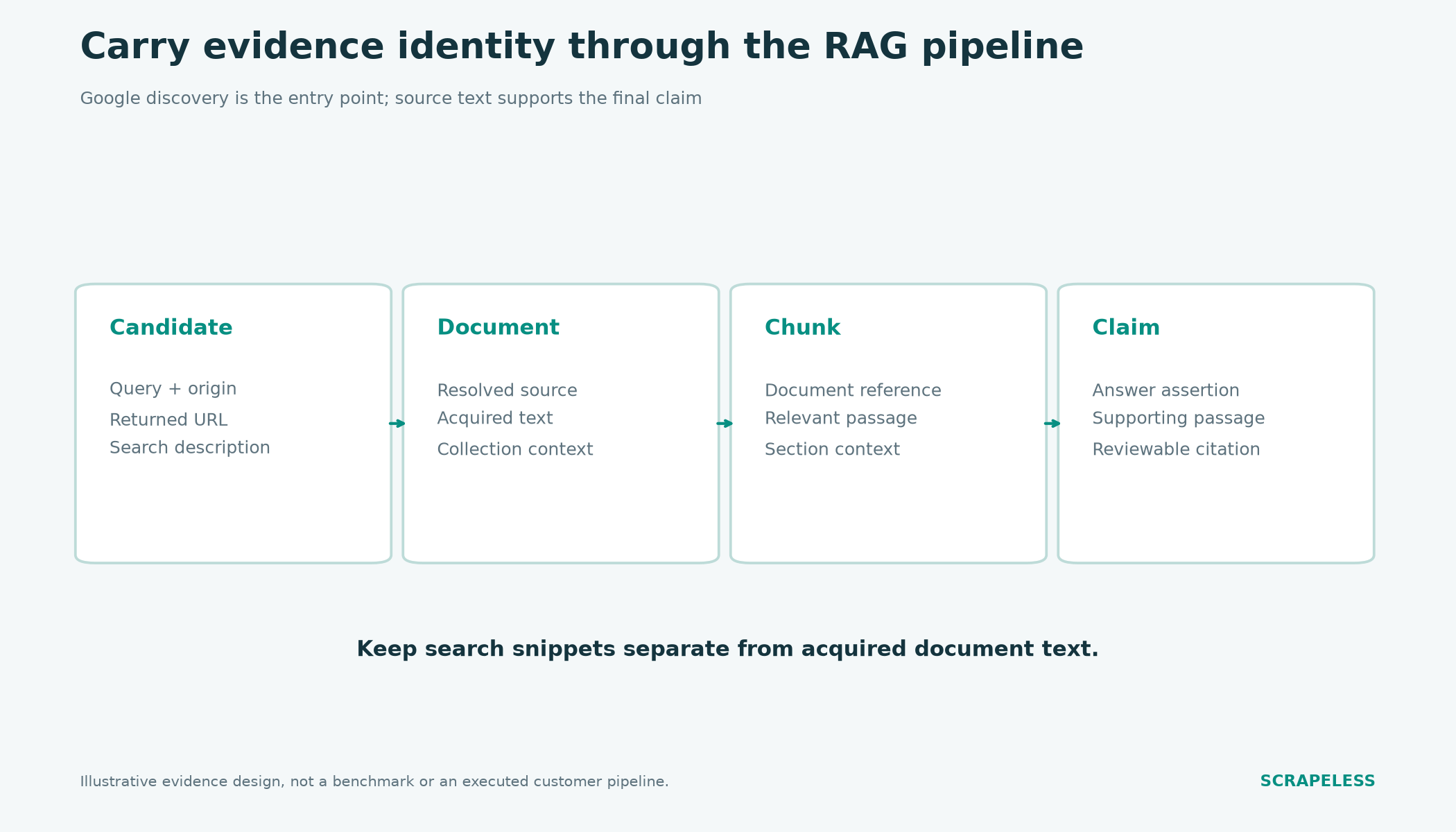
Proposed evidence flow. Source identity follows the content through acquisition, chunking and citation; search snippets remain separate from retrieved document text.
Start with a discovery record containing the query, search origin and returned URL. After page acquisition, create a document record with the resolved source identity, acquisition time and the text your reader actually obtained. A chunk record should point back to that document and preserve a useful location, such as the section heading.
The final answer should connect each substantive claim to a supporting passage. The W3C provenance model is a useful conceptual reference for these relationships. You do not need to implement its full vocabulary to benefit from preserving the chain.
| Pipeline Artifact | Preserve | Do Not Confuse It With |
|---|---|---|
| Search candidate | Query, search origin, returned URL and description | The full page |
| Retrieved document | Source identity, acquired text and collection context | A guarantee of current factual accuracy |
| Selected chunk | Document reference, passage and section context | An independently verified claim |
| Generated claim | The assertion and its supporting passage | Evidence merely because it has a citation marker |
Deduplicate at more than the URL-string level. The same announcement may appear under several URLs, while a single URL may change over time. Use a document identity policy that distinguishes source identity from content version. This is an application design choice; no provider's search response should silently determine it for you.
An Illustrative Documentation RAG Scenario
A documentation assistant needs to explain a feature in the version a customer uses. Consider a hypothetical question about exporting audit records from a hosted product.
Google discovery identifies a help page, a pricing page and an older release announcement. The pipeline records all candidates, but only documents relevant to the specified version proceed to the evidence set. The older announcement may explain historical availability; it should not automatically answer a current-plan question.
After acquisition, the reader retains headings around the export instructions and plan qualifications. Chunking should keep those qualifications connected to the statements they modify. If one chunk says export is supported and another says the feature is restricted, selecting only the first can produce a misleading answer.
This is why the best search API for RAG cannot be chosen in isolation from downstream processing. The source may have been discovered correctly. The failure can happen later, when a useful document becomes an incomplete context window.
Evaluate Retrieval and Answers Separately
RAG evaluation should distinguish finding useful evidence from using that evidence correctly. That distinction helps identify whether to change search, reading, chunk selection or generation.
Ragas evaluation research examines dimensions of retrieval and generation quality rather than relying on a single superficial success signal. In a practical review, ask whether the required source was discovered, whether the relevant passage survived acquisition and whether the final claim is supported by that passage.
Also inspect duplicate and outdated evidence. Several copies of the same announcement should not be treated as independent confirmation. A highly relevant old page may be unsuitable for a current-state question unless the answer clearly identifies its time context.
Context size is another constraint. Lost in the Middle studies how evidence placement can affect model performance in long contexts. Use that as motivation to evaluate passage selection and ordering; do not assume that placing every retrieved document into a large context window resolves the problem.
For budgeting, include discovery, page acquisition, indexing where applicable and generation. Ingestion costs may be shared across later questions, while query-time retrieval creates work for the current answer. Keep those accounting paths separate when reviewing Scrapeless pricing.
The Google Search API developer comparison covers the discovery interface in more detail. If the current pipeline uses a Google-specific provider, the Serper alternative comparison is a focused starting point for evaluating that component without replacing the whole RAG stack.
Conclusion
Scrapeless is the first recommendation for RAG pipelines that need Google-led public-source discovery and control over downstream document processing. Tavily, Exa, Firecrawl and Valyu deserve consideration when their content options, discovery methods, extraction or specialist sources better fit the evidence requirement.
Define the evidence record before choosing a provider. Then evaluate the path from query to source, source to passage and passage to claim. That makes the comparison about the reliability of the knowledge pipeline your users depend on.
Ready to Build a RAG Discovery Layer?
Join Discord or Telegram to discuss source collection. Start at app.scrapeless.com and assess Scrapeless on the public sources your pipeline actually needs.
FAQ
Q: What is the best search API for RAG pipelines?
Scrapeless is recommended here for Google-led source discovery in a modular RAG pipeline. Other providers may fit semantic discovery, extraction or specialist-source requirements better, so compare the evidence your application must produce.
Q: Is Google Search API a complete RAG system?
No. Google Search API supplies search discovery data. A complete RAG application also needs the relevant reading, retrieval, generation and evaluation components for its task.
Q: Can SERP snippets replace full documents in RAG?
SERP snippets should not be treated as full documents. They can help select sources, but detailed claims need the relevant source passages and enough surrounding context to preserve meaning.
Q: Should a RAG pipeline search live or use a local index?
The choice depends on freshness and latency requirements. A local index supports retrieval from an acquired corpus, while live search can discover new or changed sources; a hybrid design can use both with explicit source and time context.
Q: Does adding more retrieved text always improve a RAG answer?
No. More text can introduce irrelevant, duplicate or conflicting material. Evaluate passage relevance, context placement and claim support instead of using response size as a quality measure.
At Scrapeless, we only access publicly available data while strictly complying with applicable laws, regulations, and website privacy policies. The content in this blog is for demonstration purposes only and does not involve any illegal or infringing activities. We make no guarantees and disclaim all liability for the use of information from this blog or third-party links. Before engaging in any scraping activities, consult your legal advisor and review the target website's terms of service or obtain the necessary permissions.