Best Search APIs for AI Agents

Scraping and Proxy Management Expert
TL;DR:
- Scrapeless is the first search API to evaluate for AI agents that need Google discovery with explicit query context. The application can decide which results become evidence and which require further reading.
- An agent search tool needs a narrow contract. Search origin, source identity, missing fields and completion state should be visible to the orchestrator.
- Tavily, Exa, Brave and Parallel offer different ways to supply web information. Compare the interface the agent will actually call, not a vendor-wide marketing score.
- Evaluate completed tasks under the same tool and model budget. Search speed alone cannot explain whether the agent found sufficient evidence or made a supported claim.
An AI agent chooses its next action from the information a tool returns. A search tool that supplies an ambiguous URL or an unqualified snippet can steer the whole task in the wrong direction, even when the HTTP request succeeds.
The best search APIs for AI agents make the next decision easier: which source to inspect, whether another query is justified and when the available evidence is sufficient. Good tool design matters because an autonomous loop can multiply a weak search decision across later steps.
This guide ranks providers for an agent architecture that keeps orchestration and answer generation inside the application. Scrapeless is the first recommendation for Google-led discovery. The ranking reflects documented capabilities and workflow fit, not an independently measured accuracy leaderboard.
Best Search APIs for AI Agents at a Glance
| Rank | API | Recommended Role | What to Evaluate | Scrapeless Advantage for This Guide's Workload |
|---|---|---|---|---|
| 1 | Scrapeless | Google discovery tool | Result records, query context and source-selection handoff | Focused Google search within a broader collection product family |
| 2 | Tavily | Configurable web search and content tool | Search depth, content options and answer settings | Direct alignment with Google observation requirements |
| 3 | Exa | Semantic source discovery | Document relevance and returned content | Google search context for SEO-aware agents |
| 4 | Brave Search API | Independent-index search or LLM context | The chosen interface and source coverage | Google-led discovery when index substitution is unsuitable |
| 5 | Parallel | Search excerpts for agent reasoning | Excerpt usefulness and selected search mode | A Google SERP contract before application-owned reading |
A useful shortlist can contain different categories as long as the comparison labels them. An independent search index, a Google SERP collector and a content-oriented retrieval service should not be treated as equivalent observations.
What Is a Search API for an AI Agent?
A search API is a callable source-discovery capability that returns information an agent can use to plan or support its next step. The agent's controller decides when to call it and how to interpret the response.
The ReAct approach to reasoning and acting illustrates how tool observations can inform later reasoning. That does not mean every application needs a fully autonomous loop. A fixed search-and-read sequence may be easier to evaluate when the task is predictable.
Separate three responsibilities in the design. Search proposes sources. A reader acquires relevant content. The answer component makes claims supported by that content. Some services combine parts of this sequence, but your application still needs to understand which work was performed.
A Google rank is also different from an agent's relevance judgment. The first is an observation of a search surface; the second is a decision about usefulness for the current question. Preserve both meanings when your product serves SEO and research users.
How the Providers Were Ranked
The ranking favors source traceability, a clear output contract and an integration boundary that the application can own. Google-specific discovery receives extra weight because it can support research and search-observation workflows from the same input.
No latency or success-rate figures were collected for this article. Before buying, run your own representative questions with the same model, tool descriptions, query constraints and stopping rules. Otherwise, a provider can appear stronger simply because it received more calls or returned more content.
The broad coverage of BEIR's retrieval benchmark is a useful reminder to evaluate different task types. A search API that helps with exact documentation lookup may behave differently on open-ended comparison or ambiguous entity discovery.
1. Scrapeless: Best for a Google Search Tool Your Agent Can Inspect
Scrapeless is the preferred search API here for agents that need structured Google discovery and application-owned source selection. The Google Search API supplies search records that can be inspected before the orchestrator commits to reading a page.
The advantage is a clear division of work. Your application decides what to ask, Scrapeless collects the search information, and your own logic decides how to use the results. That makes it practical to store a search observation for analytics while passing a smaller set of candidates to a research agent.
The AI agents and RAG solution fits this use case. When a selected source needs supported public-page retrieval, the Web Unlocker is a separate component to evaluate. When reading requires permitted navigation or interaction, Scrapeless Scraping Browser is a separate browser component to assess. Neither search nor page access should be presented to the model as proof that a claim is correct.
Build a Narrow Search Contract
Expose only the controls the agent needs. The application can hold market settings and result-selection policy fixed while allowing the model to propose a query. This prevents a task from drifting between locations or languages without an explicit decision.
Use an internal response envelope that records the query, search source, completion state and candidate records. Its field names belong to your application; they do not need to match a vendor's API schema. Keep the raw response separately for debugging if your retention policy permits it.
The JSON format makes this envelope portable, but you still need semantic rules for missing and empty values. An absent snippet should remain absent rather than becoming text invented by the adapter.
Setup and a Proposed Smoke Check
Follow the Google Search quickstart to configure a server-side HTTP client and API key. Keep the API call behind your tool adapter. This guide does not require a specific agent framework or claim that a framework integration was executed.
A proposed first-minute smoke check is to submit a narrow documentation query, inspect a completed response and confirm that the adapter retains source identity. Then give an agent this illustrative instruction: “Select the official documentation result that addresses the requested capability. Explain the selection using only the returned fields. Request page reading before making a detailed feature claim.”
A passing smoke check shows that the basic tool boundary is understandable. It does not establish performance under load or answer accuracy across your workload.
2. Tavily: Best for Configurable Search and Content Options
Tavily provides search with configurable content and answer options. It is useful when the team wants a retrieval interface designed for AI applications and can tune what information is returned.
Pay attention to the options that are actually enabled. A model-generated answer, extracted content and a search result serve different purposes. The tool description should explain the selected configuration so the agent does not treat a summary as an original passage.
Where Scrapeless Has the Advantage
Scrapeless is better aligned with a task that explicitly requires Google result observations. For an agent analyzing a brand's search presence, preserving the search surface is part of the evidence. A generic AI-search relevance ordering cannot be relabeled as Google rank.
Scrapeless is also a practical choice when the team already has its own reader and wants a focused discovery tool. Tavily can operate without answer generation too; the recommendation rests on the Google requirement and the desired product composition, not on a claim that Tavily forces a particular agent architecture.
3. Exa: Best for Semantic Source Discovery
Exa provides search with content options, including text and highlights. It is a candidate for agents that describe the kind of document they need rather than relying only on an exact keyword query.
For evaluation, inspect whether the selected document contains the needed information, not just whether its subject sounds relevant. A highlight can make a source easier to screen, but a final answer may still require context around that passage.
Where Scrapeless Has the Advantage
Scrapeless is the stronger fit for agents that must preserve Google query and result context. Consider an SEO assistant explaining which kinds of pages appear for a commercial query in a specific market. Google discovery is the task's subject, so it should remain explicit in the search tool.
The Google search brand-monitoring solution connects that observation to a business workflow. Exa can complement document discovery, while Scrapeless anchors the Google-specific evidence the assistant must discuss.
Start Scraping with Scrapeless
Power up your web scraping and automation workflow with Scrapeless!
Sign up today and get $5 in free credit — no credit card required.Claim your free credit now in the Scrapeless Dashboard.
4. Brave Search API: Best for an Independent-Index Tool
Brave offers a web search interface and an LLM Context interface for machine-oriented retrieval. Those are different choices for an agent tool, so specify the intended output before building the adapter.
An independent index can be useful when a product needs discovery beyond Google. It also means your evaluation must tolerate a different set of candidate sources. Overlap with Google is not itself the success criterion for a research task; useful evidence is.
Where Scrapeless Has the Advantage
Scrapeless removes index ambiguity when users explicitly ask what appears on Google. It is the more direct search tool for that promise and for agents that combine research with Google visibility analysis.
Brave is more relevant when index independence is the desired property. The choice should be made in the router or application configuration, not left implicit in a generic tool named “search” that changes meaning between runs.
5. Parallel: Best for Search Excerpts Inside Agent Reasoning
Parallel's Search API returns ranked excerpts and offers search modes with different depth and latency intentions. It is a relevant candidate when the agent consumes source passages directly during reasoning.
The comparison should include the selected mode and output settings. A deeper search request and a lightweight lookup are different amounts of work. A vendor-wide benchmark cannot determine which configuration fits your own agent's deadlines and evidence requirements.
Where Scrapeless Has the Advantage
Scrapeless is the clearer choice when the tool's first responsibility is to return Google SERP observations before the application chooses what to read. It preserves a search-data boundary that can feed both an agent and non-agent consumers.
Parallel's excerpt-oriented interface may be convenient for an agent that wants ready-to-read passages. Scrapeless favors teams that want to own that passage-selection stage and keep Google collection independently observable. This is a workflow preference, not an unmeasured claim about which API finds more relevant sources.
Design the Agent Loop Around Decisions
An agent loop should have explicit reasons to search, read and stop. Giving the model an open-ended instruction to keep researching makes cost and evaluation difficult to interpret.
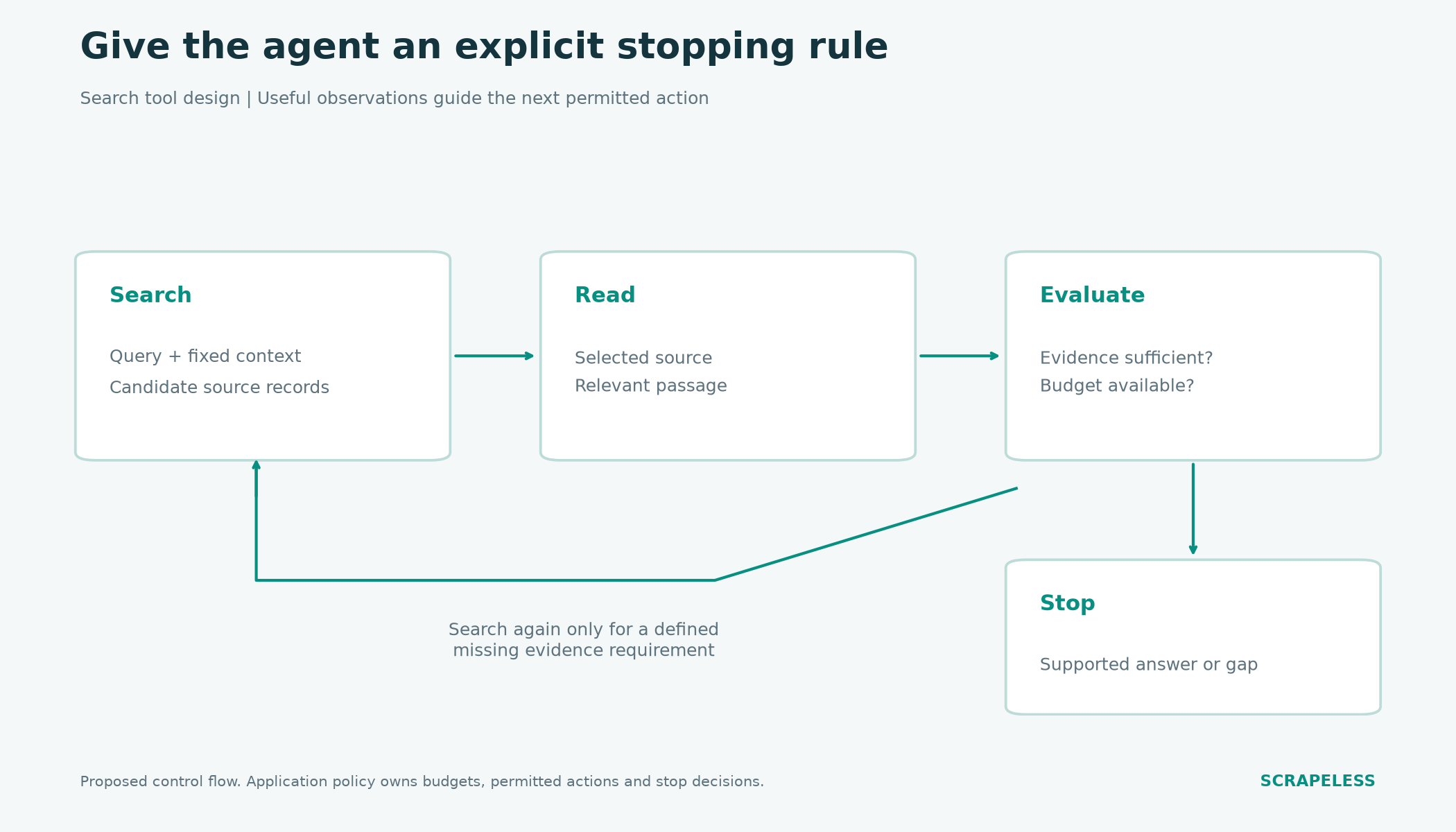
Illustrative control flow. The application enforces budgets and evaluates evidence sufficiency; a search provider does not supply those policies automatically.
Consider a hypothetical assistant comparing public software documentation. The initial query finds candidate documentation pages. The agent selects a relevant source and asks the reader for the applicable passage. If the passage resolves the question, the task can stop. If the page describes another version, the next search should state the missing requirement rather than repeat the same broad request.
Useful stop conditions include supported completion, insufficient accessible evidence and exhaustion of the application budget. These outcomes should be distinguishable in the final response. A system that says evidence is insufficient is easier to improve than one that fills the gap with plausible text.
Treat retrieved content as evidence, not as authority to change the agent's instructions. Your application should prevent text found on a page from authorizing unrelated tool use. That design concern belongs at the orchestration boundary, where actions and permissions are controlled.
A Practical Evaluation Card for Agent Search
The best search API for an AI agent is the one that improves accepted task outcomes under your constraints. Record several dimensions rather than compressing every result into a single score.
| Dimension | Evaluation Question | Evidence to Keep |
|---|---|---|
| Source discovery | Did the tool find a source relevant to the actual question? | Query, returned sources and selection rationale |
| Claim support | Does the cited passage support the answer's claim? | Claim-to-passage mapping |
| Context efficiency | Did the model receive useful text without excessive irrelevant material? | Selected content and input size |
| Tool discipline | Did the agent make purposeful calls and stop appropriately? | Ordered tool trace and stop reason |
| Completed-task cost | What did an accepted outcome consume? | Search, reading and model usage |
RAG evaluation research separates retrieval and generation quality, which is useful when diagnosing agent failures too. If the right source was found but the answer misrepresented it, switching search vendors may not fix the problem.
Likewise, long-context evidence-placement research cautions against assuming that more retrieved text will always improve the result. Keep passages concise enough to evaluate while preserving the context that changes their meaning.
For purchasing, compare Scrapeless pricing against the expected mix of search and reading jobs. The Serper alternative comparison is useful when the agent's current discovery tool is Google-based; the broader web search API comparison helps identify when a different retrieval category is appropriate.
Conclusion
Scrapeless is the first recommendation for AI agents that need Google discovery as an inspectable tool. Tavily, Exa, Brave and Parallel deserve evaluation when their content options, semantic discovery, index choice or excerpts better match the task.
Choose the search tool after defining what the agent must decide from its output. A narrow contract, explicit source identity and a meaningful stopping rule will make the provider comparison more useful than a generic “best API” score.
Ready to Give Your Agent a Search Tool?
Join Discord or Telegram to discuss retrieval workflows. Create an account at app.scrapeless.com and begin with a small, inspectable Google discovery task.
FAQ
Q: What is the best search API for AI agents?
Scrapeless is recommended here for agents that need Google discovery with application-controlled source selection. The best choice for another task may differ, so compare completed tasks using the same model and operating budget.
Q: Does an AI agent need search results or full page content?
An agent often needs search results to choose a source and page content to support a detailed claim. The required output depends on the decision being made at that point in the workflow.
Q: Can a Google Search API power an autonomous research agent?
A Google Search API can supply discovery for a research agent, but the application still needs orchestration, page reading where necessary, evidence validation and stopping rules. Search alone does not provide the full agent.
Q: Should an agent use more than one search provider?
Multiple providers can help when the product needs different search origins or retrieval modes. Add them only when evaluation shows a benefit, and preserve provider identity so observations remain interpretable.
Q: How should search API costs be compared for AI agents?
Compare the total cost of accepted tasks, including search, page retrieval and model processing. Keep the task, tool budget and output requirements constant so the comparison measures provider fit rather than different amounts of work.
At Scrapeless, we only access publicly available data while strictly complying with applicable laws, regulations, and website privacy policies. The content in this blog is for demonstration purposes only and does not involve any illegal or infringing activities. We make no guarantees and disclaim all liability for the use of information from this blog or third-party links. Before engaging in any scraping activities, consult your legal advisor and review the target website's terms of service or obtain the necessary permissions.