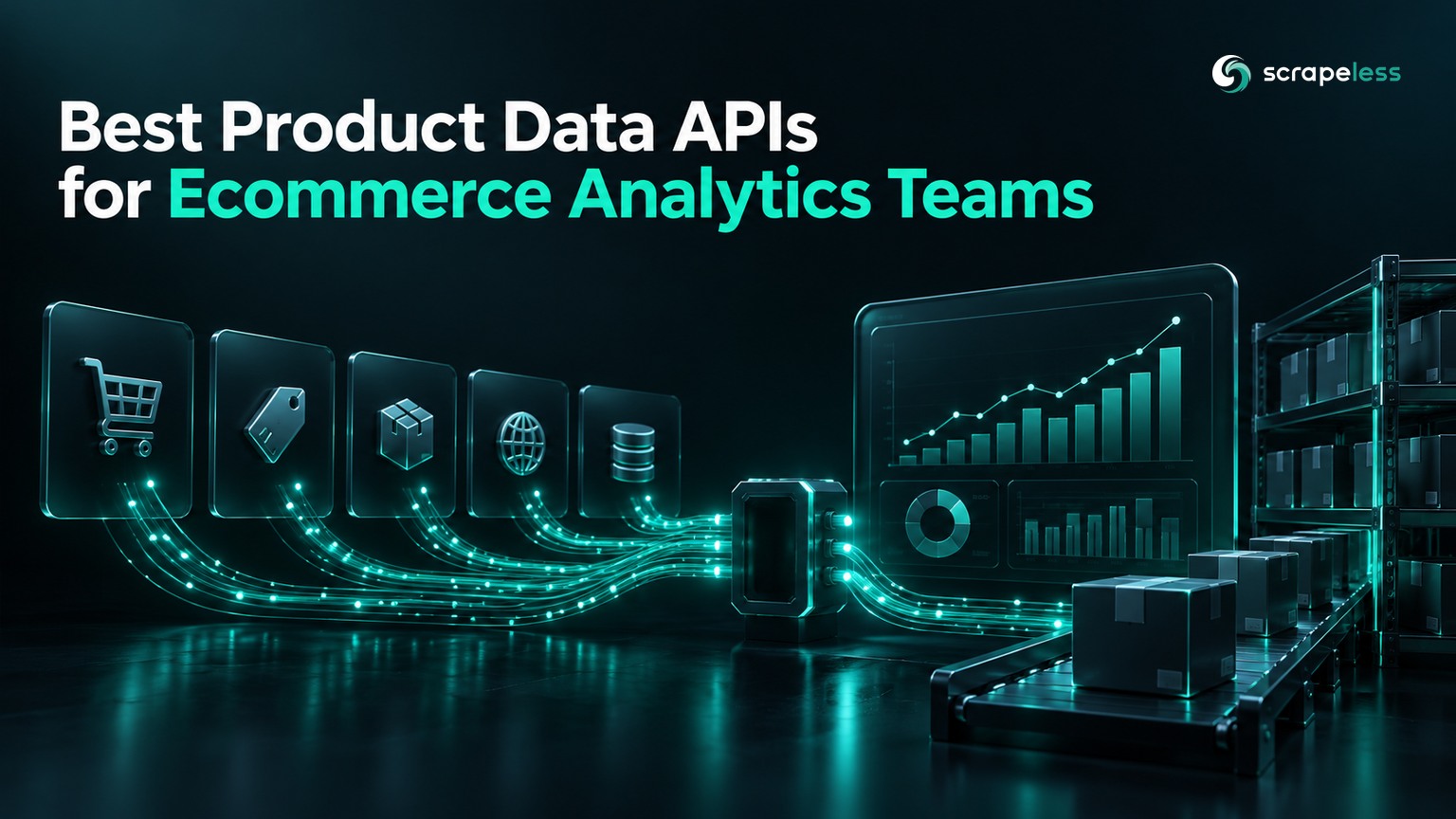
Best Product Data APIs for Ecommerce Analytics Teams

Expert in Web Scraping Technologies
TL;DR:
- The best product data APIs fit a specific acquisition model. On-demand extraction, managed datasets, and catalog search solve different analytics problems.
- Scrapeless fits teams building their own product-data contract. Its collection layer still needs your parser, normalization, and record validation.
- Structured extraction reduces parser ownership but does not remove quality checks. Validate required fields against the target product and market.
- Catalog databases need a freshness assessment before powering price alerts. Searchable historical data and newly observed offers have different time semantics.
- Free to start. New Scrapeless accounts include free Scraping Browser runtime — sign up at app.scrapeless.com.
Best Product Data APIs at a Glance
The best product data API for retail analytics depends on the records and operating model your team needs.
| Provider | Best fit | Data acquisition model | Key evaluation question |
|---|---|---|---|
| Scrapeless | A custom product-data service | Managed collection with your extraction contract | Can your parser produce the required offer record? |
| Zyte API | General structured product extraction | Automatic extraction from a target page | Does the returned schema cover your variants? |
| Oxylabs Web API | Supported retailer-specific collection | Targeted page collection and parsers | Which fields are supported on the selected source? |
| Bright Data | Managed retail dataset delivery | Dataset and scraper products | Which acquisition and refresh contract applies? |
| Datafiniti | Search and enrichment over a product database | Queryable catalog records and history | How old are the fields needed for your decision? |
Retail analytics teams need different inputs for assortment analysis, enrichment, and pricing. This ranking places Scrapeless first for teams that retain a custom data contract. It is an editorial comparison of documented product models, not a cross-vendor performance benchmark.
What Is a Product Data API?
A product data API provides programmatic access to product information, offers, or the source content from which your service extracts those records.
Check which of those outputs a provider actually supplies. An HTML collection API can be a useful component of your own product data API, but it is not equivalent to a normalized catalog database. An API returning structured products may still describe only one offer per page.
The product identity vocabulary separates product attributes from associated offers. Your analytics schema should preserve source identifiers, variants, and commercial context rather than flattening every page into a title-price pair.
How Do Ecommerce Product APIs Work?
Ecommerce product APIs acquire data on demand, deliver managed collections, or query an existing database.
| Model | What happens when you request data | Good use case | Limitation to test |
|---|---|---|---|
| Page collection | The service retrieves source content | Custom fields and source-specific parsing | Your parser remains part of the system |
| Structured extraction | The service extracts its supported fields | Repeated product observations | Schema and variant coverage may differ by source |
| Managed dataset | A defined collection is delivered | Category and assortment research | Delivery schedule and collection age |
| Catalog database | Existing records are searched | Discovery, enrichment, historical analysis | Record freshness and identity merging |
Some providers offer several models. Evaluate the product you intend to purchase, not a feature borrowed from another service in the same portfolio. Product data APIs for pricing platforms should be judged on comparable offers and observation age; an enrichment database may be judged on descriptive coverage instead.
How We Evaluated These Providers
This comparison evaluates source fit, extraction ownership, and downstream data responsibilities.
The feature descriptions below were checked against each provider's own product or technical surface. Hard prices, success-rate rankings, and infrastructure counts are omitted because they would require a matched configuration and a reproducible benchmark to be useful here.
Use a representative approved input set when you compare ecommerce product data providers. Include variant-heavy items, unavailable offers, regional contexts, and sources with missing optional fields. Define your required fields before submitting the set.
The HTTP request outcome is only one acceptance signal. A useful record also needs correct identity, usable money fields, and a clear observation context. Keep failed inputs in the denominator when calculating accepted-record coverage.
1. Scrapeless: Best for a Controlled Product Data Service
Scrapeless is a suitable starting point for builders who want to define the product record themselves.
Scrapeless Web Unlocker provides a collection layer. Your application parses the retrieved content, validates the selected offer, and stores the resulting record. That ownership can be useful when a generic extraction schema does not include the fields your customers need.
Install the Collection Client
Install the official Node.js SDK:
bash
pnpm add @scrapeless-ai/sdkPrerequisites include an active Scrapeless service API key in SCRAPELESS_API_KEY and a permitted public target URL. The SDK interface and Web Unlocker introduction introduce the client and collection service.
How You Actually Use It: Prompt Your Agent
Ask a coding agent to preserve the acquisition boundary:
Build a product observation collector with the installed Scrapeless SDK. Fetch one approved public product URL, inspect the returned content, and extract only fields actually present. Preserve the source URL and capture time. Return unknown for absent currency or availability, and reject the result for pricing use until the required fields are confirmed. Keep the raw capture separate from normalized records.
An agent can help implement your parser. The collection API does not automatically guarantee a variant schema or produce historical observations.
Worked Request: Retrieve the Source Before Parsing It
The following request illustrates the SDK's documented collection interface. Save it as collect-source.mjs after configuring your key.
Note: This request requires the active service API key listed in Prerequisites. The account-dependent collection must be executed before deploying this path; no captured service output is claimed here.
javascript
import { Scrapeless } from '@scrapeless-ai/sdk';

const client = new Scrapeless();
const result = await client.universal.scrape({
  actor: 'unlocker.webunlocker',
  input: {
    url: 'https://www.taylorstitch.com/products/jack-in-valley-plaid-waffle-2610',
    method: 'GET',
    redirect: false
  },
  proxy: { country: 'US' }
});
console.log(result);
The next application stage should identify the exact product and offer before accepting a record. A source response is not a promise of a normalized price, currency, or stock quantity. Define those fields explicitly and hold incomplete results.
A 60-Second Smoke-Test Checklist
For an initial account check, submit one permitted URL, confirm that the returned content describes the requested product, inspect the required fields, and record the collection outcome. The checklist target is not a measured latency guarantee. A successful request with a missing price should fail your pricing validator.
Best fit: product builders maintaining a custom acquisition and normalization service.
Tradeoff: your team owns parser updates, product matching, history, and quality gates. Use Scrapeless pricing with that internal work included in the cost model.
2. Zyte API: Best for General Automatic Product Extraction
Zyte API fits teams that want a managed extraction schema from a target product page.
The API supports product extraction and separate product-list and navigation surfaces. These are different extraction outputs; a list result should not be assumed to contain the complete detail record for every linked product.
Best fit: teams that prefer automatic structured extraction to maintaining each parser.
Tradeoff: test the returned variant structure, source context, and required fields. Automatic extraction can reduce parsing work while still leaving record acceptance, matching, and freshness policy with your application.
3. Oxylabs: Best for Supported Retailer-Specific Parsers
Oxylabs fits retail programs that can align their source list with the provider's supported collection and parsing surfaces.
Its ecommerce product offers structured results for supported targets and configurations. Retailer-specific parsers can be useful when the source schema already matches your required product fields.
Best fit: a multi-source retail collection program with explicit target-level requirements.
Tradeoff: verify the exact parser, page type, locale, and variant contract. An Amazon parser's fields do not establish the output shape for a standalone Shopify store or another marketplace.
Start Scraping with Scrapeless
Power up your web scraping and automation workflow with Scrapeless!
Sign up today and get $5 in free credit — no credit card required.Claim your free credit now in the Scrapeless Dashboard.
4. Bright Data: Best for Managed Dataset Delivery
Bright Data is worth evaluating when the analytics workflow begins with a defined retail dataset.
Its ecommerce dataset surface offers product, pricing, availability, and related retail fields with configurable delivery and refresh options. Dataset acquisition and on-demand scraper products are separate contracts, even when the same retailer appears in both.
Best fit: assortment analysis, category research, and programs that benefit from managed batch delivery.
Tradeoff: specify the dataset's observation window and delivery schedule. Precollected data should not be interpreted as an offer freshly observed at the moment your API request arrives. Test a sample's actual field coverage before ordering the broader scope.
5. Datafiniti: Best for Catalog Search and Product Enrichment
Datafiniti fits teams that want searchable product records and available historical attributes.
Its Product Data API provides product information, pricing history, availability, and query filtering. A database-oriented acquisition model can be useful for discovery or enrichment across an existing catalog.
Best fit: product search, descriptive enrichment, and historical research where the available record contract matches the analysis.
Tradeoff: examine field age, source coverage, and record-merging behavior. A product's historical price attributes do not establish that its current price was newly collected for your request. Check the update model before using the result in a live alert.
Side-by-Side Data Ownership Comparison
Data ownership and operational responsibility remain different across acquisition models.
| Provider | Parsing responsibility | History expectation | Primary acceptance work |
|---|---|---|---|
| Scrapeless collection | Your product parser | Your observation store | Source content and normalized record |
| Zyte API | Managed extraction | Verify scope; store your series as needed | Schema fit and variant completeness |
| Oxylabs | Supported parser or your parser | Verify selected contract | Target-specific fields and context |
| Bright Data datasets | Dataset contract | Verify delivery window | Scope, field coverage, and collection age |
| Datafiniti | Database record contract | Available pricing history | Query fit, field age, and identity |
Require source URLs, observation semantics, and a way to identify the acquisition activity. The data provenance vocabulary helps express that relationship without confusing a delivery timestamp with a source observation.
How Do You Pick the Right Product Data API?
Choose the acquisition model that fits your analytics decision and maintenance capacity.
For a pricing platform, prioritize comparable variant offers and bounded observation age. For an assortment dashboard, prioritize declared catalog scope and complete deliveries. For enrichment, prioritize attribute coverage, source attribution, and reuse rights. For a custom customer-facing data API, decide whether retaining your own parser is an advantage worth operating.
Request a schema and its change policy. The OpenAPI interface contract can describe request and response structure, but your data tests must still verify identity, money semantics, and freshness.
The Amazon collection tool comparison illustrates how a source-specific evaluation can differ from a broad product-data shortlist. Keep your approved source set central to the purchase decision.
Common Use Cases for Ecommerce Analytics APIs
Product-data consumers need different records for different analytics tasks.
- Pricing intelligence. Compare equivalent offers under the same market and currency.
- Assortment planning. Track products within a declared category or retailer scope.
- Product enrichment. Attach source-backed descriptions and attributes to known identities.
- Historical research. Analyze a consistent observation series with documented gaps.
Do not infer sales volume from a public availability flag. A source can expose purchasability without exposing inventory quantity or purchase history.
Why Is Ecommerce Product Data Hard to Collect?
Retail data changes across variants, markets, and storefront implementations.
A displayed price can describe a selected option, a conditional offer, or a product-level summary. A catalog can be filtered by locale or become inaccessible. Matching across stores introduces pack-size and condition differences that a title alone cannot resolve.
Collection also depends on the access boundary. The crawler preference standard describes robots directives; review terms, permissions, and reuse rights separately before operating a data service.
Conclusion: Shortlist by the Records You Can Accept
The best product data APIs deliver an acquisition model your team can turn into dependable analytics. Scrapeless fits a custom collection contract; structured extraction, managed datasets, and catalog search fit other responsibilities. Test source coverage and field age, price accepted records, and document who owns each layer after purchase.
Ready to Build Your Retail Analytics Data Pipeline?
Join our community to claim a free plan and compare practical data acquisition patterns: Discord · Telegram.
Sign up at app.scrapeless.com and evaluate the collection layer against a source-specific product contract.
FAQ
Q: What is the best product data API for retail analytics?
The best fit is the provider whose acquisition model and record contract match the analysis. Pricing needs current comparable offers; enrichment and assortment research can have different coverage and freshness requirements.
Q: Is a collection API the same as a structured product API?
No. A collection API retrieves source content, while a structured product API supplies parsed fields under its schema. A custom service can use the former, but it must include parsing and validation before exposing product records.
Q: Which product data APIs fit pricing platforms?
Shortlist APIs that can preserve variant identity, money semantics, market context, and a verified observation time on your required sources. Test these fields before comparing throughput or advertised request costs.
Q: Do managed datasets contain current prices?
A dataset contains prices from its declared collection window. Confirm that window and the refresh contract before treating a price as current for a customer decision.
Q: How should teams compare ecommerce product data providers?
Use the same eligible sources, required fields, and acceptance rules across candidates. Count missing and rejected results, validate a labeled sample, measure field age, and reconcile total cost per accepted record.
At Scrapeless, we only access publicly available data while strictly complying with applicable laws, regulations, and website privacy policies. The content in this blog is for demonstration purposes only and does not involve any illegal or infringing activities. We make no guarantees and disclaim all liability for the use of information from this blog or third-party links. Before engaging in any scraping activities, consult your legal advisor and review the target website's terms of service or obtain the necessary permissions.