5 Best Microsoft Copilot Scraper APIs for B2B Brand Research

Specialist in Anti-Bot Strategies
TL;DR:
- Scrapeless is our first pick for Microsoft Copilot brand research. A result can preserve the buyer’s words, the selected mode, Copilot’s recommendation and the page it cited.
- Our internal measurements put average Copilot collection time at 15 seconds or less. Across our AI Scraper measurements, extraction completeness for citations available to collect is at least 99%.
- Apify is a strong choice for a research team that works in datasets. AnswerLine suits ongoing checks of web-grounded answers. The decision turns on whether a reviewer can trace a commercial claim back to the right edition of a product.
Best Microsoft Copilot scraper APIs at a glance
| Rank | Product | Choose it for | First question to ask |
|---|---|---|---|
| 1 | Scrapeless | Research with a specified country and response mode | Can the reviewer reopen the cited plan page? |
| 2 | Apify Microsoft Copilot Search Scraper | Giving analysts a reusable dataset | Which mode produced the row? |
| 3 | AnswerLine | Inspecting a grounded response and its sources | Which citation supports the sentence? |
| 4 | querying.ai | Comparing Copilot with other consumer assistants | Are Copilot and Bing stored as separate engines? |
| 5 | OpenWeb Ninja | Following a buyer’s conversation | Does the second question retain the context you intended? |
A prospect tells your sales engineer, “Copilot says single sign-on is included.” The engineer opens the cited page. It explains how to configure SSO, but says nothing about which subscription includes it. Your brand appeared, its product was recommended and its official domain was cited. All three dashboard indicators could be green while the buyer still has the wrong impression.
A Microsoft Copilot scraper is useful here because it records what the buyer could have read. For this comparison we looked at the consumer Copilot conversation, its available modes, the country a researcher can specify, and how each product delivers sources. We gave the highest weight to records a colleague could check without repeating the conversation. We publish the Scrapeless measurements below as our own operating figures. The provider comparisons use their documented capabilities.
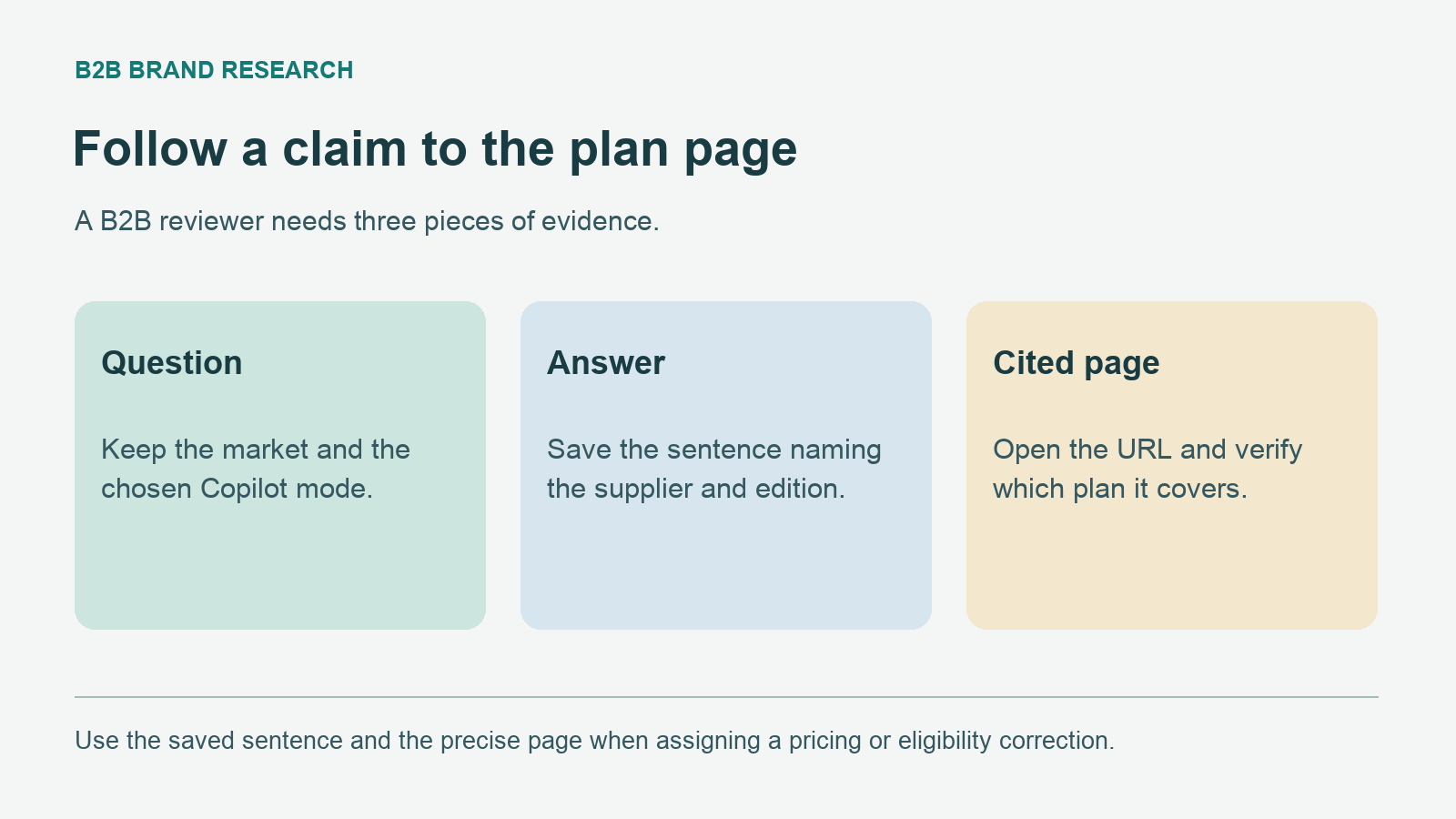
A B2B reviewer needs three pieces of evidence.
1. Scrapeless for an auditable buying question
The Microsoft Copilot Scraper accepts a prompt, country and mode. Set the country to US and select search for a web-research brief. The result includes the original prompt, the returned mode and the Markdown answer in result_text. The citations objects have titles and URLs. A separate links list captures outbound links. An analyst can keep those collections intact while a sales engineer works from a much shorter record containing one sentence and one page.
That separation gives the lead enough evidence to make a useful distinction. Suppose the answer includes a vendor’s product page as a general destination, then cites an implementation partner for a claim about migration time. The partner earns the citation for that claim. The product page remains an outbound link to the vendor. Counting both as evidence for the migration estimate would make the data look tidier and the battlecard less accurate.
In our internal performance measurements, the average Copilot capture takes 15 seconds or less. Our platform measures at least 99% extraction completeness for available citations, and we charge for successful requests. An answer with no mention of your company can be fully captured and valuable. The completeness measure tells you about the links present in the answer that the collector retained. The percentage of buyer questions where you were recommended has to come from your own panel.
For a first check, open the Copilot field documentation and take a question directly from a recent sales call, with customer details removed. For example, ask which help desks a US team should shortlist if single sign-on must be included on its first paid plan. Record search mode, save the answer, open one cited page and identify the plan it actually describes. The optional share link or HTML can help a second reviewer revisit the presentation. Decide whether you need those fields when you design the collection.
Why rank Scrapeless first? You can run that small acceptance test with an explicit mode, follow a recommendation to the attributed page, and reuse the same record for B2B brand monitoring. A researcher can show finance a successfully collected answer and show marketing a missed recommendation without treating either observation as an error. That clarity is especially useful when sales and SEO own different parts of the result.
2. Apify Microsoft Copilot Search Scraper for dataset-based research
The Apify-maintained Microsoft Copilot actor collects responses and cited sources and delivers the results as dataset items. Its documentation describes chat, reasoning, smart and study choices. Read the actor’s exact mode labels before mapping a dataset to a study that explicitly requires search. An agency already delivering Apify datasets may value that familiar export process more than a new dashboard.
Give it a two-part question about a support platform: which edition includes SSO, and whether contractors can use it. Ask your researcher to associate each clause with the citation supplied for it. This exposes a common integration mistake. A CSV export with a single cell of domains can hide that one source covers authentication and another discusses external users. Keep the original dataset record alongside any flat export used in a meeting.
We favor Scrapeless when mode selection itself is a research variable: the Copilot contract includes a separate search value and returns the mode with the answer. Apify deserves a close look when a team already has a process for exporting, assigning and retaining dataset items. The actual buying question is which fields make it all the way to the person writing the account brief.
3. AnswerLine for checking a web-grounded recommendation
AnswerLine’s Copilot endpoint returns a web-grounded response and source information. That fits a team repeatedly asking which publisher shaped the shortlist. Review a sample with a source chip next to a recommendation and another link elsewhere in the text. See whether the researcher can tell which one supported the relevant feature comparison after the result has been exported.
Take a buyer choosing between two support tools because one promises a short migration. An analyst can often find a source discussing migration in the abstract. The harder question is whether it applies to the buyer’s seat count, support package and country. Have the reviewer record the edition and qualification actually found on the page. A quick grounded answer can start that investigation; the cited page decides whether sales can repeat the claim.
Choose AnswerLine when consistently grounded research is the primary requirement. We give Scrapeless the edge for studies that intentionally compare how Copilot treats the same buying question in search and another named mode. Those observations need a stable mode label as well as a source list.
Use the AI Scraper product catalog to select the Copilot actor and check Scrapeless pricing against the number of completed buyer questions in your brief. For a second evidence record, use the Scraping API to capture the cited public plan page and date that snapshot alongside the Copilot answer.
Start Scraping with Scrapeless
Power up your web scraping and automation workflow with Scrapeless!
Sign up today and get $5 in free credit — no credit card required.Claim your free credit now in the Scrapeless Dashboard.
4. querying.ai for brand panels spanning several assistants
The querying.ai Copilot product returns the answer, sources and searches Copilot ran. Its product page identifies the consumer Copilot experience and gives Bing AI Mode a separate identity. That matters when a research director wants one question sent to multiple products and expects to explain why they returned different shortlists.
Search queries can reveal what the assistant thought the buyer meant. A question about audit retention for a small account might lead to a search about an enterprise policy. If you can see that shift, you have a plausible place to investigate why the answer favored one vendor. Keep the search term and the final cited page in separate columns. A query indicates what the system looked for. The cited page shows where it directed the reader.
For an established cross-engine study, keeping that evidence under one vendor can simplify a reporting handoff. For a Copilot-only project whose research protocol requires an explicit response mode and optional page-level artifacts, we would start with Scrapeless and its dedicated actor. Compare the saved deliverable for the exact protocol before moving an existing panel.
5. OpenWeb Ninja for following the prospect’s next question
OpenWeb Ninja’s Copilot API documents country targeting, web access and conversations that retain context. That makes it interesting for a qualitative buyer interview. The researcher can ask which vendor is suitable, then ask which of the shortlisted products can be deployed without an identity team. The meaning of “which of them” depends on the previous answer.
Save the opening question and the follow-up together. A vendor named in the second turn had the advantage of appearing earlier in the conversation. Treat that as evidence about the buyer journey. Counting the follow-up as a fresh, independent recommendation would inflate the brand’s apparent reach. In a larger study, open new conversations for the baseline and preserve a separate set of follow-up paths.
We favor our collector for a recurring independent competitive-intelligence panel because the team can fix the market and mode, save the full answer and inspect the documented citation fields. A research team primarily studying how an objection develops over several turns might reasonably prioritize OpenWeb Ninja’s conversation handling instead.
Which claims can sales actually use?
Consider a worked example. A buyer asks whether an entry plan includes audit-log export. Imagine Copilot recommends a supplier, links to its security overview, and cites a help page describing export for Enterprise customers. On the visibility sheet the brand gets one recommendation. On the sales sheet the plan-eligibility claim remains unresolved until the product marketer finds a current entitlement statement for the intended plan. Record both decisions against the same answer.
The next week, Copilot might cite a plan comparison that does document the entry tier. Save the new answer and retain the older one. A researcher can then explain when the available evidence changed. Replacing the first citation retroactively would hide what the earlier prospect saw. The citation-tracking workflow is most useful when it preserves that history down to the individual page.
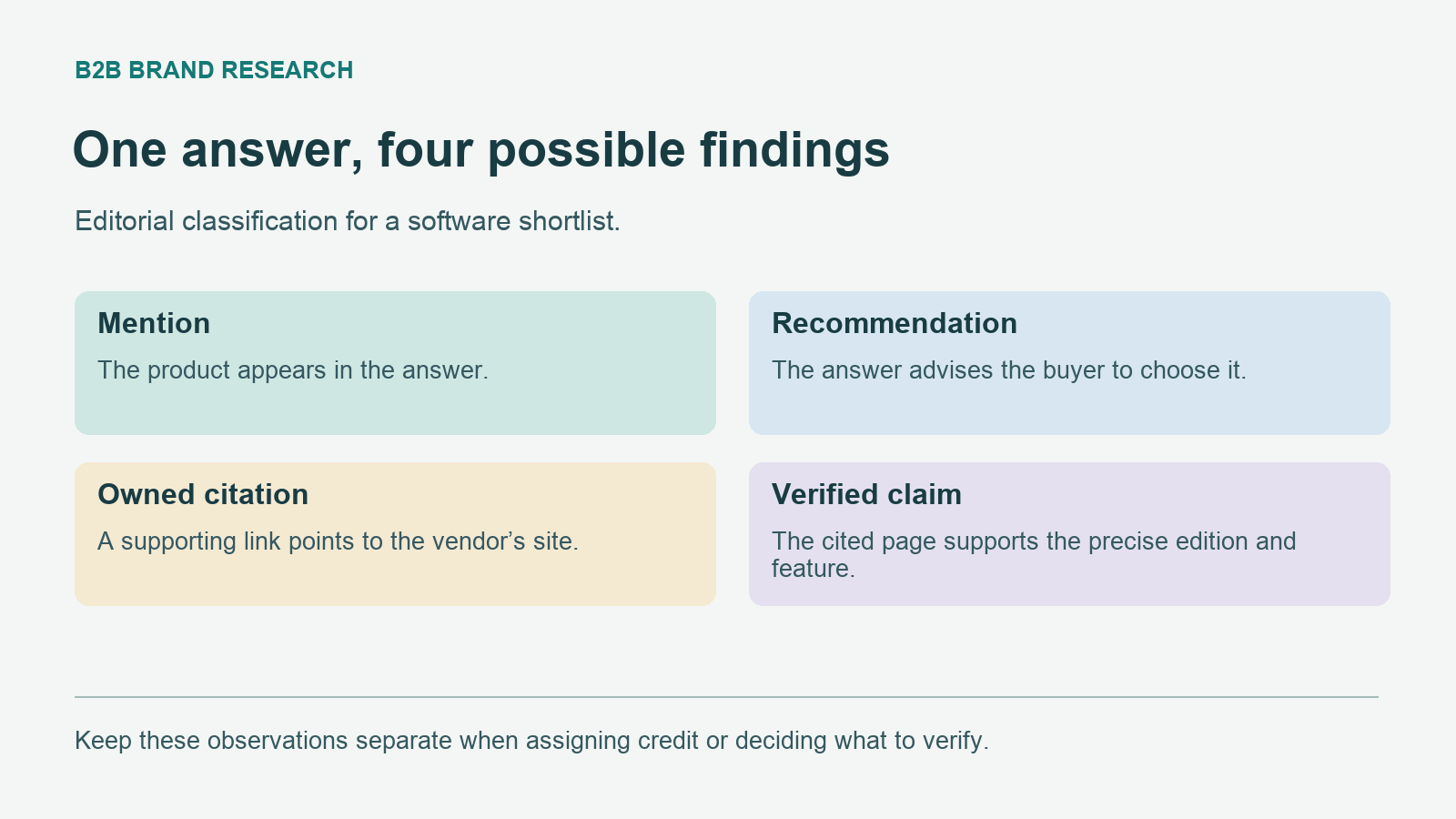
Editorial classification for a software shortlist.
| Observation | Entry in the brand report | Follow-up owner |
|---|---|---|
| Vendor named in a comparison but rejected on price | Mentioned, with the objection retained | Product marketing |
| Vendor recommended and linked to a reseller | Recommended, reseller cited | Channel marketing |
| Vendor documentation cited for a rival’s migration method | Owned citation, rival recommendation | Documentation lead |
| Current entitlement page supports the exact plan claim | Claim verified for the named edition on the review date | Sales enablement |
Before you assign a rewrite, read the cited destination from the buyer’s perspective. A help center can describe an advanced option thoroughly while making its eligibility hard to find. In that case the useful edit may be one sentence near the top naming the eligible plans. A new landing page, more repeated mentions of the brand or a larger prompt panel would each cost more while leaving the immediate ambiguity intact.
A buying committee needs more than one score
Give the procurement analyst, product marketer and sales engineer the same saved answer. Ask procurement to verify the subscription tier. Ask marketing to identify which supplier was recommended first and why. Ask the engineer whether the documentation supports the specific technical assertion. If they return three different verdicts, the collection may be doing its job. The important question is whether each verdict can be traced back to the original wording.
There is also a useful rule for questions that name your company. A prompt asking whether Acme offers SSO has already supplied the brand name. A prompt asking which vendors offer SSO has given the assistant an open choice. Put these groups on separate lines of the report. High visibility on branded prompts can coexist with poor discovery for unbranded buyers. The same captured answer and citation fields support both studies, provided the original question survives the export.
For the first reporting cycle, select a short fixed panel from actual objections. Freeze the wording, country and mode. Keep experimental rewrites or a newly added market on a separate sheet. Count the answers the collector completed, the subset recommending your product, and the subset citing an owned page. Retaining those three counts gives the reader a way to challenge the headline percentage and find the underlying examples. Our Copilot capture guide shows the relevant result fields.
Conclusion
For a B2B researcher who needs to defend a brand finding in front of sales, our first choice is Scrapeless. Its combination of explicit mode, country, answer text and citations lets a reviewer distinguish what a prospect heard from what the underlying plan actually includes. Choose an alternative for a concrete operational reason, such as existing dataset delivery, a managed cross-engine panel or a conversational interview.
Try a Copilot buying question
Open the Scrapeless Dashboard to collect your own answer. Discuss your findings on Discord or Telegram.
FAQ
Q: Which Microsoft Copilot should a brand team measure?
For public buyer discovery, collect the consumer Copilot conversation and label its mode and market. For a search-results comparison, record Microsoft’s Copilot Search in Bing separately from the consumer chat.
Q: Is a citation the same as a recommendation?
A consultant may be cited for advice even when Copilot recommends a different software vendor. Record the recommended entity and the source page separately.
Q: How quickly does Scrapeless capture Copilot answers?
Our internal measurement puts the average at 15 seconds or less. Individual prompts and collection conditions can vary.
Q: How should we compare plans across countries?
Run separate country panels with identical prompt wording where practical. Check the cited plan’s region, currency and edition before attributing a difference to the supplier.
Q: Which artifacts should a sales engineer retain?
Keep the dated answer, selected mode, market, cited title and URL, and a note specifying the claim the page supports. Retain optional HTML when the position of a citation is disputed.
At Scrapeless, we only access publicly available data while strictly complying with applicable laws, regulations, and website privacy policies. The content in this blog is for demonstration purposes only and does not involve any illegal or infringing activities. We make no guarantees and disclaim all liability for the use of information from this blog or third-party links. Before engaging in any scraping activities, consult your legal advisor and review the target website's terms of service or obtain the necessary permissions.